The Horus Heresy is the most important event in Warhammer 40K lore. It’s the civil war that broke the Imperium, killed some of the best characters in the setting, and put the Emperor on the Golden Throne where he’s been rotting for ten thousand years. Everything in 40K is downstream from what happened here.
Black Library spent 60+ novels telling this story, and honestly, it’s one of the best long-form science fiction sagas ever published. I’m going to walk through the major events in order, with novel recommendations at each stage so you know where to start if something catches your interest.
The Great Crusade: When Things Were (Relatively) Good
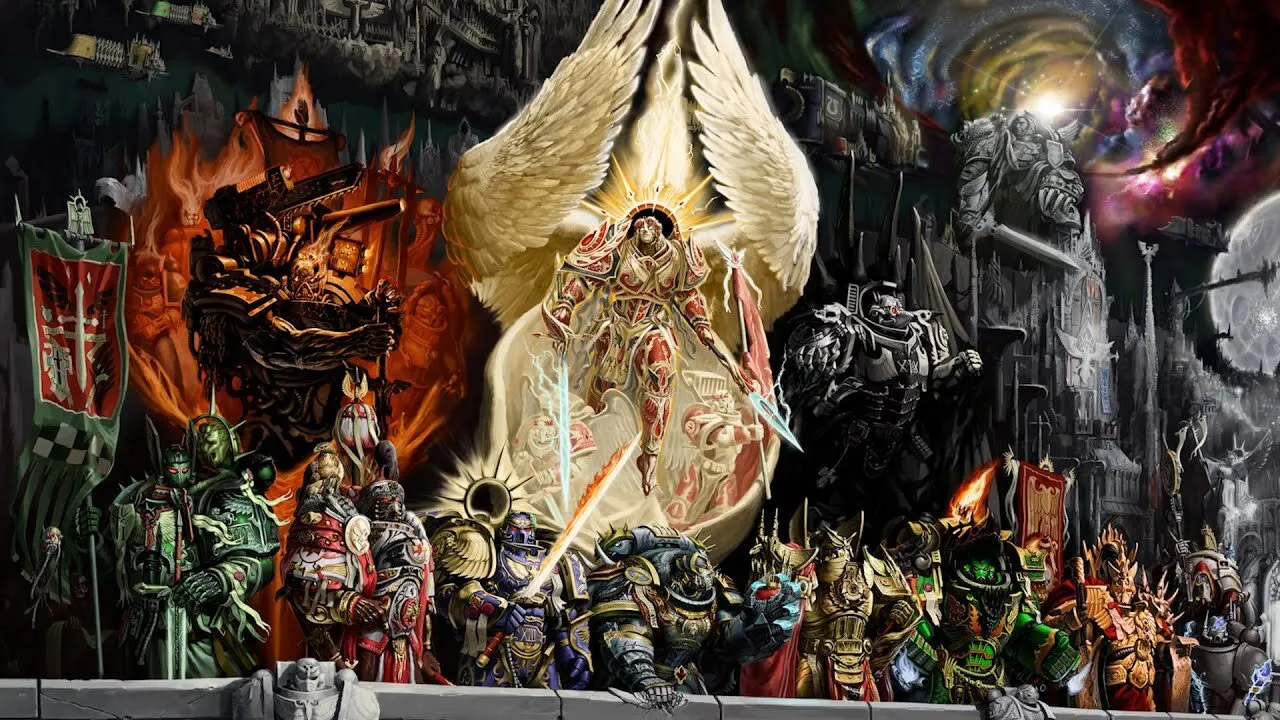
In the late 30th Millennium, the Emperor launched the Great Crusade to reunite humanity’s scattered colonies. He created twenty Primarchs to lead his Space Marine Legions. Chaos scattered them as infants across the galaxy, and the Emperor spent the Crusade finding them. Each one became a demigod-general commanding tens of thousands of superhuman soldiers.
Horus Lupercal, the first Primarch found, became the Emperor’s favorite. After a massive victory against the Orks at Ullanor, the Emperor named Horus Warmaster (supreme military commander) and retired to Terra to work on a secret project (the Webway, which he never explained to anyone, because the Emperor’s idea of communication is “tell nobody and be surprised when it goes wrong”).
This is where it started unraveling. The Emperor’s absence bred resentment. Some Primarchs felt abandoned. Lorgar of the Word Bearers had already been publicly humiliated for worshipping the Emperor and was secretly exploring Chaos. Seeds planted.
Read: Horus Rising by Dan Abnett (the opening novel, and still one of the best).
The Fall of Horus
On the moon of Davin, Horus was wounded by a Chaos-tainted blade. His Legion, manipulated by the Word Bearers chaplain Erebus (the most hated character in the fandom, and deservedly so), brought him to a Chaos cult for healing. The Chaos Gods showed Horus a vision of the future: the Imperium as a repressive theocracy, the Emperor worshipped as a god against his will. They offered Horus the galaxy if he’d overthrow his father.
The cruelest part? The vision was basically accurate. The Imperium did become exactly what Horus was shown. But it became that way specifically because Horus rebelled. A self-fulfilling prophecy, and the Chaos Gods knew it.
Horus said yes. The Heresy began.
Read: False Gods by Graham McNeill (the actual fall).
The Isstvan Massacres
Horus moved fast. At Isstvan III, he purged Loyalist elements from his own forces by virus-bombing the planet with them on it. Garviel Loken and Nathaniel Garro survived and escaped to warn Terra. At Isstvan V, Horus set a trap for the Loyalist Legions sent to stop him: the Drop Site Massacre. Four Legions that were supposed to be reinforcements turned traitor mid-battle. The Iron Hands, Salamanders, and Raven Guard were nearly annihilated. Ferrus Manus was killed by Fulgrim, his former friend, who beheaded him with a daemon-possessed sword.
Eight of eighteen Legions were now traitors. The galaxy was at war.
Read: Galaxy in Flames by Ben Counter (Isstvan III), Fulgrim by Graham McNeill (Isstvan V and Fulgrim’s fall).
The Galaxy Burns
The next several years were a sprawling, multi-front civil war. I’ll hit the highlights:
The Burning of Prospero: The Emperor sent Leman Russ to bring Magnus the Red to Terra. Russ (possibly manipulated by Horus) destroyed Prospero instead, driving Magnus and his Thousand Sons to Chaos. Read: A Thousand Sons and Prospero Burns.
The Battle of Calth: The Word Bearers ambushed Guilliman’s Ultramarines at their muster world, then used sorcery to create the Ruinstorm, a massive Warp storm that cut Ultramar off from Terra. This kept the Ultramarines out of the final battle. But Calth was only the beginning of Ultramar’s suffering. Lorgar and Angron launched the Shadow Crusade, a systematic campaign to burn the Five Hundred Worlds of Ultramar. While Guilliman was still reeling from the betrayal at Calth, the Word Bearers and World Eaters tore through his realm, performing dark rituals on each conquered world to fuel the Ruinstorm. Angron was so consumed by slaughter that Lorgar used the campaign to elevate him to Daemon Prince, transforming him mid-battle on Nuceria. The Shadow Crusade is one of the most underappreciated parts of the Heresy because it shows how Chaos wasn’t just fighting a military war. The destruction had a ritual purpose: every world burned made the Ruinstorm stronger, which kept the largest loyal Legion pinned in place while Horus marched on Terra. Read: Know No Fear by Dan Abnett (one of the best Heresy novels, period), and Betrayer by Aaron Dembski-Bowden (the Shadow Crusade and Angron’s ascension).
Signus Prime: Sanguinius and the Blood Angels were lured into a trap and attacked by a daemonic horde. Sanguinius defeated the Greater Daemon Ka’Bandha but the Blood Angels’ Red Thirst manifested. Read: Fear to Tread.
The aftermath of Prospero deserves more attention than it usually gets. Magnus was broken by the destruction of his world and his Legion. He’d tried to warn the Emperor about Horus’s betrayal by using sorcery to send a psychic message to Terra, but that message shattered the Emperor’s webway project and unleashed daemons into the Imperial Palace. The Emperor sent Russ to bring Magnus in. Russ burned Prospero instead. Magnus and his surviving Thousand Sons fled into the Warp and ended up on the Planet of the Sorcerers, a daemon world in the Eye of Terror. Magnus didn’t choose Chaos so much as Chaos was the only thing left standing after everyone else had rejected him. It’s one of the most genuinely tragic arcs in the Heresy because Magnus was trying to do the right thing at almost every step and still ended up a Daemon Primarch of Tzeentch.
The Dark Angels are the Heresy’s great mystery. Lion El’Jonson and his Legion spent much of the war away from Terra, fighting in campaigns that seemed strategically important but kept them conveniently absent from the decisive moments. The Lion eventually turned up at Caliban, his homeworld, only to discover that his second-in-command, Luther, had turned traitor. The resulting battle destroyed Caliban, and the Fallen (Dark Angels who sided with Luther) were scattered through time and space. The Lion was wounded and hidden away in stasis deep beneath the Rock, the fortress-monastery built from Caliban’s remains. This schism is the secret the Dark Angels have been killing to protect for ten thousand years. It also meant that one of the most powerful Loyalist Legions was effectively absent during the Siege of Terra, which raises uncomfortable questions about whether the Lion deliberately waited to see which side would win.
The Shattered Legions are another thread that often gets overlooked. After the Drop Site Massacre gutted the Iron Hands, Salamanders, and Raven Guard, the survivors didn’t just roll over. They formed guerrilla bands from mixed Legion remnants and waged a hit-and-run war against Horus’s supply lines and rear echelons. These were broken marines with nothing left to lose, fighting not to win but to make the traitors pay for every step toward Terra. Meduson of the Iron Hands became their most effective leader before his inevitable death. The Shattered Legions couldn’t change the war’s outcome, but they bled the traitors and proved that even defeated Loyalists refused to stop fighting.
Imperium Secundus is one of the most controversial chapters of the Heresy, and it deserves attention because it reveals how close the Loyalists came to fracturing even without Chaos involvement. With the Ruinstorm blocking all communication and travel between Ultramar and Terra, Guilliman made a decision that haunts him to this day: he declared Imperium Secundus, a second Imperium with Sanguinius as its nominal Emperor, intended to preserve human civilization in case Terra had already fallen. The Lion and the Dark Angels eventually made it to Ultramar too, and for a time three Primarchs and their Legions were sitting in Guilliman’s realm, building a backup civilization while the rest of the galaxy burned.
The problem is obvious. While they were governing, debating, and fortifying Ultramar, Terra was screaming for reinforcements. Guilliman’s intentions were practical. He genuinely believed Terra might be lost and that someone needed to preserve what remained. But the optics are devastating: three of the Emperor’s most powerful sons chose to build a kingdom instead of marching to their father’s rescue. When the Ruinstorm finally broke and they learned Terra still held, all three rushed to join the battle, but only Sanguinius and the Blood Angels arrived in time. Guilliman and the Lion got there after it was over. The what-ifs around Imperium Secundus have fueled ten thousand years of suspicion, and Guilliman knows it. Read: Unremembered Empire by Dan Abnett (Imperium Secundus begins), Ruinstorm by David Annandale (the journey to break through).
Mars fell to the Dark Mechanicum. Titan Legions fought at Beta-Garmon (the “Titandeath”). The Assassinorum tried and failed to kill Horus. The Death Guard got trapped in the Warp and accepted Nurgle’s plagues to survive.
By 014.M31, Horus had cleared the path to Terra. Only the Imperial Fists, Blood Angels, and White Scars made it back to defend the Throneworld.
The Siege of Terra
This is the climax. The full story is covered in our Siege of Terra article, but the short version:
Rogal Dorn fortified the Palace. Sanguinius held the Eternity Gate. Khan’s White Scars launched lightning raids. The Traitors pushed through anyway. At the Saturnine Gate, Dorn sprung a trap that killed thousands of Traitor Marines and sent Fulgrim’s Emperor’s Children fleeing. But losses were catastrophic on both sides.
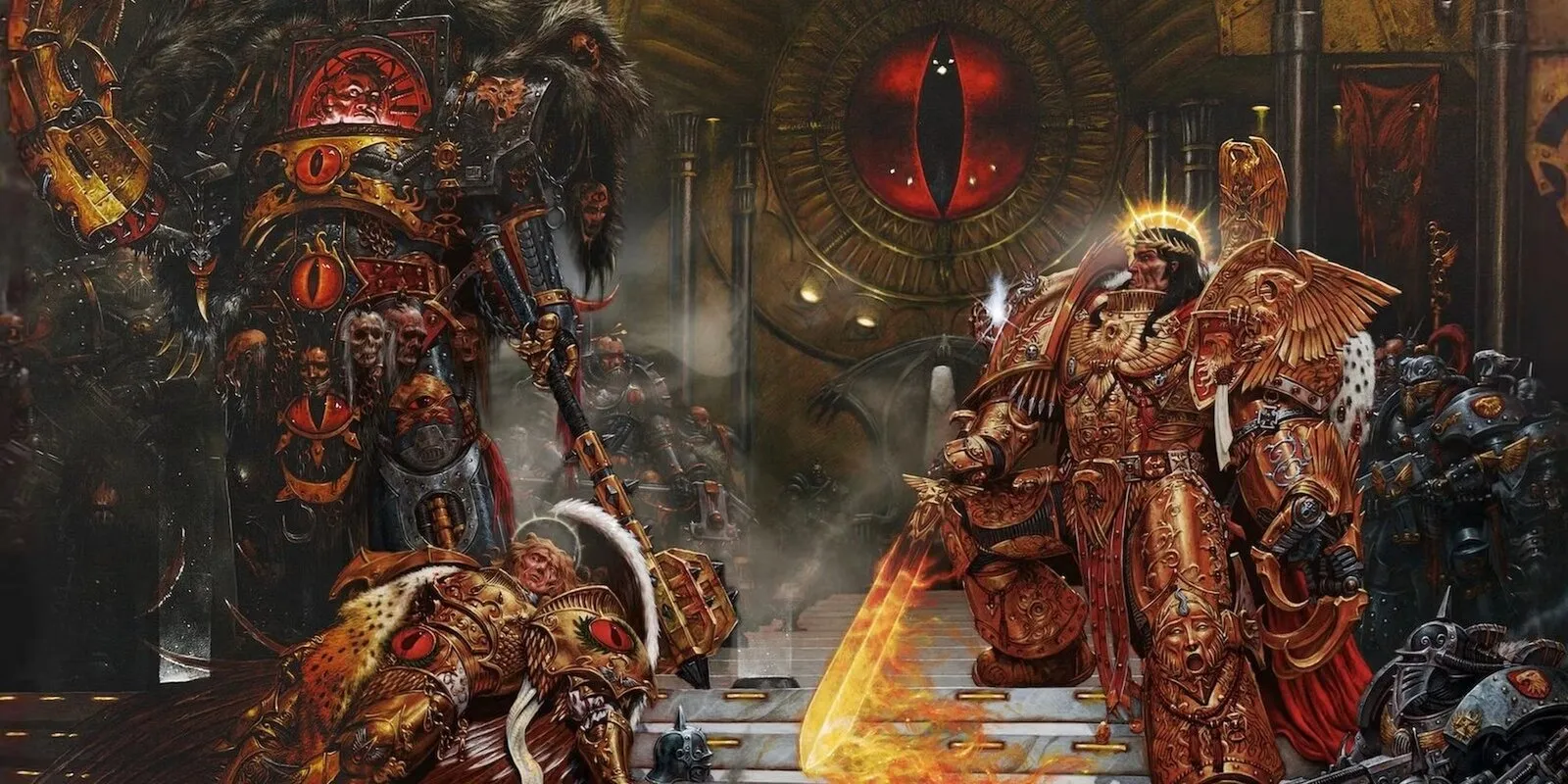
Horus dropped his flagship’s void shields. The Emperor teleported aboard with Sanguinius, Dorn, and a strike team. Sanguinius found Horus first. Horus killed him. The Emperor found Horus standing over Sanguinius’s body.
The duel between Emperor and Horus was devastating. The Emperor held back, still hoping to save his son. Horus didn’t hold back at all. He nearly killed the Emperor before a lone warrior stepped between them and was instantly destroyed. That sacrifice broke the Emperor’s hesitation. He annihilated Horus’s soul with a single psychic strike so complete that the Chaos Gods couldn’t bring him back. The identity of that lone warrior has been debated for decades, with older lore naming Ollanius Pius, a regular human Guardsman whose courage shamed a god into action. The Siege of Terra novels expanded this into something more layered, with multiple individuals making sacrifices in the final moments, but the core of the story remains the same: the Emperor only won because someone without his power showed him what was worth fighting for.
The Emperor, mortally wounded, was placed on the Golden Throne. He’s been there since.
Read: Saturnine by Dan Abnett (the best single Siege novel), The End and the Death (the finale, also Abnett).
The Aftermath
The Traitor Legions fled into the Eye of Terror. Guilliman reformed the Imperium, wrote the Codex Astartes, and broke the Legions into Chapters so nobody could ever command that many Space Marines again. The Ecclesiarchy grew from underground emperor-worship cults into the galaxy’s dominant religion.
The Emperor’s dream of a secular, rational human civilization died on the Vengeful Spirit. What replaced it was a theocratic empire that worships a man who explicitly forbade worship, run by institutions that can’t agree on anything, fighting enemies on every front with technology nobody fully understands anymore.
The Heresy lasted about seven years. Its consequences have lasted ten thousand and counting. And every time someone in 40K talks about duty, sacrifice, betrayal, or the price of power, they’re talking in the shadow of what Horus did. It’s the best kind of foundational myth: one that explains everything about the present by showing you exactly how things went wrong in the past.
If you read nothing else from the Horus Heresy, read Horus Rising, Know No Fear, Saturnine, and The End and the Death. Those four give you the beginning, the middle, the climax, and the ending. Everything else is enrichment. Very, very good enrichment.