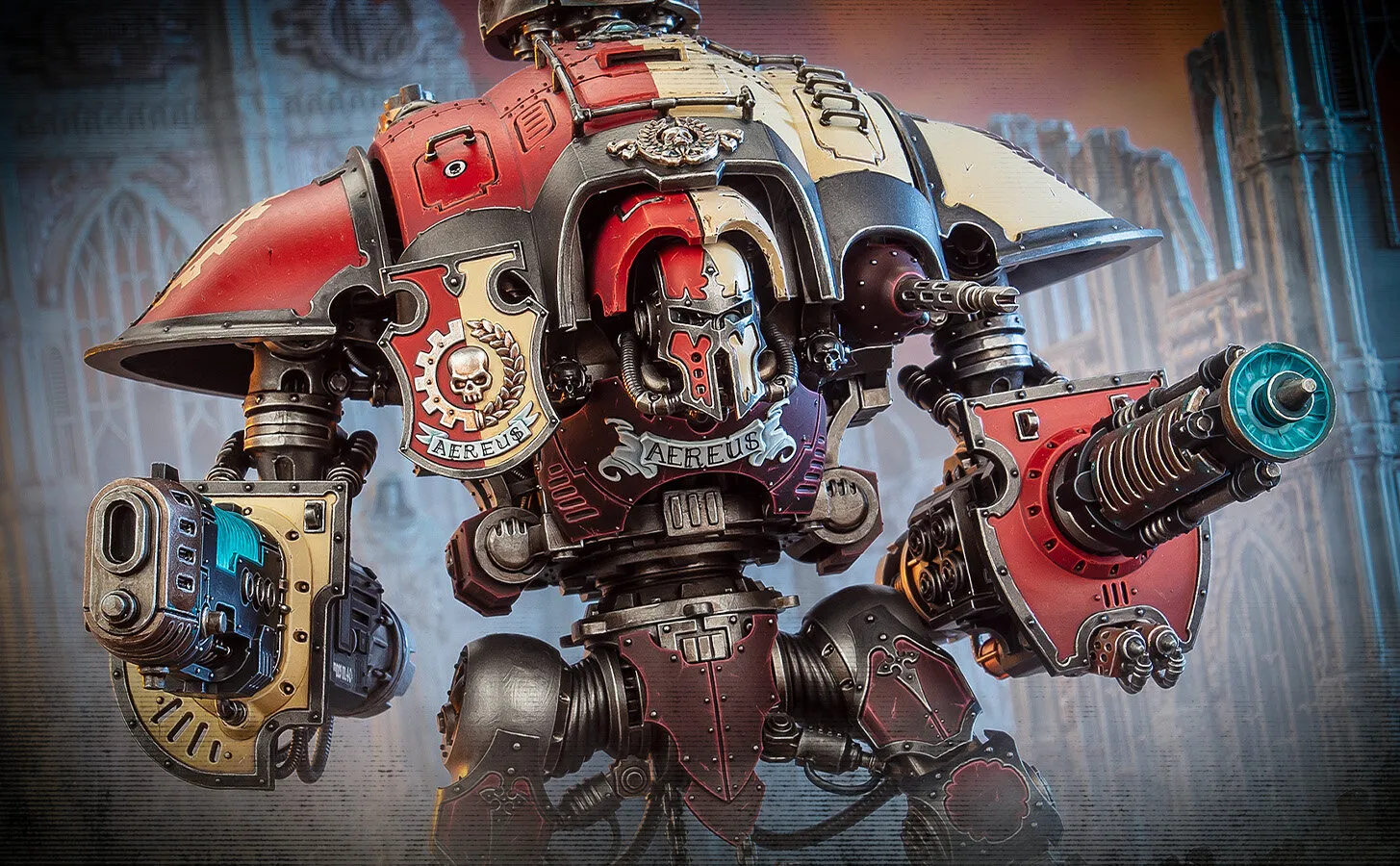
The Imperial Knights are getting a new variant, and this one fills a role that the faction has been missing: a genuine support piece. The Knight Defender is a Questoris-pattern chassis built around a dome void shield generator that projects an energy barrier over a wide area, protecting not just the Knight itself but nearby allied units. In a faction where every model is a lone wolf stomping across the table, having a Knight whose job is to make everyone around it harder to kill is a significant shift.
Knight players have been asking for something like this for a while. The faction’s biggest weakness has always been that every model is essentially on its own. A Gallant goes forward and kills things. A Crusader stands still and shoots things. A Warden does a bit of both. But none of them actively help each other in a mechanical sense. The Defender changes that equation, and in a game that increasingly rewards synergy and army-wide buffs, having a Knight that contributes to the survival of everything around it is more than a nice-to-have.
What Makes It Different
The dome void shield is the headline feature. Unlike the standard ion shields that other Knights use (directional shields that only protect one facing), the Defender’s void shield projects a bubble. Anything under the dome gets the benefit. Park this thing behind your front line and your Astra Militarum infantry or Armiger screen suddenly has a save it wouldn’t normally get. For Knight players who run allied detachments, this changes the math on which support units are viable.
The weapons are interesting too. The plasma executor is what you’d expect from a Knight-scale plasma weapon: devastating against heavy targets, with the standard 40K plasma risk of overheating if you push it. The conversion beam obliterator is the more unusual choice. It gets stronger the further away the target is, which rewards a patient, back-line playstyle that’s unusual for Knights. Most Questoris variants want to be in the middle of the fight. The Defender wants to stand back, shield its allies, and delete things from across the table.
That combination of defensive aura and long-range firepower creates a role that no other Knight fills. A Castellan has the firepower but no aura. A Gallant has the presence but wants to charge. The Defender does something new: it makes your army better by existing, regardless of whether it kills anything.
The comparison to the Castellan is worth drilling into, because the Castellan has been the default “big Knight that stands at the back” choice for years. The Castellan’s appeal is pure damage output: volcano lance and plasma decimator give it the ability to threaten anything on the table from range. But the Castellan does nothing for the rest of your army. It’s a selfish piece in the best sense, demanding a significant chunk of your points budget to do one thing very well. The Defender asks a different question. Instead of “how much can this model kill,” the question becomes “how much does this model prevent the opponent from killing.” In a game where controlling objectives matters more than raw lethality, the answer might favor the Defender more often than people expect.
For list-building, the Defender fundamentally changes the math on Knight armies. Pure Knights have always struggled with board control because each model is a single, expensive piece that can only stand on one objective. The Defender doesn’t solve that problem directly, but by keeping your smaller units alive longer, it extends the effective life of your objective holders. A Warglaive that survives one extra turn of shooting because it was under the dome is a Warglaive that scores one more turn of primary points. Over the course of a game, that survivability compounds.
The Lore Angle
In the lore, Knights Defender are piloted by nobles known for selflessness, which is a nice bit of characterization for a feudal warrior culture that usually rewards the opposite. Most Knight pilots are glory-seekers who want personal kills and dramatic duels. The Throne Mechanicum, the neural interface that bonds pilot to machine, amplifies whatever personality traits the pilot already possesses. For most Knights, that means aggression and pride get dialed up to eleven. A Defender pilot must possess enough innate selflessness that even with the Throne Mechanicum amplifying their instincts, their first impulse is to protect rather than attack. That’s a rare quality in a warrior aristocracy.
A Defender pilot deliberately puts themselves between the enemy and their allies, absorbing fire so others can advance. It’s a different kind of honor, and one that the lore suggests is respected but not envied within Knight houses. Nobody grows up dreaming of being the shield. They grow up dreaming of being the sword.
The void shield generator is described as rare and poorly understood technology, which fits 40K’s pattern of the Imperium using things it can’t fully maintain. The dome shield is more advanced than standard ion shields, and the implication is that not every forge world can produce them. That scarcity explains why the Defender is a variant rather than the standard: if the Adeptus Mechanicus could put dome shields on every Knight, they would.
The selflessness theme goes deeper than just battlefield tactics. In Knight house culture, glory is everything. A Noble’s worth is measured by their personal kill tally, the enemies they’ve dueled, the campaigns they’ve survived. A Defender pilot earns none of that. Their contribution is measured in what didn’t happen: the allies who didn’t die, the advance that wasn’t stalled, the flank that didn’t collapse. That’s a much harder thing to celebrate at the victory feast. The lore suggests that Defender pilots tend to come from a specific temperament, Nobles who understand that the house survives as a unit or it doesn’t survive at all. In a culture obsessed with individual heroism, choosing to be the shield requires a kind of moral courage that charging into melee doesn’t.
There’s also a generational element to it. Some Knight houses assign the Defender role to elder pilots who’ve already earned their glory in more aggressive patterns and now serve the house by protecting the next generation. Others use it as a proving ground for young Nobles who must demonstrate patience and discipline before they’re entrusted with an offensive chassis. Either way, the Defender pilot occupies an unusual social position within the household, respected but not celebrated, essential but not glamorous.
On the Tabletop
For Knight players, the Defender slots into a couple of list archetypes really well. If you’re running a mixed army (Knights plus allies), the Defender becomes the anchor that makes your non-Knight units survivable. A squad of Astra Militarum Cadian Shock Troops under a dome void shield is a much more credible objective holder than the same squad on its own.
If you’re running a pure Knights list, the Defender pairs nicely with Armigers. Two Warglaive Armigers advancing under a Defender’s dome shield can reach melee in much better shape than they would crossing the board exposed. The conversion beam obliterator also gives you a long-range option that pure melee lists typically lack.
There’s also the question of how the Defender interacts with the new detachment rules in the upcoming codex. If one of the four new detachments rewards defensive play or aura stacking, the Defender could become the centerpiece of a viable competitive archetype. Knights have traditionally been a one-dimensional faction on the tournament scene: stomp forward, kill things, hope you don’t get shot off the table first. A detachment that rewards holding ground and protecting allies would give the faction a genuinely different playstyle, and the Defender would be the key piece that makes it work.
The one thing to watch is points cost. A Defender that costs as much as a Crusader or Castellan needs to justify itself through the aura, because its raw damage output is probably lower than either. If the points are right, I think it becomes an auto-include in competitive Knight lists. If they’re too high, it’s a cool model that sees casual play but doesn’t crack the tournament scene.
In narrative play, the Defender is an automatic pick. The dome shield creates memorable battlefield moments, those turns where your opponent pours everything into a unit and the void shield just absorbs it. The lore of a noble house’s steadfast protector standing firm while lesser warriors advance under its shelter writes itself. If you play Crusade campaigns, the Defender’s pilot is going to accumulate a story of sacrifice and endurance that the glory-hunting Gallant pilot can only envy.
The Kit
GW is restructuring the Questoris kit into two boxes with the Defender’s release. One box includes the Defender sprue alongside the existing Paladin/Errant/Warden/Gallant/Crusader options. The other builds a Preceptor or Canis Rex. If you already own a Questoris kit, you’re looking at the Defender box specifically for the new sprue.
The dome shield generator sits on top of the Knight’s carapace and is the most visually distinctive feature. It’s a bulbous, almost mushroom-shaped piece that gives the Defender a different silhouette from other Questoris variants. Whether you think it looks cool or awkward probably depends on your taste, but it’s certainly recognizable from across the table.
From a hobby perspective, the dome shield is a gift. That large, smooth, curved surface is a canvas for freehand heraldry, object source lighting effects, or weathering that tells a story. You can paint energy crackle patterns across it to suggest the shield mid-activation, or cover it in battle damage to show what the Defender has absorbed on behalf of its allies. I’ve already seen painters in the community doing heat-bloom effects where the shield transitions from cool blue at the edges to hot white at impact points, and the results are stunning. For competitive painters, the dome gives you a focal point that no other Knight variant has. For everyone else, it’s at minimum a great surface for transfers and house markings.
The conversion potential is also worth mentioning. That dome generator is a distinct piece that’s relatively easy to modify or replace. I expect we’ll see hobbyists creating custom shield effects using clear resin, LED setups for a glowing dome, or entirely scratch-built generators that match their house’s aesthetic. The Defender kit is going to be one of those releases that the hobby community goes wild with, because the central design feature practically begs to be customized.
Full rules are in the upcoming Codex: Imperial Knights, which also includes four new detachments and a painting/heraldry guide in place of a new Combat Patrol. The heraldry guide is a nice touch for a faction where personalizing your models with house colors, campaign markings, and kill tallies is half the hobby appeal. For the full Imperial Knights lore, check our Knights overview or the broader Collegia Titanica article.
The Defender also represents something interesting about where GW is taking the Knight faction conceptually. For years, Knights have been defined by individual heroism: one pilot, one machine, one story. The Defender introduces a cooperative element that changes the faction’s identity. It suggests that GW wants Knights to function more like an army and less like a collection of solo characters who happen to be on the same side. Whether the community embraces that shift or resists it will probably depend on how the rules play out, but the lore groundwork is solid. A Knight house that fights as a coordinated unit, with Defenders shielding the advance while Gallants and Crusaders press the attack, is a more interesting force than eighteen individual dueling machines.
I’m cautiously excited about this one. Knights have needed a support variant for a while, and the dome shield concept is strong. Whether the Defender becomes a competitive staple or a narrative-play favorite depends on the points, but either way it’s a welcome addition to the range.