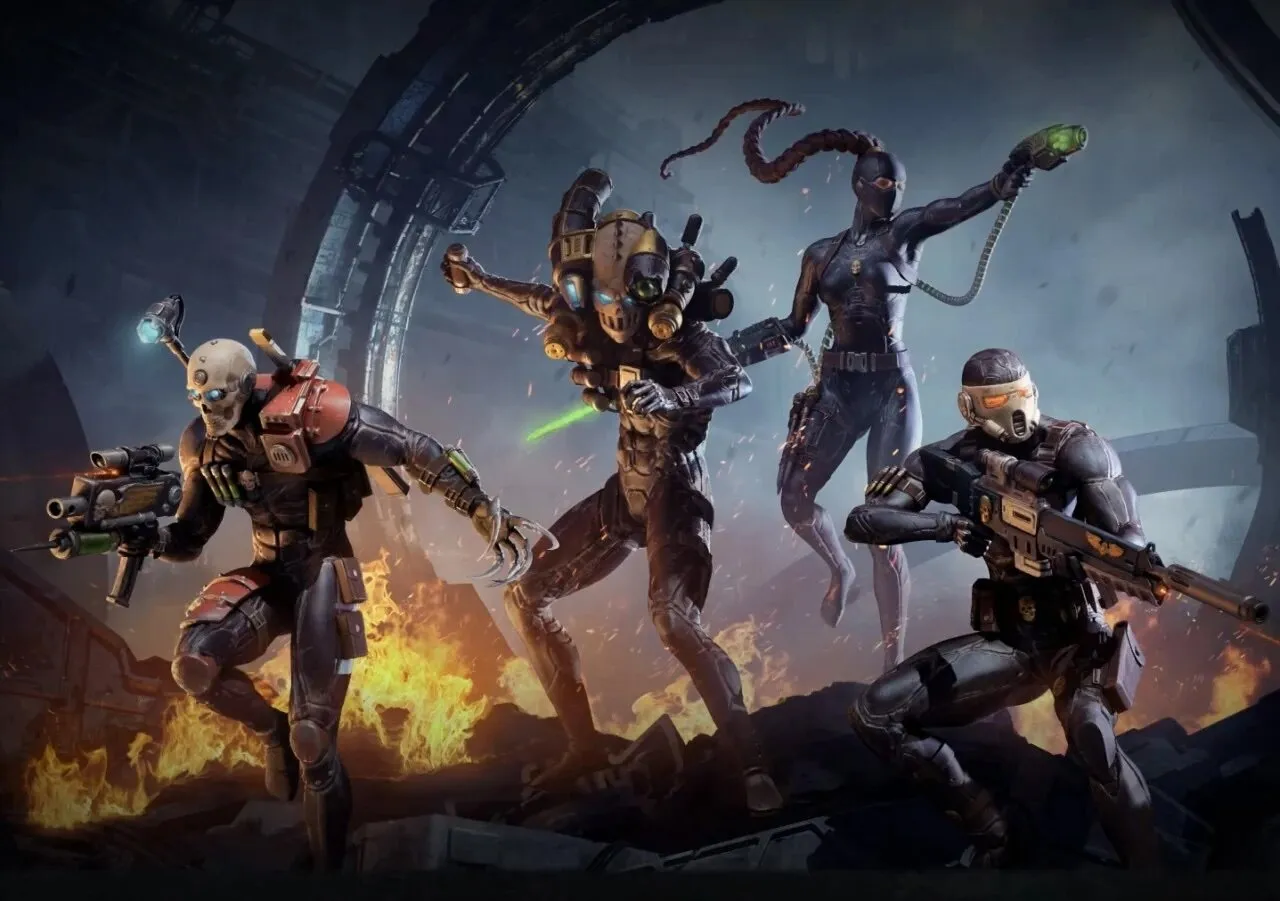

If you’ve ever looked at the Adeptus Arbites and thought “those are just Judge Dredd in 40K,” you’re right, and GW has never really tried to hide it. The Arbites are the Imperium’s federal law enforcement, operating above and outside local planetary law. They enforce the Lex Imperialis (Imperial Law), and their jurisdiction covers anything the Imperium cares about: sedition, heresy, failure to pay tithes, unauthorized trade with xenos, and generally any crime that threatens Imperial authority rather than just local order.
Local cops handle local crime. The Arbites handle everything else, and they handle it with shotguns, shock mauls, and zero patience for legal nuance.
What They Actually Do
The distinction between the Arbites and local Enforcers (planetary police) is important and often misunderstood. Arbites don’t care about muggings or theft or any of the daily crime that plagues hive cities. That’s the local Enforcers’ problem. Arbites care about the big stuff: insurrection, cult activity, large-scale corruption, and any threat to the Imperial tithe system.
Think of them as a mix of the FBI, federal marshals, and riot police, but with the authority to declare martial law and the firepower to back it up. An Arbites Precinct-Fortress on a hive world is exactly what it sounds like: a fortified compound full of heavily armed judges who answer to the Adeptus Terra, not the local governor. If the governor is the problem, the Arbites are the ones who show up at his door.
This makes them deeply unpopular. Local authorities resent the Arbites’ jurisdiction. Civilians fear them. Governors plot against them. The Arbites don’t care. They exist to enforce the Emperor’s law, and if the Emperor’s law says your planet owes a tithe of ten million soldiers this year, the Arbites will make sure those soldiers get collected whether the governor cooperates or not.
The Judge Dredd DNA
The Judge Dredd influence runs deep, and it works beautifully in the 40K context. The Arbites serve as judge, jury, and executioner. They conduct investigations, pronounce verdicts, and carry out sentences, often in the same encounter. There’s no defense attorney. There’s no appeals process. An Arbites Marshal pointing a combat shotgun at your face IS the legal system.
Where the Arbites differ from Dredd is the scale of what they’re dealing with and the institutional context they operate in. Mega-City One is a single city. The Arbites police a million worlds, each with its own culture, its own legal traditions, and its own ways of resenting central authority. A Judge in 2000 AD has the full weight of his city’s infrastructure behind him. An Arbites Marshal on a frontier world might be one of a dozen law enforcers on an entire planet, maintaining order through reputation and the implicit threat of what happens if the Imperium decides the planet has become ungovernable. Dredd is overwhelming force. The Arbites, at their most interesting, are the thin blue line between civilization and anarchy on worlds where the nearest Imperial reinforcement is months or years away.
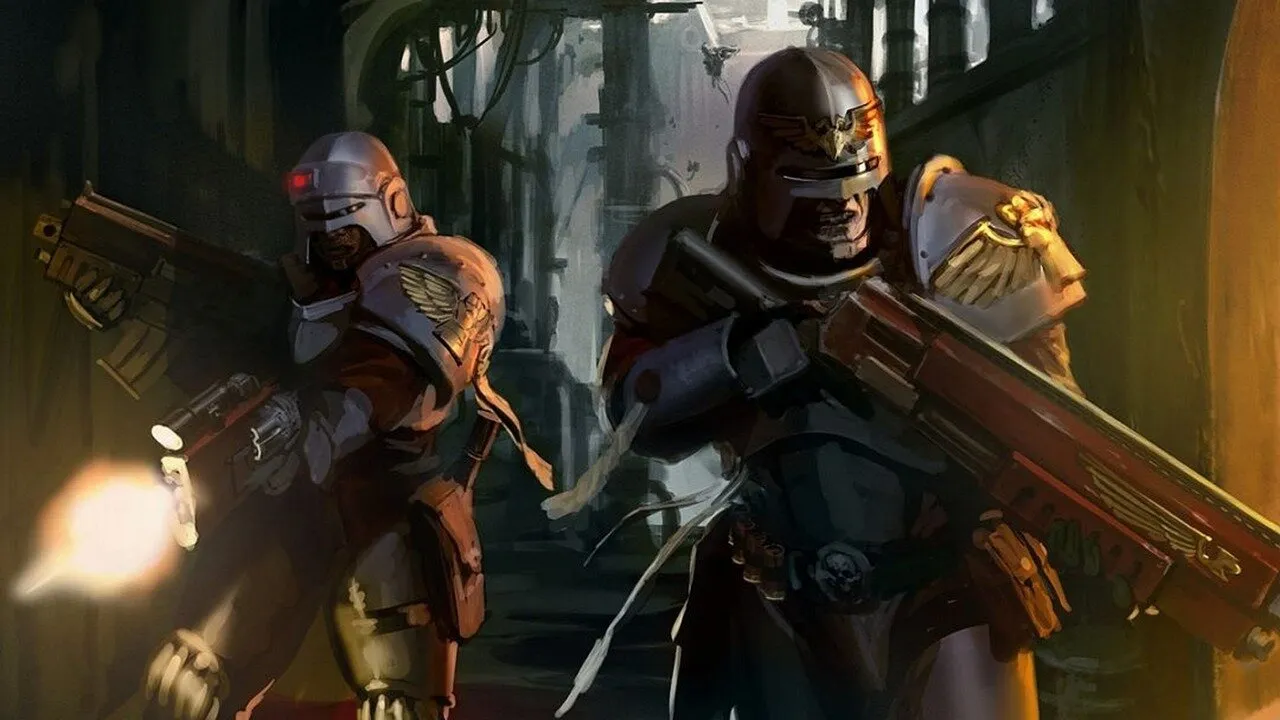
Their equipment reflects this enforcement-first philosophy. Suppression shields, shock mauls for crowd control, combat shotguns loaded with various specialist rounds (Executioner rounds for armor penetration, Inferno rounds for fire, Stasis rounds for immobilization). The Cyber-Mastiff, a robotic attack dog, is probably my favorite bit of Arbites kit. It’s exactly the kind of over-the-top detail that makes 40K’s aesthetic work.
The Arbites maintain Precinct-Fortresses on most major Imperial worlds. These are designed to withstand planetary insurrection, because the Arbites know that the people they’re policing would happily tear them apart if given the chance. During the novel Crossfire by Matthew Farrer (excellent Arbites fiction, if you can find it), there’s a great depiction of how an Arbites precinct functions day-to-day. It’s paranoid, heavily armed, and constantly under siege from the population it serves.
The Lex Imperialis
It’s worth understanding what the Arbites actually enforce. The Lex Imperialis (Imperial Law) isn’t a comprehensive legal code covering every crime. It’s a set of overarching principles that protect the Imperium’s interests: the Emperor is god, the tithe must be paid, psykers must be surrendered to the Black Ships, alien influence is forbidden, and rebellion is punishable by death.
Everything else is local jurisdiction. If a hive city’s underhive gangs are murdering each other, that’s the local Enforcers’ problem. If those gangs start hoarding weapons to overthrow the planetary governor, that’s an Arbites problem. If the governor is a Chaos cultist, that’s an Arbites and potentially an Inquisition problem. The distinction matters because it means the Arbites are only involved when the stakes are Imperial-level, which means every Arbites deployment is inherently dramatic.
The relationship between the Arbites and the Inquisition is worth exploring, because it’s more complicated than a simple hierarchy. The Inquisition technically has authority over everything, including the Arbites. An Inquisitor can commandeer Arbites resources, override their investigations, or classify their findings. In practice, though, the Arbites and the Inquisition often work in parallel, sometimes cooperatively and sometimes at cross purposes. The Arbites are an institution with procedures, chain of command, and bureaucratic accountability. The Inquisition is a collection of individuals with near-unlimited authority and wildly different methods. When an Inquisitor shows up at a Precinct-Fortress and starts making demands, the local Marshal has to balance cooperation with protecting their own ongoing operations. It creates a dynamic tension that good 40K fiction exploits regularly.
The Book of Judgement at each Precinct-Fortress is more than a record-keeping system. It’s a living document that codifies local interpretations of the Lex Imperialis, building up centuries of case precedent that shapes how the law is applied on that specific world. A Book of Judgement on an agri-world will look very different from one on a forge world or a hive city, because the threats and the social dynamics are completely different. Senior Arbites study the Book the way scholars study religious texts, looking for precedents and patterns that can guide their decisions. When a Precinct-Fortress falls, the destruction of its Book of Judgement represents a loss of institutional knowledge that can take centuries to rebuild.
The system also means Arbites are often the first line of defense against threats that haven’t yet been identified as Chaos or xenos. A Genestealer cult might look like a labor uprising in its early stages. A Chaos infiltration might look like political corruption. The Arbites investigate, and if they find something beyond their capacity, they call in heavier assets. If they don’t survive long enough to call anyone, the planet might be lost before the Imperium even knows something is wrong.
When Things Go Wrong
The Arbites’ most dramatic moments come during planetary uprisings. When a world rebels against the Imperium, the Arbites precinct is usually the first target, because the rebels know the Arbites will call for Imperial intervention. Some of the best Arbites lore involves garrisons holding out against impossible odds, surrounded by millions of hostile civilians, waiting for Astra Militarum reinforcement that may never come.
During the Horus Heresy, the Arbites fought alongside the defenders of Terra, and the Grand Provost Marshal sat on the Imperial War Council. The Siege of Terra novels depict Arbites units holding hab-blocks and transit corridors against Traitor forces, enforcing order among panicking civilian populations while the sky burned overhead. They weren’t soldiers, but they fought and died like soldiers because that’s what the situation demanded.
The Age of Apostasy gave the Arbites one of their most dramatic moments. When Goge Vandire seized control of the Ecclesiarchy and effectively became dictator of the Imperium, the Arbites were among the few institutions that resisted his authority. Vandire’s Frateris Templar clashed with Arbites forces on multiple worlds, and the resulting conflict demonstrated that the Arbites’ loyalty was to the law itself, not to whoever happened to hold political power. It’s a distinction that matters, and it elevates the Arbites from simple enforcers to something more principled.
In the current era, they’ve been stretched thin by the Great Rift splitting the galaxy in half. Entire sectors in the Imperium Nihilus have lost contact with the Adeptus Terra, which means the Arbites in those regions are operating without central authority, making their own calls about what constitutes Imperial Law when the Imperium itself is barely holding together.
The Necromunda Connection
If you want to see the Arbites in their natural habitat, Necromunda is where to look. The underhives of Necromunda are exactly the kind of environment where the line between local Enforcer jurisdiction and Arbites authority gets blurry and interesting. Necromunda’s Palanite Enforcers handle the day-to-day policing, but when gang activity threatens the hive’s productivity or the planetary tithe, the Arbites step in with overwhelming force. The game’s recent Arbites expansion gives them a full roster of units including Exaction Squads, which are essentially rapid-response teams built for surgical operations in the confined, chaotic environment of an underhive. It’s the Arbites at their most tactically interesting, operating in close quarters where their heavy equipment and fortified doctrine have to adapt to narrow corridors and unpredictable gang warfare.
The Arbites also maintain a network of orbital surveillance platforms, monitoring planetary populations for signs of large-scale dissent. Combined with the Books of Judgement mentioned earlier, the Arbites have an institutional memory that spans millennia. They know which worlds have histories of rebellion, which noble families have flirted with heresy, and which trade routes are vulnerable to xenos influence. That intelligence network is as much a weapon as the combat shotguns.
This is ripe territory for fiction, and I wish GW would do more with it. An Arbites Marshal on a world that’s been cut off from the Imperium for decades, still enforcing laws that might not even be relevant anymore, dealing with a population that’s forgotten why the Arbites exist? That’s a great story waiting to be told.
On the Tabletop
The Arbites recently got new models through the Necromunda game system, which gave them updated sculpts that look fantastic. The Judge-style helmets, the riot shields, the Cyber-Mastiffs. They’re one of the best-looking Imperial infantry kits GW has produced.
In 40K proper, the Arbites can be fielded as part of an Imperial Agents force, which lets you slot them into other Imperial armies. They’re not going to win you a tournament, but thematically, having a squad of space cops backing up your Astra Militarum or running alongside your Inquisitor is incredibly cool.
There’s also something to be said for how the Arbites reflect the broader themes of the setting. They’re not heroes. They’re not villains. They’re functionaries of a system that is simultaneously necessary and monstrous. The law they enforce keeps the Imperium from fragmenting into a billion warring fiefdoms, but the methods they use and the system they serve are deeply unjust by any reasonable standard. The Arbites don’t question the law. They don’t have the luxury or the inclination. In a galaxy where questioning the system gets you branded a heretic, the Arbites represent the grim reality that order and justice are not the same thing, and that the Imperium chose order a long time ago.
The best Arbites stories lean into this ambiguity. Matthew Farrer’s Shira Calpurnia novels, the Enforcer trilogy, are still the gold standard for Arbites fiction. They depict the Arbites as competent, professional, and committed to their duty, while making it clear that the system they serve is broken in ways they can’t see from inside it. It’s the kind of moral complexity that 40K does better than almost any other franchise when it’s firing on all cylinders.
If you like the aesthetic of armored law enforcement in a dystopian sci-fi setting, the Arbites are your faction. The models paint up beautifully in dark blue or black with metallic accents, and the Cyber-Mastiff is worth buying the kit for on its own.