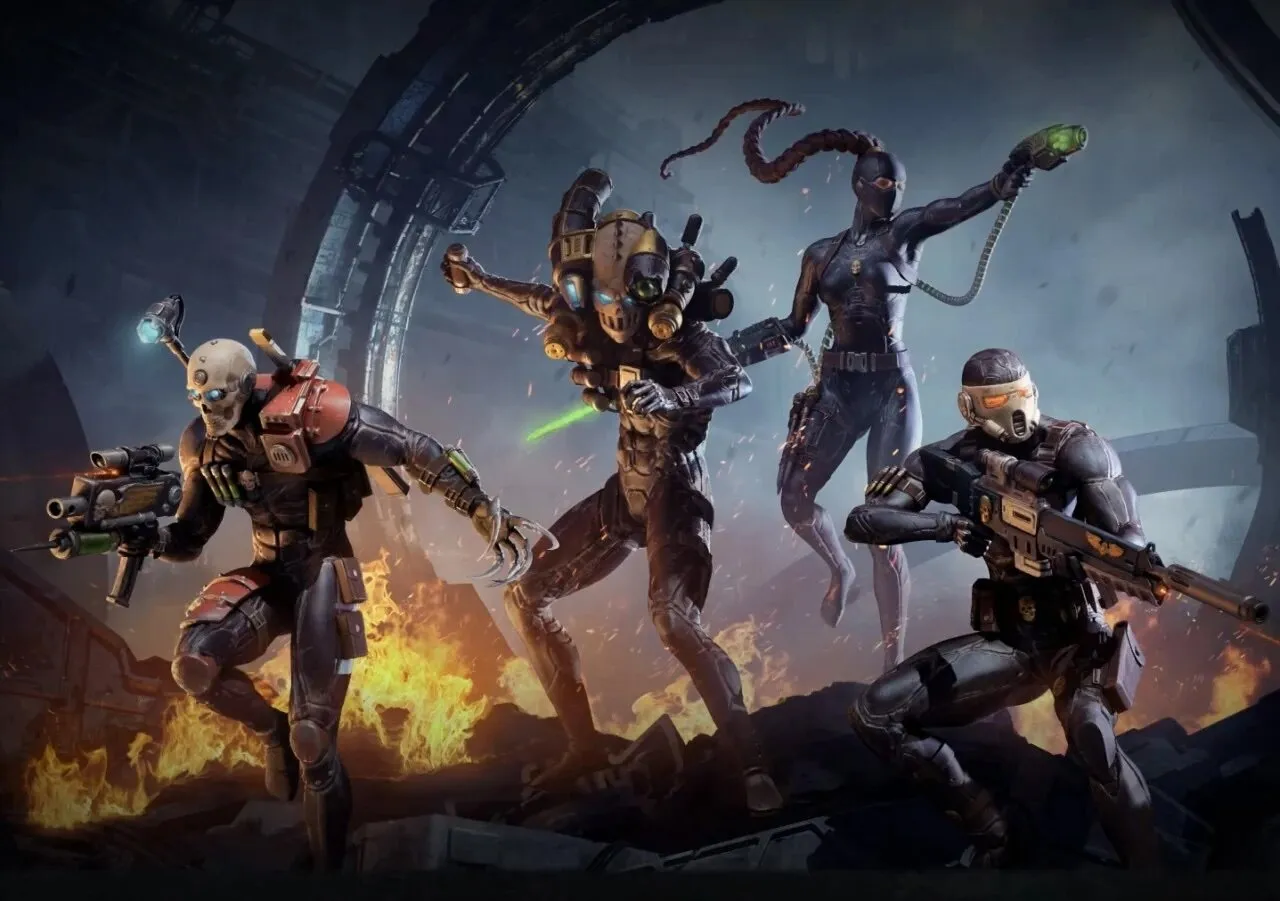
The Officio Assassinorum is the Imperium’s answer to a simple question: what do you do when the problem is one person? You can’t deploy a Space Marine Chapter to kill a single heretic governor. You can’t virus bomb a world because one Chaos cultist is hiding in a hive city. Sometimes the surgical option is a single operative, dropped in alone, with one target and absolute authority to complete the mission by any means necessary.
The Assassinorum has been doing this since before the Horus Heresy. And their four main temples each produce assassins so specialized and so terrifyingly effective that they’ve changed the course of galactic history more than once.
The Four Temples
This is the good stuff. Each Assassinorum temple (called a Clade) produces a completely different type of killer, and each one is fascinating in its own way.
The Vindicare Temple trains snipers. Classic long-range marksmen, but scaled up to 40K’s ridiculous standards. A Vindicare Assassin can hit a target from miles away, through walls, using rounds designed to penetrate any armor. Their Exitus rifles fire specialist ammunition: shield-breaker rounds that ignore invulnerable saves, turbo-penetrator rounds for heavy targets, and hellfire rounds for biological horrors. On the tabletop, the Vindicare is your answer to enemy characters hiding behind bodyguards. One shot, one kill. That’s the pitch.
The Callidus Temple produces shapeshifters. Callidus Assassins use a drug called polymorphine that lets them physically transform into other people. They infiltrate an enemy’s inner circle, spend weeks or months building trust, and then strike at the exact moment that will cause maximum disruption. There’s a famous operation where a Callidus impersonated a planetary governor for months before poisoning the entire command structure at a dinner party. The combination of deep infiltration and close-combat lethality makes the Callidus the most unsettling of the four temples.
The Eversor Temple is the one that gets the most attention, and honestly, the one I find most 40K. Eversors aren’t subtle. They’re berserker-assassins pumped so full of combat drugs that they’re essentially living weapons. They’re deployed in cryo-coffins, dropped near the target, and unleashed. An Eversor doesn’t sneak in and eliminate a single target. An Eversor tears through an entire compound, killing everyone between the drop zone and the target, killing the target, and then killing everything else in the vicinity. Their bodies are rigged with a bio-meltdown device that detonates when they die, so even killing the Eversor doesn’t save you if you’re nearby.
The lore describes them as “barely controlled.” Their handlers are terrified of them. Other Imperial forces evacuate when an Eversor deployment is announced. They’re the nuclear option of assassination: effective, but the collateral damage is horrifying.
The Culexus Temple is the weirdest and the scariest. Culexus Assassins are Blanks, psychic nulls whose very presence suppresses the Warp. Being near a Culexus makes psykers scream and daemons flicker out of existence. Normal humans feel a deep, instinctive revulsion. The Culexus wears a device called an Animus Speculum that channels their null aura into a focused beam of anti-psychic energy.
They’re the anti-psyker weapon. If the target is a sorcerer, a daemon prince, or a psychically gifted alien leader, the Culexus is the answer. Nothing psychic functions normally around them. On the tabletop, dropping a Culexus into a psyker-heavy army is one of the most satisfying plays in the game.
There’s a fifth temple that gets mentioned less often but is worth knowing about: the Vanus Temple. Vanus Assassins don’t kill anyone directly. They’re information warfare specialists who destroy targets through data manipulation, logistical sabotage, and systemic disruption. A Vanus operative might spend months infiltrating a planetary communication network, subtly altering supply manifests, troop deployments, and intelligence reports until the target’s entire command structure collapses from within. The enemy commander makes decisions based on information that’s been carefully poisoned, and by the time anyone realizes what’s happened, the damage is done.
The Vanus don’t have tabletop rules, which is a shame, because their concept is arguably the most 40K thing about the entire Assassinorum. In a setting that loves over-the-top violence, the scariest assassins are the ones who never fire a shot. They just make you destroy yourself.
How They’re Deployed
Assassins aren’t requested by field commanders. The process goes through the highest levels of Imperial authority. A petition must reach the High Lords of Terra (or someone with equivalent authority), who evaluate the target and assign the appropriate temple. The Assassinorum itself then selects the operative and plans the insertion.
This means assassination missions are rare and significant. Each deployment represents a judgment by the highest powers in the Imperium that a specific individual is dangerous enough to warrant this response. Most of the time, the target never knows the assassin is coming. The first sign is usually the last sign.
The Assassinorum’s operations are almost entirely classified. After a mission, the Officio scrubs records, eliminates witnesses, and sometimes even deploys memory-wiping teams to ensure nobody knows an assassin was involved. A planetary governor might suddenly die of “natural causes” or “enemy action,” and nobody outside the Assassinorum ever learns the truth.
The Dark Side
The Assassinorum hasn’t always been used responsibly. During the Horus Heresy, the Master of Assassins tried to deploy all four temples simultaneously against Horus himself. The Execution Force mission is one of the most fascinating “what if” moments in the lore. An operative from each major temple was assembled into a kill team and sent to assassinate Horus before the Heresy could reach Terra. They infiltrated a world Horus was visiting, fought through his defenses, and got close enough to attempt the kill. It failed, obviously, because the Heresy had to happen for the setting to exist, but the attempt revealed something important: even with the best assassins the Imperium could produce, a Primarch is so far beyond human capability that conventional assassination is nearly impossible. Horus brushed off the attempt like swatting a fly.
After the Heresy, the organization was restructured with oversight mechanisms to prevent any single individual from weaponizing it for personal power. The Grand Master of Assassins sits on the Senatorum Imperialis (the High Lords of Terra), which tells you how important the role is and also how dangerous. Giving the head of a secret assassination bureau a seat at the highest table of power is exactly the kind of decision the Imperium makes that sounds insane from the outside but is entirely logical from within. You need that person in the room because the alternative is them operating without any oversight at all.
Those mechanisms have been tested repeatedly. During the Age of Apostasy, the Assassinorum was nearly turned into a political tool. Rogue Inquisitors have tried to commandeer assassins for unauthorized targets. The most chilling scenario in the lore is when different High Lords have attempted to direct assassins against each other. Political assassination at the highest levels of Imperial government, using weapons designed to kill alien warlords and Chaos champions, applied to internal power struggles. It’s happened more than once, and each time it’s been covered up.
The list of confirmed and suspected Assassinorum targets over ten millennia reads like a who’s who of galactic threats. Ork Warbosses who unified too many tribes. Drukhari Archons who raided too close to critical Imperial worlds. Chaos sorcerers whose rituals threatened to tear open new Warp rifts. T’au Ethereals whose diplomatic expansion was absorbing Imperial border worlds too efficiently. Genestealer Patriarchs entrenched in hive cities where conventional military action would cost millions of loyalist lives. The Assassinorum’s deployment history is essentially a record of every problem the Imperium decided to solve with a scalpel instead of a hammer.
The political dimension is what really keeps me interested in the Assassinorum’s lore. An institution built to kill the Imperium’s external enemies will inevitably be turned inward. Grand Master Drakan Vangorich proved this definitively during the War of the Beast. After the High Lords failed catastrophically to respond to the Ork invasion of Ullanor (the largest Ork WAAAGH! since the Great Crusade), Vangorich took matters into his own hands and assassinated the entire Senatorum Imperialis. Every High Lord, killed in a single coordinated strike. He then ruled the Imperium himself for about a century before Imperial Fists Successors finally took him down. The Beheading, as it became known, is the Assassinorum’s darkest chapter and the clearest warning about what happens when an institution designed to kill anyone is run by someone who decides “anyone” includes the people above him.
What often gets lost in discussions about the Assassinorum is the human cost of producing these operatives. The temples don’t recruit volunteers. They take children, sometimes infants, sourced from the Black Ships, orphanages, or outright abduction. The training process has an attrition rate that makes Space Marine selection look gentle. For every operative who completes Vindicare training, dozens died during the process. Callidus candidates undergo polymorphine exposure that kills most of them before their bodies learn to tolerate the drug. Eversor candidates are subjected to chemical and surgical modification so extreme that the ones who survive are barely recognizable as human. And Culexus recruits are drawn from the Pariah gene pool, individuals who are already outcasts despised by every living thing around them, and then trained in an environment that weaponizes their isolation.
The temples also maintain a standing practice of eliminating operatives who show signs of independent thought, emotional attachment, or doubt about their missions. An assassin who asks “why” instead of “where” is a liability. Several Inquisitorial investigations have attempted to audit the temples’ internal practices, and every single one has been quietly shut down. The few reports that survived describe training facilities that would horrify even hardened Inquisitors. There’s a particular account from a Vanus operative who documented the Eversor temple’s conditioning chambers before his report was classified and he was reassigned to a suicide mission. The implication is clear: the Assassinorum doesn’t just produce weapons. It consumes children to do so, and the institution protects its methods with the same ferocity it applies to external targets. It’s one of the ugliest corners of an already ugly Imperium, and the fact that it’s considered necessary tells you everything about what kind of galaxy this is.
The War of the Beast (the massive Ork invasion in M32) saw the Assassinorum pushed to its operational limits, revealing vulnerabilities in its command structure. The Officio Assassinorum is one of those 40K institutions that works because the threats are real, but the potential for abuse is always present. A single person with the authority to kill anyone, anywhere, accountable to almost nobody, is exactly the kind of power that the Imperium shouldn’t have. And exactly the kind of power it can’t survive without.
On the tabletop, all four assassin models are fantastic. They’re each designed to counter a specific type of threat, and slotting one into your Imperial army as a surgical tool is deeply satisfying. The Callidus appearing in your opponent’s backline on turn one is chef’s kiss. The Eversor charging out of a drop and killing six models in one fight phase is pure joy. Just don’t forget the bio-meltdown explosion when it dies. That’s always good for a laugh.
The best part about running assassins is the mind game. If your opponent knows you’re bringing one but doesn’t know which type, they have to play around all four possibilities. Are you going to snipe their warlord with a Vindicare? Drop a Callidus behind their lines? Unleash an Eversor into their infantry blob? Counter their psyker with a Culexus? The uncertainty alone changes how they deploy, and that psychological pressure is worth the points cost before the assassin even does anything. I’ve had games where the threat of an assassin warped my opponent’s entire game plan more than the assassin’s actual performance on the table.