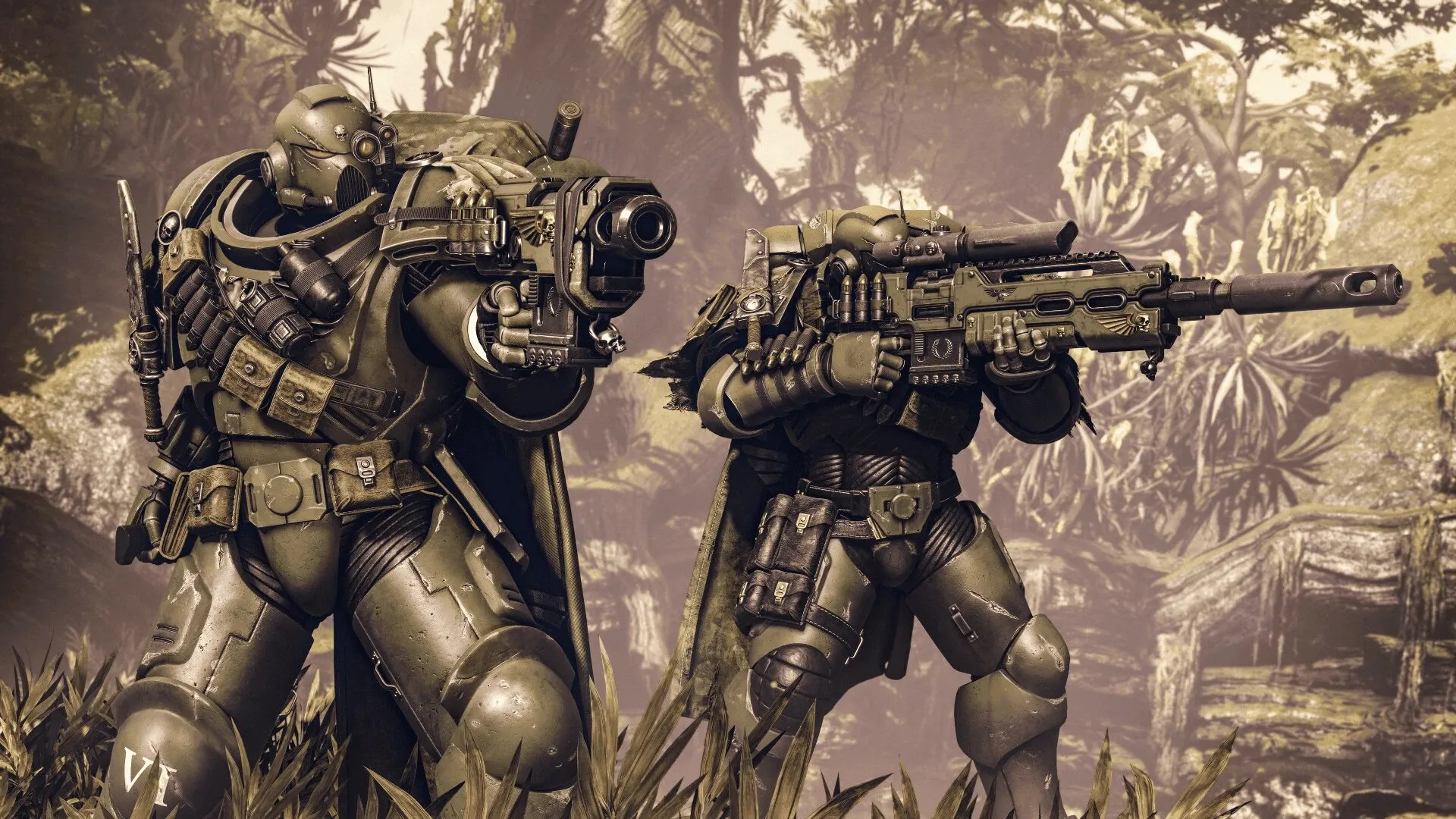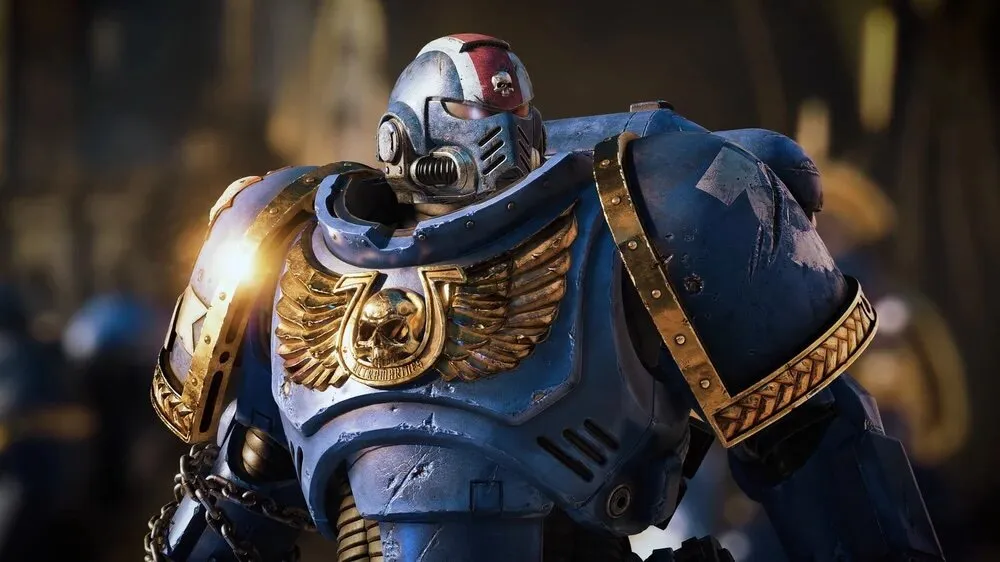
Space Marines are the face of Warhammer 40K. They’re on every box, in every trailer, and they’re probably the first thing anyone associates with the setting. But if you’re new to the hobby, the details of what they actually are and how they work might be blurrier than you’d expect. So let’s break it down.
What They Are
Space Marines (officially the Adeptus Astartes) are genetically enhanced super-soldiers created to fight humanity’s wars in the 41st millennium. They’re made from regular humans, but the process of becoming a Space Marine involves implanting nineteen (or more, for Primaris) additional organs derived from the gene-seed of the Emperor’s twenty sons, the Primarchs. These organs give them enhanced strength, speed, reflexes, endurance, and senses. They can spit acid. They can enter suspended animation. They can eat the brain of a dead enemy and absorb some of its memories. It’s wild.
The transformation process takes years, starting in adolescence, and not everyone survives it. The implantation isn’t a single procedure. It’s a sequence of surgeries spaced out over months and years, each one installing a new organ that reshapes the aspirant’s body. The secondary heart comes first, giving redundancy if the primary one fails. Then the ossmodula, which strengthens the skeleton by fusing calcium-based ceramics into the bones. The biscopea enhances muscle growth. The haemastamen supercharges the blood. And so on, through nineteen organs, each one building on the last to transform a teenage boy into something that can survive bolter rounds and breathe toxic atmospheres.
Some of these organs are genuinely strange. The Betcher’s Gland lets a Space Marine spit a corrosive acid strong enough to eat through metal. The Sus-an Membrane allows him to enter suspended animation indefinitely if mortally wounded. The Omophagea lets him eat the flesh of a dead creature and absorb some of its memories, which is as disturbing as it sounds and is used regularly for battlefield intelligence. The Progenoid Glands are the most important of all: they mature over decades and contain the genetic template needed to create new gene-seed. When a Space Marine dies, the Apothecary’s first job is to recover those glands, because without them, the Chapter cannot create new warriors. Every dead marine whose gene-seed is lost is a wound that may never heal.
Those who survive the full implantation emerge as something not quite human anymore. Bigger (averaging around 7 feet tall, more in armor), faster, tougher, and with a drastically extended lifespan. A Space Marine can live for centuries, and some have survived for over a thousand years.
They wear power armor, which is itself a marvel of technology. Ceramite plates, integrated life support, auto-reactive systems that respond to the wearer’s neural impulses. The standard Space Marine bolter fires mass-reactive rounds that penetrate a target and then explode. Every piece of their equipment is designed to make an already superhuman warrior even more devastating.
How They’re Organized
Space Marines are divided into Chapters of roughly 1,000 warriors each (the number varies). There are about a thousand Chapters in existence, though the exact count is deliberately left vague. Each Chapter is semi-autonomous, with its own homeworld (or fleet), its own traditions, and its own gene-seed lineage tracing back to one of the original Primarchs.
This organizational structure exists because of the Horus Heresy. Before the Heresy, Space Marines were organized into Legions of tens of thousands under a single Primarch. When half the Legions turned traitor, the Imperium decided that was too much power in too few hands. Roboute Guilliman wrote the Codex Astartes, which broke the Legions into smaller Chapters so no single commander could ever control enough marines to threaten the Imperium again. (This is covered in more detail in our piece on the evolution from Legions to Chapters.)
Most Chapters follow the Codex Astartes to varying degrees. The Ultramarines follow it religiously (Guilliman wrote it, after all). The Space Wolves basically ignore it. The Dark Angels pretend to follow it while secretly doing whatever they want. Each Chapter’s relationship with the Codex is a good shorthand for its personality.
Gene-seed lineage matters enormously. Every Chapter’s gene-seed traces back to one of the original Primarchs, and it carries more than just biology. The Blood Angels and their successors all share the Red Thirst and the Black Rage, a genetic echo of Sanguinius’s death that can turn marines into frothing berserkers. The Space Wolves’ Canis Helix makes their marines increasingly wolf-like over time. Even Chapters with “clean” gene-seed from Guilliman’s lineage carry his traits: a tendency toward organization, strategic thinking, and a certain rigidity. Your Primarch’s legacy isn’t just history. It’s in your blood, literally, and it shapes everything about how your Chapter fights and thinks.
What Makes Them Interesting (Beyond Being Big and Shooty)
I think the most common misconception about Space Marines is that they’re just cool action heroes in armor. They can be played that way, but the lore is much darker and more interesting than that.
Space Marines are, in many ways, tragic figures. They’re taken as children, subjected to years of painful modification, stripped of most normal human emotional range, and turned into weapons. They don’t have families. They don’t have hobbies (with exceptions like the Blood Angels, who paint and sculpt). They don’t retire. They fight until they die, and then their gene-seed is harvested to make more Space Marines.
The process of creating a Space Marine also involves extensive psychological conditioning. They’re taught to view themselves as superior to normal humans, which creates a distance between them and the people they’re supposed to protect. Many Space Marines view regular humans as something between “beloved charges” and “useful civilians.” Some genuinely care. Others are barely aware that non-Astartes exist.
Daily life for a Space Marine, if you can call it that, revolves around three things: training, prayer, and maintenance. When they’re not deployed, marines follow a rigid schedule of combat drills, weapons practice, and tactical simulations. Many Chapters incorporate religious observance, from the relatively restrained litanies of the Ultramarines to the full-blown worship rituals of the Black Templars. Equipment maintenance is treated almost as a sacred act. A marine’s power armor has often been worn by dozens of warriors before him, and tending it is a way of honoring that lineage. Sleep is minimal, maybe four hours, thanks to the Catalepsean Node implant that lets them rest half their brain at a time.
The relationship between Space Marines and the broader Imperium is complicated and sometimes tense. Chapters are technically independent of the normal Imperial chain of command. A Chapter Master doesn’t answer to a planetary governor or even to most military commanders. They cooperate with the Astra Militarum and other Imperial forces when it suits them, but they choose their own battles and pursue their own agendas. This makes them both indispensable and politically awkward. A single Space Marine company can turn a losing war, but the Chapter might decide a different conflict is more important and simply leave. The Inquisition has theoretical authority over them, but trying to enforce that authority against a thousand superhuman warriors who don’t recognize your jurisdiction is a fast way to create a very ugly incident. It has happened. It usually goes badly for everyone involved.
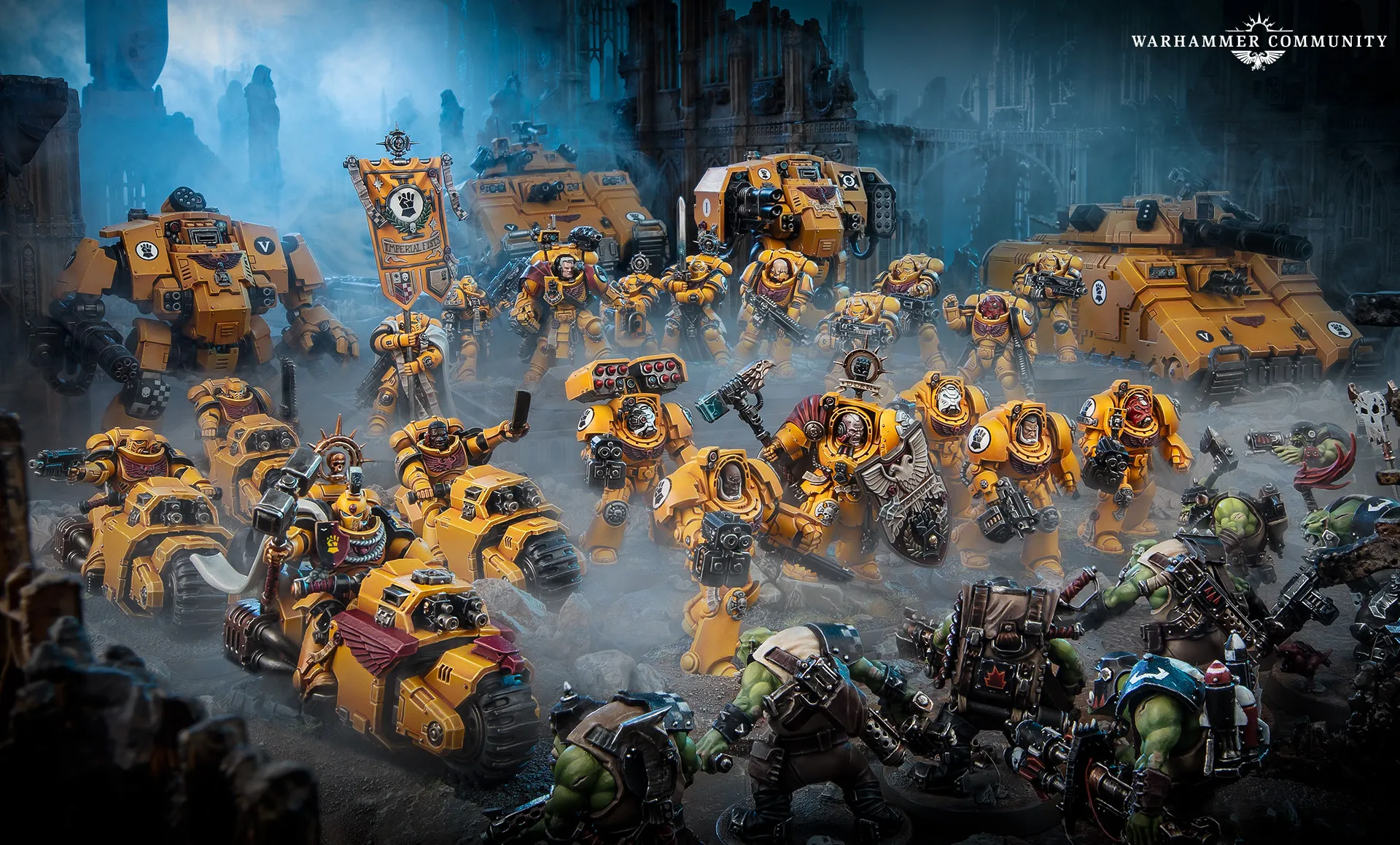
This is where the different Chapters become really interesting. The Salamanders actively protect and value human life, even risking missions to save civilians. The Marines Malevolent are notorious for treating civilian casualties as an acceptable cost. The Imperial Fists punish themselves through pain for any failure. The Blood Angels struggle with a genetic curse that turns them into blood-crazed berserkers. Each Chapter takes the basic Space Marine template and adds a layer of culture, philosophy, and dysfunction that makes them distinct.
The Big Names
If you’re starting out, here are the Chapters you’ll encounter most often:
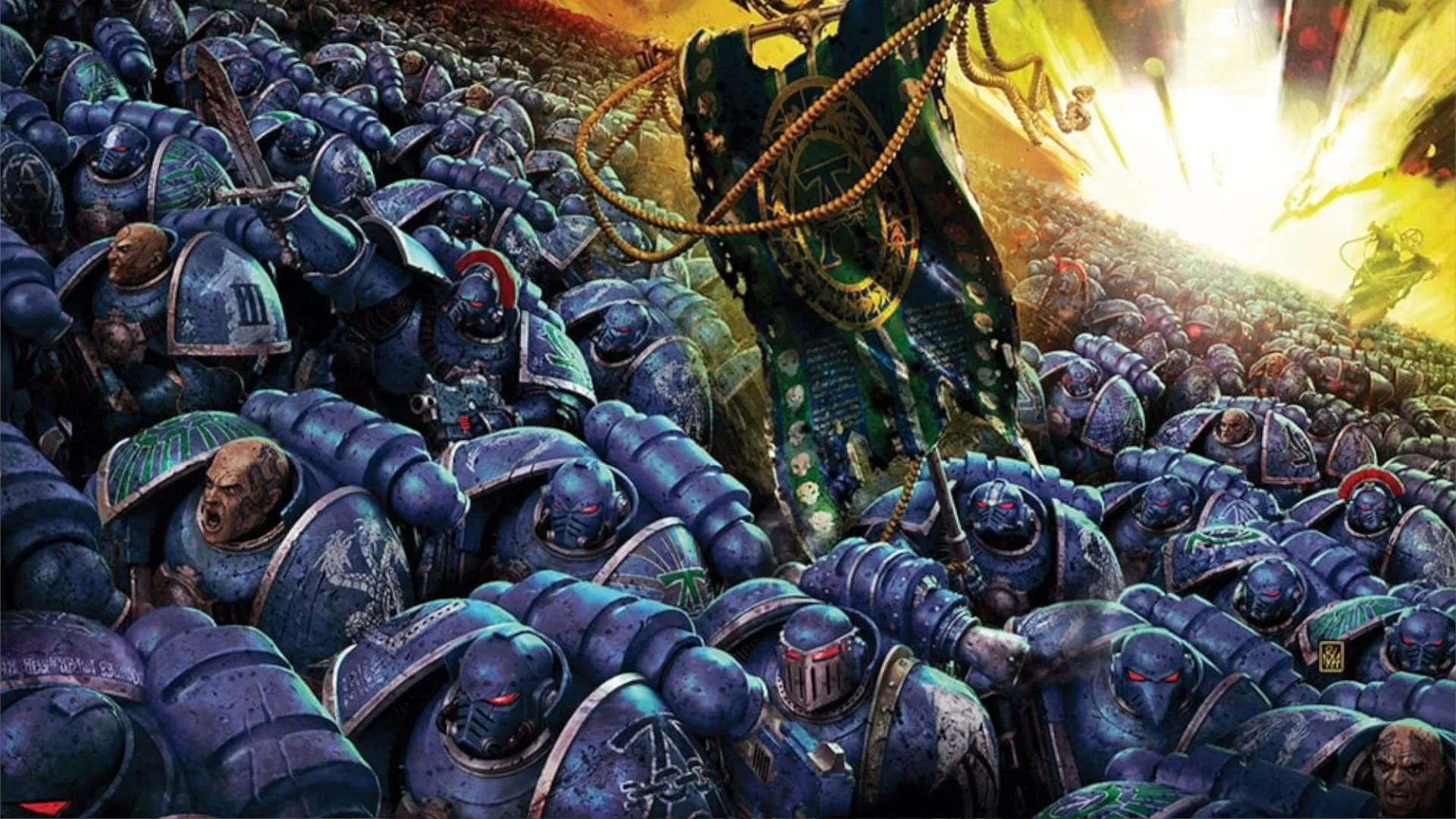
The Ultramarines are the poster boys. Blue armor, Roman aesthetic, fanatically devoted to Guilliman’s Codex. They’re the “default” Space Marines, which makes some fans love them and others find them boring. I think they’re better than their reputation suggests, especially in the post-Guilliman era where they’re grappling with what it means to have a living Primarch again.
The Blood Angels are the tragic vampires. Beautiful, noble, cursed with a blood-hunger and a psychic echo of their Primarch’s death. The best-looking army in the game and probably the most emotionally resonant lore.
The Space Wolves are the Viking berserkers. Fenrisian culture, giant wolves, a healthy disrespect for authority. They’re the Chapter most likely to punch an Inquisitor in the face, and they’ve done it more than once.
The Dark Angels are the paranoid secret-keepers, hunting their own traitors across ten thousand years and lying to everyone about it.
The Black Templars are the crusading zealots. No Librarians (they distrust psykers), no fixed homeworld (they live on a fleet), and no upper limit on their Chapter size (they’ve been “crusading” continuously since the Heresy, conveniently avoiding anyone who might count their numbers). They’re fun.
The Salamanders deserve a mention because they’re the nicest Space Marines, which in 40K means they actually care about civilian lives and go out of their way to protect them. They come from the volcanic death world of Nocturne, their skin is coal-black from radiation exposure, and they’re master craftsmen who forge their own weapons and armor. In a setting full of grim sociopaths, the Salamanders are a reminder that being post-human doesn’t have to mean being inhuman. They’re my personal favorites, and I’ll argue with anyone who says otherwise. What makes them work as a Chapter is that their compassion isn’t free. Nocturne’s volcanic cycles periodically devastate the planet, and the Salamanders grew up watching their communities get destroyed and rebuilt, over and over. They protect civilians because they know what it’s like to lose everything. That’s not softness. That’s hard-won empathy forged in literal fire, and it gives their kindness a weight that most “noble hero” archetypes lack. Vulkan’s legacy runs deep in them, and the search for his lost artifacts (the Artefacts of Vulkan) drives some of their most compelling lore.
The Iron Hands are the Salamanders’ polar opposite in temperament, and they’re one of the most underappreciated Chapters in the setting. Their Primarch Ferrus Manus was killed at the Drop Site Massacre by his closest friend Fulgrim, and the Chapter never recovered emotionally. They dealt with the grief by deciding that flesh is weak. Literally. Iron Hands marines replace their biological parts with augmetics at a rate that makes even the Adeptus Mechanicus raise an eyebrow. A veteran Iron Hands marine might have both arms, both legs, and most of his torso replaced with cybernetics. They see emotion as a flaw to be excised alongside the weak flesh that produces it. Their clan-company structure (they organize into clans rather than standard companies) reflects a culture that values cold logic over brotherhood, efficiency over camaraderie. They’re difficult to like, which is exactly the point. The Iron Hands are what happens when trauma becomes doctrine, when a Chapter decides the solution to grief is to cut out the part of yourself that can feel it.
On the Tabletop
Space Marines are the most popular faction in the game by a wide margin. They’re well-supported with models, rules, and lore. They’re also a great starting point for new players because the basics of the army are straightforward (tough infantry, good shooting, decent melee) and the model range is enormous.
If you’re choosing a Chapter, pick the one whose aesthetic and lore appeals to you most. Don’t worry about competitive strength. Editions change, rules change, but you’ll be looking at your paint scheme for years. Pick something you love painting, because you’re going to paint a lot of it.
The current range (Primaris models) is excellent. If you’re coming from the Space Marine 2 video game and want to build a force that looks like Titus and his squad, the Intercessor and Assault Intercessor kits are your starting point. Welcome to the hobby. The Emperor protects. Your wallet, less so.