This is one of those lore questions that starts simple and gets complicated fast. “Who’s the oldest human in the Imperium?” seems like it should have a straightforward answer. It doesn’t. Because “oldest” depends on whether you mean chronological age, biological age, or “has been conscious for the most total time.” And “human” gets fuzzy when you factor in Space Marines, Dreadnoughts, and whatever the Emperor technically is.
Let me walk through the main candidates.
The Emperor (If He Counts)
The obvious answer is the Emperor himself. He’s been alive for somewhere between 38,000 and 48,000 years depending on the source. But is he really “alive” on the Golden Throne? His body is a decaying husk sustained by machines and psyker sacrifice. His mind is active in the Warp, but he can’t communicate clearly. If “alive” means “conscious and capable of experiencing life,” the Emperor might not qualify.
Also, whether the Emperor is “human” is its own debate. He was born from the collective psychic sacrifice of ancient shamans. He’s been called a Perpetual (a being that reincarnates after death). His psychic power is so far beyond normal human capability that calling him human feels like calling a hurricane “weather.”
Most people exclude the Emperor from this question because he breaks every category. He’s less an answer to the question and more a reason the question needs better definitions.
There’s also a philosophical angle here that the lore doesn’t fully explore but is worth thinking about. The Emperor’s mind has been fractured across the Warp for ten thousand years. If consciousness is what makes you “you,” and the Emperor’s consciousness has been split into multiple aspects (the wrathful aspect, the compassionate aspect, the strategic aspect), is he still one being who’s very old, or is he several beings who are only ten thousand years old each? The lore hints at this fragmentation in various novels without committing to an answer, which is probably wise.
Bjorn the Fell-Handed
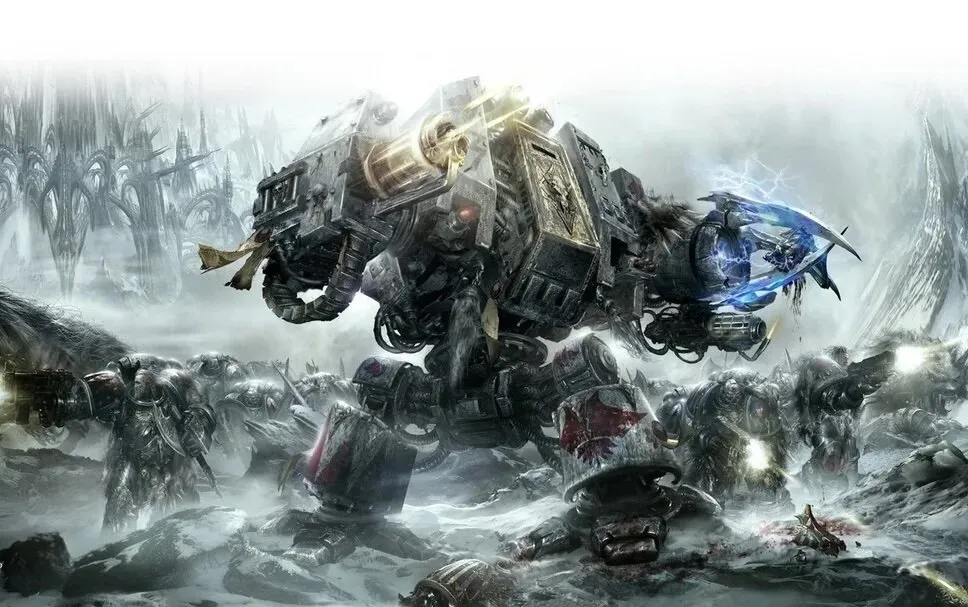
My personal favorite answer. Bjorn is a Space Wolves Venerable Dreadnought who was a young Blood Claw during the Horus Heresy. He fought alongside Leman Russ. He was the first Great Wolf after Russ disappeared. He’s been interred in a Dreadnought chassis for over ten thousand years.
The catch: Dreadnoughts spend most of their time in hibernation. Bjorn is only woken up for the most critical battles or the Space Wolves’ annual Feast of the Emperor’s Ascension, where he tells stories about Russ to the assembled Chapter. For the other 364 days of the year, he’s asleep.
So Bjorn’s chronological age is over 10,000 years, but his experienced age (time spent conscious) is much less. Still, he’s the oldest Space Marine who’s still operational, and the only living being in the Imperium who personally remembers Leman Russ and the Great Crusade. That makes him invaluable as a historical source, which is why the Space Wolves treat him with such reverence.
But here’s the thing about Dreadnought life that the lore explores in some genuinely unsettling ways: being entombed isn’t pleasant. A Dreadnought is a life-support sarcophagus wired into a walking tank. The marine inside has been so badly wounded that their body can’t function without the machine. They can’t eat, can’t sleep naturally, can’t feel touch. Their sensory experience is filtered through the Dreadnought’s systems: auspex data instead of sight, vox pickups instead of hearing. Over time, many Dreadnoughts lose their grip on reality. They confuse past battles with present ones. They wake up swinging at enemies that aren’t there. The Space Wolves put Bjorn into hibernation between wars partly out of respect and partly because even a mind as strong as his degrades with each waking cycle.
Bjorn handles this better than most, probably because he has a purpose that keeps him anchored. The Feast of the Emperor’s Ascension, where he wakes to tell stories about Russ, gives him continuity. He’s not just a weapon that gets rolled out when things are desperate. He’s a living memory, and the Wolves’ decision to build their culture around his recollections is one of the most thoughtful pieces of Space Wolf lore. It turns what could be a grim existence into something almost sacred.
Dante
Commander Dante of the Blood Angels is the oldest non-Dreadnought Space Marine in the Imperium, at over 1,800 years old. Unlike Bjorn, Dante has been conscious and active for his entire lifespan. No stasis, no hibernation. Just 1,800 years of continuous warfare, administrative duty, and the constant threat of the Black Rage.
Dante is tired. The lore makes this explicit. He’s considered ending it multiple times, not from cowardice but from exhaustion. He keeps going because of a prophecy that a golden warrior will stand between the Emperor and darkness at the end of days, and he can’t risk that warrior being him.
If your question is “who’s been actively fighting the longest without a break,” Dante is probably the answer. And that’s genuinely tragic.
The Perpetuals
Perpetuals are beings who reincarnate after death, and several have been alive since before the Emperor united Terra. Ollanius Pius (or Ollanius Persson, depending on the source) may be tens of thousands of years old. John Grammaticus is another ancient Perpetual who’s been manipulating events behind the scenes for millennia.
The problem with counting Perpetuals is that “death and reincarnation” is a weird kind of continuity. Are you the same person after you’ve died and come back? The lore suggests yes (memories carry over), but it’s an asterisk on the “oldest” claim.
Ollanius Pius is the Perpetual who gets the most attention, and rightfully so. Depending on the source, he’s been alive since ancient Anatolia. He’s fought in human wars across every era of Earth’s history before the Emperor even revealed himself. He’s watched civilizations rise and fall for longer than most species have existed. In the Heresy novels, his perspective is fascinating because he’s genuinely tired of living. Not in the dramatic, tormented way, but in the quiet way of someone who’s seen too many versions of the same mistakes repeated across millennia. When he ultimately faces Horus on the Vengeful Spirit, it’s not because he’s brave in the traditional sense. It’s because he’s been doing this for so long that choosing the right thing to do has become automatic, like muscle memory for morality.
John Grammaticus adds another dimension to the Perpetual question. He was artificially made into a Perpetual by the Cabal, a shadowy xenos organization trying to manipulate the outcome of the Heresy. His immortality isn’t natural, and he resents it. He’s been used as a tool by beings older and more powerful than him, and his arc across the Heresy is essentially about whether he can reclaim agency over a life that others keep extending without his consent. He’s thousands of years old and has spent most of those years being someone else’s pawn. That’s a different kind of tragedy than Dante’s exhaustion or Bjorn’s hibernation.
Ancient Custodians
The Adeptus Custodes are individually crafted super-warriors with extended lifespans. Some Custodians active in the 41st millennium have been serving continuously since the Great Crusade. Their exact ages aren’t specified in the lore, but some are plausibly in the range of 10,000+ years, making them older than any Space Marine except Dreadnought-interred ones.
Custodians don’t age in the way Space Marines do, and they don’t require stasis or Dreadnought internment. If any of the original Ten Thousand are still alive and active, they’d be among the oldest continuously conscious humans in the Imperium.
This raises an interesting distinction that the lore doesn’t always make explicit: the difference between biological age and chronological age in 40K. A Space Marine’s body ages much slower than a baseline human’s, so a 500-year-old marine might be biologically equivalent to a 40-year-old mortal. Warp travel complicates things further because time flows differently in the Immaterium. A ship that spends six months in the Warp might arrive to find that years have passed in realspace, or vice versa. Stasis fields stop biological aging entirely. So when we say Dante is 1,800 years old, we mean 1,800 years of realspace time have passed since his birth, but his biological age could be significantly different depending on how much Warp travel and stasis exposure he’s had.
The honest answer is that 40K doesn’t track these numbers precisely, and I think that’s fine. The point isn’t the exact number. The point is what age means to these characters and how they experience the weight of time.
The Anchorites and Dreadnought Madness
Bjorn isn’t the only ancient Dreadnought worth discussing. There are others entombed across the Imperium whose stories complicate the question of age in genuinely unsettling ways. The most notable is the Anchorite, a Word Bearers Dreadnought who renounced Chaos and has been living in secret within the Imperium for ten thousand years. He’s one of the original Traitor Legionaries who turned his back on Lorgar’s corruption, was hidden by sympathetic Imperial forces, and has spent the millennia since in penitent isolation, praying to the Emperor he once betrayed. His existence is a secret known to very few, because if the wider Imperium discovered that a Chaos Space Marine had been living among them for ten millennia, the political fallout would be catastrophic regardless of his repentance.
What makes the Anchorite relevant to the age question is what ten thousand years of conscious guilt does to a mind. Unlike Bjorn, who sleeps between wakings and has the anchor of his stories and his Chapter’s love, the Anchorite has been awake and aware for much of his imprisonment, dwelling on the choices he made during the Heresy. He’s arguably experienced more subjective time than Bjorn, and that time has been spent in suffering rather than service. The lore uses him to explore a question that the Dreadnought concept raises but rarely confronts head-on: at what point does extreme age in a metal coffin stop being life and start being a sentence? The Anchorite chose his confinement as penance, which gives it a meaning that sustains him, but other ancient Dreadnoughts across the Imperium haven’t been so lucky. Some have gone completely mad, trapped in loops of ancient battles, unable to distinguish past from present. Others have become so detached from their original identity that the Chapter serfs who maintain them aren’t sure there’s a person left inside. The oldest beings in the Imperium aren’t always the most celebrated. Sometimes they’re the most pitied.
A Xenos Comparison: Eldrad Ulthran
This article is about humans, but I think it’s worth mentioning Eldrad Ulthran as a point of comparison because he puts human lifespans into perspective. Eldrad is an Aeldari Farseer who’s been alive for over 10,000 years and was already ancient when the Heresy happened. He’s manipulated human affairs, warned Fulgrim about the Heresy (Fulgrim didn’t listen), and shaped the course of galactic events across millennia.
Eldrad’s existence reminds us that by xenos standards, even the oldest humans are children. The Aeldari live for thousands of years naturally, and their Farseers can extend that lifespan considerably through psychic means. The Necrons have been “alive” (in their metal bodies) for over sixty million years. Whatever the Emperor is, he’s young compared to the C’tan. The question of “who’s the oldest” only gets interesting when you limit it to humans, because in the broader galaxy, humanity is the new kid on the block, and our oldest representatives barely register on the timescales that the elder races operate on.
My Answer
If you want the oldest by chronological age (excluding the Emperor): Bjorn the Fell-Handed. If you want the oldest by continuously conscious experience: probably a Custodian we haven’t been named yet, with Dante as the most famous candidate. If you want the most thematically interesting answer: Dante, because his age is a burden rather than a distinction, and the lore uses his exhaustion to say something meaningful about what it costs to survive in this setting.
Bjorn gets the coolest stories, though. Any character whose main job is “wakes up once a year to tell campfire stories about a Primarch” is automatically the best answer to any lore question.