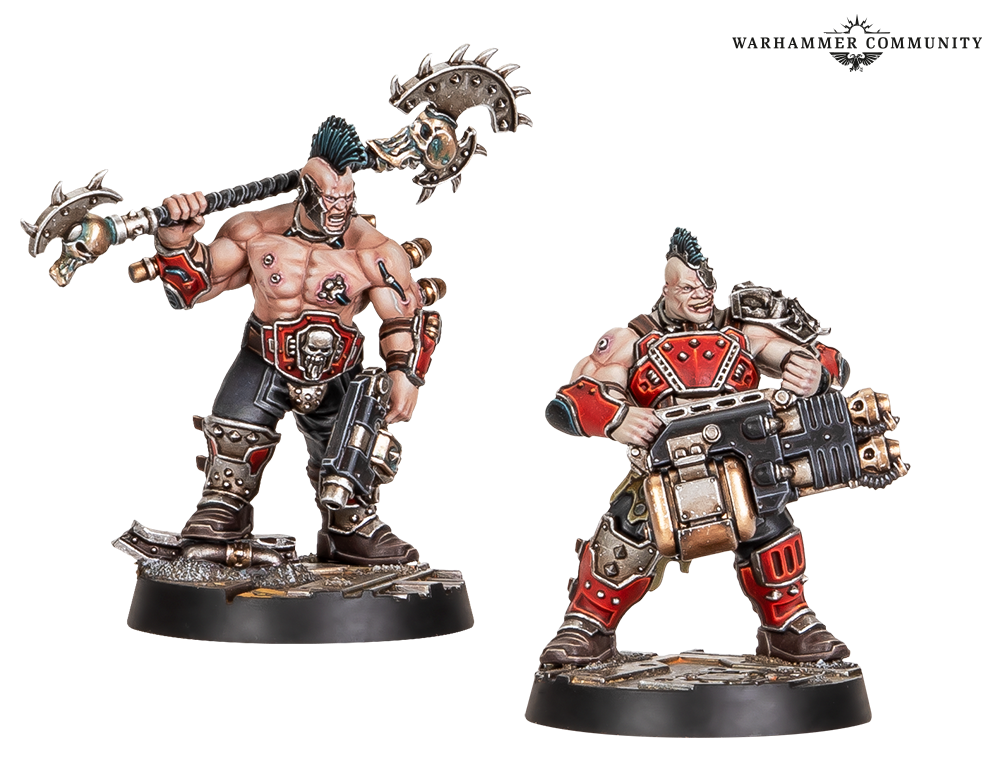
The new Goliath Forge Boss model comes with a double-headed, serrated chain axe called a renderizer, which is the kind of name GW comes up with when “big axe” isn’t quite doing it for them. Warhammer Community’s write-up leans on the word like it’s brand new. It isn’t. I went digging through old White Dwarf battle reports for House Goliath and found a ganger called “Splitter” Korg swinging a weapon called a renderizer back in issue #425, from 2017. Same word, same house, nine years apart, and nobody at GW seems to have flagged the repeat on purpose. I don’t know if that’s a writer with a long memory or just a coincidence nobody caught before it went to print.
I like it either way. Necromunda’s fiction has always worked best when it feels lived-in rather than freshly invented for the next box. A weapon name surviving nine years and two rules editions without anybody noticing is one small proof of that.
What House Goliath actually is
House Goliath owns the foundries. White Dwarf #424, the 2017 relaunch issue, lays it out plainly: they trade raw ore from House Orlock’s mines and turn it into the metal every other house depends on, and their workers are bred “like prize cattle” to be the strongest, toughest furnace-tenders the underhive has ever produced. The core of the house, the actual gangers you field on a table, are described as “huge brutes, incredibly strong and tough, but often mentally unbalanced and extremely short-lived.” Some GW writers classify them as a distinct strain of Abhuman. The Imperium hands that classification out pretty casually, honestly, and Goliaths are one of the more understandable cases for it.
The house’s head is called the Over-tyrant, and the title has changed hands “many thousands of times” through ritual combat, which is White Dwarf’s way of saying nobody’s bothered counting. The current one is Varran Gor, “Gor Iron-eye,” who killed his predecessor at a grand banquet with Lord Helmawr himself in attendance. WD #424 notes Helmawr “barely raised an eyebrow” at the murder happening a few feet from his dinner, which is apparently just how these transitions of power tend to go on Necromunda.
Here’s the bit White Dwarf clearly enjoyed writing: for a house whose entire identity is built on physical strength being something you’re born with, the Goliaths are, quote, “entirely dependent on growth stimms provided by their arch rivals, the hated Eschers, to attain and maintain their prodigious frames.” I wrote a few thousand words about House Escher two weeks ago and left a line dangling about how Varran Gor’s side of that arrangement had never been shown. The new Goliath book doesn’t resolve that. It opens up a different problem for the house instead, one that’s arguably worse for their whole self-image than owing a rival house for growth hormones.
Necromunda’s metaplot moved on without Goliath getting much of a spotlight, too, which the new book seems to know. After the Great Rift split the sky open and Lord Helmawr ended up in medical stasis, the whole planet spent a campaign book’s worth of chaos deciding who’d actually run things next. By the end of that story, Cinderak, one of the hive’s major cities, fell to Lady Credo’s rebellion with House Escher’s backing. Goliath’s contribution to that whole saga, as far as I can tell from what’s been published, was a Dramatis Persona called Gorshiv Hammerfist and some new bike rules. According to Bell of Lost Souls’ early look, the new House of Chains finally spends real pages folding that period into Goliath’s own history instead of leaving it as background noise in someone else’s civil war, which is a gap I hadn’t even clocked until I saw it mentioned.
Ajex was already the crack in the wall
Before the new book, there was already a hole in the “strength is inherited” story, and his name is Ajex Gorgoth. He’s a Natborn Goliath, meaning he was actually born into the house rather than grown in a vat, and Natborns are written as rarer, smarter, and longer-lived than the bulk of the house. Ajex used that edge to build weapons and armor out of scavenged forge-pit scrap, clawed his way up through House Goliath’s internal violence, and now runs the Fist, the biggest Goliath enclave in Hive Primus, putting him among the hive’s eight ruling Alphas. Varran Gor, according to GW’s own copy, “follows Ajex’s career closely, lest he join the trophies on his back.” He’s the Over-tyrant of the biggest, most violence-obsessed house on Necromunda, and the rival he’s actually tracking is the smart one.
Which is the part I find funny, because the entire house brand is “might equals right,” blunt force, no cleverness required. And the guy climbing fastest inside that system is doing it with intelligence he wasn’t supposed to have more of than anyone else. Natborn status doesn’t come from the vats or the stimms. It’s just how he was born, an accident the breeding program didn’t plan for and can’t really explain away.
I tried to build my own version of that idea years before GW got there, and it did not go well. This would’ve been around 2019, and I had a spare Cawdor ganger body I wanted to run as an unusually big Goliath juve for a narrative campaign, because I liked the idea of a house that looks past bloodline when someone’s tough enough. I greenstuffed bulk onto the arms and shoulders freehand, no reference, at eleven at night, because that’s when I do my best and worst work. The proportions came out wrong in a way I couldn’t articulate until a mate at my local store looked at it and said it looked like the model had been stung by something. He wasn’t cruel about it. He was right, and it’s still sitting in a box in my parents’ loft, unpainted, looking stung.
The Unborn, and the surgery nobody’s pretending is pleasant
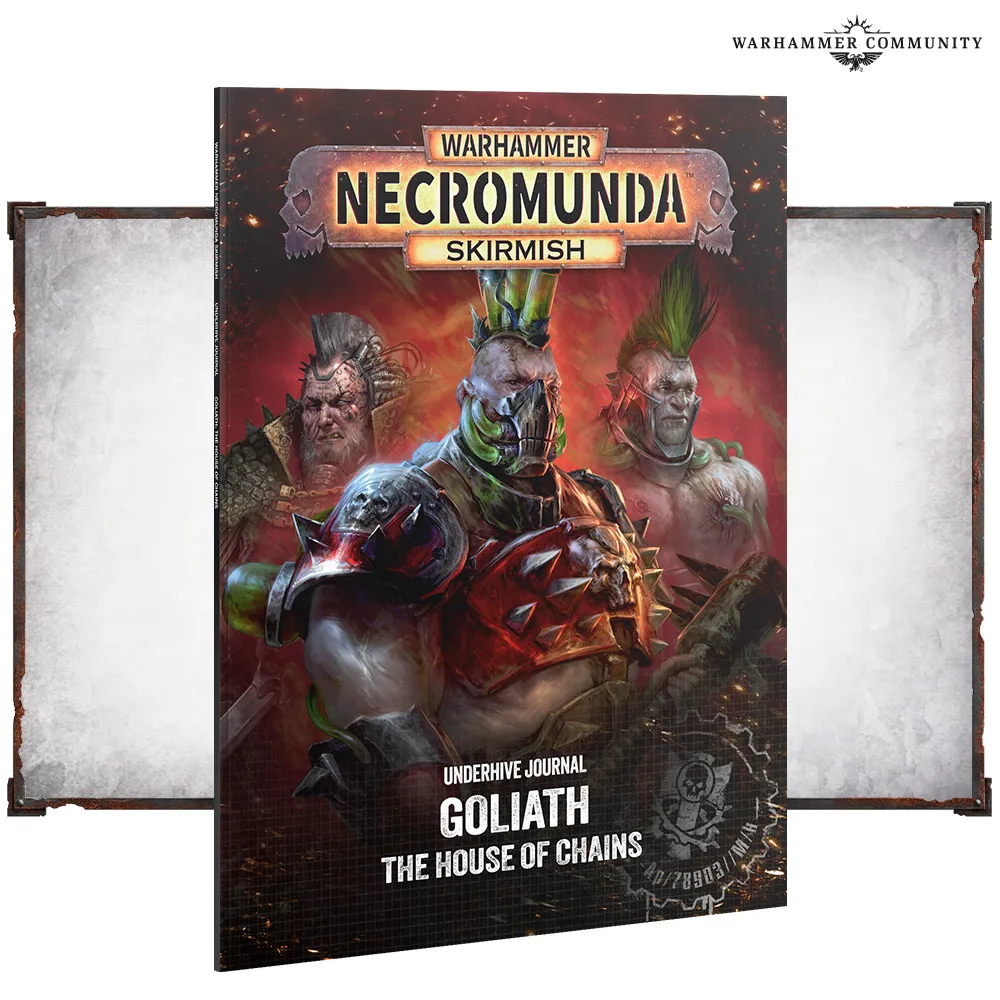
The actual news, finally: Underhive Journal: Goliath – The House of Chains is out alongside a new Forge Bosses & Sumpkrocs kit, and it splits the gang into two new archetypes. Furnace Brutes are the ones you’d expect, muscle sent out to forcibly reclaim territory from rival houses. Unborn are the ones I didn’t expect. GW’s own description: “those who, for whatever reason, have decided to become a Goliath artificially, with the help of a Doc.” Their footnote is doing a lot of quiet work, warning that becoming one “involves a LOT of very painful surgery,” capital letters and all, like GW’s copywriter wanted to make sure nobody skimmed past it.
So the identity that used to be locked behind breeding, the thing that made Goliaths a “classifiable strain” rather than just very buff humans, is now something you can buy from a back-alley Doc if you’ve got the credits and the pain tolerance. It’s not that different from walking into a clinic and asking for the kind of jaw a magazine told you was in this year, except the clinic is a converted foundry and the recovery period involves being useful in a knife fight afterward.
I want to be annoyed about this, honestly. Part of me thinks it cheapens the whole “gene-bulked from birth” pitch that made Goliath distinct from every other house on the roster. Then I remember Ajex was already proof the pitch never fully held, and a Doc with a scalpel is just a faster, uglier version of the same crack Ajex opened up by existing. GW put a price on something that was already negotiable.
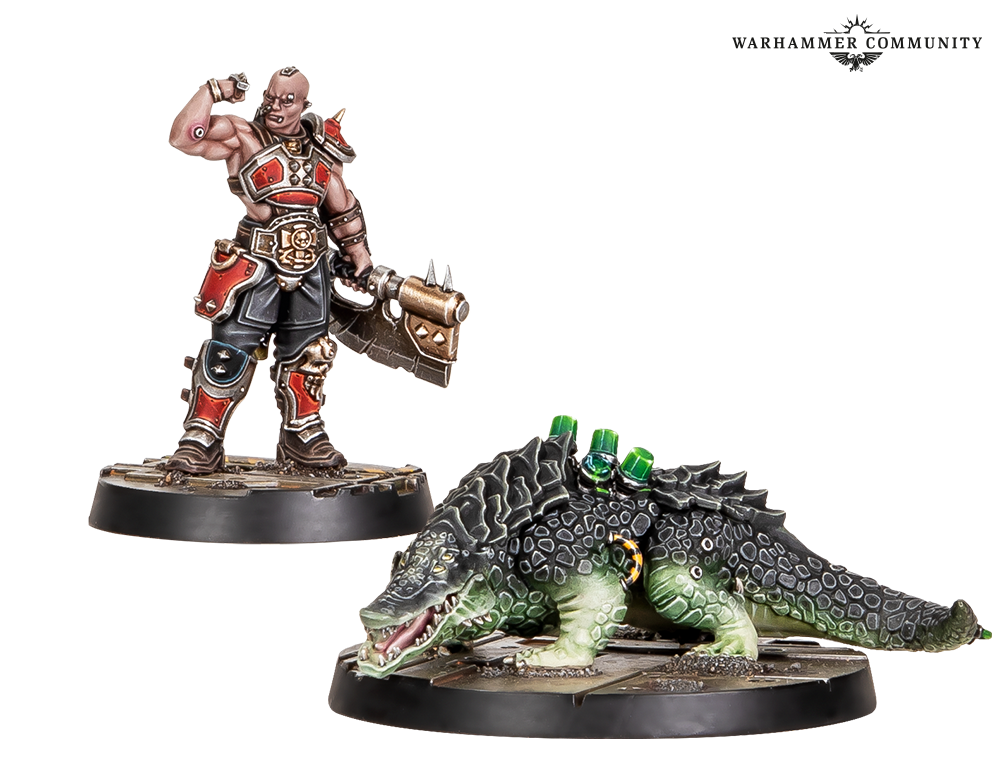
The book also adds new territory and tactics for campaign play, including a Fight Arena you can control and a gang tactic called Crunch Time, which is either the funniest or the laziest name GW’s used all year and I genuinely can’t decide which. There’s a Sumpkroc in the new box too, a tamed toxic-sump reptile the Forge Bosses drag around as muscle with teeth, and I’ll be honest, the model’s better than the joke deserves.
What might mean, exactly
So. Where’s this leave House Goliath’s founding claim. Might equals right, they say, over and over, in every bit of house fiction GW’s ever published. The Natborn didn’t earn their edge, it’s just how they came out. The vat-bred didn’t choose theirs either. The Unborn are the only ones on that list who actually decided to become what they are, and they had to pay a Doc and survive surgery to do it.
There’s a version of the Primaris Space Marine story buried in that same logic, come to think of it. GW spent years quietly widening what counts as a “real” Astartes once the new gene-seed process existed alongside the old one. It’s a slower, tidier version of the same argument, and it’s a bit strange watching the underhive gangers get there messier and with a lot more blood on the operating table.
Whether the Chymist covens ever got their stimm trade back after Cyniss’s failed coup, whatever happened to her after she fled that chamber, I still don’t know, and this book was my best chance to find out and it didn’t say. Maybe the next House of Chains supplement picks it up. Maybe Varran Gor just doesn’t think it’s worth mentioning that the woman who tried to put him on the throne through murder is still out there somewhere.
Either way, my local store’s already got a demo table set up for the new box. I’m going to go stare at the Sumpkroc some more before I decide if I’m buying one.