If the Golden Throne Fails: The Catastrophe of the Emperor's Death

In the grim darkness of the far future, the Imperium of Man endures only by the grace of a dying god. For over ten thousand years, the Emperor of Mankind has persisted in a state between life and death, enthroned upon the arcane life-support of the Golden Throne on Terra. His sustained existence is the linchpin of human civilization – a pillar whose collapse would herald an unprecedented catastrophe. This article explores an alternate history scenario: what would happen if the Golden Throne fails and the Emperor finally dies, plunging the Warhammer 40,000 galaxy into darkness. We examine the Emperor’s current state and the Throne’s function, then analyze the immediate and far-reaching consequences on the Imperium, the Warp, and every major faction.

The Golden Throne and the Astronomican: Pillars of the Imperium

The Golden Throne is not only the Emperor’s life support but also the nexus of Imperial power. This ancient techno-arcane device sustains the Emperor’s shattered body and houses his immense psychic mind. More importantly, the Throne allows the Emperor to project the Astronomican, a supremely powerful psychic beacon. Fueled by the Emperor’s will, the Astronomican sweeps across the galaxy as a lighthouse in the Warp, enabling faster-than-light navigation for Imperial ships. Without it, the vast bureaucracy, commerce, and defense of the Imperium would be paralyzed, as faster-than-light Warp travel and astropathic communication would become impossibly erratic or cease altogether.

Maintaining this beacon is a colossal undertaking. A choir of ten thousand specialized human psykers, soul-bound to the Emperor, lend their minds to magnify the Astronomican’s signal. Their psychic light does not come without cost. Fully one thousand psykers sacrifice their lives each day to sustain the Emperor’s power – their life force consumed to fuel the Astronomican and the Golden Throne’s mechanisms. Through this daily martyrdom, the Emperor’s mind is kept strong enough to broadcast the guiding light that billions of Navigators rely on to plot routes through the Warp’s shifting currents.

Equally vital, the Emperor’s presence on the Golden Throne serves as humanity’s greatest bulwark against the Warp’s horrors. At the end of the Horus Heresy, the Emperor was interred into the Throne in order to seal a catastrophic breach between Terra and the Eldar Webway. Ever since, his ceaseless psychic effort has kept that portal closed and prevented a daemonic incursion on Terra. The Chaos Gods themselves regard the Emperor as their ultimate anathema – the greatest embodiment of order and their most potent foe. In essence, the Golden Throne is not only a life-support machine and navigation beacon, but also a dam holding back the roaring floodwaters of Chaos.

Understanding these functions is crucial to grasp the scale of disaster if the Golden Throne should ever fail. The Astronomican’s light, the stability of the Warp around Terra, and the Emperor’s own soul are all bound to the Throne’s continuance. When that machinery finally breaks (as the Adeptus Mechanicus fears it someday will), the results would be nothing short of apocalyptic for mankind.

The Dying Emperor: Sustained by Faith and Sacrifice

The Emperor’s current state is often described as a living death. His corporeal form, grievously wounded by Horus, is a withered husk that can no longer survive unaided. He has remained immobile on the Golden Throne for millennia, his flesh slowly decaying and his mind in constant agony. Advanced stasis fields and Golden Throne cybernetics keep his body from final collapse, but only just. Moreover, the Emperor’s psychic soul is sustained and nourished by the daily diet of sacrificed psyker souls. Without this continuous infusion of life energy, his mental fortitude would fade and his body would rapidly expire.

It is said that the Emperor endures this eternal suffering purely out of devotion to humanity. His consciousness remains active in the Warp, where he guides the Astronomican and holds Chaos at bay, even as his physical form crumbles. To the countless trillions of Imperial citizens, he is worshipped as the God-Emperor – a divine protector whose sacrifice allows mankind to persevere. The Imperial Cult preaches that the Emperor’s spirit ascended to godhood even as His body was shackled to the Throne, and that this perpetual sacrifice is the price for humanity’s continued survival. Though the Emperor himself in life denied his divinity, in death-in-life he has become exactly that to his people.

This precarious existence is entirely dependent on the Golden Throne’s functioning. Tech-priests of the Adeptus Mechanicus labor constantly to maintain the Throne’s ancient mechanisms, but the arcane device has been failing slowly for centuries. Alarming reports in recent times suggest the mechanisms are degrading beyond the Adepts’ ability to repair. Should the Golden Throne finally break down, the Emperor’s last cell of life will gutter out. The Imperium’s master will perish – and with him go the psychic pillars upholding human civilization.

Immediate Effects of the Emperor’s Death

If the Golden Throne fails and the Emperor’s life finally flickers out, the immediate shock to the Imperium would be immense and multi-faceted. Within minutes and hours, multiple calamities would unfold in parallel across the galaxy:

The Astronomican Goes Dark

The most obvious and instantaneous effect would be the extinguishing of the Astronomican’s light. The psychic beacon directed by the Emperor’s mind would vanish at the moment of his death. In practical terms, warp navigation would become nearly impossible overnight. Navigators – those mutant pilots attuned to the Astronomican – would suddenly find the guiding light gone, leaving them blind in an ever-shifting maze of Warp currents. Imperial ships in mid-transit would be left adrift in tumultuous Warp space, unable to steer or translate back to realspace reliably. New voyages between star systems would take far longer, follow dangerous uncharted routes, or fail entirely. As Imperial scholars grimly note, “should the Emperor die, then the Astronomican will become useless, and Humanity will no longer be able to safely travel through the Warp.” The loss of faster-than-light transport and communication would cut the tens of thousands of Imperial worlds off from one another, each marooned in darkness.

Astropathic Silence and Psychic Backlash

Along with navigation, the Imperium’s psychic communications network would collapse. Imperial astropaths – sanctioned psykers who send telepathic messages across interstellar distances – are all soul-bound to the Emperor for protection. With the Emperor’s soul departing, that soul-bond is severed. Many astropaths may die instantly or descend into madness as the beneficent power that shielded their minds winks out. Others would lose their psychic sight or be left vulnerable to demonic possession. The result is likely a galaxy-wide silence of Imperial communications at the worst possible time.

The psychic shock of the Emperor’s death could also be felt by every psyker and sensitive soul across the galaxy – a profound disturbance in the Warp echoing from Holy Terra, perhaps heralded by nightmares, despair, or a great psychic scream.

Terra Becomes a Gate to Hell

Nowhere would the disaster be more immediate than on Terra itself. The Emperor’s final death means the Emperor’s psychic seal on the Webway portal beneath the Imperial Palace would collapse. That ancient gate, the site of the Emperor’s failed Webway Project, has been held shut only by his unimaginable will. The moment he is gone, the portal would rip open, and a ravening horde of daemons would spill directly into the heart of the Imperial Palace. Terra – humanity’s homeworld and seat of government – would become a new major Warp rift, a door thrown wide for the Realm of Chaos.

The Adeptus Custodes and Palace defenders would find themselves fighting an immediate daemonic incursion on Terra of unprecedented scale. Given the suddenness and ferocity of such an onslaught, even the elite Custodian Guard and Grey Knights might be overwhelmed. Legend holds that a device called the Talisman of Seven Hammers would detonate and utterly annihilate Terra should the Throne fail, to deny Chaos its prize. If true, the entire globe of Terra might explode or be consumed in a Warp cataclysm as an immediate last resort. In any case, the Imperial capital would effectively be lost at the moment of the Emperor’s passing, either overrun by the Warp or scorched to ash.

Panic and Collapse Across the Imperium

As the news (or at least the effects) of the Emperor’s death reach the wider Imperium, the psychological and societal impact would be shattering. The faith of quadrillions of Imperial citizens rests on the belief that “The Emperor Protects.” To suddenly be faced with the loss of their God-Emperor would induce mass panic, despair, and chaos. Loyalist populations might riot or fall into despair; conversely, latent heretical cults and Chaos worshippers would launch uprisings now that the Emperor’s psychic gaze is gone.

Fracturing of Imperial Command

With travel and communication crippled, the centralized command of the Imperium breaks down immediately. The Adeptus Terra on Holy Terra can no longer coordinate the far-flung sectors and fleets. Imperial Navy armadas and Astra Militarum armies find themselves without orders or resupply. Many ongoing war efforts against xenos or rebels would falter as reinforcement stops. Regions of the galaxy previously bound by the Emperor’s light and the High Lords’ decrees now become effectively independent by necessity. The Imperium is poised to fragment – segmenting into isolated pockets that must fend for themselves. As one archive bleakly states, “The Imperium would then become fractured and disintegrate into civil war” in the absence of the Emperor’s guiding force.

These immediate effects feed into each other, creating a cascading collapse. The Astronomican’s loss triggers isolation; isolation breeds panic and opportunism; Terra’s fall decapitates the government; the loss of central authority invites further chaos. Within the first days and weeks after the Emperor’s death, the Imperium would be reeling on its knees, bloodied and leaderless.

Metaphysical and Warp Shockwaves

The death of the Emperor would unleash profound metaphysical shockwaves in the Warp. The Emperor’s existence has long been a calming light and an anchor of order in the Sea of Souls. With that light snuffed out, the balance between Chaos and order tips dramatically in Chaos’s favor, and reality itself would feel the strain.

Rise of Warp Storms

Without the Emperor’s calming presence, the Warp is likely to become even more turbulent. In the current timeline, the galaxy has already been torn by the Cicatrix Maledictum (the Great Rift), a massive Warp storm; the Emperor’s demise could magnify this phenomenon or spawn new Warp storms across the stars. Unchecked psychic disturbances might cut off whole sectors behind raging Warp storms, much as occurred during the ancient Age of Strife. In that dark era before the Emperor’s rise, massive Warp storms isolated human planets for millennia, resulting in anarchy and regression. History may repeat itself.

Daemonic Incursions Galaxy-Wide

Not only Terra, but many places across the Imperium could see increased daemonic manifestations. The Emperor’s soul was a beacon that helped protect human minds from the Warp’s predations. In his absence, the barriers between reality and the Warp grow thinner. Possessions and Chaos infestations on vulnerable worlds would spike. The Grey Knights and Ordo Malleus would be stretched beyond their limits battling an onslaught of daemonic incursions on many fronts.

The Emperor’s Soul in the Warp

When a psyker dies, his soul drifts into the Warp – and the Emperor is the mightiest psyker of all. Upon death, the Emperor’s spirit would be loosed from its tether to his corpse. One terrifying possibility is that the Emperor’s soul could be assailed by the Chaos Gods directly. In life, he was their anathema; in death, he might be vulnerable to being devoured or absorbed by them. The four Ruinous Powers could converge on this powerful soul like sharks scenting blood, eager to eliminate him permanently or corrupt his essence for their own designs.

On the other hand, hidden mystical theories suggest a more hopeful outcome: that the Emperor’s soul could endure and even be reborn as a new psychic entity rather than being destroyed. In any case, the Immaterium would convulse at the moment of the Emperor’s passing – perhaps marked by a psychic shockwave felt by every daemon and god, like the echo of a giant’s fall in a great ocean.

Collapse of Psychic Wards and Soul-Binding

The Emperor’s psychic might has been silently woven into many aspects of Imperial psychic infrastructure. With the Emperor truly gone, those wards lose their potency. Talismanic relics that repelled daemons might weaken. The Emperor’s Tarot would likely cease to function meaningfully. On worlds across the galaxy, the small defenses against the Warp – from the prayers of Sisters of Battle to the hexagrammic wards in Inquisitorial vaults – may falter or at least no longer benefit from the Emperor’s grace.

The Imperium’s Response: Institutional Collapse and Turmoil

As the immediate chaos unfolds, the mighty institutions of the Imperium would each grapple with the unfolding catastrophe in their own way.

Adeptus Mechanicus – The Omnissiah’s Demise

For the Adeptus Mechanicus, the death of the Emperor represents both a spiritual crisis and a technical disaster. Many in the Mechanicus view the Emperor as the Omnissiah, the physical avatar of the Machine God. His failure and death would shatter that belief or force a radical reinterpretation.

Initially, Mechanicus personnel on Terra and Mars would likely throw every last resource into attempting to repair or restart the Golden Throne, even as it fails. When these efforts prove insufficient, a profound despair and confusion would grip the Cult Mechanicus.

A dangerous schism could emerge: those who remain loyal to the Imperium’s remnants versus those who decide to pursue the Mechanicus’s own agenda now that the Omnissiah is gone. Some forge worlds might cut off cooperation with the wider Imperium, effectively becoming independent techno-fiefdoms. Without the Emperor, the ancient pact between Terra and Mars is effectively nullified, and the Mechanicus must navigate its own uncertain path.

The Inquisition – Secrets, Panic, and Purges

The Imperial Inquisition would be among the first to recognize what has happened. Their response would be swift and ruthless in an attempt to control the uncontrollable. Initially, the Inquisition may impose a Terran lockdown and desperately try to control the narrative. Inquisitorial kill-teams might execute any officials who attempt to broadcast the news.

Internally, the Inquisition itself could split into factions over how to handle the crisis. Puritan Inquisitors might cling to preserving what’s left of Imperial order, orchestrating massive purges of heretics. Radical Inquisitors might see this as the moment to enact desperate measures long considered taboo. The Thorian faction, which has long believed in the possibility of the Emperor’s rebirth, may push to retrieve the Emperor’s genetic material or psychic essence and infuse it into a suitable host. Another faction, the Horusians, might even flirt with the idea of using Chaos against Chaos – an even darker approach to create a super-powered figure by harnessing Warp entities.

The Inquisition’s traditional role as secret guardians shifts to overt power-brokers and enforcers. The already shadowy wars that the Inquisition conducts would escalate massively, effectively becoming a civil war within the Imperium’s remains.

Adeptus Custodes – The Emperor’s Final Command

The Adeptus Custodes, the 10,000-strong golden warriors who have stood vigil by the Emperor’s side for millennia, would face the ultimate test of their resolve. In the very first moments of the catastrophe, the Custodes and Sisters of Silence would form the last line of defense around the Golden Throne chamber. Many would lay down their lives in hopeless battles against daemons.

Once it is clear the Emperor is truly gone, the Custodians’ purpose is fundamentally shaken. Historically, the Captain-General of the Custodes answers only to the Emperor; with the Emperor gone, he might arguably become one of the most authoritative figures left on Terra. The Custodes’ role could evolve from royal guardians to roving paladins of a lost empire, enforcing whatever last directives the Emperor may have given or what they perceive his will to have been.

The High Lords of Terra and the Ecclesiarchy – Leaderless Leaders

The High Lords of Terra – the committee of the most powerful Imperial leaders – are thrown into absolute disarray. Their authority was always derived from ruling in the Emperor’s name. Without that sacred mandate, their legitimacy will be questioned across the galaxy.

The Ecclesiarchy faces the greatest spiritual upheaval. This church has for millennia taught the masses that the Emperor is an immortal god. Their first reaction would be denial and propaganda – proclaiming that the Emperor lives on in spirit or has ascended to a higher form. They would urge the faithful to continue praying, insisting that through faith the Emperor’s soul will prevail.

However, fractures within the Ecclesiarchy are likely. Some clergy might succumb to despair or secretly turn to Chaos. Others might become even more fanatical, launching witch hunts. Without the Emperor, the High Lords as a body effectively cease to exist. Power would gravitate towards those who can project force or offer protection: Space Marine Chapters, charismatic rogue traders, or opportunistic warlords. The concept of a unified Imperium of Man would rapidly fade as institutional unity gives way to patchwork survival.

Enemies at the Gate: Reactions of Other Factions

The Emperor’s death would not occur in a vacuum. The innumerable enemies and rivals of humanity would immediately seize upon the situation.

Chaos Ascendant – The Great Enemy’s Hour of Triumph

For the Chaos Gods and their legions, the fall of the Emperor is nothing less than the crowning moment of victory. The Ruinous Powers would exult in the Emperor’s demise. The immediate Chaos response would be an outpouring of Warp-spawned incursions and a coordinated assault on the Imperium at every level.

The Eye of Terror, the Great Rift, and innumerable lesser Warp rifts would spew forth daemonic legions in unprecedented numbers. Demon Primarchs and Chaos Space Marine warbands would be emboldened to launch their Black Crusades en masse. Abaddon the Despoiler would rally the full might of the Chaos Space Marines to claim the Throneworld.

The Traitor Primarchs each might stake claims: Mortarion’s forces spreading plague across vulnerable sectors, Magnus taking revenge on psyker-rich worlds, Lorgar’s Word Bearers exploiting the religious schisms to convert the desperate masses to Chaos worship. The ascendancy of Chaos would be the single greatest external threat in the post-Emperor galaxy.

The Eldar – Ancient Eyes and Uncertain Allies

The Eldar would surely perceive the ripples of fate. Their initial reaction would be a mix of dread and dark opportunity. Eldar myth speaks of the Rhana Dandra, the final battle at the end of days. The Chaos ascendant scenario might convince many Eldar that this final battle is now at hand.

Craftworld Eldar would convene emergency divinations. Some isolationist Craftworlds could decide to withdraw completely. More foresighted Eldar might seek to aid pockets of humanity as a bulwark against Chaos – not out of love for humans but to deny Chaos more slaves and souls. They have the advantage of Webway travel, so they can move even as Warp travel is impossible for humans.

The Ynnari, trying to awaken their god of the dead Ynnead, might attempt bold plans like harnessing the massive psychic fallout from the Emperor’s soul to empower their deity. Possibly, Yvraine or Eldrad Ulthran could attempt to commune with the Emperor’s soul in the Warp.

The Drukhari in Commorragh would likely react by intensifying their raids on weakened human worlds. Harlequins might work behind scenes to facilitate alliances, appearing to both human and Eldar leaders with cryptic warnings and guidance.

Tyranids – The Great Devourer Exploits the Weak

The Tyranids have no regard for the Emperor in any spiritual sense. To them, his death only changes the resistance they face. With the Imperium in disarray, the Tyranids will encounter much less organized resistance. Hive Fleet tendrils could overrun isolated frontier sectors that no longer can call for aid. Individual Imperial commanders might attempt last stands, but many more will simply flee or be eaten.

The Tyranid Shadow in the Warp might compete with or even locally suppress Warp phenomena, providing an eerie bubble of stability amid galactic chaos in areas where Tyranids attack – ironically offering brief respite from daemonic incursions on worlds being devoured, trading one horror for another.

To humanity’s perspective, the Tyranid threat would appear as devouring swarms picking off the carcass of the Imperium. Picture isolated agri-worlds or hive worlds, no longer supported by a battlefleet, falling one by one to the great devourer. The one slim silver lining is that Tyranids have no malice or interest in torture – for those under attack, a quick consumption might be a relatively merciful fate compared to falling to Chaos.

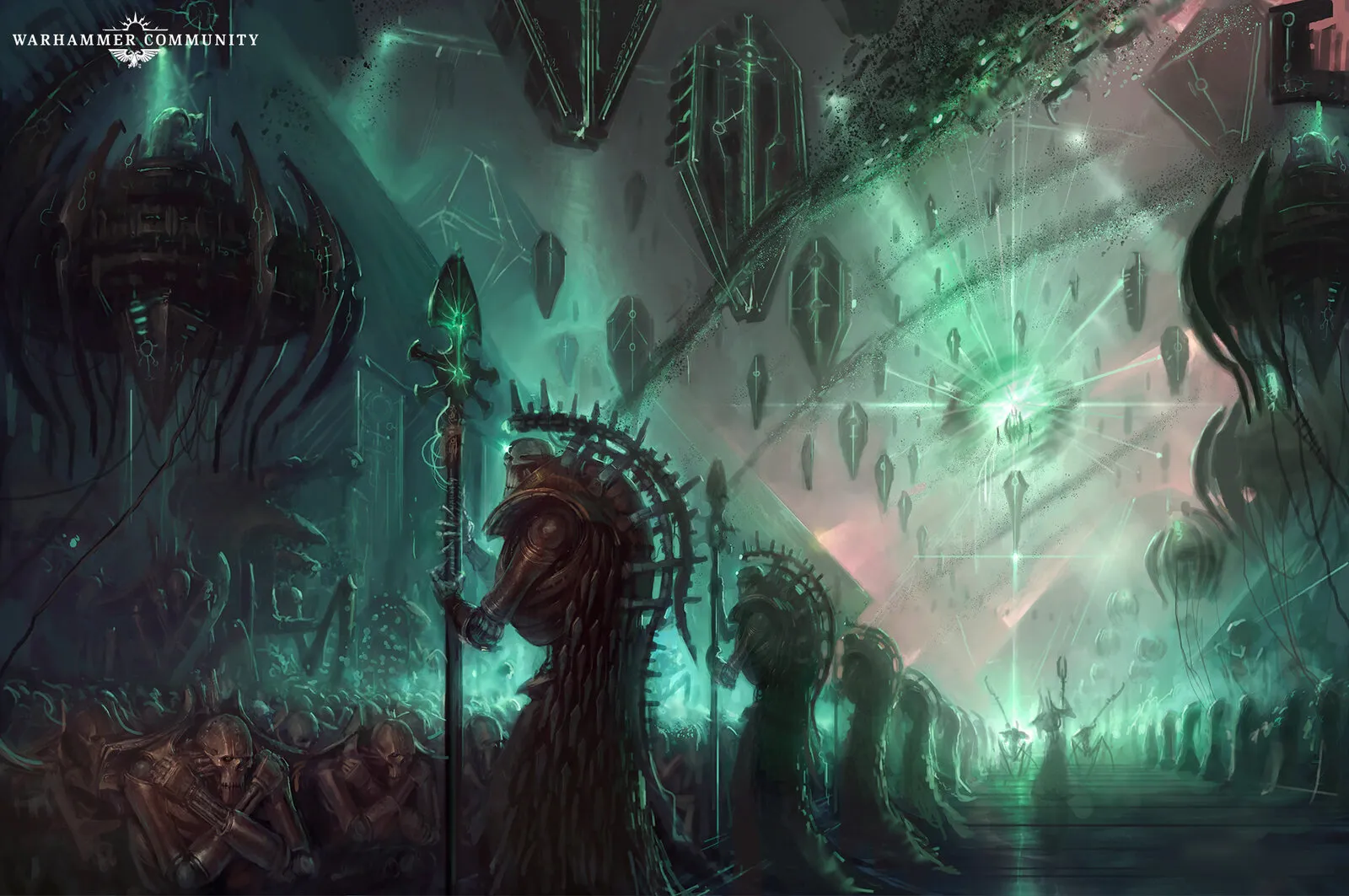
Necrons – Ancient Powers Stirring

The Necrons have their own inscrutable agenda – a galaxy purged of Chaos and dominated by their dynasties. The fall of the Emperor would be seen as a double-edged development. The Imperium collapsing eases Necron reconquest, but the resulting surge of Warp activity is anathema to the Necrons, whose entire racial goal has been to rid the galaxy of the Warp’s influence.

Many Necron dynasties would accelerate awakening protocols. Being utterly without need for Warp travel, they will have full mobility when others are stuck. However, the Necrons’ ultimate foe is Chaos, even more than the Imperium. Their anti-Warp technologies (such as Blackstone pylons that can shut down Warp phenomena) become critically important. We might see Necrons embark on projects to stem the Warp turbulence – activating networks of pylons to calm local Warp storms, creating stable zones for their own empire.

Unlikely alliances could occur: a Necron leader might parley with a human leader, offering to refrain from extermination in exchange for cooperation activating anti-Warp technology. During the 13th Black Crusade, Belisarius Cawl and Trazyn the Infinite collaborated to use pylons on Cadia – showing such cooperation is possible when goals align.

Necrons are possibly the least weakened faction in this new age – their strengths remain intact, while their main opponent is gone and their main objective becomes even more relevant. They could become the last bastion of order in certain regions, albeit a cold, inhuman order.

The Orks – The Galaxy’s Green Tide Unleashed

Orks live for war, and nothing guarantees widespread war like the fall of the biggest kid on the playground. With Imperial warfleets and Space Marine chapters busy or cut off, Ork infestations can grow unchecked. Expect a surge of Ork WAAAGH!s erupting across the galaxy.

Orks are not strategic in a grand sense, but their ever-increasing brawls will incidentally claim large swathes of territory. They also serve as a crude counterbalance – they will fight Chaos armies just as readily as they fight humans. Perhaps Ghazghkull Thraka would launch the greatest WAAAGH! ever, declaring that “Humies lost their big boss, now we’s da biggest boss!”

In a galaxy without the Emperor, Orks are perhaps the only ones who are unequivocally happy. There’s more war than ever – essentially the galaxy becomes one big everlasting WAAAGH!

The T’au Empire – Cautious Expansion and New Alliances

The young T’au Empire would observe the fall of the Imperium with a mix of disbelief and opportunism. Once it becomes clear that Imperial response is faltering, the T’au will likely launch a new sphere of expansion. T’au military fleets would cautiously move to annex nearby Imperial systems that suddenly find themselves unsupported.

They might present themselves as liberators or peacekeepers: “Join the T’au Empire for protection now that your Emperor’s realm has abandoned you.” The T’au’s best asset is their philosophy of the Greater Good, which could be attractive to desperate populations. They could swell their ranks with human auxiliaries and alien allies.

In a few decades post-Emperor, the T’au Empire might grow from a small enclave to controlling whole swathes of the Eastern galaxy. If any semblance of progress and diplomacy is to survive in this dark era, it might be under the T’au’s guidance, since they are one of the few factions whose goal isn’t destruction or domination for its own sake.

Theories of Reincarnation and the Emperor’s Legacy

Amidst the despair, some will cling to hopeful legends and esoteric theories about the Emperor’s ultimate fate.

The Star Child Prophecy

One of the oldest legends is the Star Child prophecy. According to forbidden lore kept by a sect known as the Illuminati, the Emperor’s soul, once fully released by death, will form a new presence in the Warp – a pure, benevolent consciousness that is effectively the Emperor’s “child.” This Star Child is believed to be a nascent god of humanity in the Warp, one that could eventually reincarnate as a new messianic Emperor.

In this scenario, the Emperor’s death is not a defeat but the necessary precursor to rebirth: “in the same way the ancient shamans died together to reincarnate as the single man who would become the Emperor, the Emperor’s death could herald the birth of a new savior for Humanity… when Mankind’s collective desire for a savior strengthens the core of the Emperor’s soul in the Warp and rekindles it to new life.”

The Sensei and the Illuminati

The Sensei are tied to this theory – immortal souls believed to be the descendants of the Emperor’s many pre-Imperium bloodlines. They possess no trace of Chaos and have potent psychic abilities. If any Illuminati survive, they would likely step out of the shadows, proclaiming that now is the time to help the Emperor reincarnate. The common populace might even start worshipping a Sensei or expecting one to rise as the “Child of Light.”

Inquisitorial Theories

Within the Inquisition, the Thorian faction has long been searching for ways to re-embody the Emperor’s spirit. They might interpret unusual psychic phenomena as signs of his essence moving – perhaps a newborn child exhibiting a prodigious psychic aura or a known saint performing real miracles. Multiple figures might be touted as the new Emperor reborn, creating schisms or false messiahs.

Another theory involves the Emperor’s supposed Perpetual nature. Some lore indicates the Emperor was a Perpetual – effectively immortal, able to reincarnate after death. Now that he would be fully dead, perhaps the Emperor’s soul will eventually be reborn as a new human infant somewhere, just as he once was born from the sacrifice of ancient shamans.

Full Godhood in the Warp

There is also the theological concept that upon death, the Emperor ascends to full godhood in the Warp. This view holds that the Emperor instantly becomes a new Warp Power – perhaps the God of Human Unity or Order. If so, the Emperor’s many worshippers might provide him a large reservoir of power to manifest through miracles, empowering the most devout souls.

The Dark Emperor

On the darker side, a nightmare scenario is that a corrupted version of the Emperor could rise. If the Emperor’s soul were twisted by Chaos, he could become effectively a fifth Chaos God – an ironic reflection of the Imperial Truth’s downfall. This theoretical “Dark Emperor” might combine the worst aspects of extreme order and despair, enslaving mankind’s souls in a cruel parody of the Imperial Cult.

The Primarchs as Successors

The surviving loyalist Primarchs might take up the Emperor’s mantle in a practical sense. Roboute Guilliman would be a natural candidate to lead what’s left of humanity. If he survived, he might rally the Space Marines and form a new governing council. The Lion (Lion El’Jonson) would similarly become a beacon for many. These Primarchs, while not replacements for the Emperor’s psychic might, are warlords of unmatched skill and could carve out defended realms where humanity can make a stand.

The Fate of Humanity: Fragmentation or a New Dawn

With the Emperor’s death unleashing catastrophe, what long-term paths lie ahead for humanity?

Fragmentation into Warring Realms

The most immediate outcome is the splintering of the Imperium into countless pieces. Local warlords – be they Imperial governors, Space Marine Chapter Masters, surviving Primarchs, or upstart renegades – will establish their own mini-empires. For example, Ultramar could become one nucleus of order, while Mars and nearby forge worlds form a Mechanicus-aligned bloc. Humanity could regress to the feudal warfare of the Age of Strife.

Civil War and Succession Crises

Even within connected pockets, expect civil wars and internal purges. The Emperor’s death creates a succession crisis with no clear successor. The Imperium’s own institutions could fight each other: the Inquisition versus the Adeptus Astartes, the Ecclesiarchy versus the Mechanicus. As the archives warned, humanity “would disintegrate into civil war” without the Emperor.

Technological and Cultural Regression

Large parts of humanity would slide into a new dark age. Hive cities could go dark as fusion reactors fail and no tech-adept arrives. Over generations, some isolated colonies might completely forget their Imperial past, retaining only legends of the Sky Emperor who fell. Mankind could enter a new “Long Night” reminiscent of pre-Emperor times.

Radical Transformation or Rebirth

Amid the darkness, there is the possibility of radical transformation. Humanity might become a more psychic race, better able to navigate the Warp without the Emperor. New forms of governance and cooperation could emerge. Alliances with aliens might fundamentally change humanity’s role – a departure from 10,000 years of xenophobic doctrine.

The most optimistic path: the rebirth of a united human empire under a new leader or even the Emperor reborn. If a young human claiming to be the Emperor’s reincarnation emerges and starts reuniting worlds, it could snowball into a reconquest akin to the Great Crusade. This “Imperium Secundus” might correct some of the old Imperium’s flaws, forged in the crucible of the apocalypse.

Different parts of humanity will experience different fates. The common theme is that the era of the unified Imperium of Man is over. What follows is an age of darkness and uncertainty, but also one of potential – potential for new heroes, new cultures, and perhaps eventual illumination after the darkness.

Conclusion

The failure of the Golden Throne and the resulting death of the Emperor of Mankind would be an unparalleled catastrophe – a turning point that ends the Age of the Imperium and plunges the galaxy into a new dark era. The Astronomican goes dark, Warp travel and communication are crippled, Terra itself falls to the inferno of a daemonic invasion, and terror and confusion reign among the stars.

In the wake of this cataclysm, the Imperium’s mighty institutions fracture and falter. The forces of Chaos surge triumphant. Xenos foes – from the expansionist T’au to the hungering Tyranids, from the ancient Necrons to the savage Orks – all move to exploit mankind’s weakness.

And yet, amid the despair, humanity would not be entirely devoid of hope. Forbidden prophecies like the Star Child offer a whisper that the Emperor’s sacrifice could eventually lead to his rebirth – but only after humanity walks through fire and shadow. The shape of the future would depend on which embers are extinguished and which are kindled.

One thing is certain: the galaxy following the Emperor’s death would be almost unrecognizable to those who knew the Imperium at its height. The tale of “If the Golden Throne Fails” serves as a grim hypothetical that highlights why the Imperium is as harsh and desperate as it is – because the alternative might truly be worse. It also offers a dramatic stage for the themes of Warhammer 40k to play out: faith versus despair, order versus Chaos, sacrifice versus survival.

In the darkness of that possible future, there is only war – but whether humanity will continue to wage it as a coherent force or fall to endless suffering is the trillion-soul question.


Spotted an error? Or want to share something with us? Write us at grimdarkgamerhq[at]gmail.com.

If the Golden Throne Fails: The Catastrophe of the Emperor's Death