The thing that always gets me about Armageddon is that nobody ever cleans up.
You fight a war there and whatever you leave behind stays. A downed Gargant sinks into the ash and becomes terrain for the next generation. A burned stretch of jungle grows back wrong, full of squigs the size of grox and feral Orks who learned to hunt Guardsmen from their fathers. A hive falls and the ruins are still there a hundred years later, still full of gangs, still smoking in places. Every previous mistake just sits there waiting for somebody to trip over it.
WarCom just dropped Lore of Armageddon Part 2, the surface piece, and it’s the one I’d been waiting for. Part 1 was the system map (which I wrote about in the nine other planets nobody covers), and part 2 finally gets into the dirt. The Equatorial Jungle. The Ash Wastes. The Fire Wastes across the Boiling Sea. The bits of Armageddon that aren’t a hive city but are still full of people trying to kill each other.
The Equatorial Jungle is a wound that won’t close
If you’ve only read about Armageddon through the hives, you’ve missed the weirdest bit.
Stretching across the main continent, visible from orbit as a dark green band between Prime and Secundus, is the Equatorial Jungle. It’s massive. It’s dense. And it’s infested with, according to WarCom, “hundreds of disparate tribes” of feral Orks who use the canopy as shelter during the Season of Fire, when surface temperatures punch over 90°C and the ground actually tears open in tremors.
Here’s the bit that matters for the Ghazghkull angle. Those feral Orks weren’t always there. They’re leftovers. When the Second War for Armageddon ended, the Imperium pushed the greenskin invaders back into the wild and then moved on, because the hives were the strategic prize and the jungle was a sideshow. What they didn’t account for, because nobody ever accounts for it (this is the tabletop lore equivalent of invasive species), is that Orks are fungal. You kill them, their spores settle into the dirt, and a few decades later you have a breeding population of ferals who’ve never even heard of Ghazghkull but are still technically part of his legacy.
This is why the Armageddon Ork Hunters exist. They’re an entire Guard specialism drawn from regiments that got chewed up in the hives and now spend their careers deep in the canopy, hunting squiggoths through steam. I love this unit conceptually. Their whole existence is an admission that the previous wars didn’t end — they just got pushed into the trees. Yarrick’s own Return of Yarrick novel has him running an Imperial burning campaign to try to flush the ferals out with promethium, and it worked about as well as you’d expect, which is to say the canopy grew back and the survivors got tougher.
I remember reading a White Dwarf battle report — I want to say it was around 3rd edition, possibly early 4th, I was buying issues out of the spinner in a WH Smith and the Armageddon campaign had just ended — where a scenario was set inside the Equatorial Jungle and the terrain rules were absolutely miserable. You couldn’t fire your heavy weapons through the foliage. You couldn’t see your own squad at range. A mob of forty Orks just walked up through the vines and caved everyone’s heads in. I lost. I still think about it when people complain that new terrain rules feel too punishing. The jungle is meant to eat your shooting.
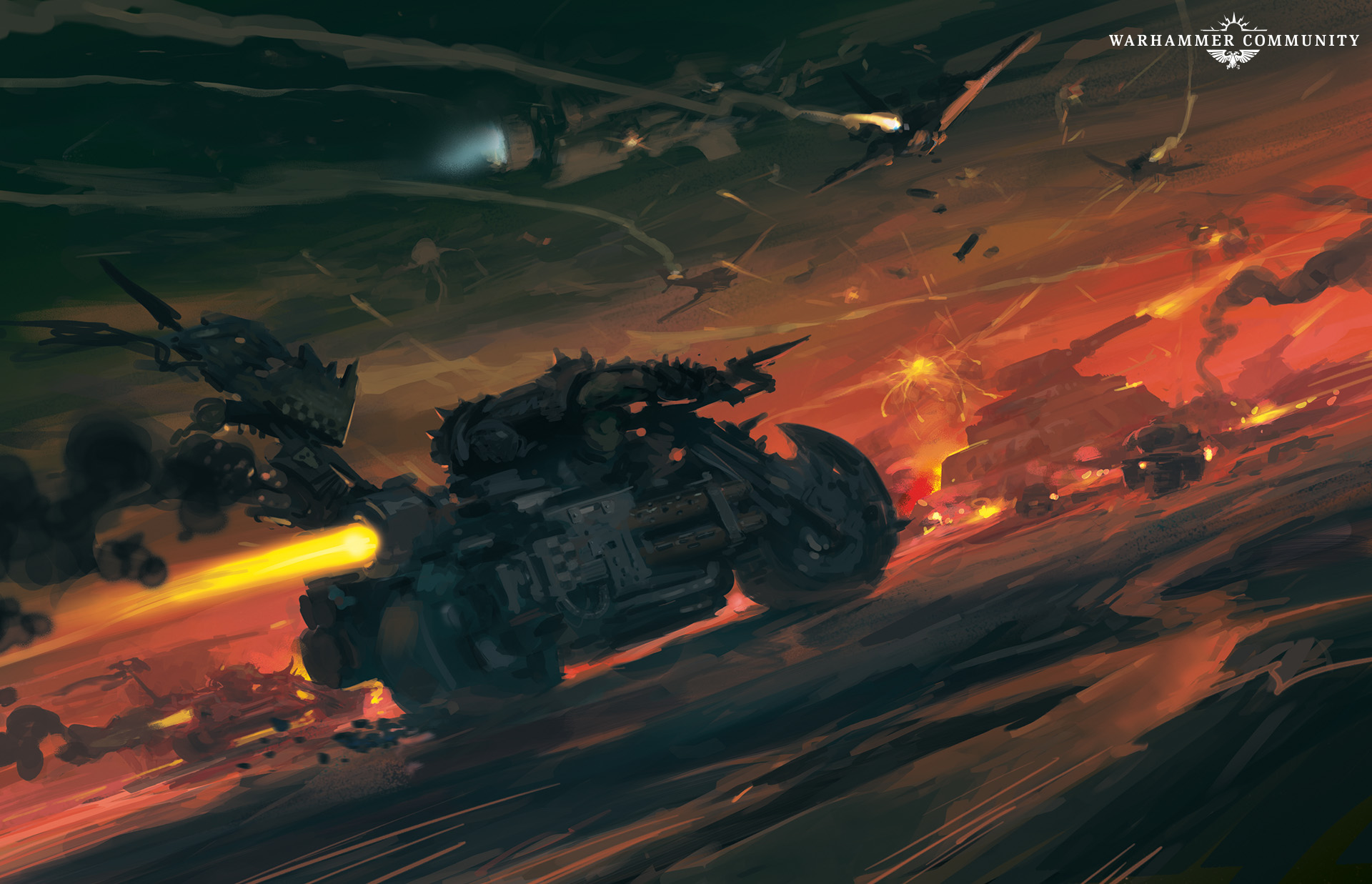
So when the Third War kicks off and Ghazghkull’s boyz pour back onto the planet, they’re not invading empty country. There are already Orks there, waiting. Cousins. Distant, fungal, feral cousins. The canopy fills in behind the new lads and suddenly the Guard has to fight the Third War in the scars of the Second, against a population that’s been quietly compounding for fifty-seven years.
The Ash Wastes remember everything
The other half of the surface is the Ash Wastes, and this is where Ghazghkull’s prints are literally still in the dirt.
Officially, the Ash Wastes are what they sound like: the space between Armageddon Prime’s hives, a choking gray expanse of volcanic ash, industrial runoff, radioactive waste and poisonous compounds that’s accumulated over millennia of heavy industry. You need a respirator to cross it. A few minutes without one and your lungs are cooked. WarCom’s part 2 is clear that the Wastes advantage Orks because Orks are ridiculous and basically eat the atmosphere for fun, which is why every guerilla raid during the Third War ended with the boyz fading back into the ash where the Guard couldn’t follow.
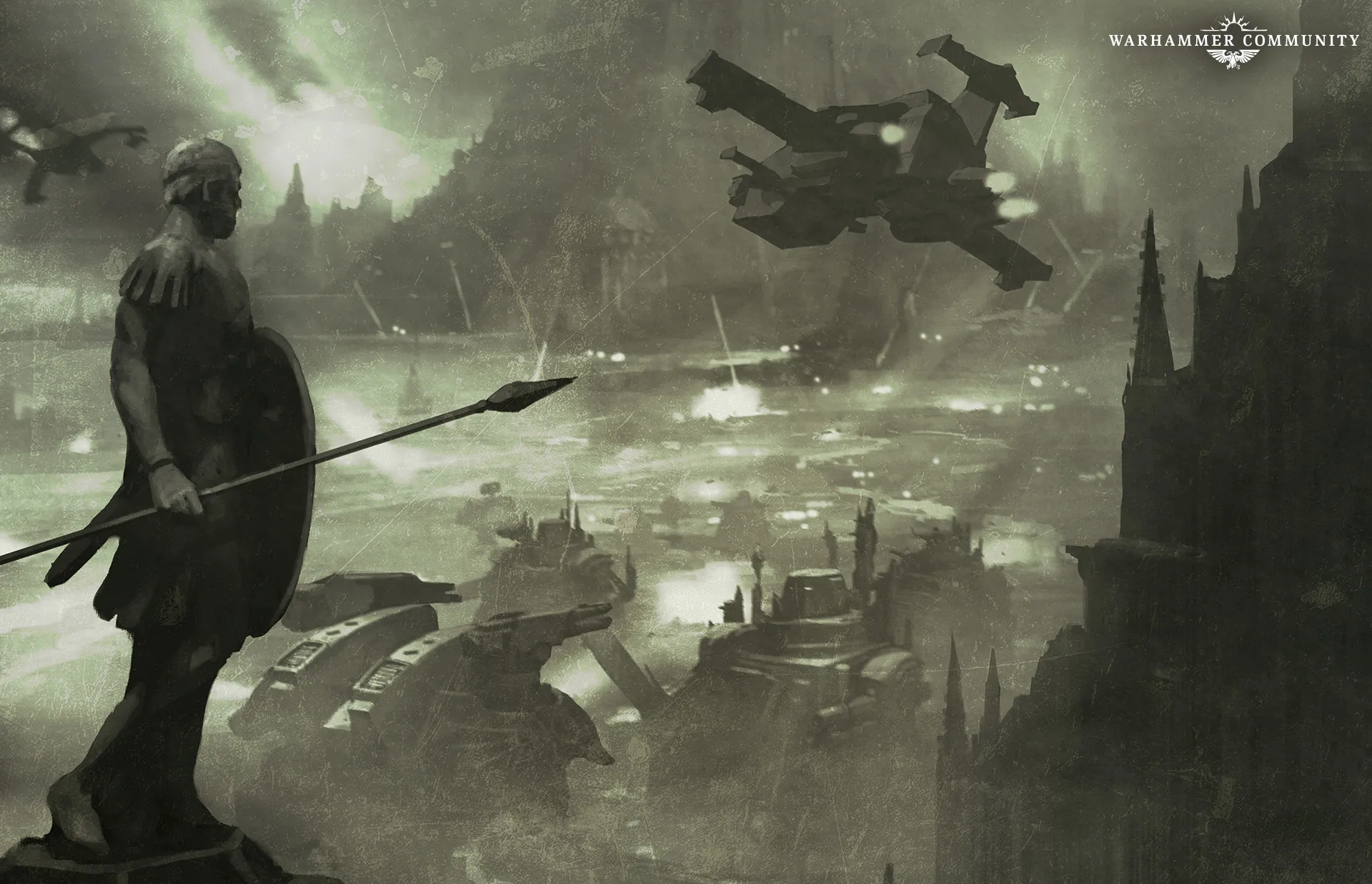
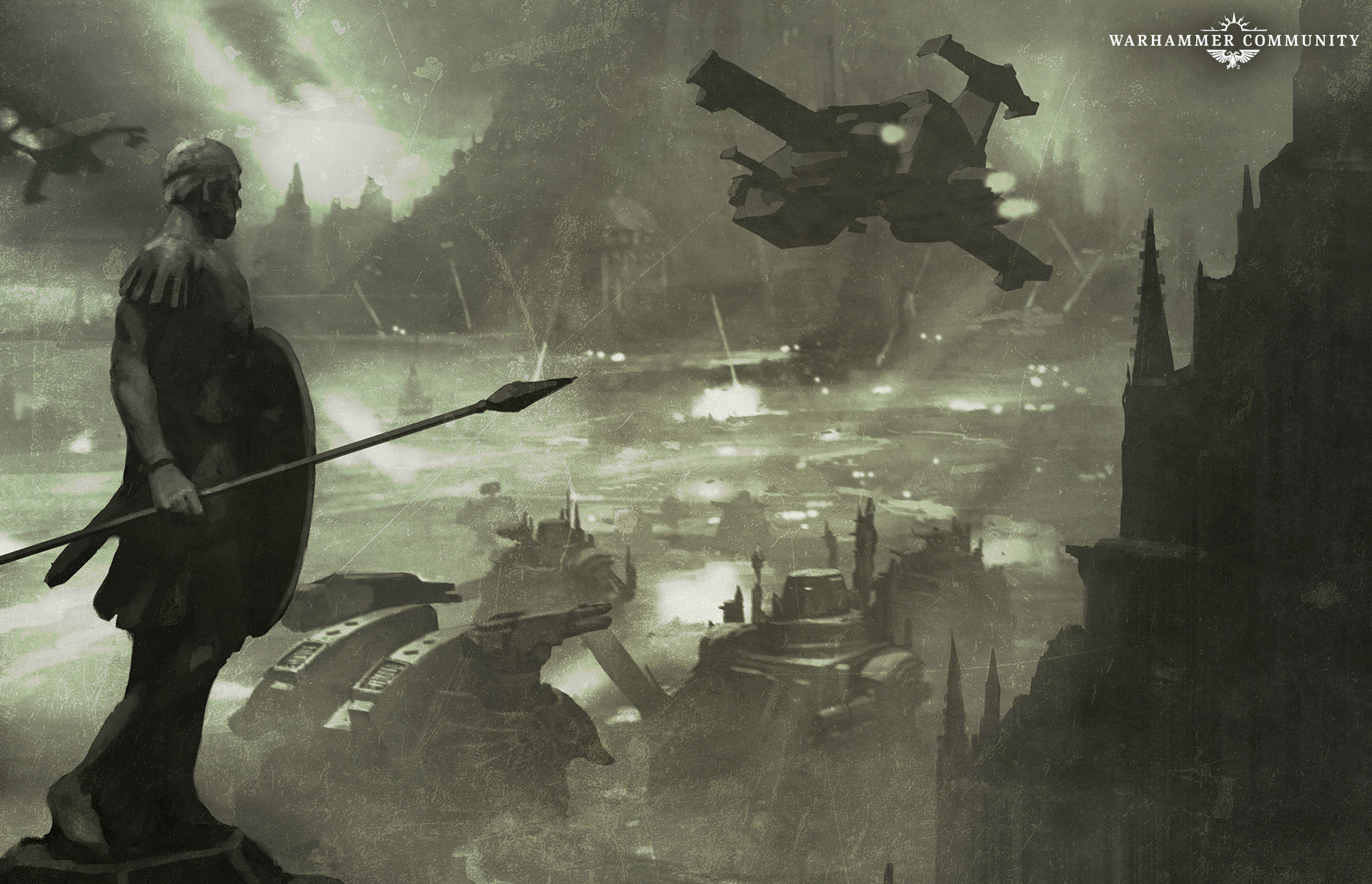
But the Wastes aren’t just pollution. They’re also where the big fights happened and where the big machines died. The Mannheim Gap — the only pass through the mountains wide enough for a super-heavy — is explicitly described as the “final resting place of dozens of Titans and Gargants.” Dozens. Of Titans. And Gargants. Sitting there. Nobody’s moved them. You can’t. They’re too big, the ash is too deep, and every time a Mechanicus crew starts a salvage op a mob of ferals drifts in from the jungle and ruins their day. So the Gap is a junkyard graveyard of god-machines and nobody’s going to clean it up in any of our lifetimes.
There’s a scene I keep picturing, and I don’t know if this is canon or if I’ve just invented it in my head over the years, but: a Steel Legion column pushing through the Gap in the Third War and the first landmark they pass is a Warlord Titan lying on its side, half-buried, with its carapace gun still pointing at nothing. That Titan died in the Second War. The Guardsmen walking past it had grandfathers who fought near it when it was upright.
The wars don’t end, they just overlap
Okay let me actually list this out because it’s easier. The three Wars for Armageddon, compressed:
- First War (444.M41): Ghazghkull Thraka launches his first invasion. Yarrick, still a young-ish Commissar, holds Hades Hive, loses his arm, gets the claw. Imperium holds. Ghazghkull pulls back and starts planning. This is covered in more detail in the Ghazghkull article.
- Second War: Ghazghkull comes back bigger. Hades Hive gets pulverised by an orbital rok bombardment. The Imperium builds three monitoring stations (Mannheim, Dante and Yarrick) above St Jowen’s Dock as an early warning net. Afterwards, the feral Ork population in the Equatorial Jungle explodes from spore drift, and the Armageddon Ork Hunters are formed from surviving Guard regiments.
- Third War (latter M41): Fifty-seven years later, Ghazghkull returns. The three monitoring stations are destroyed in the opening hours. Yarrick comes out of retirement to fight him again. War stalls during the Season of Fire when nobody can cross the ash without cooking. Planet Chosin in the system is lost entirely.
That’s just the headline stuff. Look what doesn’t get cleaned up between wars. The Mannheim Gap Titan graveyard is still there. The feral Orks in the jungle are still there. Hades Hive is still a ruin. It’d already been a ruin for decades when the Third War started, and the Third War just added a fresh layer of debris. Governor Von Strab’s betrayal of Hive Acheron is still a live wound in Armageddon politics. The Imperium reclaims Acheron in the Third War but the hive’s population is gone.
When you put it that way, Armageddon isn’t three wars. It’s one war that keeps pausing.
Or maybe that’s overstating it. I keep going back and forth on this. Part of me thinks calling it “one war” is the kind of cute framing that collapses under detail, because the three conflicts do have distinct political shapes and different Ork motivations. Golgotha genuinely did change Ghazghkull. He went from expansionist warlord in the First War to something closer to a prophet by the Third. But then you look at the ground, at the physical planet, and the Ork fungus doesn’t care about political shape. It just sits in the soil and waits.
The Fire Wastes and the Deadlands are the forgotten bits
Quick functional paragraph because this stuff matters and nobody writes about it. North of Armageddon Secundus, across the Boiling Sea, is the Fire Wastes. Volcanic hellscape. Lava rivers. Refineries and mining bases because the Imperium will put a promethium pump on literal magma if there’s money in it. South of Prime is the Deadlands, which is the planet’s main fresh water source and was historically targeted by submersible Ork attacks. Underwater Ork subs. Suboden Khan, a White Scars commander, drove Speed Freeks out of the Deadlands during the Third War. Put that image in your head and ask yourself why Wazdakka isn’t canonically from Armageddon.
So yeah, Armageddon
Short register shift. So yeah, Armageddon. Planet that eats wars. Jungle full of orks who shouldn’t be there. Ash full of Titans. Hives full of ghosts. Same fight, same dirt, for coming up on two centuries in-universe and something like thirty-five years in the hobby. GW keeps bringing the setting back because every new edition of 40K gets to re-fight the same pass, the same jungle, the same ash, and every time you add something (a new Yarrick, a new Ghazghkull, a new Ork Speed Freek) it goes on top of the old layer without moving it.
Which is the part I actually like most, even though it’s hard to put into rules. You don’t really win Armageddon. You hold the bits worth holding, lose the rest back to the spores, and wait for the ash wind to blow your predecessors’ tags back onto your doorstep.
I’m still annoyed about that White Dwarf battle report, for the record. Forty Orks through the foliage. I had a Leman Russ and everything.