There’s a book chained to the back of a combat bike somewhere out in the Octarius Sector, and you can’t read it with the lights on. The pages are black. The words only surface in the dark, because they’re written in ink milked from deep-sea creatures that glow, and the whole thing has to be read by the light it gives off itself. It’s the second copy ever made. The first one is presumably somewhere even harder to get at.
That book is called the Codex Tenebris Abyssor, and it belongs to the Dark Krakens, a Space Marine Chapter you have almost certainly never thought about, because they turned up in one issue of White Dwarf back in 2021 and then more or less vanished back into the deep. I keep coming back to them anyway. Not because of the glowing book, although the glowing book is great. Because of what the book represents, which is a Chapter that had no culture at all and set about growing one on purpose, fast and deliberately, from nothing.
A Chapter assembled from leftovers
Consider the situation they were born into. They’re an Ultima Founding Chapter, one of the new ones Guilliman and Cawl stood up after the Indomitus Crusade kicked off, and they’re descended from Vulkan, which makes them a Salamanders successor on paper. Pete, who has painted Salamanders for as long as I’ve known him, got weirdly proprietorial when I mentioned them, like a distant cousin had shown up to a wedding.
But the senior Dark Krakens aren’t from a forge world or a volcano planet or anywhere with a flag. According to White Dwarf #466, the warriors who formed the Chapter were all Greyshields, Primaris Space Marines grown on Mars by Belisarius Cawl and then handed out as reinforcements across the whole Indomitus Crusade. A Greyshield fights wherever he’s needed, alongside whoever’s there. Their most senior commander, the Reclusiarch, spent his Greyshield years fighting beside scions of Guilliman, Sanguinius, Rogal Dorn and Ferrus Manus. Captain Luceior of the 5th fought next to White Scars, Space Wolves and Raven Guard.
So when somebody finally pulled a few hundred of these blokes together and said “right, you’re the Dark Krakens now,” they had a problem that no old Chapter has. They had no shared past. No founding hero. No ten thousand years of relics and grudges and ways of doing things. They were a unit full of transfers, every one carrying habits picked up from a different mob, and not one of them had ever stood on the same homeworld as the man next to him.
What you do with a blank slate
The answer the Chapter’s Reclusiarch and its Master of Sanctity landed on was, basically, to go native. The Dark Krakens had claimed a world called Naktis, an ocean planet whose people hunt enormous sea beasts for a living, taking skins and teeth and bones as a matter of course. So the Chapter took that whole-cloth. They started hanging trophies off their armour. They built their iconography out of local sea monsters. They leaned into it hard enough that within a generation, when the Greyshields started getting replaced by actual Naktis-born recruits, the culture would already be there for those recruits to inherit.
And it works because the Greyshields already had the instinct. WD #466 is quite specific about this. Luceior picked up his taste for trophies and hanging fetishes from the White Scars and Space Wolves and Raven Guard he’d served with as a Greyshield. He just didn’t have a reason for it that was his own. Naktis handed him one. Now he wears a scaled cloak made from the skin of a maredrak, a kind of sea dragon, that he killed himself, and a necklace of shark teeth and squid beaks, and there’s a bladed dorsal fin on his helmet modelled on the local lightning sharks, none of it handed down by his gene-line, all of it picked up after the fact.
I find that genuinely fascinating and I’m aware that’s a slightly strange thing to get excited about. Most of the famous Chapters present their culture as bedrock. The Space Wolves have always howled. The Imperial Fists have always done the pain glove. It’s eternal, it’s sacred, don’t ask questions. The Dark Krakens are the same machinery with the back panel left off, where you can see that a culture is just a set of decisions somebody made and then everybody agreed to keep making. Vulkan’s sons, choosing to be sea-monster hunters because the alternative was being nobody in particular.
The bioluminescent everything
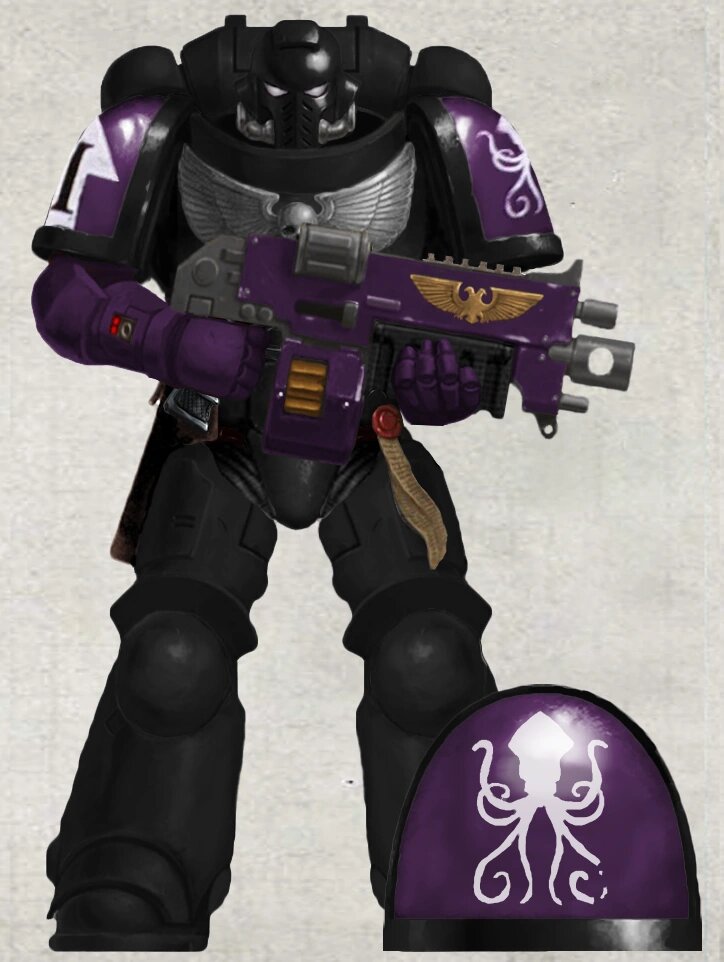
The glow is the part that sold me. Naktis is full of deep-sea creatures that produce bioluminescent chemicals, and the Dark Krakens harvest those and use them as paint and ink. So a battle-brother daubs his armour in symbols that look like nothing much in daylight and then light up green once it’s dark. The Reclusiarch has the Eye of the Kraken on his shoulder, which glows fluorescent green in low light. Their holy book is written in the stuff. Their kill-markings, oaths and honours are all in it. An entire visual language that’s half-invisible until the right conditions, which for a Chapter that does a lot of its fighting in the lightless deep, or under the sea, or in the dark of a void war, is just practical, and also one of the most flat-out cool ideas I’ve read in a Chapter writeup.
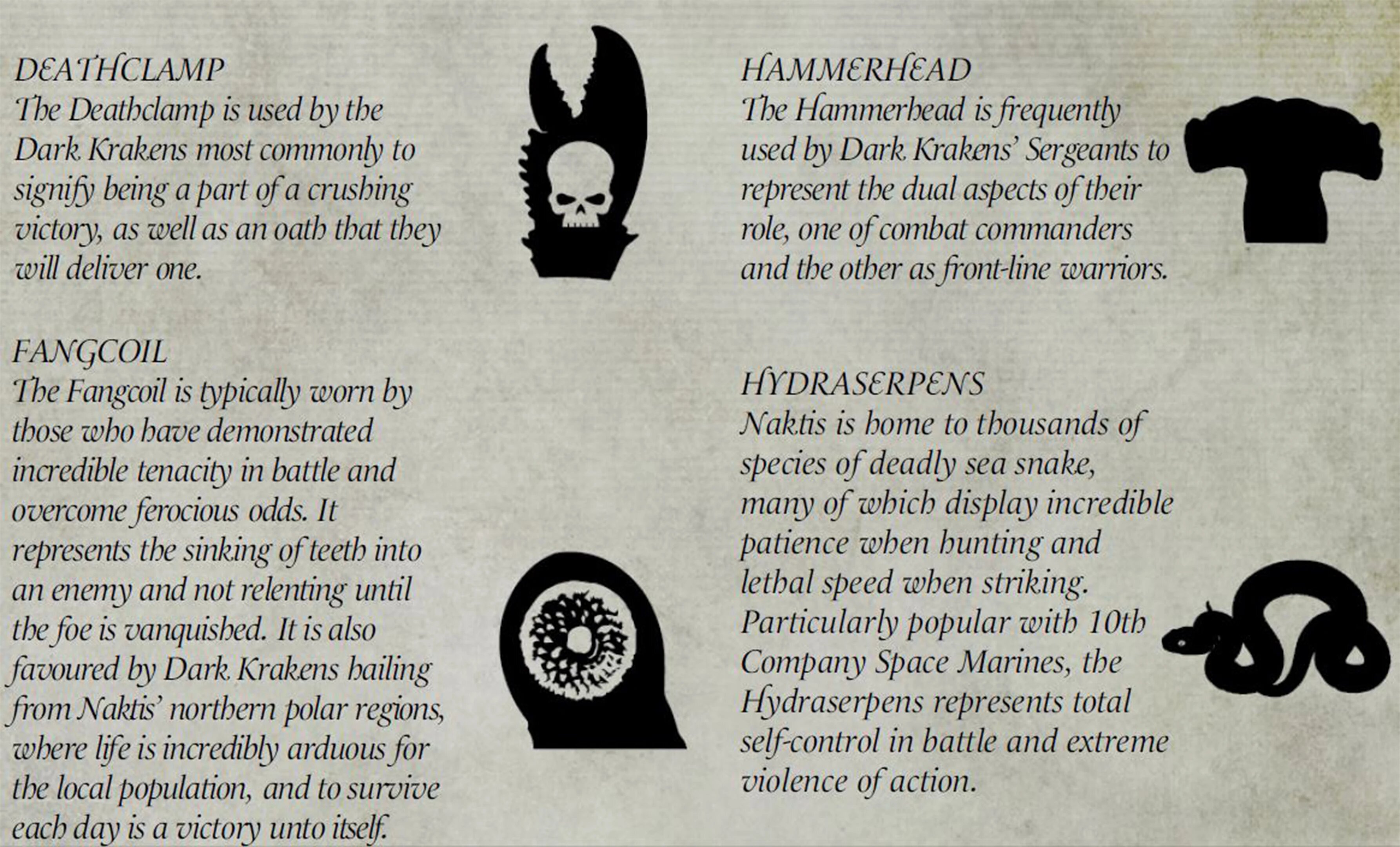
The symbol lexicon has names, too, and they’re good. The Deathclamp is a crab-claw over a skull, sworn or painted on to mark a crushing victory. The Fangcoil goes to brothers who’ve shown incredible tenacity, favoured especially by Krakens from Naktis’ brutal northern polar regions. The Hydraserpens, a sea-snake design, represents total self-control paired with extreme violence, and it’s popular with the 10th Company. The Hammerhead is a sergeant’s mark. There’s a whole heraldry here, invented in an afternoon by a writer at GW, that feels older and deeper than half the stuff I grew up with.
Do I think every single one of those details is load-bearing canon that’ll ever come up again? No. Honestly most of it will sit in WD #466 forever and never get referenced anywhere else. The Dark Krakens have had, as far as I can tell, basically zero follow-up since 2021. But that’s sort of the point of the whole exercise, that someone bothered to make this much texture for a Chapter that exists to be a one-issue narrative opponent.
Octarius, and the thing they were actually doing there
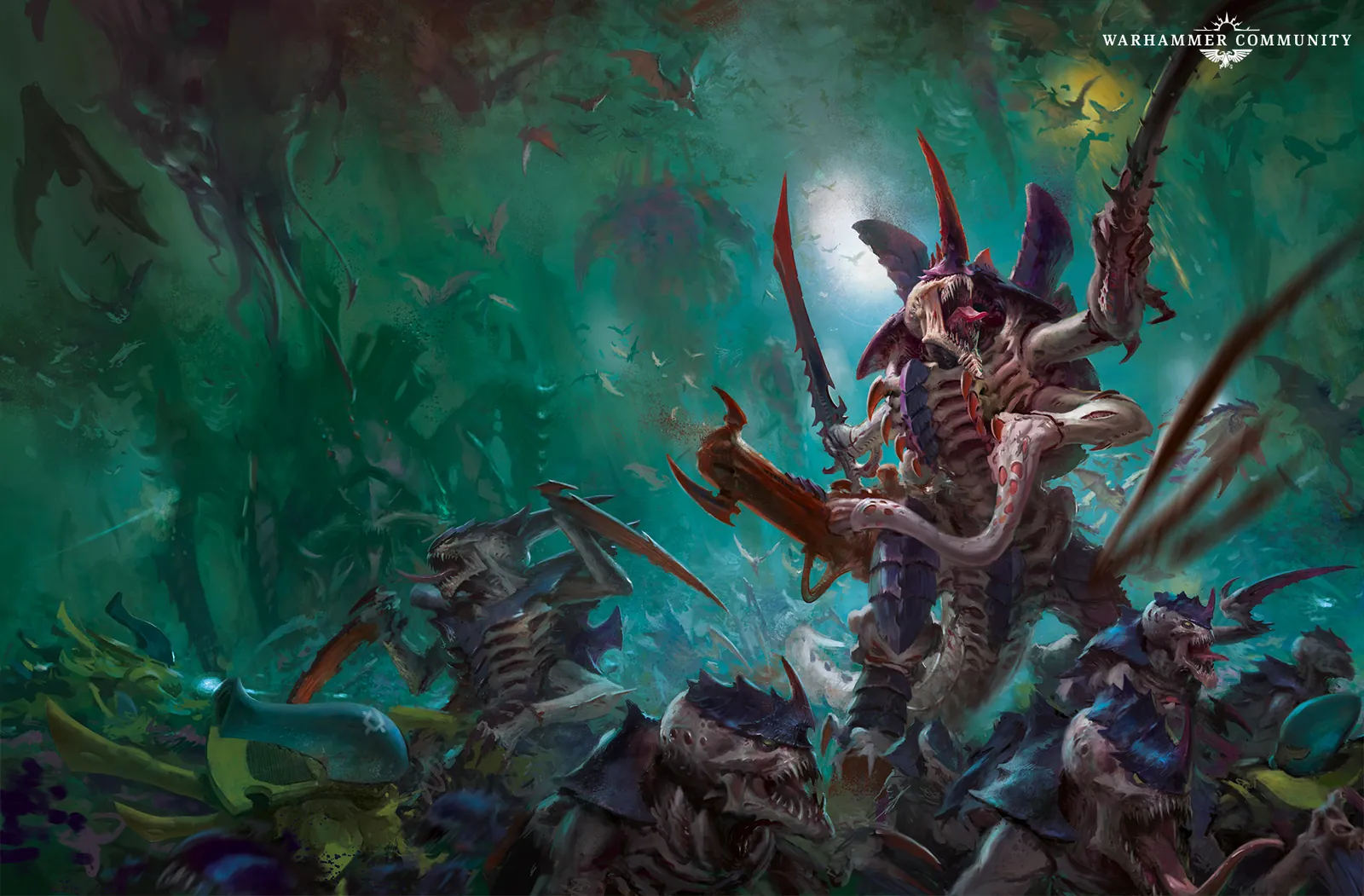
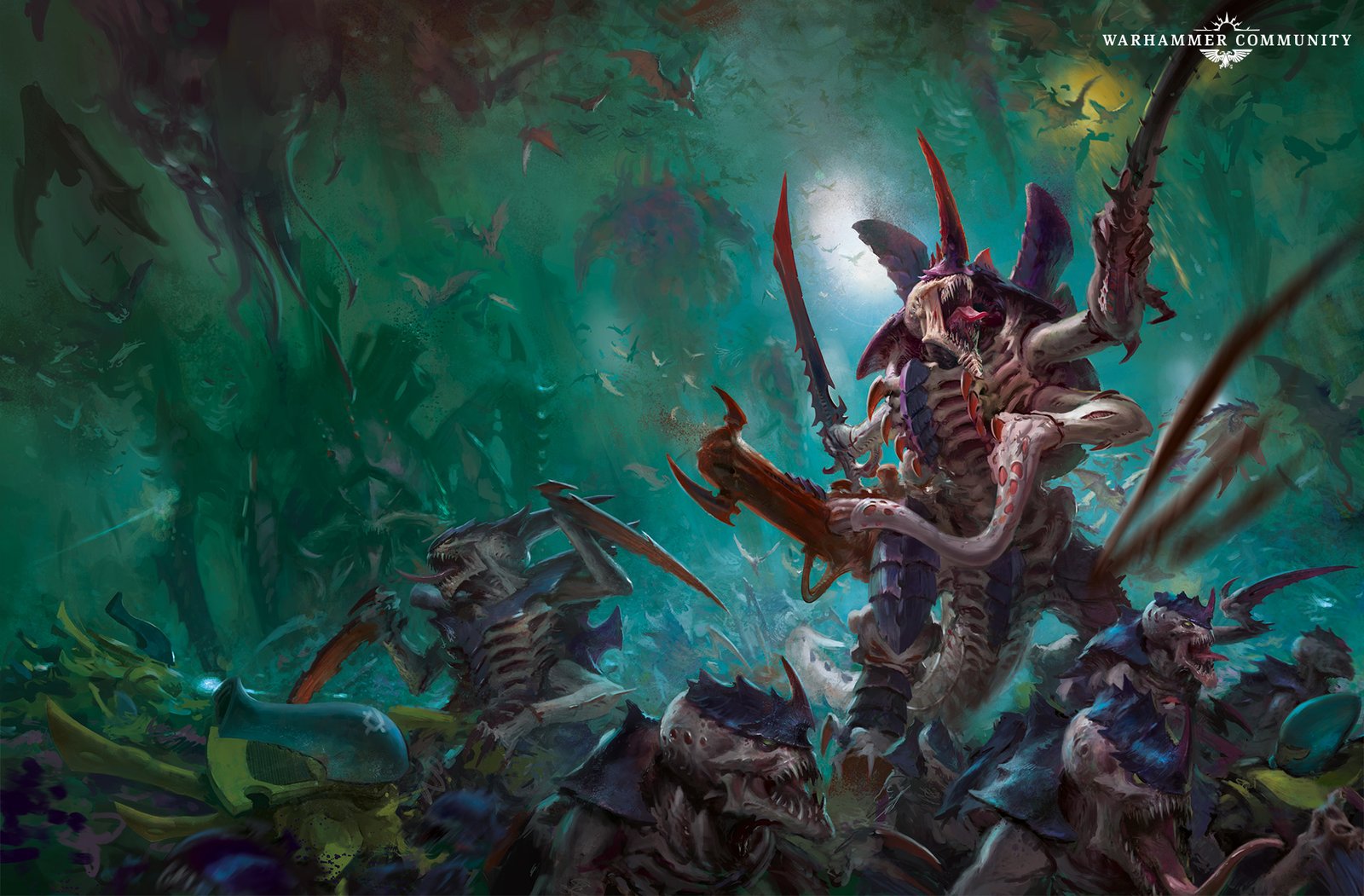
The reason they showed up at all was Flashpoint: Octarius, the big Tyranid event from mid-2021, with Hive Fleet Leviathan crashing into the sector. The Dark Krakens deployed to a frozen ocean death world called Death of Bianzeer, fighting alongside the Wolfspear Chapter and a Deathwatch kill team while the Tyranids tried to eat the place.
And the specific job they’d given themselves on that world is the detail that makes me like them as characters rather than as a paint scheme. The local apex predators, the ursun-wolf packs and the rest, carry genetic material the Hive Mind would dearly love to absorb. Sharp claws, fast venom, pack intelligence, the kind of traits a hive fleet folds into its next generation of monsters. So the Dark Krakens weren’t only defending the human population. They were trying to keep the planet’s wildlife out of the Tyranids’ gene-pool, the claws and the venom and the pack-instinct all of it. A Chapter of sea-beast hunters, spending lives to keep this world’s beasts breathing and out of the Hive Mind’s reach.
There’s a quiet bit of characterisation in there about Luceior that I keep turning over. He’s a Captain. He commands the 5th Company. A Space Marine officer with impostor syndrome, which you almost never see written down. The writeup says, plainly, that he knows he has barely more combat experience than the men he’s ordering around, because they’re all roughly the same age, all minted from the same Martian production run within a few years of each other. He feels he has something to prove to them, and the magazine just tells you that, flatly, in among the wargear notes.
I tried to paint one and it went badly
So a few years back, around when the Contrast paints were still the new exciting thing, I bought a single Intercessor specifically to try the Dark Krakens scheme. Purple and black, white kraken on the shoulder. The armour came out fine, the purple’s a forgiving colour. Then I got ambitious and decided I’d freehand the glowing tentacle markings, the Kraken’s Tentacles down each arm, in a pale green that was supposed to read as bioluminescence.
Reader, it read as spaghetti. A child’s drawing of spaghetti. The lines were wobbly, the green was too thick and sat on top of the purple like mould, and the whole arm looked like the Marine had sneezed mid-meal. Pete looked at it, did the polite pause people do, and said it had “energy.” I stripped the arms twice and gave up the second time. That model is still in a drawer with one good arm and one arm I refuse to look at. I told myself afterwards that freehand is just for other people. Really I’d rushed it and didn’t want to admit that, so the model takes the blame.
The Dark Krakens are never getting a codex. They’re a White Dwarf curio, a Crusade-only narrative force from an event that wrapped years ago, and the rules they came with were thin even at the time. If you want them on the table you’re basically running counts-as Salamanders or building your own Primaris army and pretending. None of that bothers me. I like them precisely because they’re minor, because someone gave a throwaway Chapter a glowing invisible holy book and a reason to protect the wolves they hunt, and then let them sink back into the dark where you have to go looking to find them again.