Kiran finished a new Plague Marine at our last Kill Team night and spent about twenty minutes making me look at it. The model was genuinely gorgeous. Rust-streaked armour, a single exposed rib where the ceramite had peeled, flies the size of a fingernail painted individually across the pauldron. He’d done the eyes yellow. He was insufferable about it. I stared at it long enough that my tea went cold, then spent the rest of the evening losing badly, which I’m choosing to blame on the tea rather than the list.
Actually not the tea. My Thousand Sons list was bad.
Kiran’s played Death Guard since 8th, which is long enough that he’s earned the right to be smug about them, and I mostly just wave a Rubric at him and hope for the best. That’s the pitch for this Legion, historically. They’re the army that refuses to die. I’ve always found them a bit boring for it, the hook never quite grabbed me, even when Typhus was busted. Then a few weeks ago I ended up on a Mortarion binge, not on purpose, just started with the Godblight audiobook on a long drive and ended up three deep into Black Library, half-convinced I’d missed what the Legion was actually about.
Mortarion thinks he’s free
This is the bit I’d read a dozen times without it landing. In the canon, Mortarion will sometimes insist (to himself, to his inner circle, occasionally to his brother Primarchs) that the arrangement with Nurgle is a partnership. Someone who can “set bounds” on what the Chaos Gods ask of him. The deal was transactional: the Legion was dying in the Warp, he gave himself and his sons to Grandfather for the cure, and now he works with Nurgle from a position of mutual interest.
The strongest counter-evidence is how Nurgle responds when Mortarion goes off-script. During the Plague Wars, Nurgle ordered him to hold Ultramar and consolidate, grind Guilliman down slowly, the way a plague god likes to work. Mortarion ignored this and charged at Guilliman personally to give him the Godblight, a pathogen he’d hand-made to kill a Primarch. Nurgle was furious. When Mortarion got chased off Iax, the lore strongly implies his Grandfather was displeased in the way a cat is displeased with a kitten that’s wandered off. A notice is taken. A correction is coming. The fact that Mortarion occasionally wanders off to pursue his own grudges doesn’t change the arrangement. Iax ended with him banished back into the Warp while the Plague Companies kept the campaign going under Typhus.
The psychology of this is what gets me. Mortarion hated psykers because his foster-father on Barbarus was a warp-tyrant who enslaved human souls. He hated the Emperor because the Emperor was also a psyker, and Mortarion’s pattern-recognition said one warp-worker was as bad as another. Horus turned that prejudice into treason by selling him a story where the Emperor was just Necare in gold. And Mortarion walked into his own version of that story. He now serves a Warp god, the exact thing he swore to resist. The Plague Wars novels mostly handle this by having him change the subject whenever a POV chapter edges too close to the contradiction.
Kind of like every lapsed gym member who still says they’re “technically a member.”
What the Destroyer Plague actually did
The other thing I’d missed is more mechanical, but it changes how you read every Death Guard miniature GW has put out since Mortarion’s plastic release.
The Dusk Raiders (the XIV Legion’s original iteration on Terra, before Mortarion was even found) were a specific thing. Heavy infantry. Grim. Grey power armour with red arms, no ornamentation. Eighty-plus years as a Legion without a Primarch bred a self-reliance and quiet pride that didn’t quite survive contact with Mortarion’s Barbarus militia; the Terran veterans mostly just endured the reshuffle. Still recognisably Astartes, though, and still mostly doing the grinder-infantry job they’d been built for.
The Destroyer Plague remade the Legion from the inside out. Typhon engineered the whole thing: he murdered the Navigators, steered the fleet into a Warp storm, and let Nurgle handle the rest. The Legionnaires rotted for what felt like forever, couldn’t die, and finally Mortarion broke and handed the whole Legion away. What came out of the Warp operates as a new kind of organism. The Dusk Raiders survive on the muster roll as a Chapter ID number and an old heraldic colour scheme nobody uses any more.
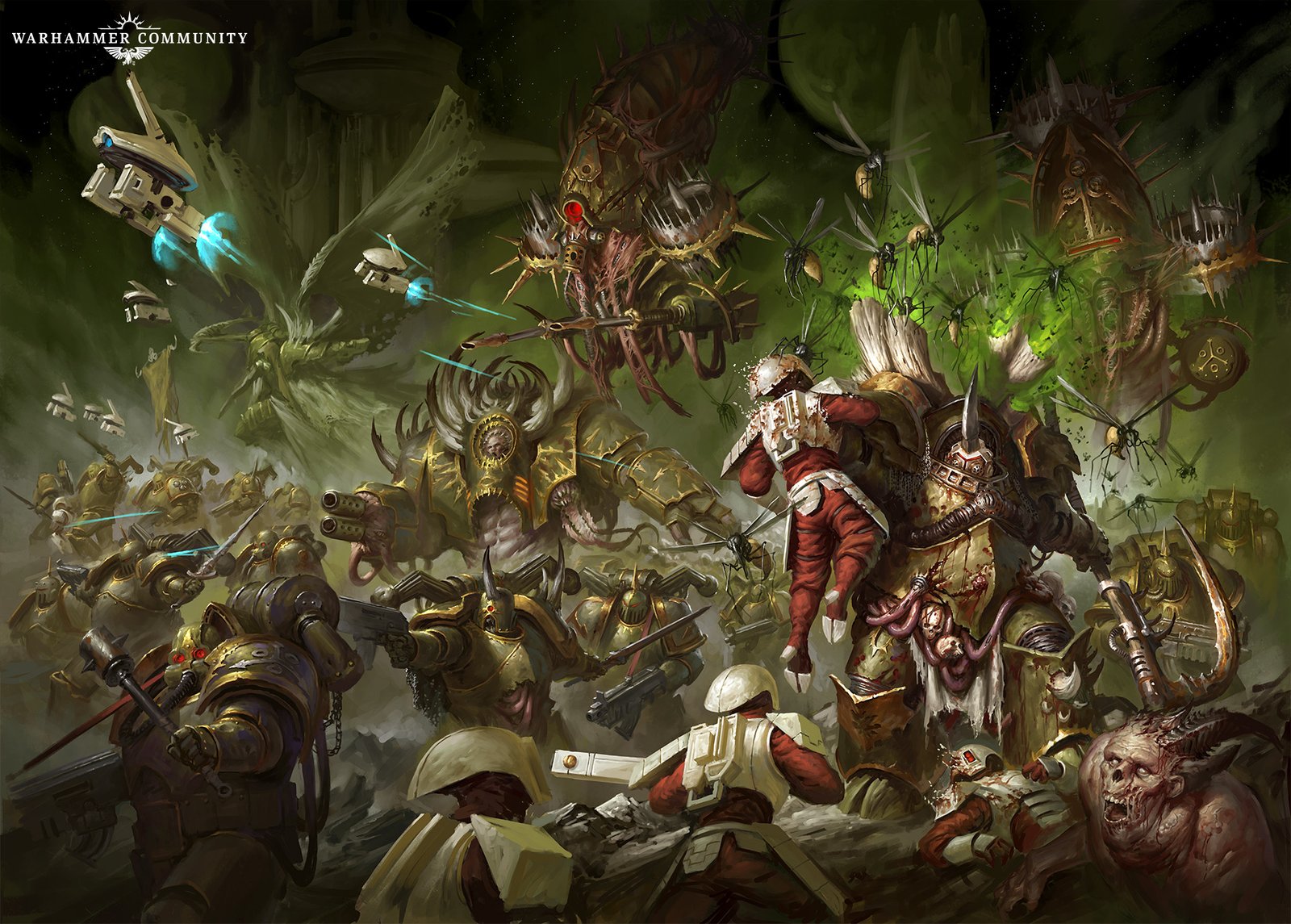
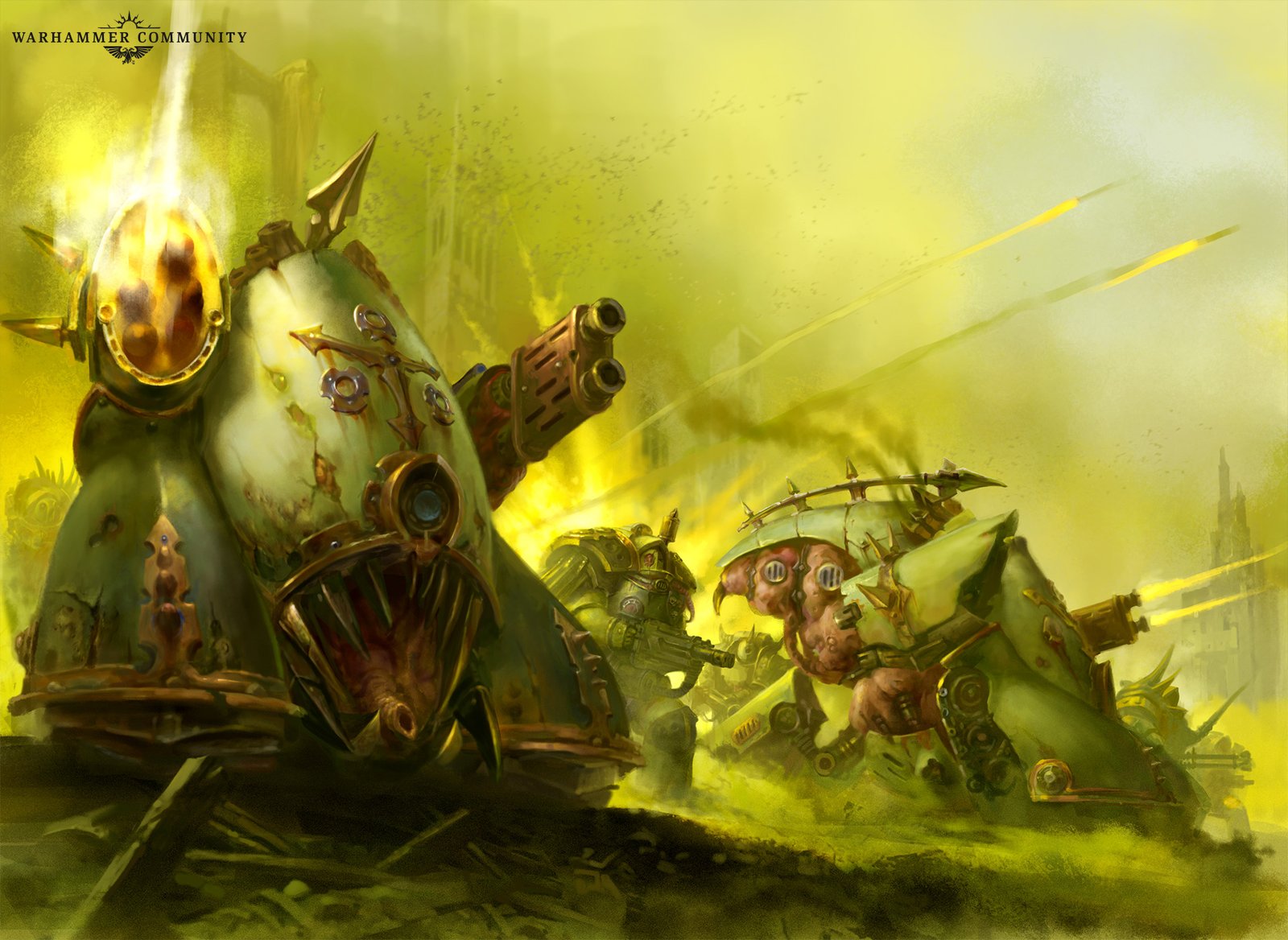
Plague Marines feel no pain because the nerves have rotted out. They don’t die from wounds that would kill any other Astartes, because death isn’t an option Nurgle lets them take. Their armour is fused to their bodies, their bodies host insect swarms, their bolters fire rounds that infect before they kill. Mortarion still calls them sons, and the “Unbroken” motto still shows up in 40K flavour text as Heresy-era carryover.
(Yes, a handful of Loyalists escaped. Nathaniel Garro, the Eisenstein, the Knights-Errant. I know. Garro is a whole novel and I’m not doing him justice in a half-paragraph so I’m not going to try.)
Why this Legion doesn’t splinter
One detail the codex likes to emphasise, and which Kiran brings up unprompted at least once per game, is that the Death Guard have stayed more coherent than any other Traitor Legion. World Eaters are a fistfight in a warehouse. Emperor’s Children splinter on aesthetic differences. Night Lords barely admit to being a Legion. My Thousand Sons at least organise around a shared grievance with a very clear named enemy, so even we hold together better than most.
The Death Guard don’t splinter because they don’t need to. Nurgle’s domain is, paradoxically, the most patient of the four powers — he can afford to run his Legion as a single slow pressure front. Mortarion rules. Typhus operates semi-autonomously and is allowed to, because Mortarion delegates almost as a matter of policy. A handful of lesser warlords lead Plague Companies under a shared strategic vision. When they commit to a war, like the Plague Wars, they commit as a Legion. Ultramar is the closest any Traitor Legion has come to something resembling Crusade-era coherence, which I’d expect Imperium players to find more unsettling than they seem to.
I pointed this out to Kiran once. He said he’d noticed, because his playgroup keeps losing to him, which was not the observation I was making.
Why I still don’t play them
I’ve been threatening to start a Death Guard kill team for about two years. I’ve got a Plague Marine box on the shelf I bought at a 3+Tough convention discount and absolutely do not need. Every time I’m ready to prime it I look at my Drukhari, the little Cult of Strife scheme I picked years ago for reasons of pure vibes, and I think — I can’t add another army until I’ve actually finished that one. My Drukhari are objectively worse than Kiran’s Death Guard at almost everything. The 11th edition updates haven’t been kind to narrow-lane glass cannons, and the Talos I keep running is borderline self-sabotage. Them’s the models I got, though.
There’s supposedly a version of the hobby where you start armies because they’re strong. I don’t actually know if I’ve ever met anyone who does this consistently, or if those players are a rumour the rest of us tell ourselves to feel better about the grey plastic. My old club had someone who was, at least by reputation — the guy who switched to whatever Marine chapter was top of the meta in the preceding codex cycle. He mostly got paired with other tournament regulars on club night, by a kind of unspoken mutual agreement.
The thing I keep chewing on
Whether Mortarion, in some genuine psychological sense, deserves what’s happened to him. He’s a character whose whole arc is built from a reasonable trauma, a reasonable grudge, and a reasonable prejudice that he applied consistently until it ruined him. The warp-hatred was earned. The Horus-sympathy was a trap laid by someone who knew exactly how to read him. The Nurgle-bargain was the only option he had in the moment he had it. The character runs the same psychological operation against every warp-tyrant he meets, and the operation’s accuracy varies wildly by target. If you squint, he’s the sort of tragic figure the Heresy produced in volume. Black Library writers seem to know this. His POV chapters skirt the Nurgle question.
I don’t know if that makes him the best-written traitor Primarch or just the most infuriating. I go back and forth. Kiran thinks he’s the best one and will die on that hill. I think that’s mostly because he plays them, and anyway Ahriman is the best one…