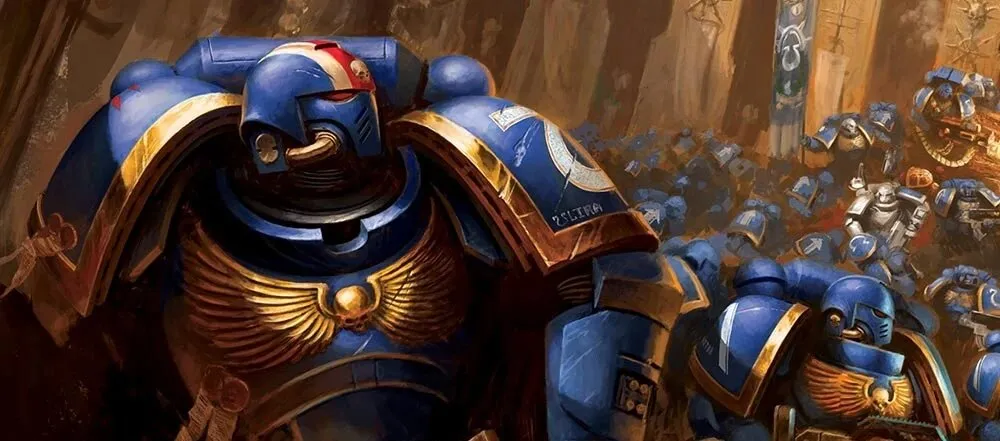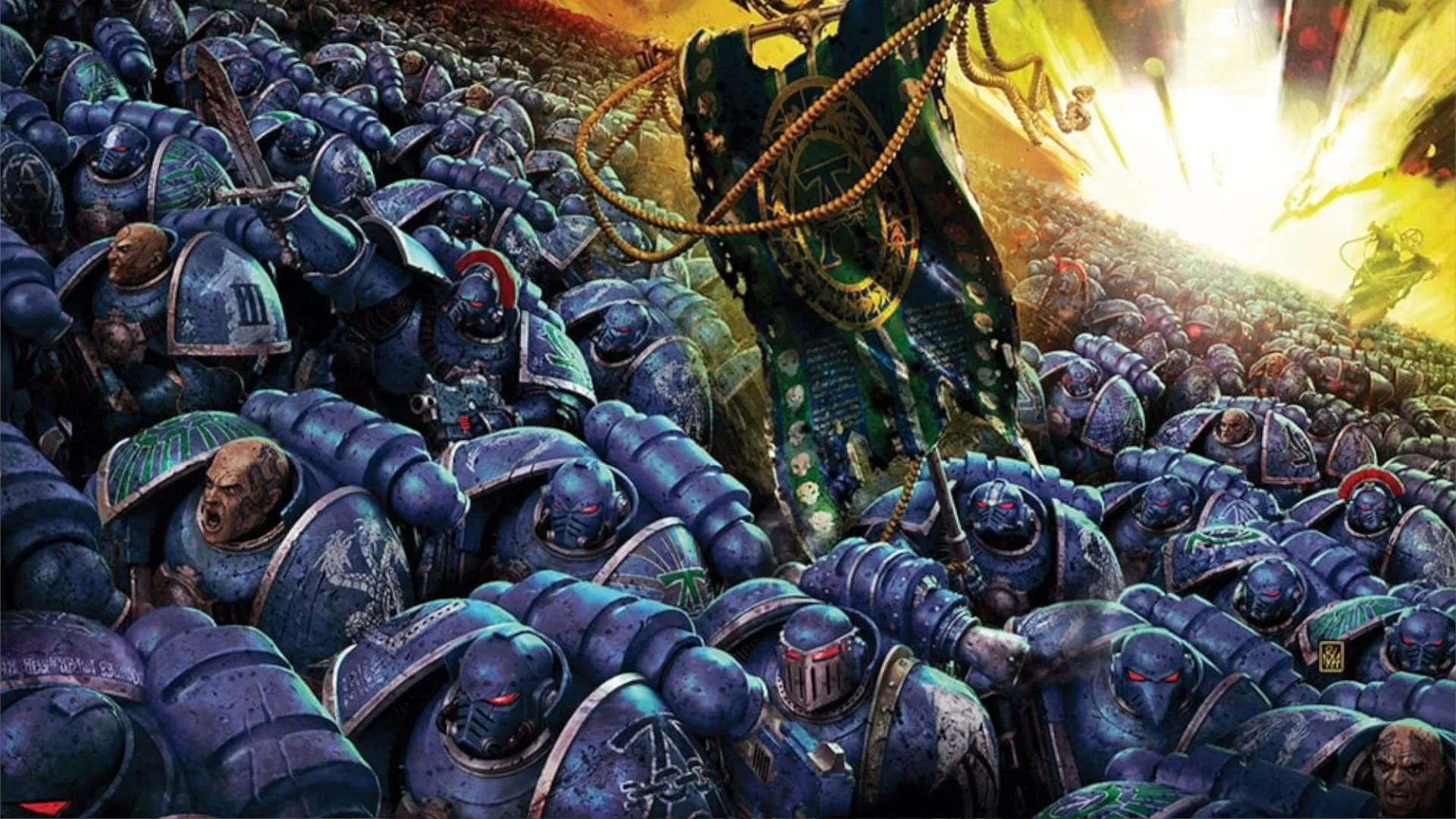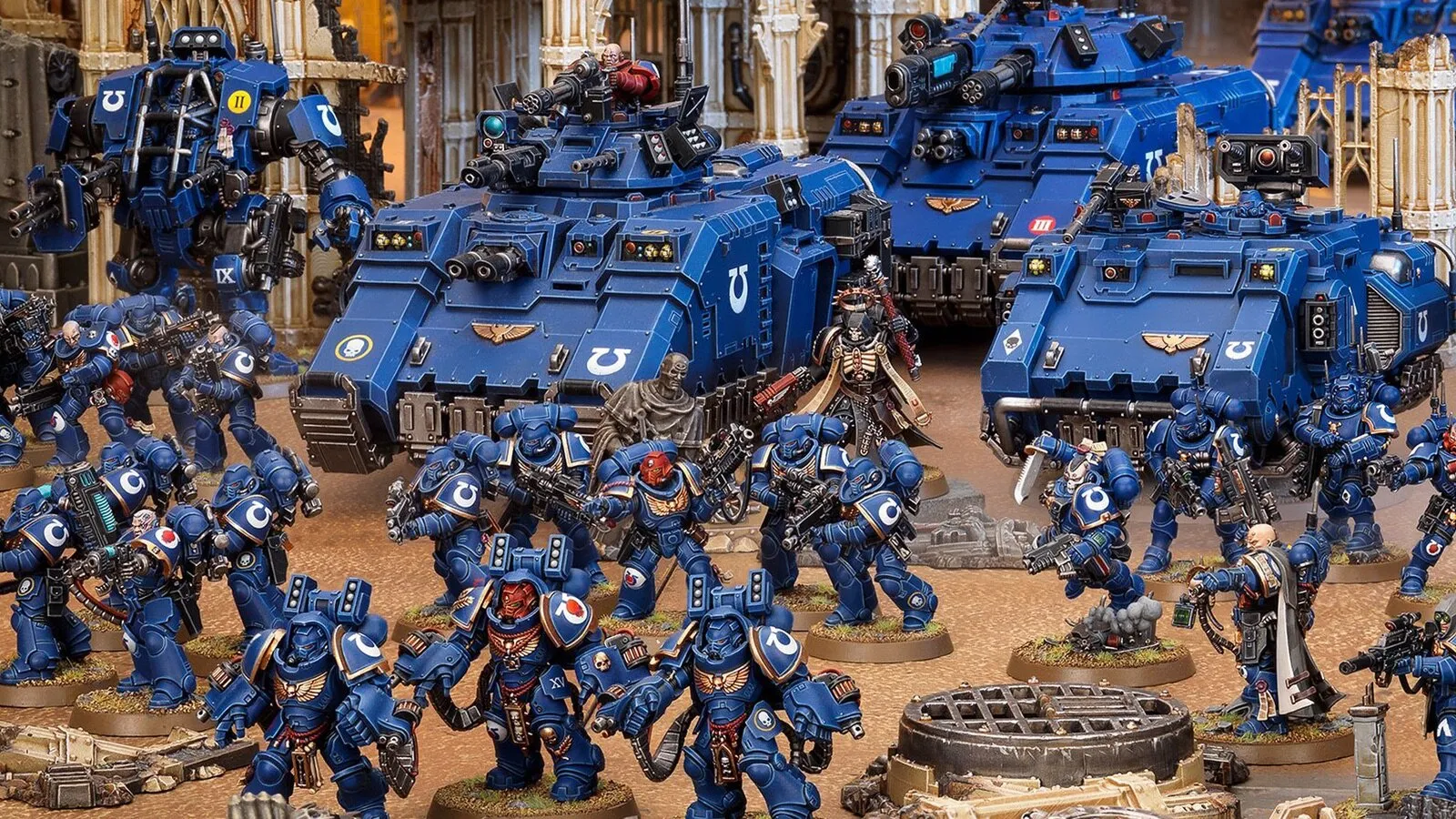
The Ultramarines have a reputation problem. They’re the poster boys. The blue guys on every box. The Chapter that the lore insists is the best at everything. A lot of 40K fans find them boring precisely because they’re presented as the gold standard with no obvious flaws or quirks to make them interesting.
I used to agree with that take. I don’t anymore. The Ultramarines are actually fascinating, but you have to look past the marketing to find it.
Why People Think They’re Boring
The criticism is fair on the surface. The Blood Angels have the Red Thirst and Black Rage. The Space Wolves are Vikings. The Dark Angels are paranoid secret-keepers. The Ultramarines are… organized. Disciplined. Codex-compliant. They follow the rules, they administrate well, and they’re painted in a shade of blue that GW puts on literally every starter set.
In a setting where every other faction has a dramatic flaw or a dark secret, “we’re really good at logistics” doesn’t grab the imagination. And for a long time, GW’s lore made it worse by treating the Ultramarines as objectively superior to every other Chapter, which annoyed fans of every other Chapter.
What Actually Makes Them Interesting
The Ultramarines’ real story isn’t about being the best. It’s about Guilliman.
Roboute Guilliman is the Primarch who wrote the Codex Astartes. He’s the one who broke the Legions into Chapters. He built Ultramar, a 500-world empire within the Imperium that actually functions well (one of the only parts of the Imperium that does). He’s the administrator, the statesman, the Primarch who thought about what comes after the war.
And then he was poisoned by Fulgrim during the Heresy, put in stasis for ten thousand years, and woke up to find that the Imperium had become a nightmare. The secular, rational civilization he’d been trying to build had turned into a theocratic hellscape that worships his father as a god. The Codex he wrote as a practical military guide had been treated as holy scripture. The administrative systems he designed had calcified into bureaucratic monsters.
Guilliman’s return in the current lore is the most interesting thing happening in 40K right now. He’s a rationalist in an irrational empire. He’s a reformer whose own followers resist reform because they’ve been doing things the old way for ten millennia. He’s furious at the Ecclesiarchy but can’t dismantle it because the faith is the only thing keeping billions of people from despair.
The novels do a great job with this tension. In Guy Haley’s Dark Imperium series, Guilliman is constantly navigating the gap between what he wants to do and what’s politically possible. He knows the Imperium needs radical reform. He also knows that pushing too hard, too fast will shatter the fragile alliances holding everything together. There’s a scene where he looks at a prayer to the God-Emperor and has to stop himself from correcting the theology because the people praying need the comfort more than they need the truth. That’s a very human moment from a demigod, and it’s the kind of writing that makes Guilliman (and by extension the Ultramarines) so much more interesting than their reputation suggests.
Key Characters
Guilliman gets most of the attention, but the Ultramarines have a deep roster of characters that add texture to the Chapter. Marneus Calgar, the Chapter Master, held the line for ten thousand years without a Primarch. He was the first to undergo the Primaris upgrade, which is significant because it meant submitting to a transformation he didn’t fully understand on the orders of a returned Primarch he’d never met. Calgar’s willingness to adapt rather than cling to tradition mirrors the Chapter’s broader identity.
Chief Librarian Tigurius is one of the most powerful psykers in the Imperium outside the Grey Knights, and his visions have guided the Chapter through crises that would have destroyed lesser organizations. He foresaw the Tyranid invasions, the Fall of Cadia, and dozens of lesser threats. The lore portrays him as perpetually exhausted from the weight of what he sees, which is a nice parallel to Dante’s exhaustion in the Blood Angels.
And then there’s Uriel Ventris, the Captain of the 4th Company, who’s the protagonist of Graham McNeill’s long-running novel series. Ventris is interesting because he’s an Ultramarine who breaks the rules. He deviates from the Codex when circumstances demand it, gets exiled from the Chapter for it, fights his way back through a Death World and a Chaos-held forge world, and returns a better leader for having learned that rigid adherence to doctrine isn’t always the answer. His arc is basically the argument against “Ultramarines are boring” distilled into one character.
The Ultramarines are interesting because of the tension between what they were supposed to represent (rational, well-organized, progressive) and what the Imperium actually became (authoritarian, stagnant, superstitious). Guilliman’s Chapter is the living embodiment of the Emperor’s failed dream.
Ultramar
The Ultramarines’ home domain, Ultramar, is the best argument for what the Imperium could be if it wasn’t run by incompetents. It’s a collection of about 500 worlds in the Eastern Fringe that Guilliman personally organized. The worlds trade with each other. Citizens have actual rights. The government functions. Infrastructure works.
By Imperial standards, Ultramar is a paradise. By any normal standard, it’s still a military dictatorship. But the fact that it works at all, in a galaxy where most Imperial worlds are dystopian nightmares, says something about what competent leadership can achieve.
The 500 Worlds of Ultramar function as a mini-empire with its own military, its own trade networks, and its own governmental structure that predates the Imperium. Macragge is the capital, but worlds like Calth, Espandor, and Konor each have distinct cultures and roles within the realm. Calth was an industrial powerhouse before the Word Bearers destroyed its surface during the Heresy, and it’s been rebuilt as an underground civilization that still produces materiel for the Chapter. The depth of Ultramar’s worldbuilding is one of the things that elevates the Ultramarines above “generic blue Space Marines.” They don’t just defend a fortress monastery. They govern a functioning civilization, and the challenges of governance are as much a part of their story as the battles.
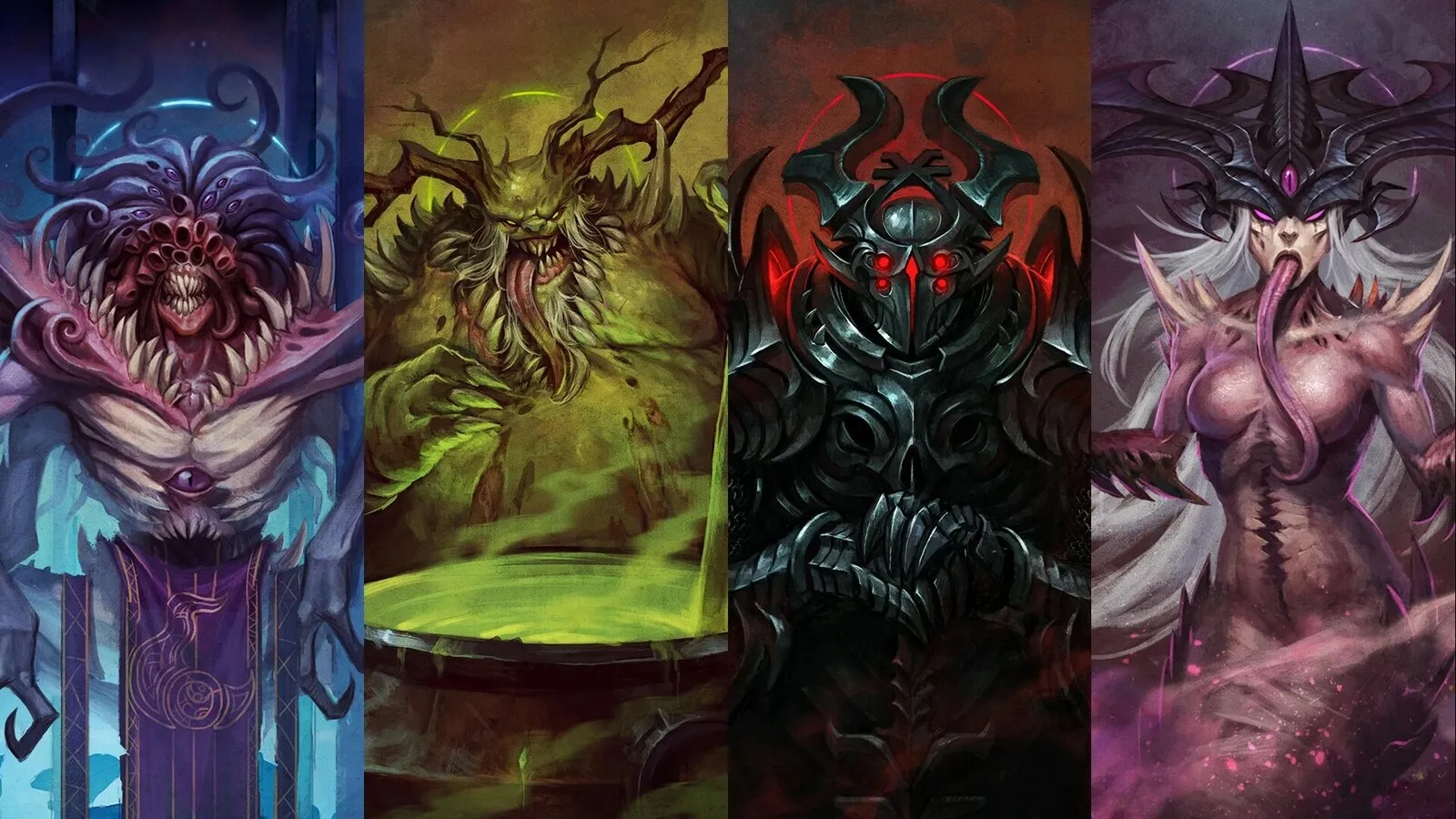
Ultramar was also the site of the Plague Wars, where Mortarion and the Death Guard invaded and nearly destroyed everything Guilliman had built. The Plague Wars weren’t just a military conflict. Mortarion specifically targeted the worlds of Ultramar because he wanted to prove that Guilliman’s dream of a functional, well-governed realm was naive. He spread Nurgle’s plagues across entire systems, corrupted worlds that had been stable for millennia, and turned Ultramar’s own infrastructure against it. The fact that Guilliman had to fight his own brother to defend his home makes the conflict personal in a way that generic “Chaos invades” stories aren’t. And Guilliman’s eventual victory came at a cost that the lore doesn’t shy away from. Ultramar survived, but it was diminished, and some of the worlds that were lost will never be fully reclaimed.
The Battles That Define Them
The Ultramarines have been tested in ways that go beyond standard Imperial campaigns, and two conflicts in particular define the Chapter’s identity in the modern lore.
The Battle of Macragge against Hive Fleet Behemoth is the one every Ultramarine player knows. This was the Imperium’s first major engagement with the Tyranids, and nobody understood what they were dealing with. Behemoth was a full-strength hive fleet bearing down on Ultramar, consuming everything in its path. Calgar committed the entire Chapter plus significant naval assets and Ultramar defense forces to stop it. The space battle above Macragge was devastating. The Ultramarines lost a huge portion of their fleet, and Calgar ordered the remaining ships to ram the hive ships in a last-ditch effort to break the fleet’s cohesion. On the ground, the First Company was deployed in full Terminator armor into the polar fortresses to hold the line. They were wiped out to the last man. Every single Terminator veteran in the Chapter died holding those walls. The Ultramarines won, technically. Behemoth was broken. But the cost was staggering, and the Chapter spent decades rebuilding. The battle established a template that the Tyranids would repeat across the galaxy: even victory against a hive fleet leaves you diminished.
The Plague Wars are the other defining conflict, and they hit differently because Guilliman was there to see what happened to his realm. Mortarion brought the Death Guard into Ultramar specifically to prove that Guilliman’s vision of a well-ordered, functioning society was fragile. Nurgle’s plagues spread through the same efficient infrastructure that made Ultramar work. Trade routes became vectors for disease. Communication networks carried corrupted data. The systems Guilliman had built to connect his worlds became the mechanism for their destruction. Watching Guilliman fight to save a civilization he’d designed, against a brother who wanted to prove that civilization itself was a lie, gives the Plague Wars an emotional weight that most 40K campaigns lack.
On the Tabletop
The Ultramarines are mechanically the most balanced Space Marine Chapter. No extreme specialization, no dramatic weakness. They’re good at shooting, decent in melee, and their Chapter Tactic (which benefits tactical flexibility) rewards adaptable play.
If that sounds boring, consider this: in a game where most armies are built around exploiting one specific strength, playing a balanced army that can respond to anything is its own kind of skill expression. The Ultramarines are the Chapter for the player who wants to win through good decisions rather than good matchups.
They’re also genuinely one of the best beginner armies in the game, and I don’t mean that as a backhanded compliment. When you’re learning 40K, you’re already dealing with a massive rulebook, army-specific rules, stratagems, and a hundred other things competing for your mental bandwidth. Playing a Chapter with a straightforward, universally useful Chapter Tactic means you can focus on learning the fundamentals of the game, movement, shooting priority, objective control, without also having to master a complex faction mechanic. Blood Angels players need to understand charge distances and melee timing. Space Wolves players need to build around specific character synergies. Ultramarine players need to understand the game itself, and that knowledge transfers to every other army you might play later. I’ve watched new players start with Ultramarines, learn the core game, and then branch out to more specialized Chapters with a much stronger foundation than people who started with a complex faction and never learned the basics because they were too busy managing their gimmick.
The blue paint scheme is iconic for a reason. It’s clean, it’s striking, and it photographs well (which is why GW uses it for marketing). If you’re painting Ultramarines, the good news is that blue is one of the most forgiving colors to work with. A base of Macragge Blue, a wash of Nuln Oil or Drakenhof Nightshade to pick out the recesses, then a layer of Calgar Blue on the raised areas gives you a clean, tabletop-ready result without much difficulty. Edge highlighting with Fenrisian Grey is where the scheme really pops, but it’s optional for a good-looking army. The gold trim on the shoulder pads and aquilas takes practice, but Retributor Armor with a Reikland Fleshshade wash handles most of the work. I’ve seen first-time painters produce great-looking Ultramarines because the scheme is so well-documented. There are hundreds of tutorials on YouTube for every skill level, which isn’t something you can say for more obscure Chapters.
If you’re starting your first Space Marine army and you don’t have a strong faction preference, Ultramarines are a genuinely good choice. You’ll never struggle to find painting guides, and the lore gives you a lot to work with once you look past the surface.
Guilliman is back. The Imperium is falling apart. And the Ultramarines, the boring ones, the ones everyone makes fun of, are the faction carrying the weight of the setting’s biggest narrative question: can this broken empire be fixed?
That’s not boring. That’s the most interesting question in 40K.