Some of the people who first fought back on Tallarn were wounded soldiers whose regiments had already moved on. I keep getting stuck on that detail. Visions of Heresy, in its account of The Battle of Tallarn, puts injured personnel in the underground bases alongside the civilians who’d survived the bombardment. There were vehicles in storage beneath their feet, left behind as the Great Crusade pushed farther out into the galaxy. The book describes surviving soldiers and citizens crewing vehicles from those stores.
This week’s Loremasters episode, announced on 20 October, returns to the devastation of Tallarn. WarCom’s description picks out the defensible tunnels, the supplies inside them, and the counterattack against the Iron Warriors. I haven’t watched the episode, so I’m going back through the published campaign accounts here. There’s a lot tucked into those few sentences about the tunnels.
The survival of Tallarn depended on a military supply system built for an earlier war. Its inhabitants inherited enough shelter and equipment to keep fighting after the surface became poisonous. Following the vehicles back down into those stores makes the campaign easier for me to understand, especially the awkward stretch between surviving an attack and having an army that can do something about it.
Tallarn had room below ground
Before the Horus Heresy, Tallarn served as a staging post for the Great Crusade. Visions of Heresy places it near several stable warp routes and describes an unusually considerate piece of Imperial development: most of the military infrastructure went underground, leaving much of the surface alone. The planet had dozens of enormous subterranean facilities. Later, when the Crusade’s front moved away, the stores remained while Tallarn’s military importance declined and its defences thinned.
I like the slightly untidy quality of that arrangement. An army passes through, leaves equipment, changes its priorities, and years later somebody still has responsibility for the buildings. You can imagine the stores expanding through successive campaigns, although the account doesn’t give us the inventory history. I’d happily read several pages about who was supposed to be looking after all those vehicles before the invasion.
The Iron Warriors brushed aside the planet’s light defences and delivered their viral bombardment. White Dwarf #470’s 010–012.M31: The Death of Tallarn describes billions killed and a surface reduced to poisoned organic sludge. The people who reached sealed shelters were left under a world whose atmosphere could kill them. Outside the shelters, the account describes an unbreathable fog of toxins.
The details of the bombardment vary between accounts. Imperial Armour Volume 13’s The Battle of Tallarn includes a subsequent planetary firestorm; Visions of Heresy explicitly says that secondary ignition didn’t happen and describes the lingering toxic atmosphere instead. I’m following the latter account for the campaign sequence. Both versions leave the survivors dependent on sealed shelter and armoured vehicles to operate outside.
Having a bunker could get somebody through the bombardment. Keeping a force active afterwards required the supplies and weapons already housed there. The underground depots held tens of thousands of vehicles, according to Visions, and the early resistance combined surviving soldiers with local people. I’d be guessing if I described how individual civilian crews were trained or assigned their tanks; the campaign summary moves straight to their raids on the Iron Warriors searching above them.
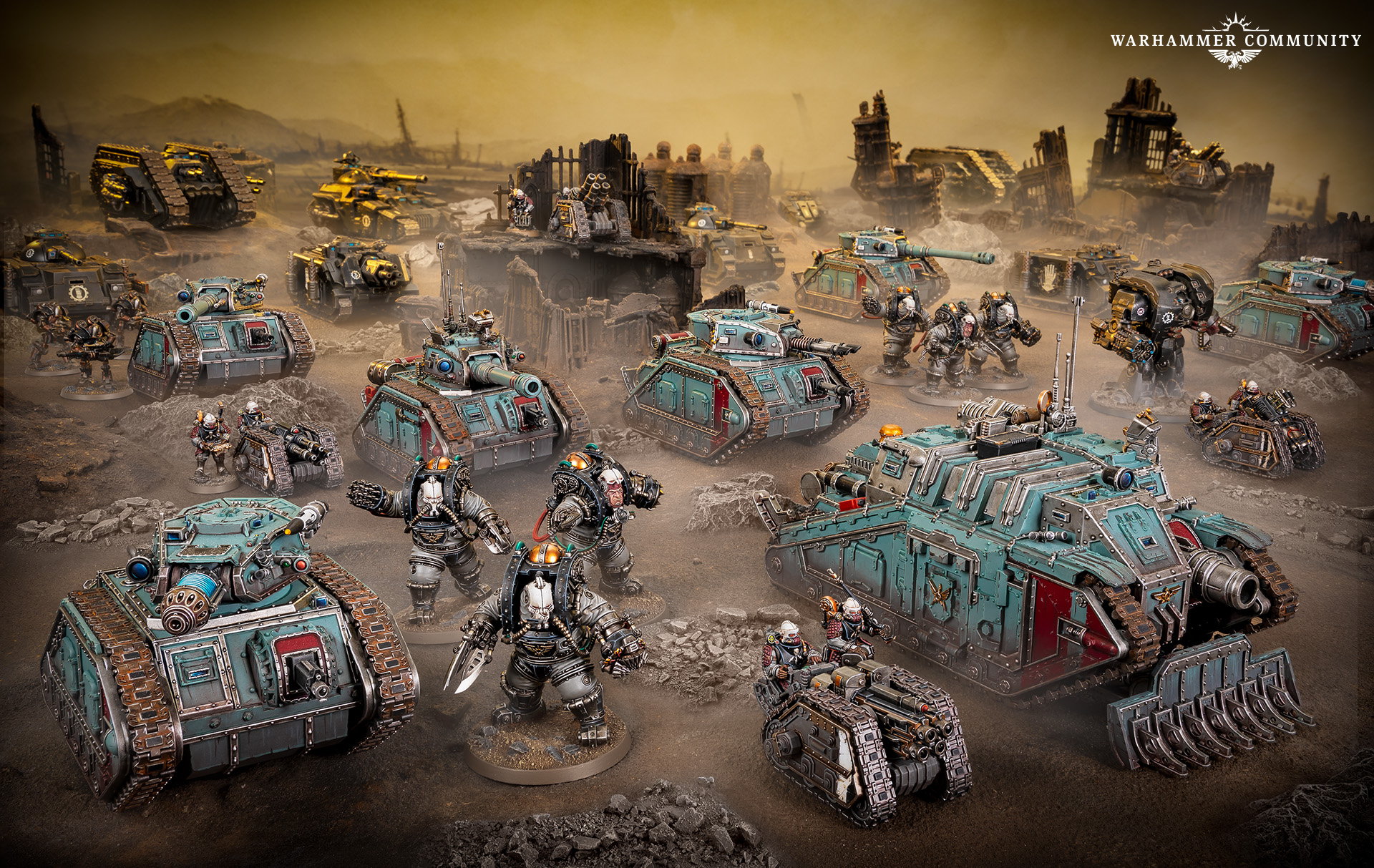
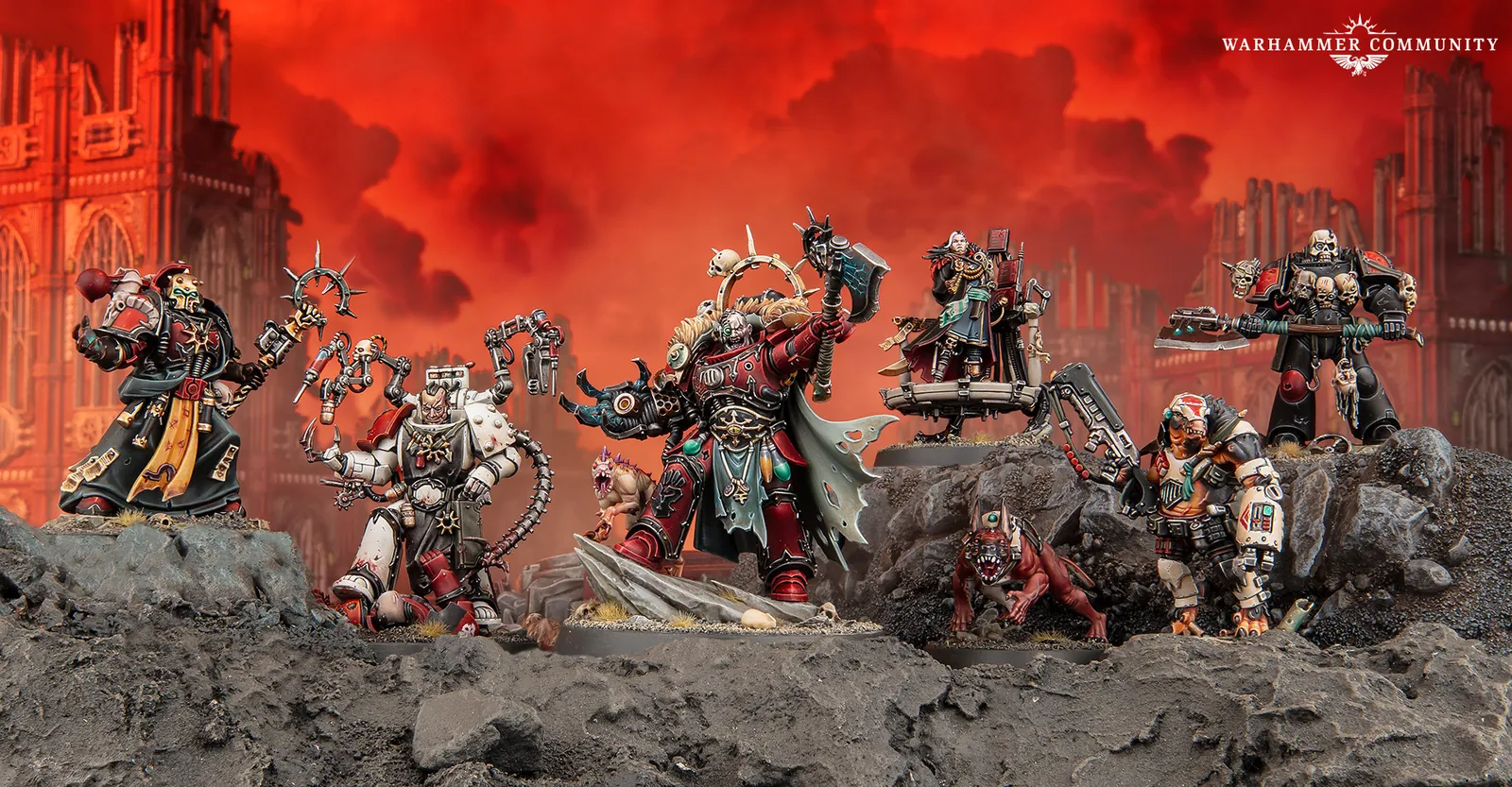
Tallarn forces photographed for Journal Tactica. Image: Games Workshop / Warhammer Community.
Getting a tank out of the shelter
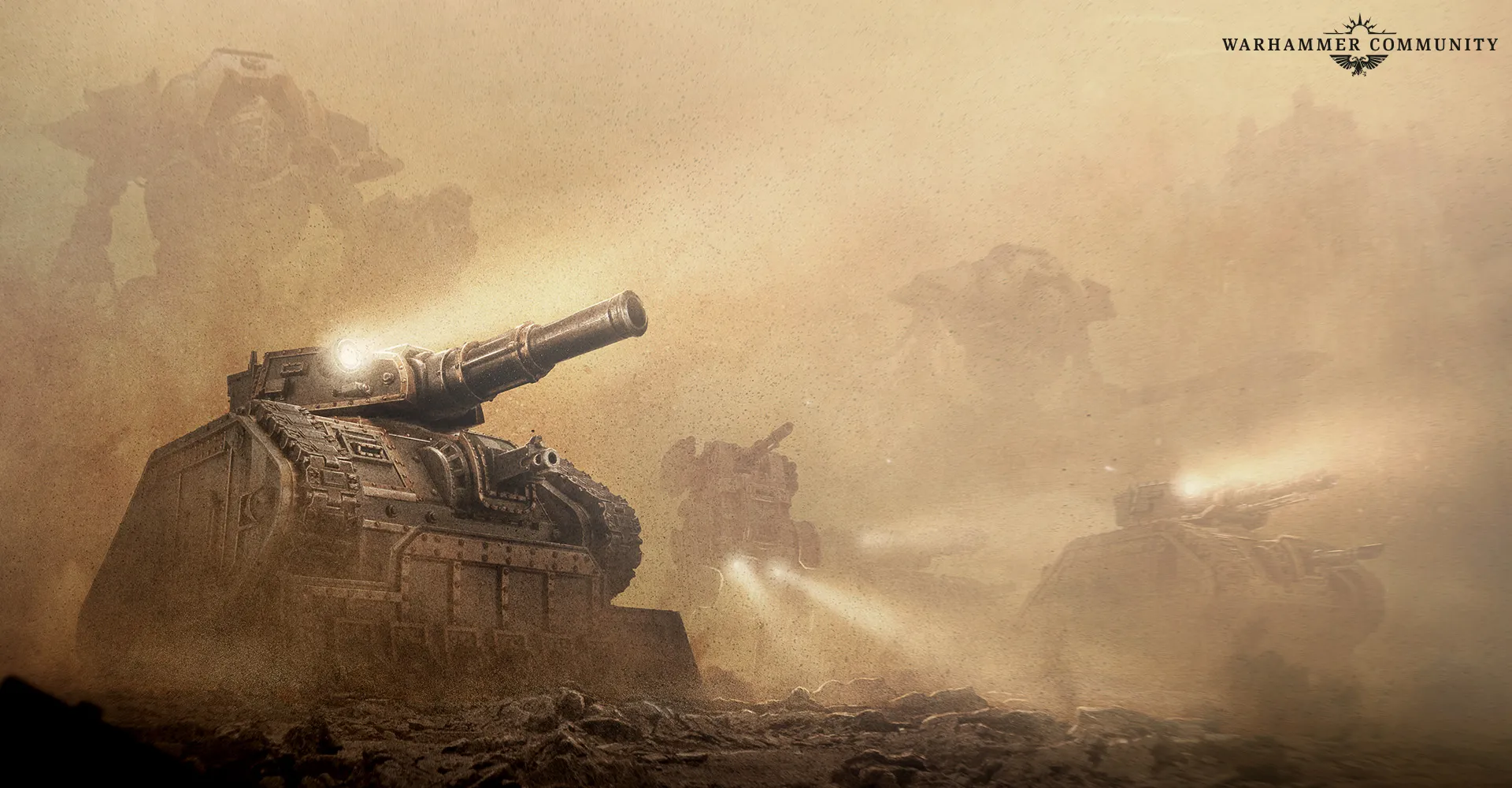
I tend to picture the Leman Russ as a gun with an enormous amount of inconvenient plastic attached. Mine spends most of its time being carried somewhere, taking up space, or waiting for me to finish its commander. At Tallarn, the sealed hull has a more immediate job. A crew can cross ground where exposure outside the vehicle is lethal. White Dwarf #470 describes the loyalists emerging inside tanks and super-heavies, then fighting amid the decomposing remains of the planet’s surface.
That gives damage to a vehicle a horrible extra consequence. A tank crew already has plenty to worry about when the armour gets penetrated. On Tallarn, the air outside is another threat waiting at the breach. Visions eventually describes enormous numbers dying from contaminated air before they can fire. I find those losses harder to take in than the vehicle totals, because they put a limit on how long somebody can simply sit inside a damaged machine and hope for help.
During seventh edition I took my Cadian Russ to a garage game with a turret I’d only dry-fitted. I’d put a little folded bit of paper underneath to stop it wobbling. Halfway through deploying, I picked the tank up by the barrel and left the hull on the table. Pete watched me hold the turret for a second before asking whether the tracks were an optional upgrade. I spent the rest of the evening moving my lovely brick with both hands. The paper shim’s probably still in the turret ring.
Yeah. Tanks. You spend ages making the big lump look heavy, then discover you’ve left a wheel loose or glued a hatch where the gun needs to turn. Mine’s got a commander waiting for his arms. I keep moving him from the painting tray to the tank and back. Must be six months now. Longer than that, actually.
I’m getting less sure how much credit to give Imperial planning as I read. I was ready to praise the underground construction quite extravagantly a few paragraphs ago. Trying to assign credit to whoever kept the place supplied gets awkward when the account also describes its declining importance and weakened defences. I don’t know whether the officials who inherited the depots had been congratulating themselves on the maintenance budget the week before.
GW’s earlier studio introduction to Journal Tactica: The Battle of Tallarn calls the survivors the Tallarn Reborn. It describes their attacks from underground bunkers and the later arrival of reinforcements, including Space Marines. There’s a specific engagement in that introduction that I’d missed when I first read it: Solar Auxilia tanks pose as wrecks, then ambush an Iron Warriors convoy at close range.
The wrecks in Sector Rho
The accompanying Sector Rho:18/19 map is lovely, in the way a diagram of somebody having an appalling day can be lovely. It marks a patrol called Scorn Two-Six entering the canyon, a mine detonation and rock slides, concealed loyalist positions above the route, and an Iron Warriors relief force coming in along the eastern side. The legend identifies reactivated vehicles that had been lying dormant until the initial detonation.
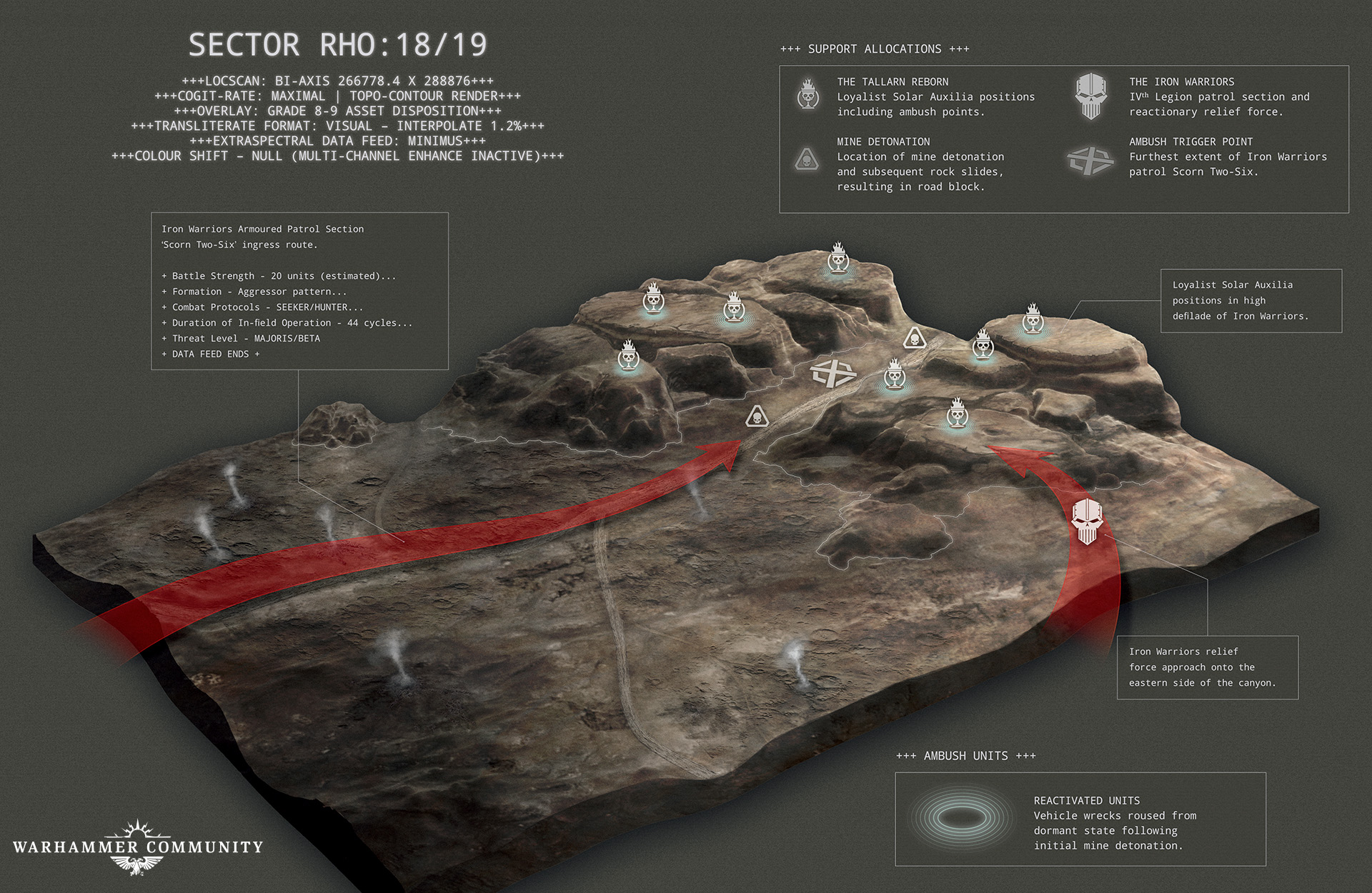
The Sector Rho ambush map from WarCom’s Journal Tactica feature. Image: Games Workshop.
A wreck would be ordinary scenery across a battlefield like that. The defenders could use the quantity of destroyed machinery to help conceal working vehicles, then let the convoy enter a prepared position. The map also includes the arriving relief force, which leaves the ambushers with more to handle after the trap is sprung. I’d want that second approach on the table if I were setting up the fight; it gives the loyalist crews another direction to watch while they’re firing into the road.
My terrain collection would need work. Most of my wrecks are buildings, and the one ruined vehicle I own still has its turret because I couldn’t bring myself to damage it properly. There’s something quite appealing about making a wreck that needs to pass for a usable tank when the scenario calls for it. I’d probably start with removable smoke and leave the hatches alone. That’s a modelling thought, though; I haven’t played this mission or tested how comfortably it fits on my table.
The larger campaign grew out of resistance on that scale. Visions of Heresy describes Tallarn’s last astropath getting a distress call through the Ruinstorm. Reinforcements arrived in increasing numbers. The mixture of incoming formations made command difficult, and Governor-Militant Dellisarius gradually brought some order to the defence. His assassination nearly undid that work before General Gorn emerged to carry it on. The survivors had acquired allies whose operations now needed coordinating across the planet.
More forces kept arriving
White Dwarf #470 places the Death of Tallarn across 010–012.M31 and describes loyalist and traitor forces arriving from hundreds of nearby worlds. Its short account includes tank formations and Titan maniples fighting through the poisoned wastes. The familiar claim that this was the greatest tank battle in Imperial history encompasses a campaign that had expanded well beyond the first local counterattacks.
The Iron Warriors had also come with a purpose that the defenders couldn’t initially see. In the Visions account, Perturabo was searching for the Cursus of Alganar, also called the Black Oculus, a warp gateway. That search put troops on the surface and helped draw him into the escalating fighting. The book leaves his intended use of the artefact uncertain. I’m leaving the gateway there too; explaining every strand around it would take us a long way from the people trying to keep their tanks running.
Gorn eventually committed the loyalist arsenal in a huge attack on the Plains of Khedive. Visions gives the engagement ten million fighting machines of all kinds, with neither side gaining the upper hand. Other summaries use smaller totals for tanks and other armoured vehicles across the campaign, so I’d keep those categories attached to their respective accounts. Even allowing for 40K’s enthusiasm for enormous numbers, assembling that force implies a grotesque volume of ammunition and fuel moving through the surviving infrastructure.
The fighting ended when Horus ordered Perturabo to withdraw, according to Visions. The defenders had sustained their resistance through the arrival of reinforcements, the assassination of their governor, and Gorn’s massed attack. Imperial Armour Volume 13 also credits the hit-and-run methods they developed during the campaign with inflicting heavy losses on the invaders before their withdrawal.
There’s an enormous amount missing between those summary events. How often could a crew go back underground? How much fuel remained in each depot? Who got priority for replacement seals or a functioning engine? I don’t have published figures for any of that. They’re the questions I keep ending up with after reading the accounts, because a year of fighting means repeating all the grubby practical jobs long after the first emergency has passed.
Tallarn’s population continued living beneath the surface into the later setting. White Dwarf #448’s Tallarn entry describes much of the world remaining uninhabitable and most people living underground. The Astra Militarum’s Desert Raiders come from a place whose inhabitants still need those protected spaces. For a little Tallarn board, I’d want a shelter entrance wide enough to take a tank, with worn tracks disappearing down the ramp. I’d have to measure the Russ before building the doorway. I’d leave enough clearance for the sponsons and make the ramp removable.