The red-robed thing working in Hive Secundus has been killed before. Several times, apparently. Hermiatus the Second Son carries on experimenting with Genestealer biology because the Malstrain Patriarch keeps producing versions of the scientist who started the infestation. I keep getting stuck on the practical horror of that: somewhere down there, another pair of hands is being grown to pick up his tools.
GW’s Necromunda roadmap on 23 October promises a return to the Underhells and new Malstrain fighters during 2027. The same announcement confirms that the Roleplay expansion has been cancelled, although its announced miniatures will still reach the core game. We covered the Venator side of that project when it was revealed. The roadmap gives very little detail about the new Malstrain, so the creatures discussed here belong to the established setting; we haven’t seen what the next batch will contain.
Secundus has already had a surprisingly long life in the background. White Dwarf #428’s Underhive, from March 2018, identifies its name with the Genestealer threat on Necromunda. I think the nastiest part is how readily people found reasons to keep using the place once they knew what was living there. The later studio interviews describe expeditions recovering data crystals from the ruined archive.
Hermiatus brought his specimen to Hive Secundus
Before the bombardment, Secundus held an enormous archive. A secret laboratory in a city-sized library sounds like somewhere a Magos could work for a very long time before anyone checked his paperwork. In WarCom’s studio interview, The Fall of the Jewel of Necromunda, rules lead Rob describes knowledge surviving from the Aranean Continuity, the federation that existed before the Great Crusade brought the region into the Imperium. Hermiatus came specifically to use that accumulated learning.
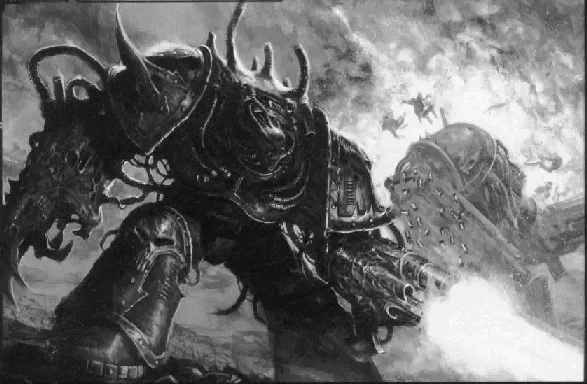
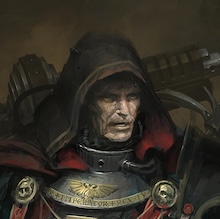
He wanted to cure the Genestealer curse. His captive was held in stasis behind hexagrammatic wards intended to contain its psychic influence, while he extracted genetic material, altered it and introduced it back into the creature. The studio traces Hermiatus himself to White Dwarf #145 and a Space Crusade campaign, back in January 1992. I wasn’t around for that one; finding out this particular disaster had an old board-game villain attached sent me looking for pictures of the original.
The containment began to fail. Psychic influence got through, Hermiatus released his specimen, and the Cult of the Second Son took root. He fled Necromunda under the influence of the Hive Mind and was eventually hunted down and killed. The cult stayed, accumulated strength in secret and became powerful enough to survive the planetary forces sent against it. The interview includes an intervention by the Imperial Fists garrison among the failed attempts to retake the hive.
Then Inquisitor Anneth Vestrix took over. In that account, she judged Necromunda too valuable to destroy outright and ordered the orbital station over the Eye of Selene to bring its weapons against Secundus. Gravitic warheads, nucleonic weapons and other fleet-killing armaments collapsed the hive into a vast crater. A Dust Wall exclusion zone surrounded the area, traffic was forbidden, and Vestrix departed after declaring the planet safe.
The Patriarch survived underground. Damaged reactors and machinery added their own radiation and chemical contamination to the effects of the bombardment, while Hermiatus’s earlier experiments had already altered its biology. Over subsequent generations, the survivors became the Malstrain. That’s the sequence the studio gives: experiments, infestation, a devastating attempt at eradication, then a brood living and reproducing amid the wreckage.
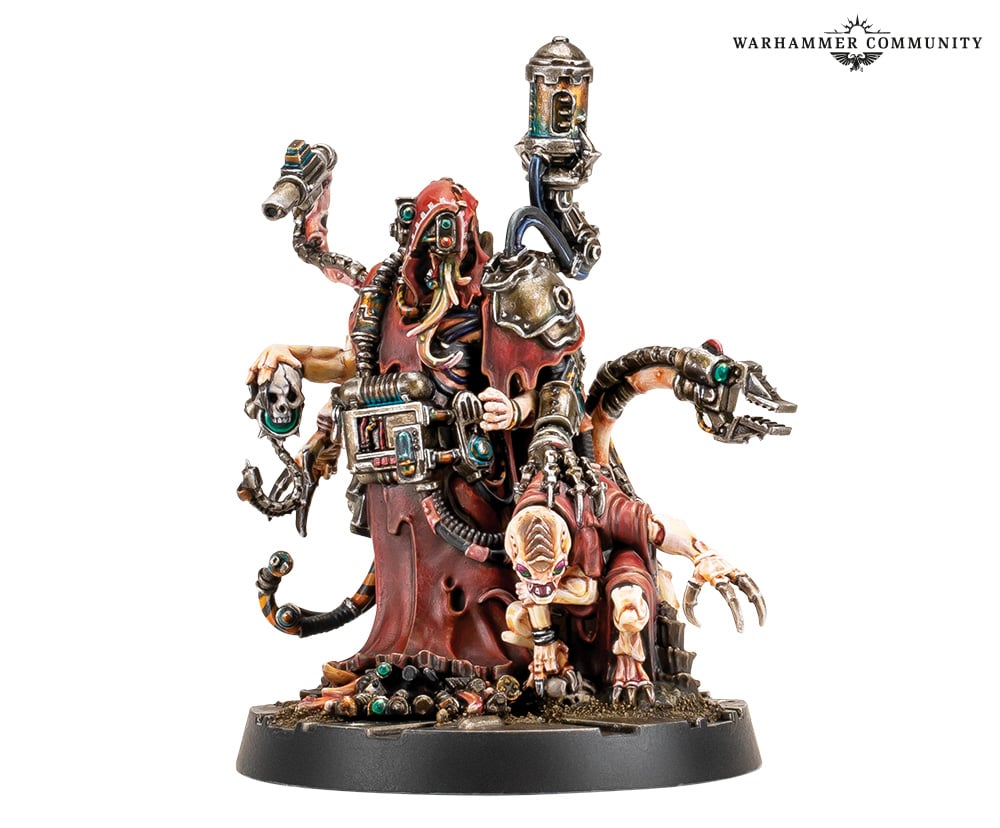
The Malstrain can grow another researcher
The Hermiatus character reveal describes the Second Son as a genetic memory given physical form by the Patriarch. This gives the brood a reconstruction of the executed scientist, with a worrying amount of autonomy to continue his experiments. He acts as a Magus for the cult, teaches his creations and extends the Patriarch’s psychic influence beyond the Underhells.
I don’t know how much of Hermiatus’s remembered personality survives in each version. The designers leave the relationship uncertain too: does the Patriarch regard him as a father, and is his continuing work supposed to cure the brood or drive its changes further? We have a being who can be recreated with enough of the original’s knowledge to resume research, and several names for him, including Hermiatus Reborn and the Hermaphage Magos. I find the ordinary title of Second Son particularly unpleasant when you put it beside all those reported deaths.
So. You kill the scientist. You find the lab. Presumably you burn whatever’s in the jars, because you’ve come this far and the jars are moving. Then somewhere else in the same enormous hole, there’s another scientist. Same general problem. I’d be asking for a second search of the lab, probably while standing in the lift. How long do you wait before you decide it’s empty?
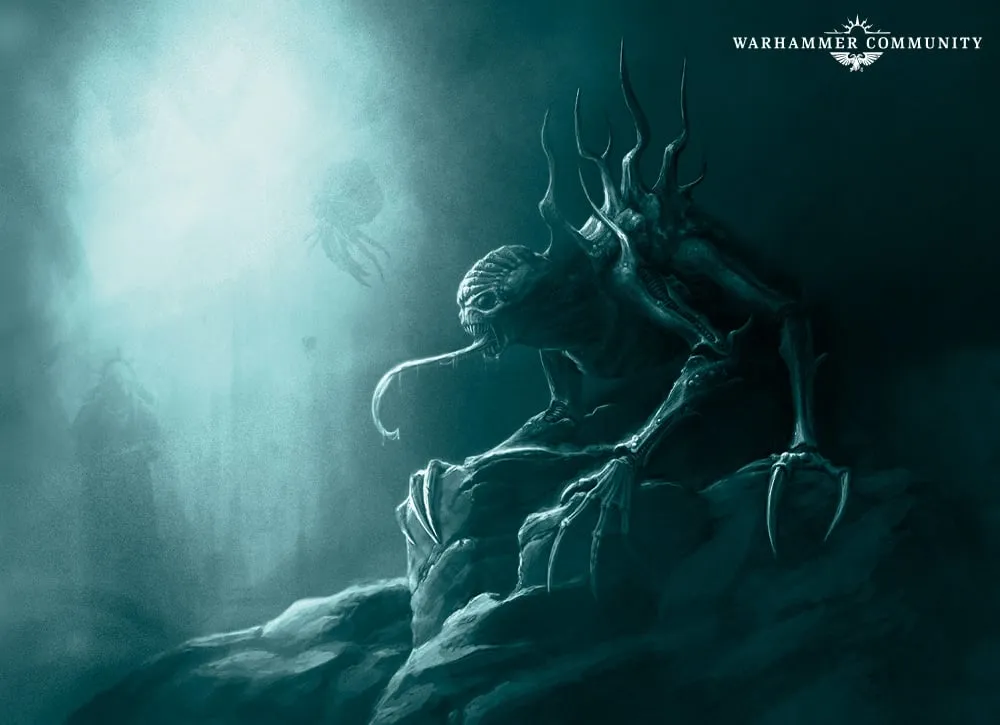
In Undoing Perfection With the Horrors of the Malstrain, the miniature designers discuss asymmetrical eyes, different numbers of claws and missing or additional limbs. They looked at fungal insect parasites and deep-sea creatures, including angler fish. The interview lists irradiation and generations of inbreeding among the causes of the brood’s deterioration.
I keep zooming in on the little creatures accompanying the Malstrain. My Tyranid collection grew out of Leviathan, and the smaller horrible lads are usually the ones I want to paint first. The studio identifies these Tyramites as mutated local insects pressed into the brood’s service, with Brood Scum providing infected human followers. There are several kinds of organism down there participating in the same damaged psychic community.
And the Hive Mind wants nothing to do with it, according to that interview. Rob describes its prospective reaction to a Malstrain beacon as horror, an extraordinary outcome for organisms related to the conventional Genestealer Cults that summon it. He even describes this as Hermiatus having succeeded, in a grotesquely qualified sense, at saving a planet from the curse. Other Genestealer cults on Necromunda also regard the Malstrain as anathema; some descend from infections spread before the brood deteriorated, while others have separate origins.
I initially wanted to cheer that as a rare case of somebody disrupting the Hive Mind’s usual feeding arrangements. I’m still a little pleased by it. Then I remember that everyone surviving within reach of these things has to deal with the actual consequences, including a researcher who can carry the Patriarch’s influence into the wastes. The interview establishes the Hive Mind’s rejection of the Malstrain signal. It gives us very little basis for estimating how much protection that affords the rest of Necromunda, and I wouldn’t trust a safety briefing built around it.
Somebody has to lower the cage
The settlements inside the Dust Wall were cut off along with the infestation. The studio account makes clear that people were stranded there regardless of whether they’d been infected. Survivors consolidated into communities and eventually built the Port Cities around the Abyss. The great cranes hanging over its edge now lower expeditions into what remains of Secundus, with local residents working as ferrymen and guides.
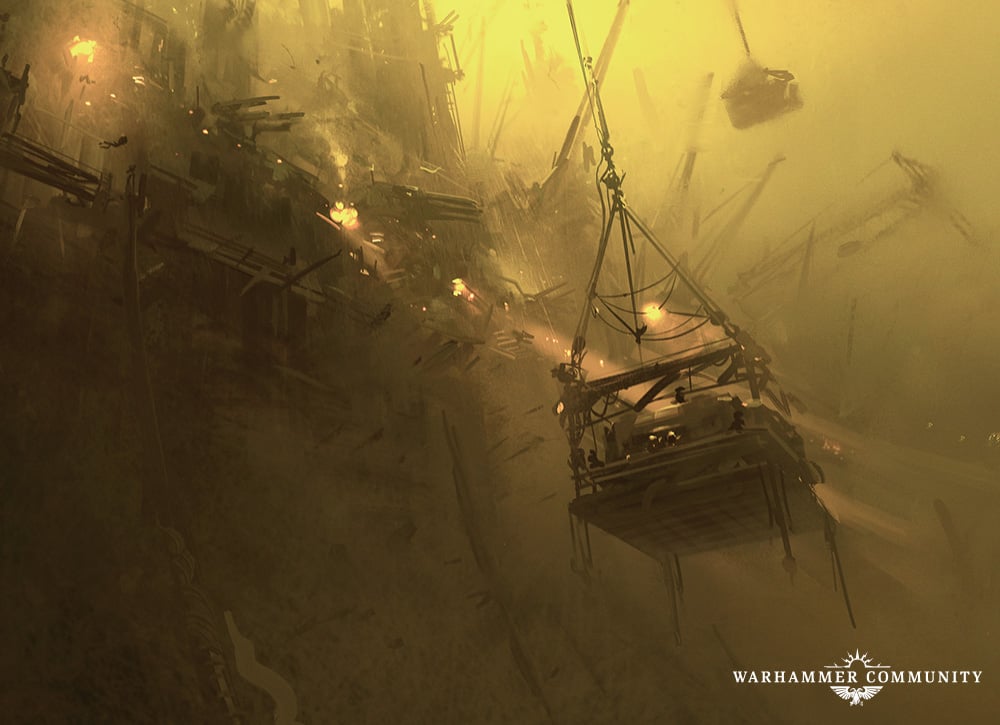
I love that picture of the suspended platforms. In 2024 I spent two evenings putting tiny safety stripes on the underside of a gantry for our local store’s Kill Team board. Zandri Dust, black lines, several corrections with the yellow. Kiran pointed out that the only way to see them during a game was to lie on the floor. I took a photograph with the terrain upside down so I had proof I’d done something, and put it back. The accessible top surface still had a mould line running across it.
The Port Cities have customers because data crystals survived the destruction. A later Lord Helmawr discovered that the exclusion zone contained both a living infestation and fragments of knowledge available nowhere else on the planet. The studio says he concealed the situation from the wider Imperium for fear that the next response would be Exterminatus.
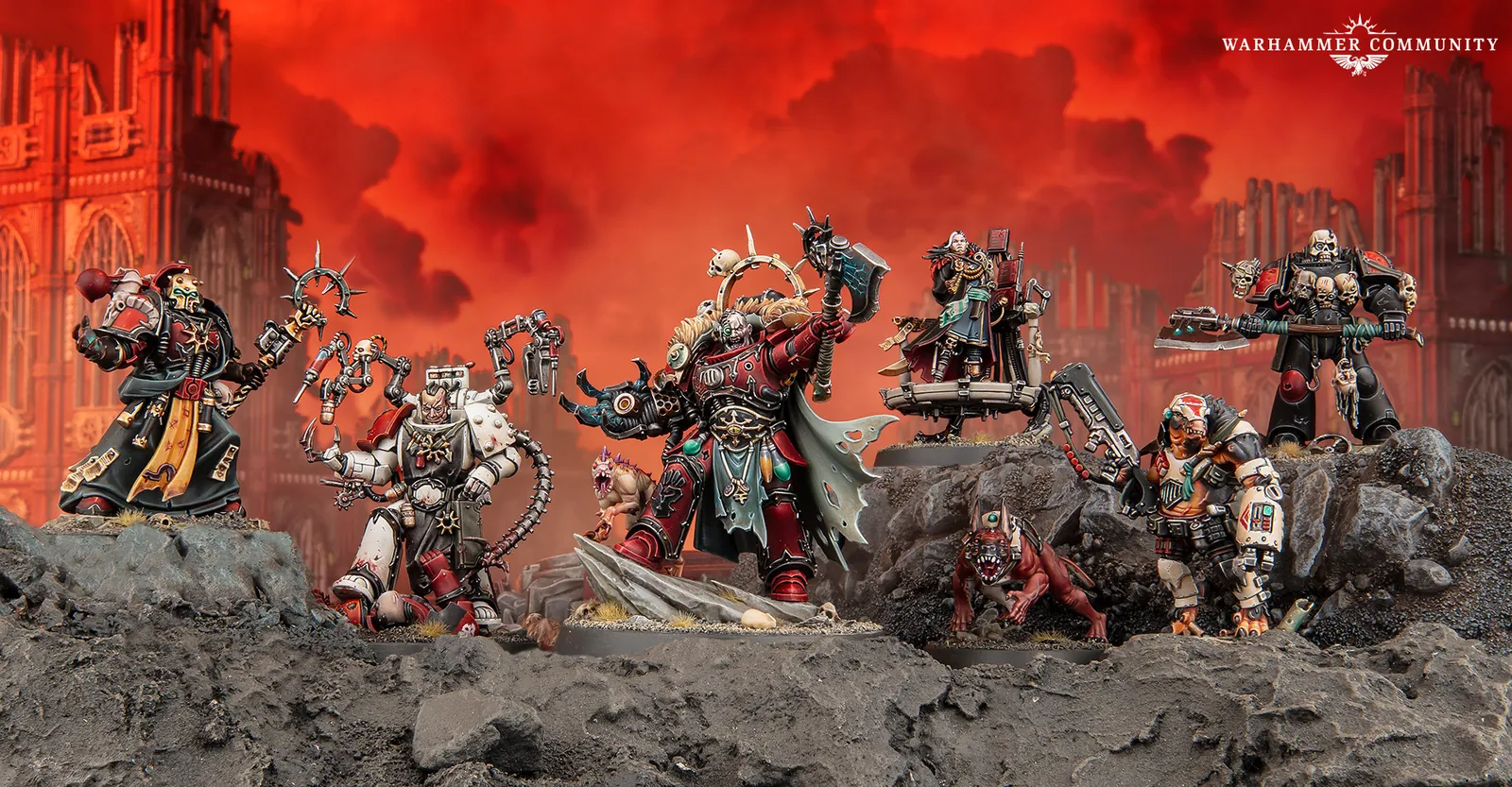
For young nobles, the descent became a rite of passage. They wear Spyrer hunting suits and collect kills to prove themselves worthy of advancement. Van Saar Tek-hunters accompany these expeditions to gain access to the lost archive. They’re hoping to recover knowledge capable of repairing the malfunctioning STC responsible for their house’s radiation problem.
The designers describe the Tek-hunters as beaters for the noble’s hunt, flushing creatures into reach of the Spyrer. I can imagine being grateful for the heavily armed person standing next to me, then watching them pursue something through a doorway while the route back fills up. That’s my reading of the arrangement, obviously. The published explanation is already blunt about how little the hunter cares for the accompanying gang or its salvage.
The whole thing gives the ruins a working population, which is a detail I want more of when GW returns in 2027. Who maintains a crane above a gravitic storm? How many successful trips does a guide need before they can afford to stop? The wider Necromunda setting has plenty of trades that shorten your life. I keep wondering what the operators charge for the return journey, especially if somebody brings back damaged equipment or a dead passenger.
I should give the containment policy some credit. Continuing to cull a surviving infestation while preserving an industrial world full of people is an intelligible decision, and the Port Cities’ inhabitants need trade. I’d probably take salvage money if I lived there. I still struggle with the noble hunting parties: once the expeditions become a route to status, there are powerful people with a reason to keep descending. I’d like to see an account from one of the crane crews before deciding how much of this arrangement actually keeps them safe.
For the coming releases, all GW has confirmed is new Malstrain fighters and another visit to the Underhells. The old studio interview describes Malstrain-corrupted house gangs as the more usual way for this infection to appear outside Secundus; that gives the writers room to follow somebody home from an expedition. I’m curious whether the new material will stay down in the ruins or spend time in those settlements above them. A campaign where your crew has to pay for passage back up sounds expensive enough before anyone starts charging for decontamination.
Images: Games Workshop / Warhammer Community.