The Test of Morkai goes like this. The aspirant is taken hundreds of kilometres into the wastes of Asaheim by the Wolf Priests. He drinks from the Cup of Wulfen. He absorbs the Canis Helix, the first and most violent strand of the Space Wolves’ gene-seed. His bones twist and reform, his canines lengthen into fangs, his nails crack and grow into claws. He’s then expected to keep enough of himself together to walk back to the Fang, on foot, across some of the most lethal terrain in the galaxy.
If he doesn’t, he becomes a Wulfen. He stays in the wild, and future Aspirants on their own Test of Morkai will likely run into him out there years later, still feral, still on Fenris.
That’s the bargain. The 5th edition codex spells it out in the bluntest possible terms: the Canis Helix is “necessary, however, as without this essential part of Leman Russ’ heritage the other gene helices cannot be implanted at all.” You can’t have the rest of the Space Wolves’ gene-seed unless you take the Canis first, and the Canis is the bit that risks turning the Aspirant feral before any of the other implants ever go in.
The chapter’s signature flaw
Every Founding Chapter has a quirk. Blood Angels have the Black Rage. Dark Angels carry the secret of the Fallen. Imperial Fists have a Pain Glove and a tendency to wall up cities. Even my Fists, painted in a slightly dodgy yellow that took me about four editions’ worth of trying to nail (we’ll come back to my paint disasters), have their failure modes baked into the codex.
The Wolves are something else. Their flaw isn’t psychological, it isn’t a buried cult, it isn’t a haemophagic memory of a dead Primarch. It’s chemical. It’s in the helix. Every Space Wolf carries it, every Space Wolf risks tipping over the edge of it, and the same Wolf Priests who induct him are also the ones who’ll be watching him for the rest of his service in case he tips.
The Wolf Priests have been studying this for ten thousand years. The 5th ed codex notes that they’ve “only succeeded in preventing the curse spreading, and it is unlikely that the damage can ever be repaired completely.” Ten millennia of effort and the best they’ve managed is keeping it from getting worse.
Why it only works on Fenris
The Canis Helix isn’t a defective gene-seed that needs fixing. It’s a gene-seed that requires a very specific kind of donor body to even survive the implantation, and for most of 40K’s history that body has to come from Fenris.
The fan-favourite explanation, and one the writers have been gently winking at since the Heresy novels, is that Fenris itself is the answer. There are no actual wolves on Fenris. The “wolves” everyone talks about, the great Fenrisian wolves the Sky Warriors ride into battle, the things in the sagas Leman Russ is supposed to have wrestled, those aren’t a separate species. They’re failed humans. Old colonist stock that mutated into something quadrupedal and toothy after enough millennia of glacial winters, warp storms, and whatever Russ’ own latent genetic legacy might be doing to the planet.
If that’s true, the Canis Helix isn’t transforming a normal human into a wolf-marine. It’s reawakening a strand of canine inheritance that’s been in the Fenrisian population for so long it’s effectively native. Off-world humans don’t have that strand. So the Helix just chews them up, the body doesn’t have what the implant is reaching for, and the change either kills the recipient outright or warps him into a Wulfen on the trip back to the Fang.
Magnus the Red has a line about this, popularised on the back of the recent BoLS piece that’s been doing the rounds: “There are no wolves on Fenris.” It gets quoted as if it’s some smug Magnus mic-drop, but if you take the gene-seed implication seriously, what Magnus is actually saying is the wolves you think are animals are something worse, and your entire chapter is built on top of them.
The Wolf Brothers and the only attempt at a fix
The cleanest evidence that this isn’t fixable is the Wolf Brothers. After the Heresy, when the Legions were broken into Chapters, Russ’ Legion was supposed to spawn successors like everyone else’s. Guilliman’s Ultramarines spun off hundreds of cousins. The Wolves managed exactly one: the Wolf Brothers, given the planet Prasine and a slice of Russ’ bloodline and told to be a Chapter.
It went catastrophically. The Wulfen mutation manifested at scale. The Chapter started turning into a pack of bestial half-Marines so quickly that the Inquisition stepped in, destroyed the gene-seed stores, and gave the survivors a choice between honourable death and execution. According to the Champions of Fenris background, much of the Chapter then vanished into deep space before the order could be carried out, and rumour persists that small bands still fight as renegades on the fringe of the Eye of Terror.
That’s it. That’s the Wolves’ entire successor history for the first ten thousand years. After the Wolf Brothers fell, the next attempt at a Russ-line Chapter doesn’t happen until Cawl shows up at the Fang in M42 with the Wolfspear.
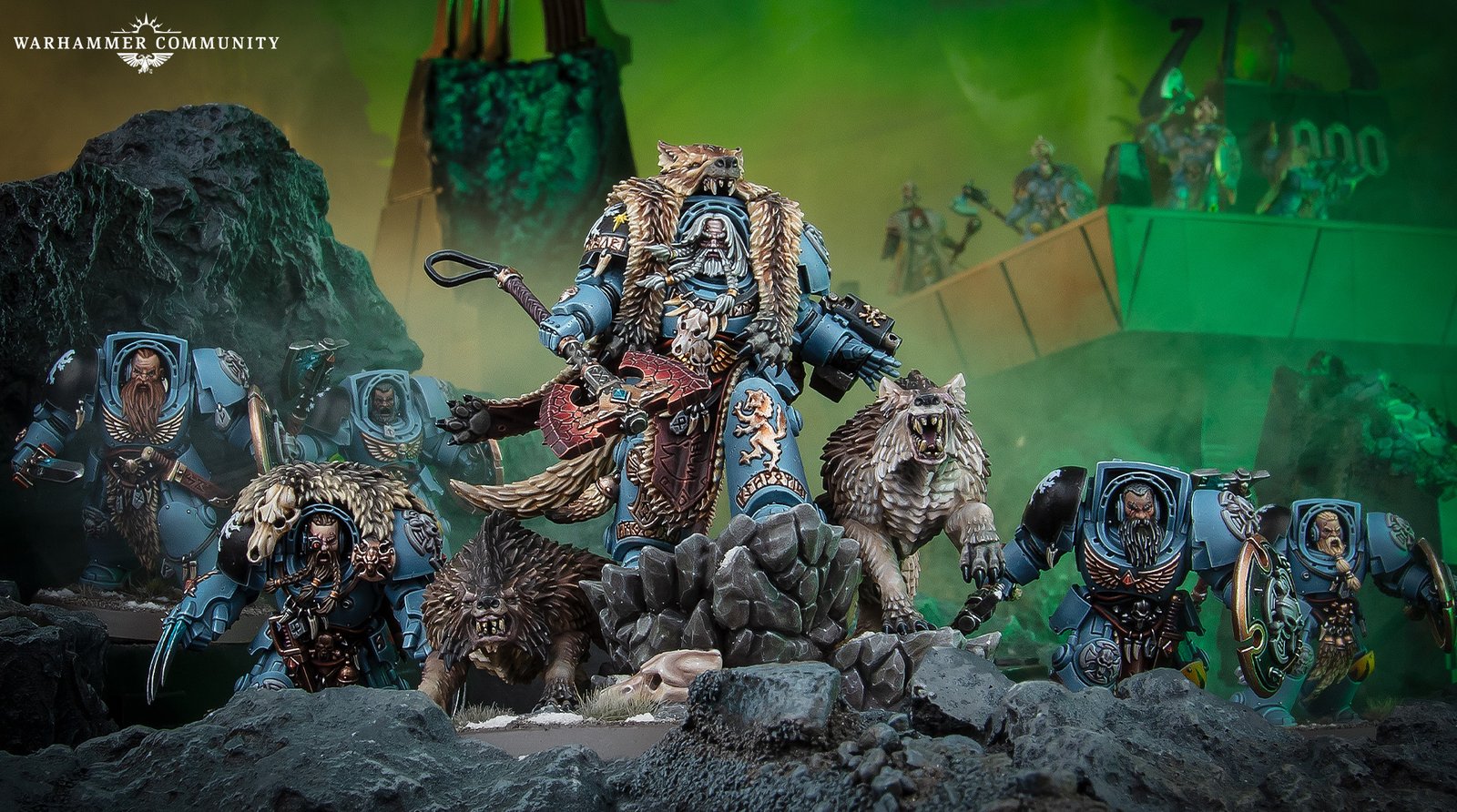
There was a serious attempt to fix it in M32. Thar Ariak Hraldir, the Wolf High Priest of the time, started a project he called The Tempering, experimental Marines bred from a modified Helix, intended to finally stabilise the line. According to the lore in Battle of the Fang (which I read on holiday in a Cornish caravan, and which is genuinely one of the best Heresy-adjacent novels Black Library has put out, fight me), Hraldir was close. Wolf Lord Vaer Greyloc and Great Wolf Harek Ironhelm backed it. Bjorn, yes, that Bjorn, the same Fell-Handed Dreadnought who’s still in the army books, found out, was outraged, and said he’d have destroyed the lab himself if Magnus hadn’t beaten him to it.
Magnus did. The Thousand Sons’ assault on the Fang specifically targeted Hraldir’s lab. Magnus was apparently terrified that a Tempered Wolves Chapter could actually scale. He destroyed the research and the man, and the Wolves haven’t tried it again until very recently.
The pile of grey plastic
This is where I should admit my own connection to all this, which is mostly that I’ve never painted a Space Wolves model and probably never will. My mate Pete, who paints Salamanders at a clip I find personally insulting, finished an entire Thunderwolf Cavalry unit one Christmas because somebody asked him to commission it and he just did it, like it was a normal thing. I have a finecast Logan Grimnar I bought at a charity bring-and-buy in 2014, still in the box, on the second shelf of my display unit behind a half-painted Imperial Fists Land Raider. He has been to three house moves with me. Once a year I take him out, look at him, think about painting him, and then put him back.
The reason I’m telling you this is that the Canis Helix is the kind of lore detail that makes Space Wolves an interesting army to think about even if, like me, you have completely failed to ever paint one. The chapter’s whole identity is built on a bargain. Every Grey Hunter on the table is, by his own Chapter’s rules, one bad day from being a creature the Wolf Priests have to put down or hide.
The 13th Company comes back
In 2016 GW dropped Curse of the Wulfen and the lore changed shape. The 13th Great Company, the original Wulfen brotherhood that had vanished into the Eye of Terror chasing the Thousand Sons after Prospero, started reappearing in the materium. Big, hulking, lupine, wearing scraps of M31-era power armour, kneeling in front of Wolf Lord Harald Deathwolf on the hive world of Nurades and managing to slur out “We are brother. We are Wulfen.”
That’s a hell of a scene. The Warzone Fenris narrative book describes it as Harald walking forward unarmed, eye-to-eye with the alpha, and recognising something of himself in the bestial face he’s looking at. He brings them home. Logan Grimnar’s Coldfang strike cruiser becomes a refit yard. New armour is built, new weapons are issued, and for a brief minute the Chapter thinks this is the omen of Russ’ return.
It isn’t. Or at least, it isn’t only that. Because the moment the Wulfen are aboard ship in numbers, the curse starts spreading. The Grey Hunters watching over them become quarrelsome and aggressive. Bondsmen get killed by Wulfen lashing out at random. Several Space Marines on the Coldfang devolve mid-voyage, indistinguishable from the 13th. Egil Iron Wolf’s auspex reads “biochemical hyperactivity” in his own warriors. Harald Deathwolf, who’d brought the first pack home with grim disquiet, tells Grimnar these Wulfen are a curse.
Grimnar refuses to believe it. He insists the Stormcaller has tested them and found no Chaos taint. He orders the fleet to make warp for Fenris. The Wulfen, he says, will defend their home world at the Chapter’s side.
The point of all this, and the thing the new BoLS piece is gesturing at without quite saying, is that the Canis Helix may not just be unstable. It may be contagious. Close proximity to a fully-devolved Wulfen seems to be enough to push uncorrupted brothers towards the same change. So a Chapter whose flaw is in the gene-seed, whose only successor attempt collapsed, and whose M32 fix was murdered by Magnus has just decided, voluntarily, to bring ten thousand years’ worth of fully-devolved cursed brethren back inside its own fortress and live alongside them.
Even Cawl couldn’t fix it
When the Primaris came online, Ulrik the Slayer apparently asked whether Belisarius Cawl’s modifications might finally close the door on the curse. Cawl’s Primaris gene-seed has a deviation rate of around 0.001%. He’d rewritten enough of the Astartes genome that several gene-seed lineages had their inherited flaws softened.
According to White Dwarf #468, the Wolf Priests ran extensive trials. The result was that even Primaris descendants of Russ still suffer the Curse of the Wulfen. The Wolfspear, the first Primaris successor Chapter from Russ’ line, conduct their own Test of Morkai in the deserts of Zordion or the ice moon of Xindos II, and any of them can still tip over during a fight and stay tipped over. The gene-seed is more stable in basically every other respect, but this one quirk has survived everything Cawl could throw at it.
Which raises a thought I’m not entirely sure how to land. The Wolves themselves, the religiously-minded ones, Ulrik in particular, increasingly read the curse as a feature. Russ wanted his sons to be predators. He left them on a death world specifically because death worlds make predators. The lore-internal explanation for why Cawl couldn’t fix the Helix is increasingly “because Russ wired it that way on purpose,” which is itself a more interesting answer than “Cawl tried and the science was hard.”
I don’t actually know what to do with that. The Primaris fix-it for every other Chapter is presented as a straightforward upgrade. Sanguinius’ boys still rage, but less. The Iron Hands still trend toward augmetic obsession, but their genetic deterioration slows. The Wolves get the same gene-tech and the curse doesn’t budge. It’s either the most stubborn piece of M31 biology in the setting, or it’s something the Wolves’ own gods don’t want fixed. I lean towards the latter most days. Pete, when I floated this in the garage, called it “Wulfen anthropic principle” and immediately went back to painting his Salamanders.
So what about that line
So yeah. Magnus. “There are no wolves on Fenris.” Famous quote. Gets passed around like a Prosperine put-down, the sorcerer rubbing the Wolves’ faces in the fact that their totem animal isn’t real. It’s pointing at something more specific than that.
If the great Fenrisian wolves are degenerate post-human descendants of an earlier failed colonisation, then the wolves on Fenris aren’t wolves and never were. They’re the result of something the Imperium would, in any other context, have torched the planet for. The Inquisition tolerates Fenris because the Wolves win wars on it. The same Inquisition burned the Wolf Brothers’ gene-seed inside a generation of the Heresy.
Magnus watched his own Legion become mutants and got punished for it. The Wolves run a successful version of the same condition, paint it grey, call it sacred, and ride their cousins into battle. Magnus has been telling anyone who’ll listen for ten thousand years, from his exile in the Planet of the Sorcerers, and nobody on Terra is going to admit he has a point.
Anyway. None of this is going to make me paint that Logan Grimnar.