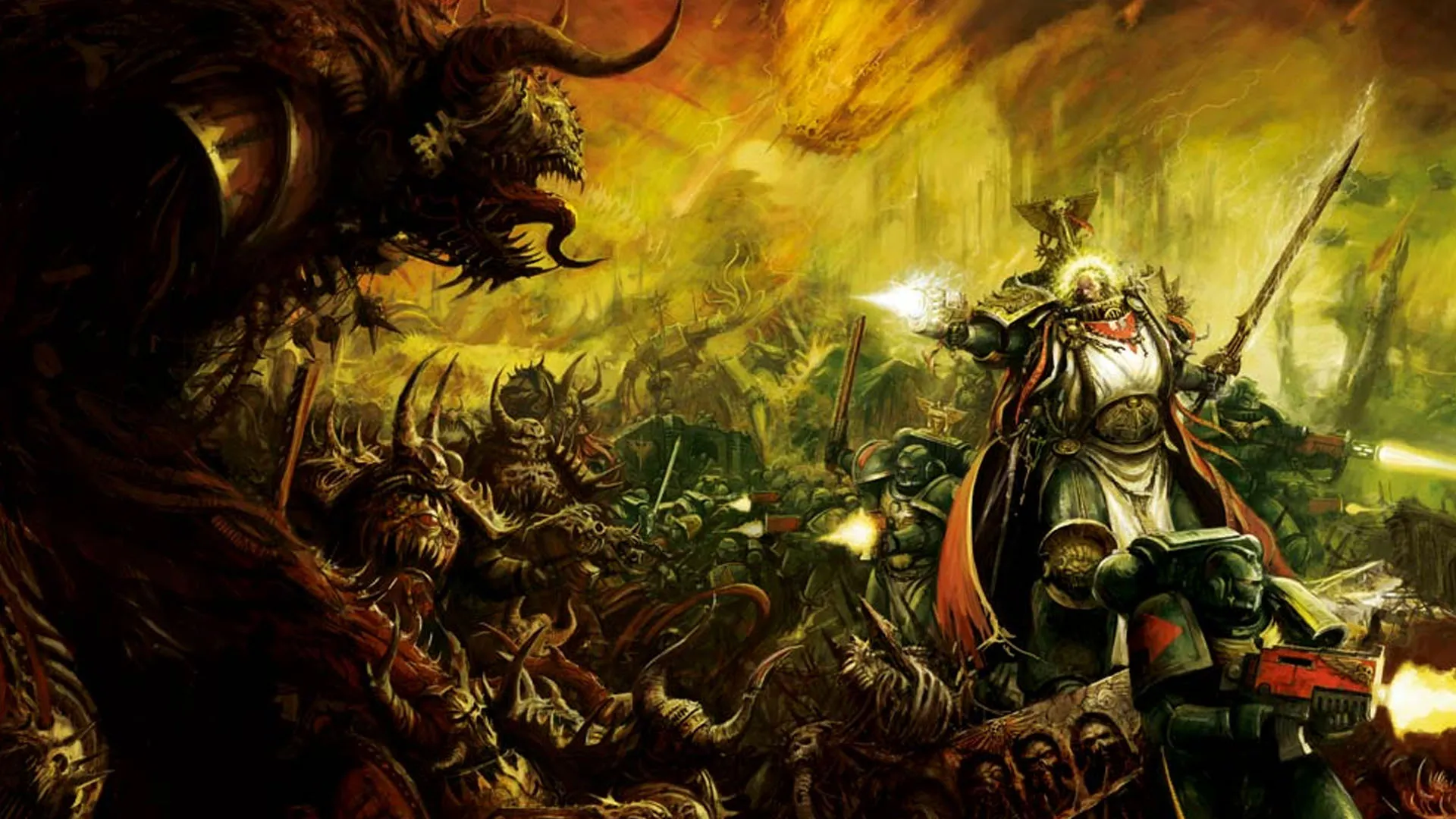
Roboute Guilliman walks through the Eternity Wall spaceport for the first time in ten thousand years, and the first thing he sees, written into the architecture of his father’s palace, is himself. Stained glass a mile high. Haloed. Codex Astartes in one hand and a severed daemon’s head in the other. A giant in a crowd of angelic worshippers. Sanguinius beside him. Vulkan beside Sanguinius. The Khan riding a comet between the stars. Guilliman looks up at his own face and Fulgrim’s voice from a parade ten millennia earlier comes back to him: all of Humanity would worship him as a living god. Guilliman must never come to believe it himself.
That scene is from The Gathering Storm: Rise of the Primarch, the supplement that brought Guilliman back in 2017. I think about it a lot. It’s the single most efficient piece of writing about what the Imperium did with its loyalist primarchs while they were dead or absent or asleep. They built a religion out of them. The architecture of Terra is now full of cathedrals to men the Emperor explicitly banned anyone from worshipping. Even Sanguinius gets his own window.
So the question r/40kLore is currently chewing on, in a thread climbing the front page this week, is whether any of that worship is doing anything to the loyalist primarchs. We know it works for the traitors. Pray to Khorne, get a stronger Angron. Pray to Nurgle, get Mortarion in his bloated glory. Their power has a clear vector and a published mechanism, and Black Library has spent twenty-odd novels showing the gears turning.
The loyalist side is supposed to work differently. The Imperial Truth was emphatically secular. The Emperor told Lorgar, in the most public way possible (by ordering Guilliman to burn the city of Monarchia to ash), that no one was to worship him. The Lectitio Divinitatus was banned. Guilliman himself burned every copy he could find after the Heresy. The reason for that ban is the part nobody at the time understood. Gods in 40K are powered by belief. The Chaos Gods are literally what mortal emotion does to the warp. The ban was tactical. Aiming worship at the Emperor would, over enough centuries, construct a fifth warp entity out of human prayer.
Worship isn’t optional anymore. The Ecclesiarchy is the largest organisation in the Imperium. Saint Celestine is a warp-empowered miracle who keeps coming back from death because enough people believe she’s holy. The Living Saints are a documented mechanism, not just flavour. Faith makes flesh is a Sisters of Battle rule that has been on datasheets across several editions. The loyalist primarchs sit at the top of that same pyramid. Their statues outnumber the statues of any individual saint by orders of magnitude.
Sanguinius is the most obvious case
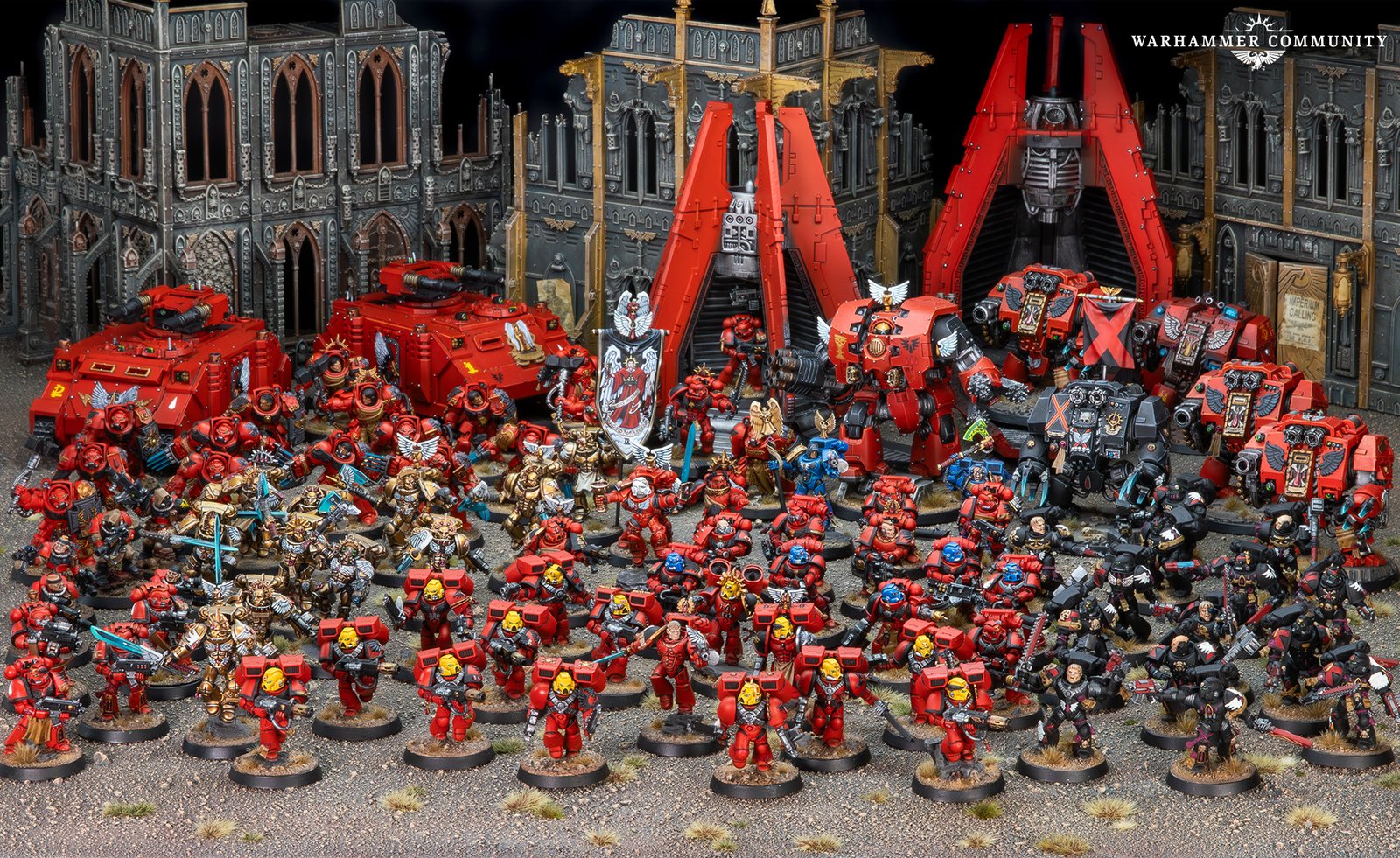
Sanguinius died on Horus’s barge. We’ve all read or watched or audiobooked our way through that moment. But his death is the strangest one in the Heresy because his sons haven’t behaved as though it took. The Sanguinor (the golden figure who descends in the Blood Angels’ most desperate moments, slaughters enemy champions, and vanishes) has been around since the chapter’s founding, and nobody, not even the chapter’s own Chaplains, will say definitively who or what he is. Shield of Baal: Exterminatus describes him as “a mythic icon of the Chapter… a being shrouded in mystery.”
There are competing theories. The Sanguinor might be a glorified Sanguinary Guard. He might be a manifestation of the chapter’s collective faith in their primarch. He might be Sanguinius’s spirit, returned. There’s a strong fan-theory reading, picked up by some Black Library writers, that ten thousand years of Blood Angels venerating their primarch has spun off a kind of revenant. A psychic echo dense enough to fight a Greater Daemon and win. The Blood Angels are also explicitly one of the most psychically gifted chapters in the entire Astartes, and their gene-seed carries the trauma of Sanguinius’s death directly. The Black Rage gets passed down through gene-seed inheritance, brother to brother, all the way back to the moment Horus put a sword through Sanguinius’s chest.
If that’s not “worship-empowered residue of a dead primarch,” I don’t know what would count, and the codex has never volunteered another explanation.
Reading the Blood Angels codex for the first time, I think it was the 5th edition one in 2010, I remember being annoyed by the Sanguinor entry. The way it was written. His identity is unknown, even to the Blood Angels themselves. That felt like a cheat. I was nineteen and I thought codices were supposed to answer questions. I’ve come round on this since. The Sanguinor is the chapter’s collective belief in their primarch given enough warp-pressure to manifest. Black Library writers nibble around the edges of this in newer Blood Angels novels, but the codex itself stays vague.
Vulkan’s whole deal is that he doesn’t stay dead
Vulkan was tortured to death repeatedly by Konrad Curze during the Heresy. Visions of Heresy lays it out plainly: “Curze discovered before Vulkan himself that the XVIII primarch was effectively unkillable, and bent all his twisted intellect to tormenting his brother, slaying him over and over again, and becoming increasingly enraged that he simply would not die.” That’s a primarch with literal in-universe immortality. And it cannot be a coincidence that the Salamanders run a chapter cult, the Promethean Cult, built around veneration of his teachings. The Cult has fire as symbol, hammer and anvil as sacraments, ritual scarring, oaths sworn over forge-flame, and a multi-volume scripture called the Tome of Fire that the chapter is still hunting down lost volumes of.
Vulkan is the only loyalist primarch with explicit in-universe immortality. The Salamanders are the chapter that organises its internal hierarchy around his sayings, runs forge-rituals as sacrament, and treats the Tome of Fire as scripture.
Pete — the one mate at my garage group who paints Salamanders, he’s been at them for over a decade and his army is the cleanest in the room — asked me once whether I thought Vulkan’s immortality was a gene-seed quirk or a faith mechanic. I genuinely don’t know. GW publishes both readings of him in different books and refuses to pick one. Pete reckons faith. I think Pete just likes the idea because it makes his army cooler. He’s probably right anyway.
The Lion woke up and nobody knows why
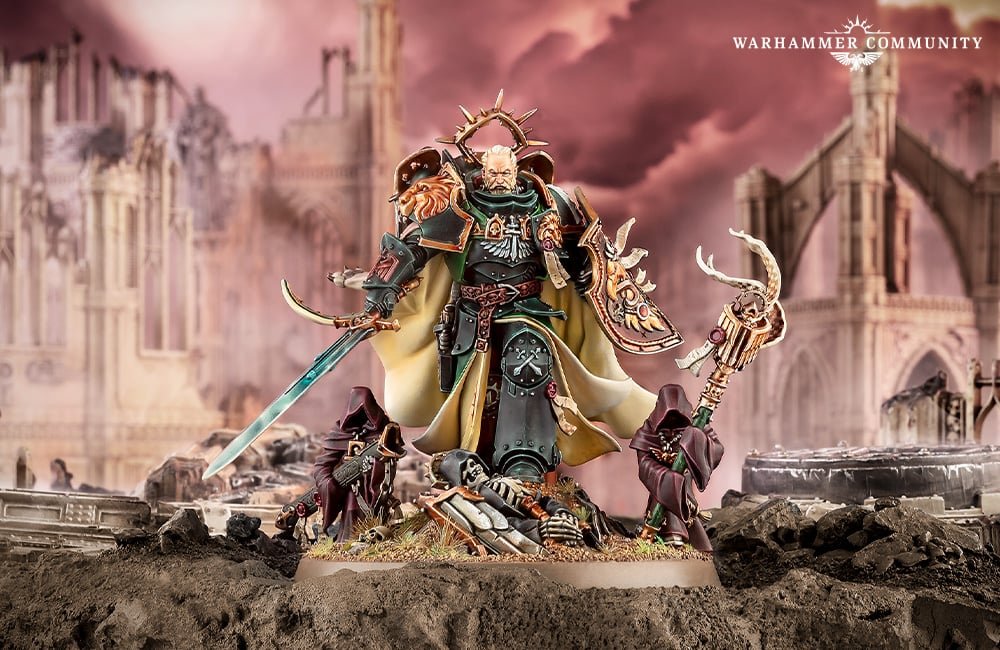
Lion El’Jonson came back to the Dark Angels during the Era Indomitus. White Dwarf #488 prints it directly: “What force woke him? Who set his feet upon the mist-wreathed paths of an otherworldly forest beyond the veil of reality? To these questions, even El’Jonson himself had no answers.”
A primarch who admits, in his own lore, that he has no idea what woke him up. And the same article notes that “day by bloody day, Lion El’Jonson grew into a figure of mythological proportions upon countless benighted worlds.” His return mythologised him further. He woke up during a period when the Dark Angels were in the deepest doctrinal crisis of their history, fighting daemons inside the Rock itself in Imperium Nihilus.
The reading I find most credible is that ten thousand years of Dark Angels vigil (the Inner Circle keeping watch on the Rock, the Watchers in the Dark performing rituals nobody outside the chapter understands, every Interrogator-Chaplain whispering the Lion’s name into the dark) finally pulled him through the veil. The Dark Angels have been waiting for the Lion for ten thousand years. That is the same kind of focused, ritually structured belief the warp converts into power on the Chaos side, and the lore has never said in print that the mechanism only runs one direction.
I’ve been arguing this reading at my local store for years, mostly to bored opponents waiting for me to deploy my Imperial Fists. Most of them have stopped engaging. There’s a particular look people give you when you start talking about emergent psychic phenomena over a half-painted Devastator squad.
Guilliman is the only one who’s noticed
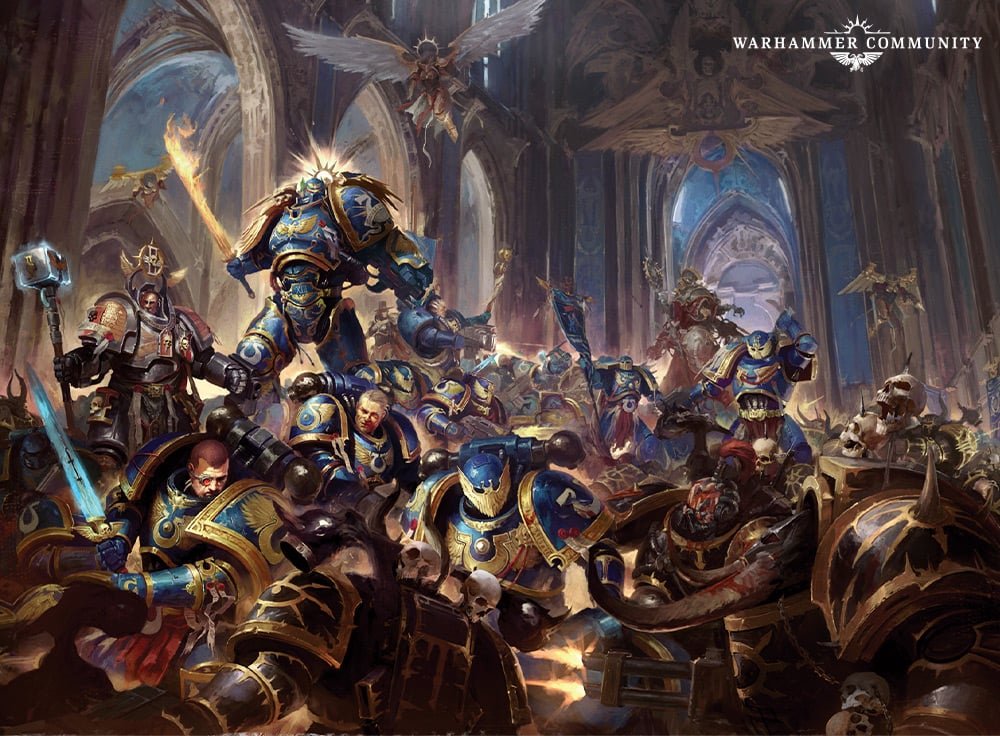
The thing that makes this interesting at all is that Guilliman, of all the loyalists, has clocked it. He’s spent every novel since Dark Imperium deeply, visibly uncomfortable with what’s been done to him. Guy Haley’s Plague Wars has the scene where he sits down and actually reads the Lectitio Divinitatus for the first time. Lorgar’s book. The one he banned. It’s described as a “memetic virus” he could not stop. The thoughts were out, a memetic virus spread from mind to mind. It had no cure. He banned the book in M31 and then sat down to read it in M42, almost ten thousand years late.
His own armour is the joke. The Armour of Fate was crafted in part by Belisarius Cawl and infused with the power of a newborn Aeldari god, delivered through an alliance with Saint Celestine and Yvraine of the Ynnari. Guilliman walks around in armour that is part Mechanicus tech, part warp-creature, part Eldar god. His sword is the Emperor’s Sword, blessed by his father’s psychic might. He is, in the most literal sense, a religious icon being kept alive by religious objects. I picked up Plague Wars at a charity shop in Greenwich for £4 last summer and have re-read the Cawl chapters three times since.
The 1d4chan summary of his post-resurrection mood is harsh and probably accurate. He’s disillusioned with his “dad,” disgusted by the Ecclesiarchy (he openly told an Ecclesiarch’s representative he considered them a lesser evil), and disappointed with the state of the Imperium as a whole. Saint Celestine and Inquisitor Greyfax have apparently convinced him to tolerate the Imperial Cult for now. He knows the Imperial Cult is wrong by his father’s standards. He also knows dismantling it would cause a civil war the Imperium can’t survive.
Whether the worship is doing anything to him is a question nobody asks Guilliman in print. Dark Imperium, Plague War, and Godblight don’t frame it that way. Neither does the Indomitus campaign material. Neither, presumably, does the next Ultramarines codex.
What about the Khan, Russ, Corvus
Quick admission. I don’t know where the other missing primarchs are in this. Jaghatai rode into the webway and never came back. Russ went on the Wolf-King’s hunt, and his return has been teased every codex cycle since 3rd edition with nothing to show for it. Corax tried to fix the Raven Guard gene-seed, failed, and walked into the warp alone to become whatever he became. None of them have returned in 10th edition lore, and there’s no clear evidence their chapters’ faith is doing anything to them.
But the loyalists we can see are suggestive. Vulkan won’t die. Sanguinius left a psychic echo behind. The Lion came back to a chapter that had been waiting for him. Guilliman is walking around in armour built by a saint, a tech-priest, and an Aeldari god.
GW has never confirmed the Sanguinor theory. They’ve never confirmed what woke the Lion. They’ve never explained why Vulkan won’t die. The lore keeps the question open, which means the loyalist primarchs sit permanently in the gap the Imperial Truth was supposed to close. Guilliman’s books read like he knows. The next codex will probably keep him quiet about it.