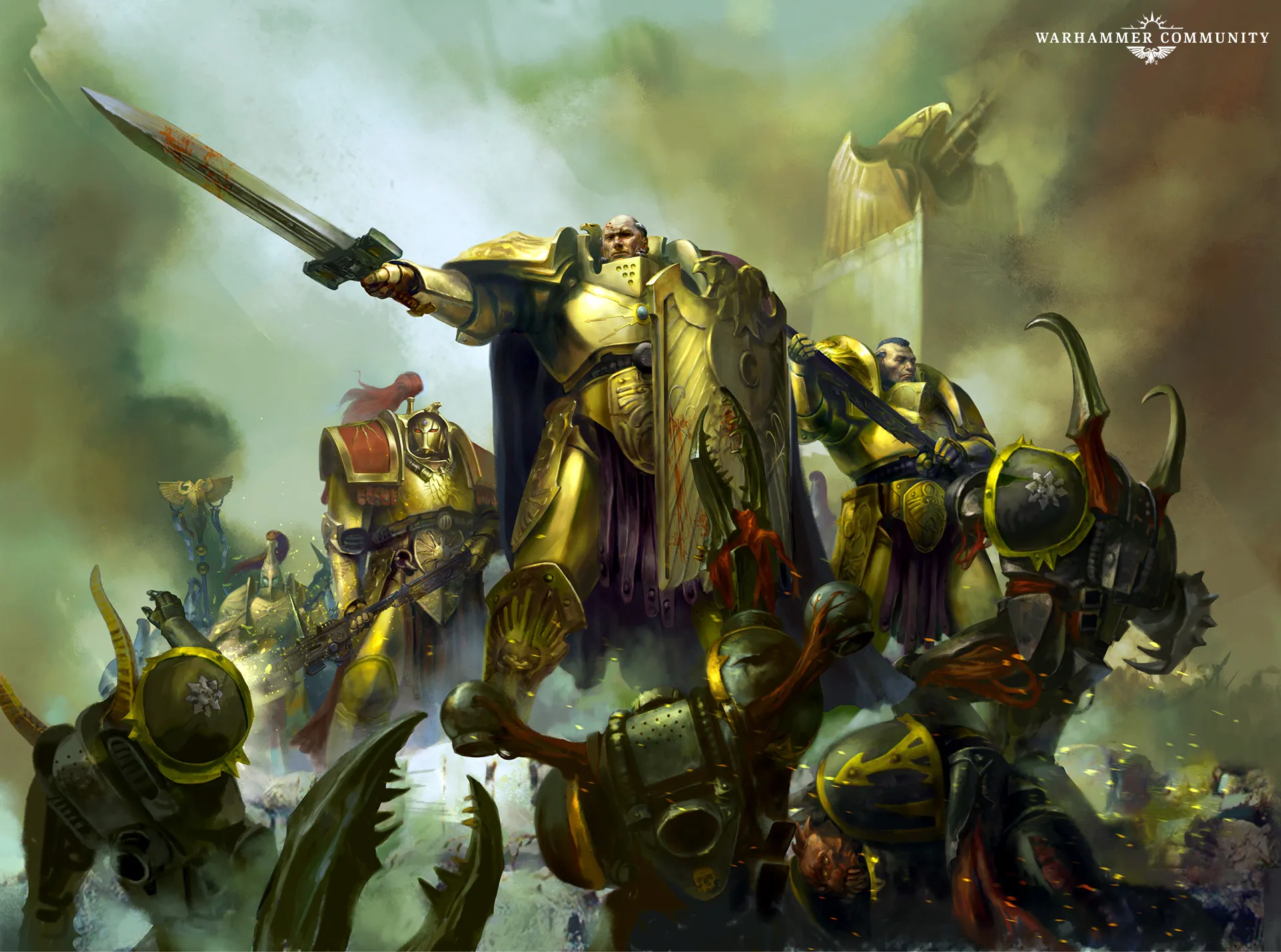
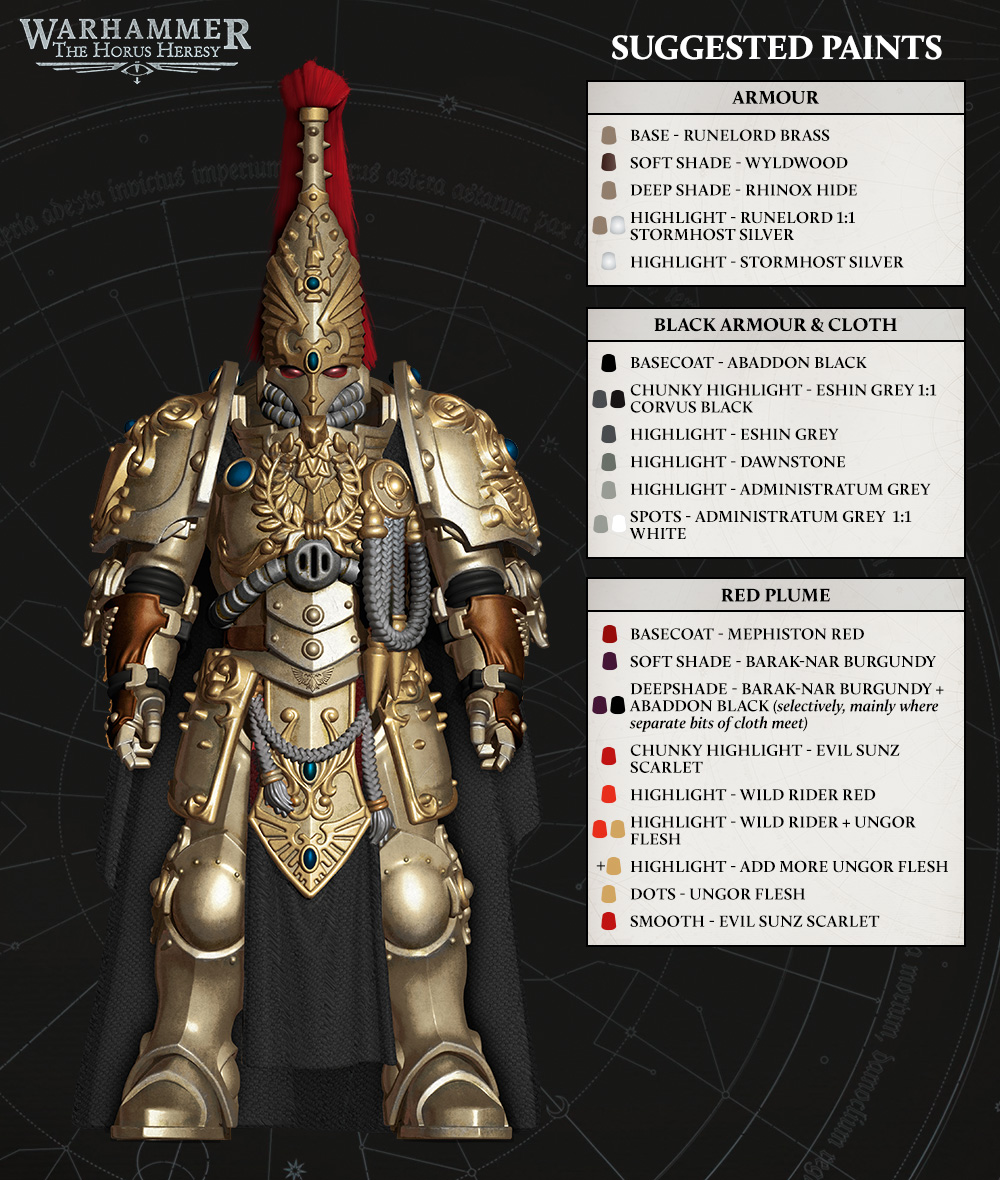
Pale brass is an unpleasantly good colour for the Custodes Templii’s executioners. Close enough to the Emperor’s gold that you’d recognise the authority coming down the ramp, with a black cloak hanging behind it. The official colour plate gives the warrior a red plume and bright blue gems. I’d happily paint that model before asking what the posting involved, and the suggested basecoat is Runelord Brass.
Friday’s Warhammer Community guide to Legio Custodes liveries puts a lot of background between the paint recipes. It describes the Templii Magisterium Tertia, the three secret orders serving different aspects of the Emperor’s work. One guards his person. Another secures his projects. The last disposes of whatever he judges unworthy, including things whose useful life has simply ended. Towards the bottom there’s a suggestion that this last order had been preparing for a purge when the Heresy began.
I think the Templii give the Emperor’s authority a more unsettling shape by showing the machinery that carried it out. There’s an organisation for protecting his plans and an organisation for making the consequences disappear. Both can arrive wearing the same gold as the warriors standing beside his throne.
The Custodes Templii could change your posting
The guide calls each Templi a loose sub-order. A Custodian might serve within one for a single assignment, or occasionally spend a lifetime there. Their associated colours can mark special service, and individual warriors can combine those colours with the usual gold to show a lasting attachment. The gold-armoured example with purple cloth is explicitly described as signalling allegiance to Prudentia’s goals regardless of the warrior’s current duty.
That’s a lovely bit of background for an army. It allows a warrior to have a service history you can represent with a cloak. You can paint a detachment for a specific mission without having to explain that every Custodian in it spent the previous two centuries in a completely separate regiment. The article leaves room for temporary assignments, personal dedication, and different colours on the same battlefield.
The oldest order, according to the guide, is probably the Templi Lictoris. These are the Custodians accompanying the Emperor into war and defending him directly. During the Great Crusade they stood beside him as worlds were brought into Compliance; after Magnus damaged the Webway project, they fought to keep the creatures beyond it out of the Imperial Dungeon. Their special livery uses iridescent black armour and ivory cloth, though ordinary gold and red remains appropriate to their duties.
Lictoris’s public visibility helped conceal the other orders. WarCom says the Imperial Household actively encouraged the assumption that the bodyguards people saw represented the entire Legio. Even during the Heresy, knowledge of the wider arrangement stayed within a small circle. The extent of the structure only became something outsiders could speculate about during the Scouring, after the Emperor was on the Throne.
The older Visions of Heresy, in its section The Custodian Guard, already describes detachments accompanying the Legions to ensure that the Emperor’s will was followed. So the idea of Custodes working beyond his immediate presence has a history. Friday’s guide gives those duties a useful organisational framework, and I’m wary of calling every detail in a current WarCom article a brand-new revelation just because I’ve only now read it properly.
Prudentia is the posting that would make me start looking at the exits. Its Custodians guard the Emperor’s secret facilities, their contents, and the knowledge of what goes on inside them. WarCom lists laboratories, vaults containing weapons from Old Night, and prisons holding monstrous enemies. The order also recovers forbidden technology from beyond Imperial territory when the Emperor wants it brought home.
You could spend a whole campaign with one of those remote garrisons. A sealed installation, a small Custodian force, an incoming vessel whose clearance was valid when it left Terra. By the time it arrives, the Heresy has broken out and somebody has changed sides. That’s a scenario I’d play, especially if the defenders have only partial information about the thing in the basement. The guide says Prudentia’s garrisons and fleets worked to keep these artefacts from the Traitors during the civil war.
It also says the order is believed to have used some of its stored weapons during the Siege of Terra. There’s an important degree of uncertainty in that wording. We get the suggestion of desperate deployment without a convenient inventory attached. I’m happy to leave that space open. I’d probably get distracted by the rules for whatever they named, anyway, and I don’t have a list of the weapons used there.
I once spent a weeknight in 8th edition repainting the purity seals on three Imperial Fists because I’d decided the parchment was too yellow. Ushabti Bone, a thin Seraphim Sepia wash, another pass with the bone. One of the seals came off on my sleeve and I glued it back upside down. Pete spotted it the following garage game, after I’d explained the new recipe at some length. The little idiot still has his inverted seal. I’ve lost the patience to correct a detail I was originally very pleased with.
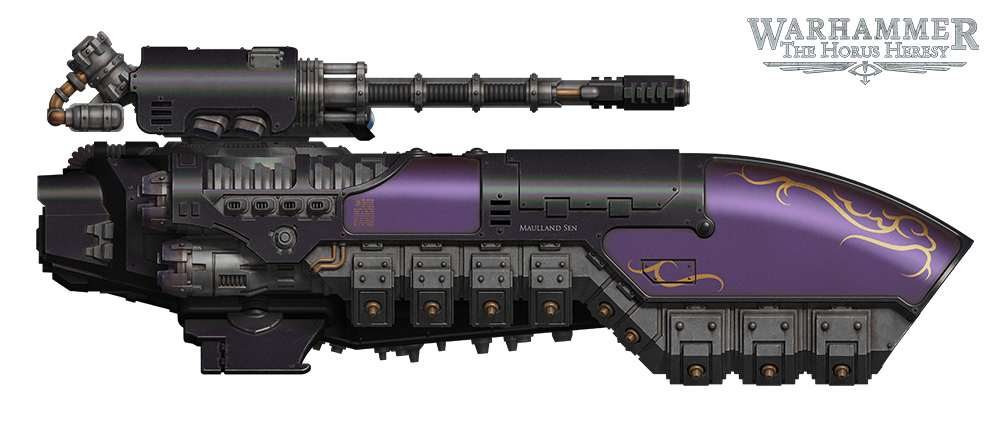
Purple cloth over polished black is the Prudentia scheme here. I like the gold-and-purple variant too, especially for my favourite overdressed Palace boys. The colour plates are generous about combining elements, which feels appropriate for individuals with long careers and changing assignments. I’d be happy using gold and purple on the same warrior, as in the guide’s final example.
The Templi Veritas and the work of erasure
Veritas has the broadest and nastiest brief. The guide describes its duty as destroying any element the Emperor considers unworthy, thoroughly enough that its memory also disappears. Betrayal qualifies. Obsolescence qualifies too. That second category gives the organisation permission to move against servants who may have done exactly what they were created to do, once the Emperor decides their continued existence has become inconvenient.
WarCom connects the order, cautiously, to the Thunder Warriors’ cull at Mount Ararat. It says Veritas is believed to have carried it out. It uses the same passage to associate the order with disposing of those judged tainted at the end of the second Rangdan campaign. We should preserve that attribution: this is a history written around concealed actions, and the source itself stops short of presenting a complete operational record.
The Thunder Warriors are an obvious reason to take the obsolescence clause seriously. Whatever the precise details of Ararat, the Emperor’s first armies provide a precedent for the fear that successful service doesn’t secure a place in the future. Veritas gives that fear a standing institutional home. A Custodian assigned there could understand an eradication order as the fulfilment of a long-established duty, with all the professional confidence that suggests.
The guide follows the order into the Heresy and its aftermath. Where complete erasure proved impossible, its attacks could instead be precisely symbolic. Chemos and Arachnus are the named examples of worlds subjected to this kind of punitive destruction. The mandate accommodates several scales of destruction, including attacks that leave surviving ruins as a demonstration of the Emperor’s judgement.
Putting Veritas beside Prudentia makes the handling of dangerous knowledge feel much more deliberate. Prudentia protects facilities and secrets, retrieves forbidden material, and controls access. Veritas can destroy people and the memory of them. I can imagine those mandates touching at the end of an assignment, when a recovered device is safely under guard and a ship’s crew has seen rather more than its orders allowed. That’s my imagined scenario, though; the guide doesn’t give us such a handover.
There’s a tempting shortcut through the Shadowkeepers and their Dark Cells here. Guarding horrific prisoners makes them an obvious point of comparison with Prudentia. I’d still want an explicit source before drawing a direct organisational line across ten thousand years. Similar duties can survive a reorganisation, or appear in several formations, and the present-day shield hosts have their own histories. The colour schemes offer an interesting comparison between formations that exist in very different periods.
An army outside the count
The sentence about the possible purge begins with a problem of numbers. During and after the Heresy, the size of the active Veritas forces apparently exceeded what outsiders understood about the Legio’s available strength. That was especially difficult to reconcile with the casualties of the Webway conflict. WarCom says this led some to suspect that the order had been making secret preparations for a future purge when the Heresy erupted.
An observer sees Custodians fighting, knows the order has suffered terribly elsewhere, and struggles to make the totals work. From that discrepancy comes a theory about preparations. The article leaves the headcount, the observers’ identities, and the intended victim unspecified. Even the starting figures belong to outsiders trying to estimate the strength of an organisation that had encouraged them to misunderstand its structure.
So, yes, I want to know who was on the list. Of course I do. You’ve put secret executioners in the setting and mentioned an unfinished job. I’m going to ask. Space Marines? A particular Legion? Some enemy we’ve barely heard of? I can already feel myself skipping past the missing evidence because one of those answers would be a much juicier story.
The idea of the Emperor eventually disposing of the Astartes comes readily to mind after Ararat. Applied here, it’s a hypothesis that needs several extra steps. You’d have to establish that preparations really were underway, determine their scale, identify their target, and explain how the supposed plan fitted the Emperor’s intentions for the Legions. Friday’s article supplies the suspicion at the beginning of that chain. It leaves the rest for us to argue about.
I initially found the hint a little cheap. An unspecified atrocity waiting somewhere behind the curtain can make the Emperor feel like a villain with an expandable filing cabinet. Then I went back to the wording about outside estimates. There is something I like about the theory originating with people trying to reconstruct an army through its deployments. They’re working from sightings and losses, making deductions from the Custodians who actually turn up. I can picture those observers comparing reports from several deployments and trying to identify the same warriors across them.
It also gives the theory a perfectly ordinary weakness. The observers may have counted badly. A hidden formation can seem impossibly large if your original estimate excluded most of it. That possibility deserves room alongside the more exciting reading, especially when the source has already told us that the Household promoted a misleading picture of the Legio. I don’t know how much confidence we’re supposed to place in those observers.
The Custodes’ campaign on Kol is a useful companion to this material because it puts another detachment into a war whose familiar account follows Sanguinius. These books keep giving the Ten Thousand jobs in the spaces around better-known battles. The Templii allow those jobs to have different purposes, even when the warriors doing them share equipment and answer to the same master. I’d happily read an entire account built around the orders for one remote garrison, with its boring supply problems included.
There’s still a practical question I’d like a later book to answer. Once the Emperor was interred, how did Veritas decide which outstanding instructions to continue carrying out? The guide places its operations into the aftermath of the Heresy, when getting clarification from the person who issued the judgement had become considerably more difficult. I’d like to know the date on which that Custodian chose to carry the order out.