Necron Dynasties: Ancient Machines Awakening from the Tomb

The Suffering of the Necrontyr

Long before humanity or even the Eldar existed, the Necrontyr civilization arose under the baleful light of a dying star. Their sun’s intense radiation inflicted rampant cancers and sickness upon them, dooming the Necrontyr to painfully short lives. In response, they became a morbid people obsessed with death. Necrontyr cities were built in the shadow of vast sepulchres — tomb complexes that far outnumbered the homes of the living. Each generation lived knowing they would soon join their ancestors; the greatest monuments were always built for the dead, never the living. Despite mastering advanced technology, the Necrontyr could not escape the curse of their biology or the hereditary weakness imposed by their harsh sun.

Driven by desperation, the Necrontyr launched slow-burning colonization efforts beyond their poisoned skies. Using stasis-ships and living metal hulls, they struck out for worlds under gentler suns, hoping to outpace death itself. In time, the Necrontyr dynasties conquered a great swath of the galaxy. Yet expansion brought division: as the empire grew, old rivalries flared and the dynasties turned on each other in bitter civil wars known as the Wars of Secession. It seemed the Necrontyr might annihilate themselves in fratricidal conflict. Salvation, ironically, came in the form of an external enemy — for in their expansion the Necrontyr had encountered the Old Ones, an ancient, godlike species who possessed secrets of immortality that the Necrontyr coveted. The Old Ones’ long lifespans and mastery of cosmic energies ignited a jealous hatred in the Necrontyr, whose own lives were so cruelly brief. The ruling Triarch saw the Old Ones as the perfect foe to unite their people: war with this immortal enemy would either bind the Necrontyr together or destroy them, and either outcome was preferable to civil extinction. Thus, the Triarch — led by the Silent King of the ruling Szarekhan dynasty — offered amnesty to rebellious dynasties and declared war on the Old Ones, initiating the cataclysmic conflict remembered as the War in Heaven.

The War in Heaven and the C’tan’s Bargain

The War in Heaven was a galaxy-spanning slaughter, pitting the technologically advanced but mortal Necrontyr against the psychic might of the Old Ones and their Warp-spawned servants. From the outset, the Necrontyr struggled; the Old Ones used their Webway portals and Warp powers to outmanoeuvre and devastate the Necrontyr forces. In mere centuries, the Necrontyr were pushed to the brink of defeat, reduced to a desperate presence clinging to the galactic fringes. Unity began to fracture again as losses mounted. In this extremity, the Silent King Szarekh sought a new power to overcome the Old Ones’ dominance. The answer came from the stars themselves: the Necrontyr made contact with cosmic entities they called the C’tan, the Star Gods. The C’tan were godlike beings of living energy — and they offered Szarekh a Faustian pact. They would grant the Necrontyr immortality and the strength to defeat the Old Ones, in exchange for the Necrontyr’s obedience and worship.

Szarekh, driven by vindication and envy, accepted the C’tan’s bargain. What followed was the horrific process of biotransference. Szarekh ordered his entire species into the bio-furnaces to be transformed. In great assembly lines of despair, the Necrontyr were stripped of flesh and soul, their frail bodies replaced with enduring shells of living metal necrodermis. As the bio-furnaces roared, the star-gods glutted themselves on the torrent of life essence that poured off the dying Necrontyr. Above each furnace the ethereal C’tan swirled and feasted, consuming the very souls of Szarekh’s people. Only at the end — when Szarekh himself emerged encased in immortal metal — did the Silent King realize the true cost of this “gift.” He felt strength, clarity, and eternal life in his new machine form, but also a yawning spiritual emptiness. The Necrontyr were gone; in their place stood the Necrons, immortal androids enslaved to cold logic and bound to the will of the Star Gods. Szarekh had won the immortality he sought, but at the price of his people’s souls — a mistake that would haunt him for millennia. Not all Necrontyr went willingly into this damnation; the astromancer Orikan the Diviner, for instance, was the lone voice who warned against consorting with the C’tan and refused the biotransference until he was dragged to the furnaces in chains.

Yet despite the terrible price, biotransference fulfilled the C’tan’s promises in sheer power. The Necrons rose as undying warriors of living metal, immune to time and plague, and armed with weapons of godlike potency. With their new starships and reality-shattering weapons, the Necrons and their C’tan masters resumed the War in Heaven with a vengeance. Planets were razed, stars extinguished, and whole systems devoured by black holes summoned at the C’tan’s whim. The Old Ones, for all their ancient power, were no longer invincible — the Necrons’ supremacy in the material universe now countered the Old Ones’ Warp-based advantages. The Necrons breached the Old Ones’ hidden dimensions and besieged them in every corner of the galaxy. One by one, the bastions of the Old Ones and their allies fell. In desperation, the Old Ones engineered new young races — such as the Aeldari and Orks — with potent psychic abilities to fight the Necrons. But this only worsened the catastrophe: the psychic carnage of the war spawned a hyper-violent backlash in the Warp, birthing the nightmare Enslaver Plague that ravaged what remained of the Old Ones’ civilisation. With their empire collapsing under Warp-spawned horrors, the last of the Old Ones went extinct or fled the galaxy, ending their aeons-long dominion.

Finally, the Necrons stood triumphant over their ancient foe — and Szarekh’s thoughts turned to vengeance upon the C’tan for their betrayal. At the moment of victory, the Silent King sprang his trap. He had secretly prepared his people for revolt, and now the Necrons turned their unimaginable weapons against the C’tan themselves. Though nigh-unkillable, the star gods were not invulnerable: Necron technology channelled the energies of the cosmos into weapons too mighty even for the C’tan to endure. One by one, the C’tan were shattered into fragmented shards and bound in arcane prisms. The masters became captives — cursed remnants to be used as weapons or imprisoned for eternity. The Necrons had overthrown both their enemies and their own gods. But the galaxy lay in ruins, and the Necrons now faced an empty, uncertain future as soulless machines.

The Great Sleep and the Awakening

With the War in Heaven over, Szarekh surveyed a devastated cosmos. The Old Ones were gone, but so too was any chance for the Necrons to rule unopposed. In the aftermath, younger species — like the Eldar, who had survived and thrived in the Old Ones’ wake — were primed to inherit the galaxy. The Necrons themselves were greatly diminished: endless war and the revolt against the C’tan had sapped their strength. Szarekh knew his people could not hold dominance in this moment. Instead, he conceived a plan for the long game — a way to outlast their rivals. He commanded the Necron dynasties to withdraw to their hidden Tomb Worlds and enter stasis in the Great Sleep, there to wait out the millennia until the time was right to rise again. The Silent King’s final order to his race was to slumber for sixty million years, then reawaken when the galaxy’s younger civilisations had grown old and weak, ready to be brought to heel. Having given this command, Szarekh took one last drastic step: he severed the command protocols that bound all Necrons to his will, freeing his subjects from centralised control. Burdened by guilt and seeking penance for the horror he had inflicted on his people, the Silent King then abdicated and left the galaxy entirely, venturing alone into the intergalactic void.

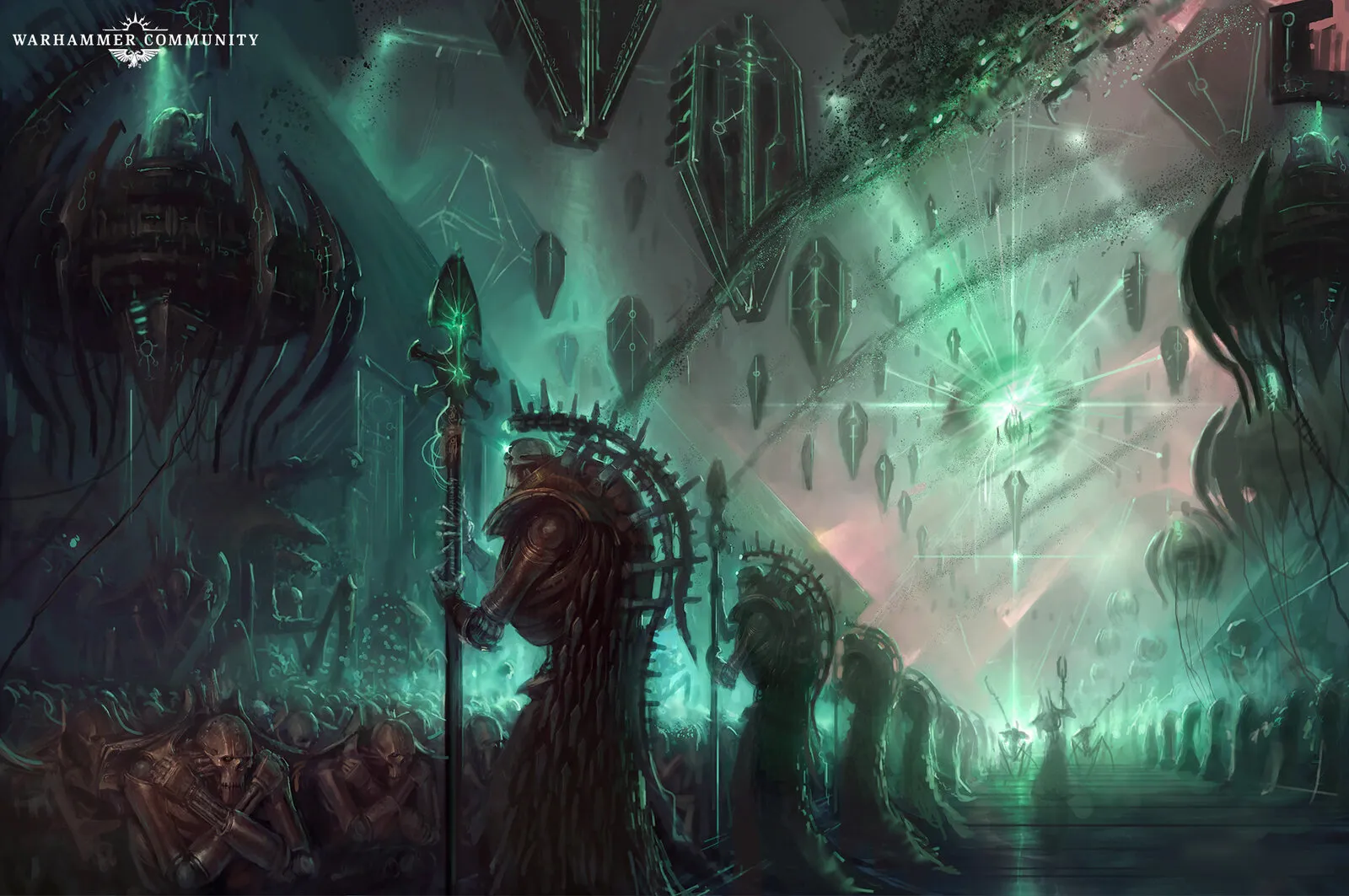
So began the Great Sleep. The Necron warriors sealed themselves in vast underground tomb complexes, suspended in timeless stasis beneath countless worlds. For tens of millions of years, the Necrons lay entombed in deathless slumber as the ages rolled on. In that time, the galaxy healed from the ancient war’s wounds, and new empires rose and fell. Many Necron Tomb Worlds, however, met ignoble ends during the long Sleep: some were destroyed by cosmic disasters, others were ravaged by enterprising aliens. The Eldar, in their heyday, took vengeful joy in annihilating Necron tomb planets wherever they found them. Countless Necrons were lost in stasis, their bodies damaged or their tombs completely erased over the aeons. Even on intact tomb planets, systems occasionally malfunctioned, causing some Necrons to awaken early or degenerate into madness over millennia of dormancy. Still, the vast majority survived in hibernation, awaiting the Silent King’s promised hour of resurrection.

The Great Awakening

The final years of the 41st Millennium — and the dawn of the 42nd — have seen that promise fulfilled: the Necrons are awakening at last. Not every Tomb World stirred at once; some Necrons awoke centuries or millennia earlier than others, emerging to find a galaxy changed beyond recognition. A few isolated tombs roused in times like the Great Crusade or even earlier, their lords bewildered by the new age of upstart civilisations. These early risers formed an Awakened Council to impose some order until the rest of their kin could rejoin them. But the true Great Awakening came in the late M41, as tomb after tomb triggered its revival protocols. Entire legions of Necrons are now rising from long-forgotten sepulchres, their silent halls flickering to life as stasis-crypts unlock and eternal warriors march forth once more.

Even now, many Tomb Worlds remain dormant or only partially awakened — but each year, more of the Necron dynasties shake off the dust of ages. What the Imperium of Man has confronted so far is merely the first stirrings of a giant, the opening movements of an ancient power regaining its strength. Should all the Necron dynasties fully awaken and unite, humanity would face an enemy as numerous and advanced as its own empire. The Imperium has thus far had but a taste of the Necrons’ true might, spared only by the fact that the Necron factions remain divided by long isolation, damaged memories, and differing agendas.

Freed from centralised control, the reawakening Necron dynasties each pursue their own path. Many tomb worlds rise in isolation, their nobles bitter and half-mad, pursuing parochial feuds or inscrutable projects. But others remember the grand vision of Necron dominance. Foremost among the returning leaders is Szarekh, the Silent King himself, who ended his self-imposed exile and cautiously returned to the galaxy in late M41. According to hidden Necron histories, Szarekh’s journey in darkness revealed a new threat: in the intergalactic void he encountered the Tyranids, extragalactic predators poised to devour the galaxy. Alarmed, Szarekh realised the Necrons must unite or be consumed in turn. In 744.M41 he and a coterie of loyal Triarch Praetorians appeared from the shadows, moving from tomb world to tomb world to awaken as many Necron legions as possible. The Silent King operates subtly — often concealing his true identity and working through emissaries — but his goal is clear: forge the Necron dynasties into a single force to confront the Tyranid menace and reclaim the mantle of rulership from the upstart powers of the present. Szarekh’s return has galvanised many Necron rulers, but also sown discord with others who crave independence.

Powerful leaders like the Silent King, Imotekh the Stormlord, and Anrakyr the Traveller are actively uniting Tomb Worlds under their banners in hopes of resurrecting the Infinite Empire of old. Each of the major dynasties has its own character and agenda, from the imperialistic wars of the Sautekh to the secretive pursuits of the Nephrekh.

Major Necron Dynasties in the Modern Era

Szarekhan Dynasty — Throne of the Silent King

The Szarekhan Dynasty was preeminent in antiquity and remains central to Necron history. It was the Szarekhan who held the title of Silent King across generations, including the last monarch, Szarekh himself. This dynasty’s very name derives from Szarekh, and it was his royal house that paid the greatest price — and reaped the greatest infamy — for the biotransference and the Great Sleep. After the defeat of the Old Ones, Szarekh took a contingent of his Szarekhan subjects with him into self-imposed exile beyond the galaxy, leaving the rest of the dynasty to sleep without their king. Those Szarekhan nobles who remained fared poorly in the millennia that followed. Eldar forces harried Szarekhan planets in ancient times, and rival Necron dynasties — harbouring bitterness at Szarekh’s “betrayal” of their souls — sabotaged and attacked Szarekhan holdings during the long sleep. A terrible Warp Storm in M18 further ravaged their domain. When many Szarekhan tombs finally awoke, they found their numbers severely reduced and their realms in disarray. Nonetheless, the Szarekhan dynasty retained an unshakable faith that Szarekh would one day return to lead them to glory — a faith vindicated when the Silent King at last appeared in the late 41st Millennium.

Szarekh’s return has positioned the Szarekhan Dynasty as a rallying point for the Necron race. Many other dynasties have eagerly bent the knee to the Silent King once more, believing unity under Szarekh offers the surest path to renewed empire. However, not all welcome the Silent King’s leadership. Some Necron lords bitterly blame Szarekh and the Szarekhan for the cursed fate of the Necrons, and these malcontents rebel or refuse to submit. The Szarekhan nobility, for its part, views the galaxy with supreme entitlement — in their eyes, they are the natural rulers of all Necrons and indeed all the stars, and they do not hesitate to subjugate or annihilate any who oppose Szarekh’s will. Szarekhan Crypteks are masters of blackstone (noctilith) technology, weaving that Warp-dampening material into their soldiers and war engines. Even rank-and-file Szarekhan Necron Warriors carry small blackstone talismans that shield them from Warp energies — a potent defence against Chaos and psychic foes.

Today, the Szarekhan Dynasty strides forth with imperial confidence. Under Szarekh’s command, the dynasty pursues a grand agenda: reuniting the Necron race and eradicating threats that could endanger their renewed empire. Chief among these threats are the Tyranids. Szarekh’s encounter with the Tyranid hive fleets beyond the galaxy convinced him that the Great Devourer could consume everything the Necrons hope to reclaim. Thus, the Silent King has made it a priority to marshal his dynasties against the Tyranids. Szarekhan forces have intervened on worlds besieged by Tyranid hive fleets, not out of charity to the younger races, but to deny the Tyranids biomass and to test ways of defeating the innumerable swarms. The Silent King’s armies have also helped establish noctilith pylons in the Pariah sectors, creating Warp-null zones that slow the Tyranids and other foes by severing their psychic synapse links. Overall, the Szarekhan Dynasty sees itself as the heir to the galaxy’s throne, and with the Silent King at the helm, they intend to forge all Necrons into a single empire that no mortal or god can withstand.

Sautekh Dynasty — Conquerors of the Eastern Fringe

Among the newly awakened dynasties, the Sautekh Dynasty has distinguished itself as one of the most militarily powerful and expansionist. In the days before biotransference, Sautekh was counted the third most powerful Necrontyr dynasty, and through fortune or foresight, many of its core tomb worlds survived the Great Sleep relatively unscathed. When the Sautekh began to awaken, however, their crownworld Mandragora fell into civil war as soon as its stasis-crypts cracked open. The dynasty’s ancient Phaeron had degenerated into senility, and rival claimants vied for the throne in a fratricidal struggle. In a gambit to tip the scales, one pretender awakened the famed general Imotekh, a mighty Nemesor of the Sautekh. The result was not what the pretender expected: Imotekh promptly seized control for himself. Imotekh the Stormlord defeated all his rivals and crowned himself Phaeron of the Sautekh Dynasty, ruthlessly unifying its worlds under his command.

Under Stormlord Imotekh’s leadership, the Sautekh Dynasty has rapidly become the greatest Necron threat to the Imperium in the current era. Consisting of at least eighty active Tomb Worlds, the dynasty’s dominion spans the Eastern Fringe of the galaxy. Imotekh’s forces have assaulted dozens of star systems, carving out a growing empire on the Imperium’s borders. The Sautekh nobility are noted as aggressive, imperialistic, and hungry to restore Necron supremacy without delay. They see this era as an opportunity to reclaim lost territories by force.

Imotekh’s ambition knows little patience even for the Silent King. Unlike many of his brethren, Imotekh does not accept Szarekh’s authority. In fact, Imotekh has outright defied the Silent King, going so far as to rise in revolt against Szarekh’s agents during the recent War in the Pariah Nexus. This open insubordination highlights the ideological divide: Imotekh considers himself the rightful master of the Necron race in this time, rather than bowing to a long-absent king.

One notable figure within the Sautekh is Orikan the Diviner, the dynasty’s chief Cryptek astromancer. Orikan can read the fate of entire star systems in the alignment of galaxies, predicting wars and catastrophes millennia in advance. Legends claim Orikan foretold the Fall of the Eldar, the rise of the Imperium, the Horus Heresy, and even the Tyranid onslaught long before each occurred. In ancient times, Orikan was unique among the Necrontyr in opposing the pact with the C’tan; he warned Szarekh against it and refused biotransference, having to be shackled and hurled into the bio-furnaces by force. Now, as a Necron, Orikan continues to chart the course of destiny — and intriguingly, he shares an ideology with the Nephrekh Dynasty in believing the Necrons’ future lies not in reclaiming flesh, but in ascending to forms of pure energy.

Another noteworthy character is Nemesor Zahndrekh, one of Imotekh’s top generals, who bizarrely believes himself to still be fighting wars of the past — treating even foes like Space Marines as if they were ancient Necrontyr enemies. Imotekh skillfully uses Zahndrekh’s tactical genius while ignoring his senility. The Sautekh also contains the Karnokh offshoot — nobles who awoke, beheld their metal forms, and concluded the Necrons were cursed abominations. They broke away and are now fanatically bent on “freeing” all Necrons from the curse of biotransference by destroying them utterly.

Mephrit Dynasty — Solar Lords of Oblivion

The Mephrit Dynasty has earned a dark renown as destroyers of stars and harvesters of light. During the War in Heaven, it was the Mephrit who mastered weapons capable of snuffing out suns — technology so apocalyptic that even other Necrontyr viewed it as dishonourable overkill. The Silent King nonetheless often called upon the Mephrit to annihilate worlds that defied the Necrons; entire systems were brought to heel or erased from existence by the Mephrit’s stellar engineering. Their gauss weapons blaze with solar flares, and their battlefields are illuminated by eerie starlight hues. No other dynasty wields death so indiscriminately on a system-wide scale; the Mephrit specialise in raw firepower and destruction, earning them the moniker “the Solar Reapers.”

Fate has not been kind to the Mephrit in the new era. Their Phaeron, Khyrek the Eternal, was slain in his stasis coffin — assassinated by Eldar agents who infiltrated the tomb during the Great Sleep. When the Mephrit began to awaken, they found themselves effectively leaderless with no clear successor. Various Overlords now compete, each trying to prove themselves the most worthy and most deadly warlord to lead the dynasty. Several Mephrit nobles have petitioned the Crypteks of the mysterious Technomandrite sect to rediscover the lost star-killing weapons of old; the first to reclaim the ability to murder suns would surely dominate the dynasty. A breakaway faction calling itself the Mephrit-Ghiar Dynasty has already formed, further weakening the dynasty’s cohesion.

Despite lacking a single guiding hand, the Mephrit Dynasty remains extremely dangerous. When the Great Rift rent the galaxy in half, the Mephrit saw opportunity: in early M42, Mephrit war hosts launched a massive invasion into the Imperium Nihilus, the beleaguered half of the Imperium cut off by the Warp storms. Entire sectors fell under sudden assault as Mephrit legions cut loose with their most devastating weapons. The fact that a Necron dynasty nearly carved out a chunk of Imperium Nihilus in one campaign is a testament to the Mephrit’s destructive capacity. Should a strong leader unify them again, the Mephrit Dynasty could become the most genocidal of the Necron powers, perhaps even turning their terrible weapons upon the stars of Segmentum Solar itself.

Nihilakh Dynasty — Keepers of the Undying Treasure

The Nihilakh Dynasty is a study in paradox: immensely wealthy and militarily potent, yet for most of its post-awakening history it remained aloof and isolationist. In ancient times, the Nihilakh were plunderers of worlds on a grand scale. They amassed vast treasure-vaults filled with the artefacts and riches of a thousand conquered civilisations. It is said that the spoils hoarded by the Nihilakh over millennia eclipse those of all other dynasties combined. Proud to the point of arrogance, the Nihilakh nobility make a great show of their prosperity and military might. Their royal court bedecks itself in glistening metagold and jewelled regalia, and their legions march to war with immaculate, gleaming armour.

However, this pride also bred caution. Terrified of losing their accumulated treasures, the Nihilakh became increasingly isolationist. For long epochs after their awakening, they ventured little beyond their own domains. But if any dared trespass on Nihilakh territory, the response was swift and merciless. The Nihilakh possess a peculiar artefact — the preserved head of an ancient alien seer — that purportedly allows them to predict future events. Using its prophecies, the Nihilakh have often struck enemies before those foes even realised they were in danger.

In recent times, the Nihilakh Dynasty has ended its isolation and taken a more active role in galactic affairs. They have formally allied with Szarekh, pledging their strength to his bid for Necron domination. Horrified by the uncontrolled Empyric energies of the Great Rift spilling across realspace, the Nihilakh have begun hunting Chaos incursions and purging daemonic taint wherever found. The Nihilakh also played a central role in the Pariah Nexus conflict, and when Imotekh’s Sautekh dynasty rebelled against the Silent King, the Nihilakh remained steadfastly loyal to Szarekh.

Among their notable leaders is Trazyn the Infinite, an Overlord of Solemnace and an odd figure who travels the galaxy collecting artefacts and specimens for his immense museum. Trazyn’s antics — stealing heroes and relics, including from other Necrons — sometimes put him at odds with fellow Nihilakh lords, but he ultimately aligns with his dynasty’s aims when the call comes.

Nephrekh Dynasty — Seekers of the Transcendent Light

The Nephrekh Dynasty is perhaps the most spiritually and scientifically ambitious of all Necron dynasties. While others fixate on restoring past empires or avenging ancient grudges, the Nephrekh have set their sights on a form of apotheosis. Their ultimate goal is not to regain mortal flesh, but to evolve into beings of pure, incandescent energy — to transcend the boundaries of material existence entirely. They envision a future in which the Necrons abandon physical bodies altogether and live eternally as rays of starlight coursing through the cosmos.

The Nephrekh have developed a unique technology known as the Golden Form: by infusing their living-metal bodies with “metagold” and harnessing stellar radiation, high-ranking Nephrekh Overlords can temporarily transform into beings of living light. In this state, they become nigh-invulnerable and can phase through solid matter or teleport across the battlefield in a flash. Even common Nephrekh warriors exhibit a lesser version of this effect — their bodies can blur into glowing light, allowing them to surge forward at frightening speed or slip through obstacles before re-solidifying. Thus far, the Nephrekh have not unlocked how to maintain the Golden Form indefinitely, but they continue to push the limits of this tech, convinced that eternal radiance is within reach.

Their territory lies near the galactic core, centred on their former crownworld of Aryand. Since the Great Rift’s emergence, the Nephrekh find themselves in direct conflict with forces of Chaos. A sect of the Thousand Sons Chaos Space Marines known as the Cult of Time has targeted Nephrekh holdings, seeking to unravel the secret of how the Necrons bent the C’tan to their will. The result has been a running war between the Nephrekh dynasty and the sorcerous legions of Tzeentch — the Nephrekh, utterly soulless and grounded in the material, are anathema to daemonic sorcery, and vice versa. If any Necron dynasty will take drastic measures to control or shut off the Warp, it is likely the Nephrekh.

Anrakyr the Traveller — The Unifier Without a Dynasty

No account of the awakening Necrons would be complete without mentioning Anrakyr the Traveller, a lone-wolf Overlord whose actions span across dynastic lines. In life, Anrakyr was the ruler of the Pyrrhia tomb world, but upon awakening, he made a momentous choice: he abdicated his throne and set out to reunite the scattered Necron realms under a common cause. He took up the mantle of the Traveller, leading a host of loyal Immortals — the Pyrrhian Eternals — on a ceaseless odyssey from tomb world to tomb world. Whenever Anrakyr finds a Necron world occupied by aliens, he and his elite warband descend to purge the trespassers — be they human colonists, Ork warlords, or anything else — thereby restoring the tomb and awakening its Necron legions. In gratitude or under gentle coercion, Anrakyr then requests a tithe of warriors and equipment from that newly awakened host to bolster his crusade.

Anrakyr has shown a notable pragmatic streak: when facing galaxy-ending threats, he is willing to make temporary alliances with mortal species. During the Cryptus Campaign against Hive Fleet Leviathan, Anrakyr and his Necrons fought alongside the Blood Angels Space Marines to stop the Tyranids. Though such cooperation is anathema to many Necrons, Anrakyr recognised that if the Tyranids consumed the system, the Necron tombs there and beyond would be lost as well. His attitude towards the living is generally one of contemptuous tolerance — lesser beings he would gladly exterminate once higher priorities are dealt with. As one translated quote has him saying to a Tau envoy: “You and your kind have trespassed, and thus invited extermination. Curse you for putting me to this inconvenience.”

Anrakyr represents the unifying impulse among the Necrons. He has no interest in ruling a single sector when he could ignite a renaissance of Necron power across the stars. Whether he will eventually pledge his accumulated forces to the Silent King’s cause or chart his own course to empire remains to be seen.

Ancient Agendas and the Modern Galaxy

Across all their differences, the Necron dynasties share a common conviction: they were the rightful rulers of the galaxy in aeons past, and so they shall be again. From the humblest Necron foot-soldier mindlessly obeying directives, to the haughtiest Phaeron plotting from a golden throne, this drive is coded into their very being. The awakening of the Necron dynasties in the 41st and 42nd Millennia is not merely a series of isolated incidents, but a slow earthquake reshaping the political landscape of the galaxy. Worlds long thought dead are stirring with mechanical life, and ancient star-empires are reasserting their claims.

The Imperium, the most widespread empire of younger races, finds itself confronted by an enemy as ancient as creation, one that does not negotiate or show mercy. Imperial colonies built unknowingly atop Necron sepulchres have been eradicated overnight. Where diplomacy is attempted, it typically fails; the Necrons view humans and other living beings as nothing more than momentary vermin or useful slaves. Any treaties are short-lived and born of extreme circumstance.

The most dramatic confrontation has been the Pariah Nexus: a Necron initiative spearheaded by Szarekh to create zones of space where the Warp is entirely nullified by massive noctilith constructs. In these “silent zones,” human psykers lose their abilities and even the human spirit is dampened, rendering populations passive — effectively preparing those worlds for easy Necron domination. The Necrons possess the means to accomplish what the Emperor of Mankind only dreamed of — sealing the Warp and denying the gods of Chaos their sustenance. This puts them in direct opposition to Chaos in a fundamental way. Necron dynasties like the Nihilakh and Szarekhan actively work to erase the influence of the Warp. Devices such as the Cadian pylons — which held back the Eye of Terror until recently — were Necron in origin, part of a grand design to neutralise the Warp’s influence. Now, with the Great Rift tearing the galaxy asunder, the Necrons may be compelled to accelerate such plans. Some Imperial savants even speculate that the Silent King might attempt a network of Pariah Nexuses across the galaxy, essentially immunising realspace from the Warp. Such a scheme casts the Necrons as potential saviours of the material galaxy from Chaos — albeit in a way that would cost humanity its empire and freedom.

When it comes to the Tyranids, the Necrons have identified them as a foe that threatens everyone indiscriminately. The Tyranids cannot be negotiated with; they seek no territory, only the consumption of all biomatter. Szarekh’s alarm at the Tyranids suggests the Silent King may be manoeuvring Necron forces to head off hive fleets before they grow too large. This has made the war against the Tyranids a rare case where multiple dynasties cooperate; even Imotekh, who disdains Szarekh, has fought Tyranids in defence of his territory, inadvertently serving the Silent King’s larger aim.

Toward the Eldar, the Necrons harbour an ages-old enmity. The Eldar are successors of the Old Ones, and their psychic might is anathema to Necron principles. Necron-Eldar battles have flared up again as tomb worlds awaken near craftworld paths or Exodite worlds. Typically, an Eldar Autarch would rather sacrifice an entire craftworld than see a Necron dynasty recover a particular relic of the Old Ones. The feeling is mutual: Necrons often single out Eldar worlds for extermination campaigns.

The future shaped by Necron agendas is a grim one for the younger races. As more dynasties awaken, dormant Necron super-weapons and megastructures come online. Entire systems may be transformed into Necron dominions overnight. The Imperium teeters under many threats — Chaos, xenos, heresy — but the Necrons represent something uniquely daunting: the return of the galaxy’s original owners, armed with technology that defies the laws of physics and a patience forged over eternity. Their Infinite Empire, once thought long lost, is now rising from the tomb.

And yet, the Necrons do have one foe that could undo them: themselves. Internal rivalries and divergent ideologies still plague their unity. Imotekh’s Sautekh refuse to bow to Szarekh; the Mephrit are in disarray; the Nephrekh follow a transcendent dream that not all share; renegades like the Karnokh or the Flayer cults sow chaos from within. The Necrons, for all their logic, are not a monolith — many are individuals with differing goals, a trait both curse and blessing bestowed when Szarekh freed them from his command protocols long ago. If the dynasties cannot overcome these differences, they could squander their chance at dominance through fraternal conflict, giving the younger races precious moments of hope.

In the end, the Necrons see themselves not as conquerors coming to a foreign land, but as lords returning to their rightful inheritance. Every tomb world that rises is, in their eyes, a piece of home restored. Every battle against the Imperium or any rival is a continuation of a struggle that began millions of years before mankind’s ancestors crawled in the mud. The Necrons bring with them the weight of history immeasurable — ancient grudges, ancient duties, ancient ambitions, all reawoken. As they stride forth from their stasis-tombs, implacable and contemptuous, they intend to remake the galaxy into the form they remember or desire: a Necron galaxy, eternal and changeless under silent, deathless rulers. The ancient machines are awakening from the tomb, and they will not rest again until the stars themselves bow to the Necron Dynasties.


Spotted an error? Or want to share something with us? Write us at grimdarkgamerhq[at]gmail.com.

Necron Dynasties: Ancient Machines Awakening from the Tomb