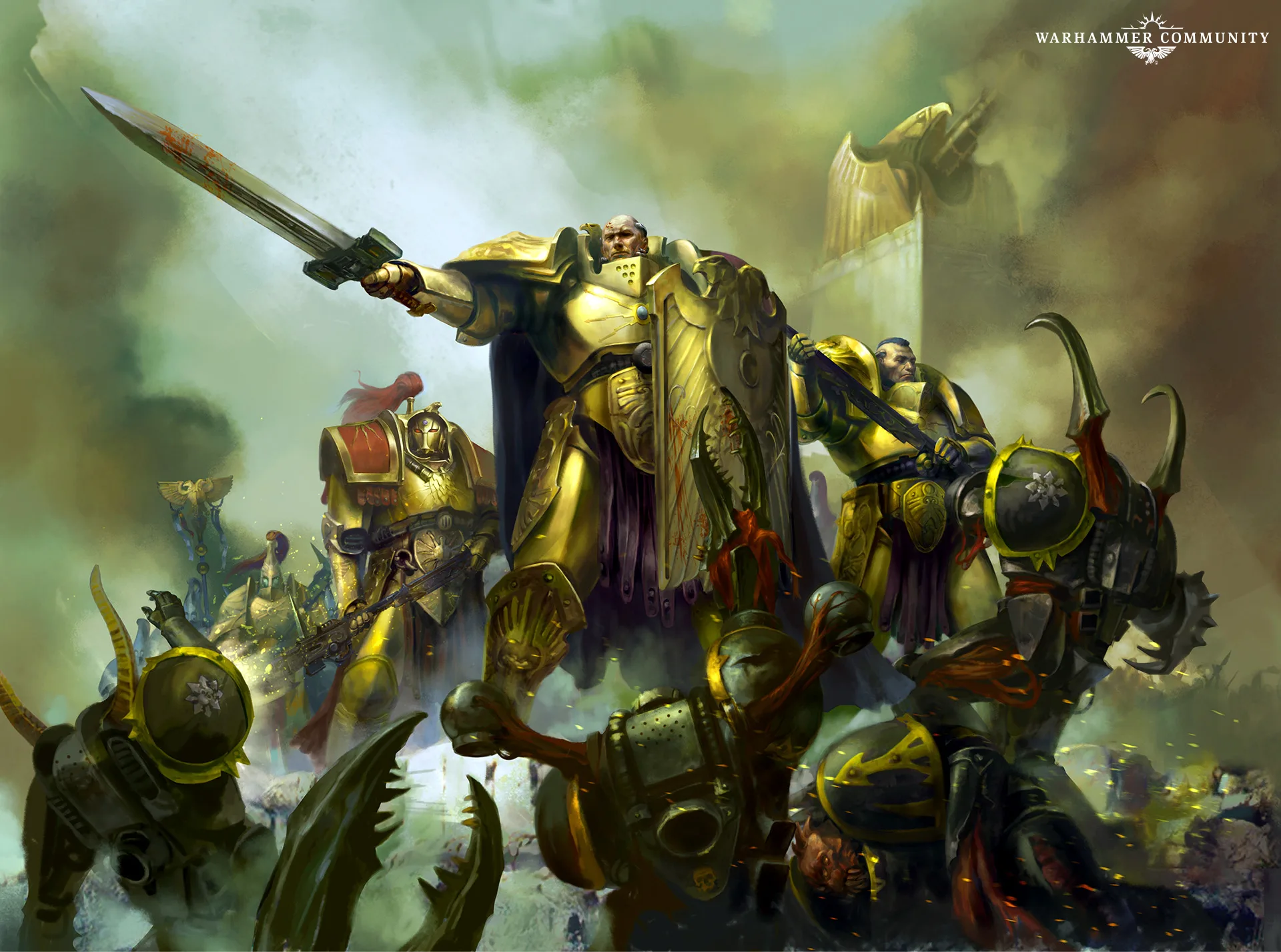
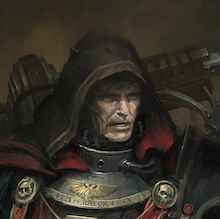
“Your presence does not surprise me, Assassin. I have known of you ever since your craft entered the Eastern Fringes.”
That’s Konrad Curze talking to the Callidus assassin M’Shen, who he had been tracking for weeks. He could have killed her. His Atramentar bodyguards could have torn her apart on the way in. He let her walk past them because his death proved his point, that a “false Emperor” punishes those who deserve punishment, just like Curze had been doing on Nostramo. Whatever you think about Curze’s logic, the speech itself appears in Index Astartes II and again in Soul Hunter, transcribed both times from the recording on M’Shen’s vambrace.
The biggest 40K assassinations are usually the ones nobody calls assassinations. Horus killing the Emperor was technically a duel. Sanguinius’s death was a battlefield casualty. Calling those events assassinations stretches the word past breaking. The five below are different: one person, blade or rifle, the Imperium’s trajectory shifts afterwards. Two of them spectacularly fail, and the failures matter more than the wins.
I am cherry-picking. BoLS ran a competing list this week and skipped Goge Vandire entirely, and Vandire is the assassination that built modern faith in the Imperium. So this list is not theirs and your favourites may be missing. Five seemed like enough.

Goge Vandire and the End of the Reign of Blood
Vandire ran the Administratum and the Ecclesiarchy simultaneously, which is roughly equivalent to being Pope and Prime Minister at the same time, except with virus bombs. He spent seventy years murdering anyone he disliked, including, by the end, planets full of people he had never met because they had not paid the right tithes. His audience chamber had a holographic galactic map, and he would point at it like a child picking sweets, and ships would burn. The Lexicanum entry on his standing orders is genuinely upsetting reading.
He died because a small Adeptus Custodes squad knew the Imperial Palace’s secret tunnels and bypassed his Brides of the Emperor entirely. Sister Alicia Dominica, who led the Brides, was taken into the actual presence of the Emperor and shown what Vandire had been hiding. She came back, told her sisters, and walked into the audience chamber herself. He did not even look up. He was scribbling orders on balled-up paper, muttering to himself. His last words, supposedly: “I do not have time to die, I am too busy.” She struck anyway.
The kill created the Adepta Sororitas. The Brides were renamed Daughters of the Emperor and folded into the new Ecclesiarchy under Sebastian Thor, becoming the Sisters of Battle as we know them now. The whole armed-faith-of-the-Imperium aesthetic that defines the modern Sororitas comes from this one murder, plus a lot of flagellant theatre Sebastian Thor added during the Reformation that followed. The Beheading happened a few weeks later, with the Custodes executing every High Lord of Terra who had let Vandire happen.
The First Execution Force and the Counter-Assassin Nobody Talks About
This one happens during the Horus Heresy, is documented in James Swallow’s Nemesis, and rarely shows up on best-of lists because the operation failed and the men who planned it died.
The setup: the Officio Assassinorum had already tried to kill Horus the lone-operative way and lost every assassin sent. Tobeld of the Venenum clade got close and didn’t get close enough. So the Master of Assassins assembled the first Execution Force in history, one operative from each major clade, sending them as a team. The Callidus rep was a woman called Koyne, even though M’Shen had been suggested for the slot. M’Shen would get her own primarch in another two centuries, but in this period she was passed over.
The Execution Force failed to kill Horus. All members died. While they were on the ground, though, they encountered a counter-assassin Erebus of the Word Bearers had sent to kill the Emperor, and they eliminated him on their way to their own deaths. So the Officio operation that killed Horus’s counter-strike was a side-effect of the operation that didn’t kill Horus.
I find this funnier than I should. The most expensive assassination in Imperial history accidentally saved the Emperor’s life by killing the assassin who was on his way to kill the target the original operation was supposed to protect by killing Horus. The Officio counts it as a partial success in the official records, on a technicality.
Konrad Curze and M’Shen, the Primarch Who Sent for His Own Killer
I wrote a whole post on Curze a couple of weeks ago, so I will not relitigate every detail. Sanguinius captured Curze after the Heresy, sealed him in a stasis coffin, and launched him into space to drift until destiny caught up with him. Curze had been seeing his own death in visions since childhood. The same scene every time, an Imperial assassin in his palace on Tsagualsa.
M’Shen was that assassin. Callidus clade, polymorphine and a phase sword. She infiltrated the palace. Curze knew she was coming, watched her ship enter the Eastern Fringes weeks earlier, and let her walk past every checkpoint in the building. The line at the top of this article is what he said to her before she struck. Then she took his head, tried to run, got intercepted by the Soul Hunter Talos in the corridors and torn apart. The vid-log of Curze’s final speech somehow made it back to Terra anyway, captured on her vambrace recorder.
This is the rare case where killing the leader actually changed the legion. The Night Lords without Curze became a directionless terror weapon. They fragmented into warbands. They got darker and more daemonic and started doing kill-raids that did not lead anywhere strategic, which honestly sounds like every Night Lords novel I have ever read.
Asdrubael Vect and the Failed Murders That Built a Throne
I have a small Drukhari force I built for Kill Team back in 8th edition. About a thousand points all in, mostly Wyches because I was obsessed with that Combat Drugs table. They sat grey on the shelf for two years before I admitted I was never going to paint them. The gloss black armour scared me off, which is embarrassing to admit out loud as someone whose primary army is Thousand Sons gold trim. Anyway, lore reading is cheaper than paint, so I have spent more time than is healthy reading Drukhari background. The recurring fact about Vect, page after page across three editions of Drukhari codex, is that everyone has tried to kill him and the body count of failed contenders is in the high thousands.
He was born a slave in Commorragh. He climbed by murder, and the nobles ignored him for centuries because his ambition was beneath their notice. By the time they bothered to notice, he had founded the Kabal of the Black Heart and outflanked them. He provoked an Imperial invasion of Commorragh on purpose, used the Salamanders to kill off his rival Lords, and stepped into the wreckage as the only Archon left standing. That was M35, and he is still in charge now.
So Vect. Old. Mean. Got himself a doppelgänger called the Geldling that takes assassinations for him. Got himself another body via the Harlequins after the Dysjunction, when his enemies thought they had buried him. Mandrakes stabbed him during the Fracture of Biel-Tan, except they stabbed the body double. The Prophets of Flesh resurrected him with a “perfect” form and now he calls himself a living Dark Muse, which is the kind of self-aggrandising title that would normally get you murdered in Commorragh, but exceptions exist.
The reason this matters as an assassination story is that the failures are the lore. Vect’s reputation comes from what nobody could do to him. Ten thousand years of dodged knives is roughly four hundred times longer than I have been playing 40K, which gives you a sense of the scale.

Eldrad Ulthran and the Counter-Assassination of an Entire Conspiracy
The Cabal were a coalition of xenos species who had been fighting Chaos longer than humanity had existed. Eldar, energy beings, lizard-things, at least one human Perpetual called John Grammaticus. During the Heresy they used their farsight to figure out that the cleanest way to kill Chaos was to let Chaos win. If Horus took Terra, humanity would extinguish itself within three generations, which would starve the Chaos Gods of the souls that fed them. The Cabal recruited Alpharius Omegon and tried to throw the entire war on that logic.
Eldrad Ulthran of Ulthwé spent decades watching this play out and decided it was a hopeless ritual sacrifice dressed up as strategy. Even if humanity died, Chaos would survive on whatever scraps were left over. So he assassinated the Cabal. Not metaphorically. He recruited a former Word Bearer called Barthusa Narek, and the two of them killed the leadership and the agents one at a time. Slau Dha. Gahet. Cartur Umenedies. Damon Prytanis. By M32, Eldrad was telling people the Cabal no longer existed, and nobody could prove him wrong.
A xenos secret society that had outlasted whole civilisations got wiped out by one Eldar farseer and one Word Bearer with a grudge, and the Imperium got to keep existing past the Heresy because of it. Whether Eldrad was right or wrong is the entire ten thousand years that followed…
Actually, let me walk that back a little. The Cabal might have been right. If humanity dies and Chaos starves, that is a clean ending for the universe. What we got instead is the slow-rot Imperium of the 41st Millennium, where nothing improves and everyone suffers in slightly different ways every century. Eldrad signed humanity up for a thousand-year cancer. Hard to call that a clear win on the timescales involved. Either way, the Cabal kill is the assassination that gave us the setting we have, so it stays on the list.
It is also an oddly mundane story for 40K. No siege, no army, no battlefield. An Eldar with a knife and a Chaos Marine with a knife, going through a list of names, like that ex you never get over making polite small talk at someone else’s wedding.
The Officio’s Bad Track Record
Two of the five on this list are failures, and a third was the target arranging his own death. The famous “successful” 40K assassinations usually just kill someone, and the political system that made the target dangerous carries on regardless. The failures are the ones that change things, because they prove the target cannot be killed, and that proof becomes a kind of authority in itself. Vect built ten thousand years on top of his obituaries.
Vect is a god in Commorragh because nobody has managed to put him down. Horus carried on for a decade because the first Execution Force died trying. Curze’s death is mostly a story about the Emperor’s assassins failing to do anything to him until he was good and ready to die. Vandire and the Cabal both died because the killers used unexpected access points, the Custodes’ tunnels in one case and a former Word Bearer’s hand in the other.
Five names worth knowing the next time someone tells you the Officio Assassinorum is the most efficient branch of the Imperium.