The most-quoted line in modern Necron lore reads: “They came to us as gods, and we, like fools, took them at their word. Mephet’ran the Deceiver, Aza’gorod the Nightbringer, Iash’uddra the Endless Swarm; I curse their names, and the names of all their malevolent brethren.”
That’s a direct quotation. The footnote in White Dwarf #450 attributes it to the Chronicle of Szarekh, Last of the Silent Kings. It’s the curse-list of the single Necron who personally accepted the C’tan’s offer of immortality, sat through a year of debate before agreeing, and then ran the biotransference programme that emptied his species into living metal.
It’s not corroborated by anyone. There’s no second source.
The Witness List Is One Name Long
If you sit down and try to figure out who else, in canon, could actually testify about what happened in the room when the deal was struck, the list gets very short.
The other two Triarchs are dead. The phaerons who governed the Necrontyr alongside the Silent King died in the rebellion against the C’tan, the same revolt Szarekh organised after biotransference. White Dwarf #450 is explicit: “millions more died, among them the other members of the Triarch.” Their account of the deal went into the rebellion graves with them, and no Cryptek I can find ever transcribed it.
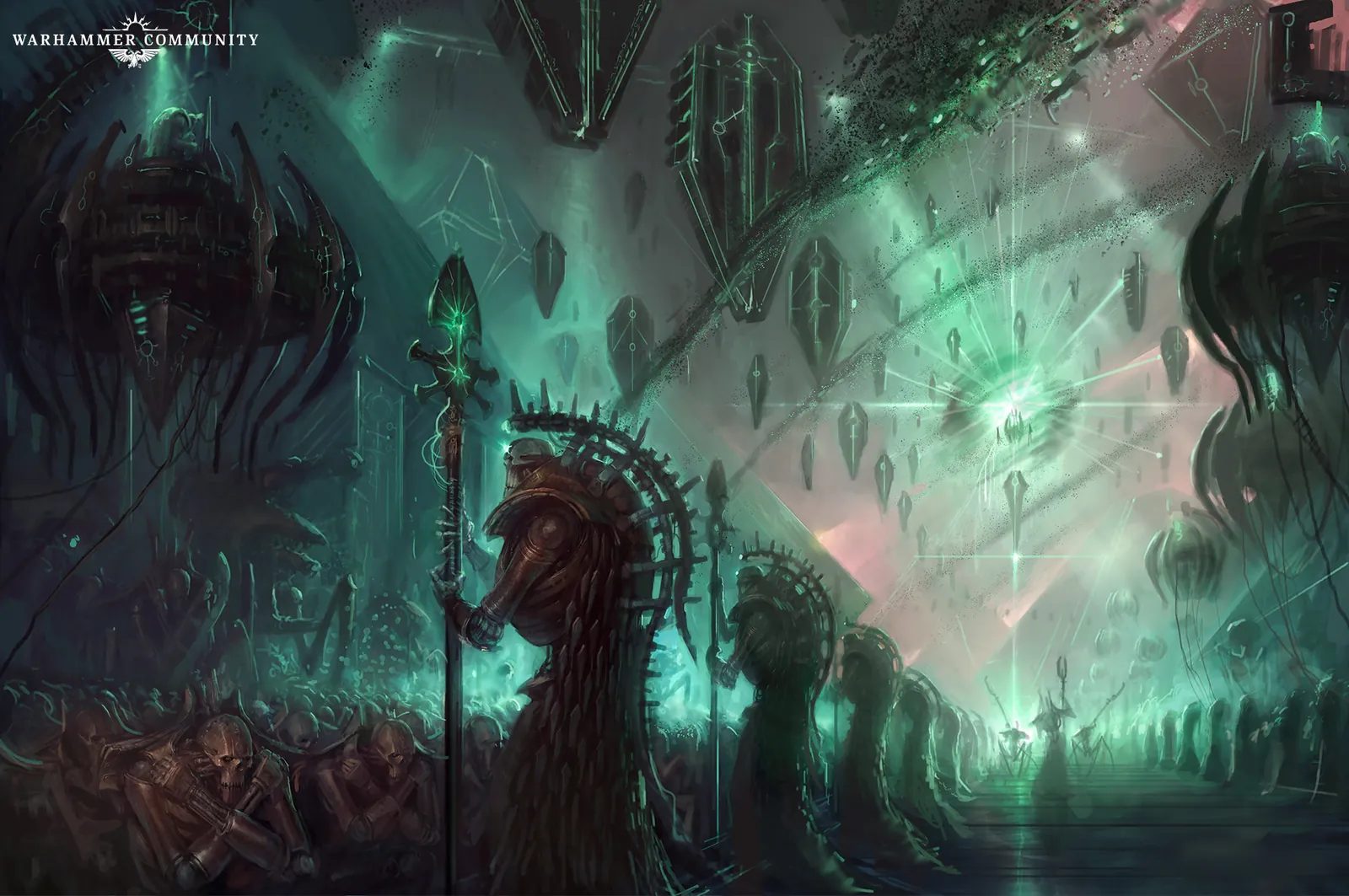
The C’tan themselves were shattered into thousands of shards. Each shard is locked inside a tesseract labyrinth, “bound securely within a tesseract labyrinth as though a genie in a bottle.” They can’t give interviews. The Burning One only emerges when Anrakyr lets it out. The Tredica shard saved Inquisitor Draxus’s life for reasons no one has ever managed to explain. Sometimes they manifest, sometimes they kill, occasionally they save someone. They do not, in any text I can find, sit down and recount the founding of the alliance from their side.
The Crypteks who actually built the bio-furnaces? Many of them died in the rebellion or were lost across sixty million years of tomb-world failure. The lower-caste Necrons who went through the furnaces in greatest numbers got, per White Dwarf #383, “comparatively cruder bodies, their wits and reactions dulled by the process.” They’re standing in dynastic phalanxes right now, and most of them can’t recall what they did last week, let alone what was said in the throne room before they were emptied out.
That leaves Orikan the Diviner, who was overruled at the original meeting, and Szarekh himself, whose chronicle this is.
What Szarekh Had Motive To Hide
Every primary source is biased. What makes this one strange is the direction the bias runs.
Szarekh approved the alliance. He sat through a year of debate. He dismissed Orikan’s caution. He gave the order for biotransference, and when his people resisted, his “command was law; all Necrontyr were compelled to submit to the great boon, willingly or not.” Command protocols embedded in their new metal minds enforced the obedience. He is implicated at every step. He bought the deal, he forced the implementation, and he watched the bio-furnaces consume his people while the C’tan fed.
A man in that position writing the history of how it happened has one rhetorical move available. He has to locate the agency somewhere else. They came to us as gods. The honeyed words. The unveiled betrayal. The C’tan offered, unveiled, fed. He’s the witness who got fooled, the verbs all happen to him, and the active subjects in every sentence are C’tan.
That’s the structure of every confession from a guilty party. I was led astray. They tricked me. If I’d known.
Where the Argument Stops Short
I want to be clear about what I’m not saying. The C’tan ate Necrontyr souls. The bio-furnaces actually happened. Necron Codex art shows the C’tan clustered around the furnace mouths drinking the discarded essences, and that part isn’t in dispute from any direction.
The argument is narrower. Every specific claim about the alliance (the C’tan approached the Necrontyr first, the words used were “honeyed,” the immortality was offered “freely, as from one ally to another,” the betrayal was “monstrous”) flows from one chronicle written by one author who has every reason to frame the events that way. The framing is suspect because the source had a year of deliberation to decide how he wanted the alliance era remembered.
And the Deceiver, Mephet’ran, is a genuine manipulator in every other text. His shard tricks people. That’s well-established. So Szarekh saying “I was deceived” isn’t implausible on its face. It also happens to be the story he most needed to record.
A Late-Night Wiki Rabbit Hole
I went down this one after reading Nate Crowley’s Twice-Dead King: Ruin on audiobook last winter, mostly because Oltyx, the Necron protagonist, has this awful gift of being able to sink into a temporal fugue and physically relive his oldest memories, at the price of losing them forever. He can’t recall his own mother’s face except by burning the recollection in the act of remembering it.
I sat with that for a while and then thought, hang on, what do the actual oldest Necrons remember about the period before biotransference? Eidetic Necron memory is supposed to be the whole point, and yet Damnos in Warzone Damnos describes the Sautekh and Nihilakh Necrons there as having “eidetic engrams… badly corrupted” by being woken too early. Awakening damages memory. So does imperfect stasis. So does the act of remembering, in Oltyx’s case.
I ended up four hours deep in the Lexicanum at one in the morning trying to find anyone, anywhere in the corpus, who corroborates the Chronicle of Szarekh independently. Couldn’t.
Kiran reckons the whole thing is moot because the C’tan are obviously evil, look at the Nightbringer, and even if Szarekh fudged the alliance era, the C’tan are still the right villain. He’s correct about the Nightbringer. He doesn’t tend to engage with who wrote down the part of the story about the Nightbringer.
The Behaviour Tells On Itself
The detail that gives me pause more than the chronicle itself is what Szarekh is up to now.
White Dwarf #450 describes his return in language that should set off alarms for any of his own people who read it: “In secret, the Silent King made pilgrimage from tomb world to tomb world, shielding his identity, working through unknowing Overlords and Crypteks to cultivate a new belief in their ascendancy.”
He approaches people in disguise. He uses their machinery against their own interests. He cultivates belief. He doesn’t reveal himself. Replace “Szarekh” in that paragraph with “Mephet’ran” and the sentence reads exactly the same way it does in the C’tan entries.
Imotekh the Stormlord, ruler of the largest awakened dynasty in canon, says of him publicly: “I have heard the rumours of the Silent King’s return. They are risible and unworthy of a real ruler. Creeping through the darkness, playing shadow games through puppets - no true king acts this way.”
The other surviving major Necron dynastic leader, presented with Szarekh’s behaviour, calls him a puppet-master. That is an in-universe pull-quote from the most powerful Necron lord currently awake, recorded in his own codex.
Orikan, The One Other Witness, Now Works For Him
The single Necron who dissented in the original meeting is, in current 41st-millennium canon, Szarekh’s close adviser. White Dwarf #480 has Orikan leading a mixed dynastic army under Szarekh’s personal authority. The one voice in the room who pushed back on the C’tan deal is now riding alongside the man whose call he questioned, sixty million years later, with full backing of the Triarch.
Maybe Orikan was reconciled to a king he respected over deep time. Maybe Szarekh absorbed the one inconvenient witness into his inner circle, where his account would stay inside the tent. The text supports both readings, and I have no idea which one is the intent.
What This Does To Reading the Necron Codex
None of this is canon-breaking. The C’tan ate the Necrontyr’s souls. The Necrons rebelled. The shards are weapons now. The biotransference happened.
What changes is how you read the framing. The history of the alliance era has one author. Or at least one editor with veto power. He’s also the man who signed the original contract sixty million years before he wrote the history of it.
I think this is what GW has been doing quietly for fifteen years. The 5th-edition Codex Necrons retconned them from soulless terminator-style horrors into bureaucrats with personal grudges and dynasty politics. The Infinite and the Divine turned them into characters who lie to each other constantly. Twice-Dead King turned the memory itself into a wound. Every modern Necron text has been undermining the idea that what these things “remember” is reliable.
Szarekh’s return makes the question urgent rather than abstract. He’s currently building contra-immaterial nodal matrices across the galaxy, manipulating his own dynasties through proxies, and steering his people toward wars he frames as the only path to survival. If the foundational story he told them about why they’re living metal is partly his own self-exoneration, the modern campaign loses some of its moral footing.
Kiran would tell me to leave room for the other reading: Szarekh genuinely loves his people, made an honest mistake sixty million years ago, has spent every waking moment since carrying the guilt, and the chronicle reads exactly the way it should because that’s what actually happened. I don’t think so. The text supports it, though, and I’m not going to pretend it doesn’t.
The thing I keep coming back to is that the Necron dynasties waking up in the 41st millennium aren’t being told the story by anyone outside the chain of command. The Triarch is gone. Most of the Crypteks who survived work for the king. The C’tan they keep in tesseract jars can’t speak. Orikan, the one dissenter, is an adviser now. The phalanxes don’t remember. The witness pool is the man whose chronicle this is, plus the people who report to him.
For a faction that bills itself as the galaxy’s only honest historians, that is a really small list.