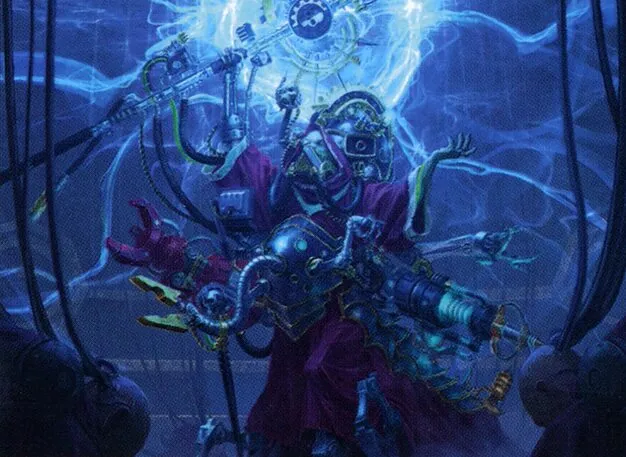

Thoughtmark is the small one. Fingers and thumb, delicate work, built for ideas that need precision. The Sisters of Silence use it for anything subtle or abstract. Battlemark is the opposite in scale, big sharp arm movements you can read across a battlefield at extreme range, close enough to Astartes battle-sign that the lore openly wonders whether the two share a root. Orsköde isn’t visual at all. It’s a clicking mechanical rattle for messages that have to travel beyond line of sight, and to anyone who hasn’t been trained it sounds like cogwheels turning.
Three separate systems, all maintained by an order whose members never speak aloud.
Warhammer Community ran a Sisters of Silence piece on the 3rd of September, part of their Pages from the Black Books series, pulling an extract out of Horus Heresy Book Three: Extermination from 2014. It’s a short post. Most of the actual substance sits in a scanned book page, which is how that whole series works, and I’d bet good money most people scrolled straight past it on the way to the Orks codex coverage.
I’ve been chewing on it since, mostly because I’d never properly sat down with what that vow actually costs them.
The Vow of Tranquility Comes at the End
I had the order of operations backwards for years. I’d assumed the silence was the entry requirement, the thing you swear on day one like a novice taking orders. The actual sequence runs a lot longer than that. Candidates are taken up as children, trained for years, and only once induction is confirmed do they take the Vow of Tranquility. Everything else about their training is already finished by the time it happens.
And it’s total. No spoken word for the rest of their lives. Not under torture, not under a blade, not when they’re shot. The lore is specific about that last part, and it’s the detail I keep snagging on.
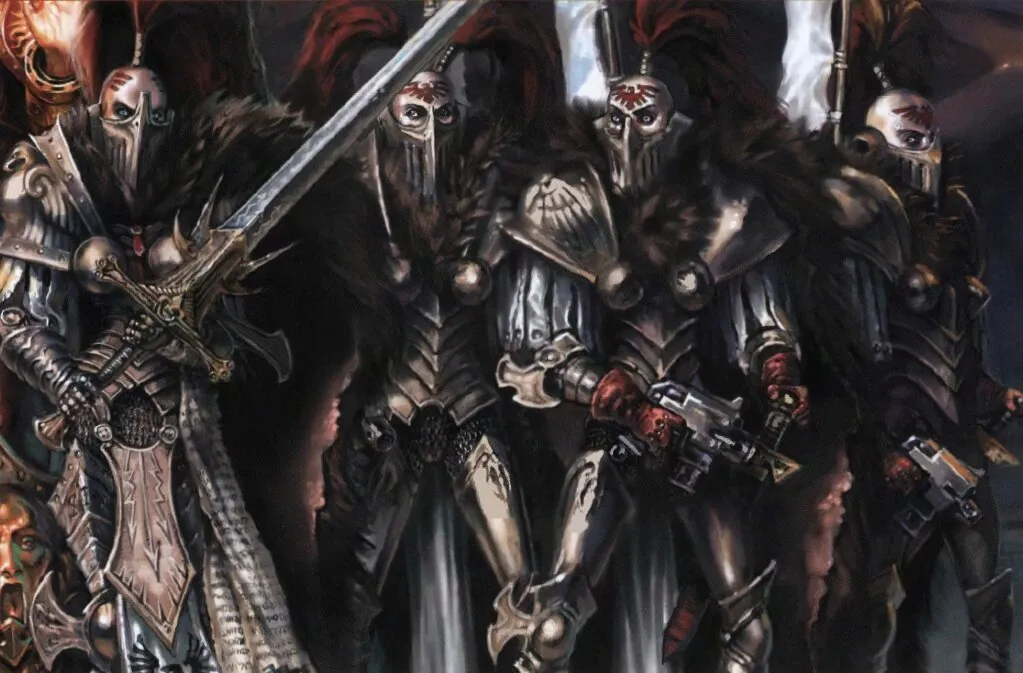
They wear a portcullis-style armoured gorget as the outward mark of it. A grille across the throat, usually paired with a skull. I’ve owned ten of these models since the Burning of Prospero box in 2016 and until about a week ago I could not have told you what that gorget was for. It’s a locked gate over the mouth, and it’s been sitting there in plain sight on the sprue for a decade while I happily painted around it.
Somebody Still Has to Talk to the Imperium
Which creates an obvious problem, and the solution is my favourite piece of Imperial bureaucracy in a setting absolutely stuffed with competition.
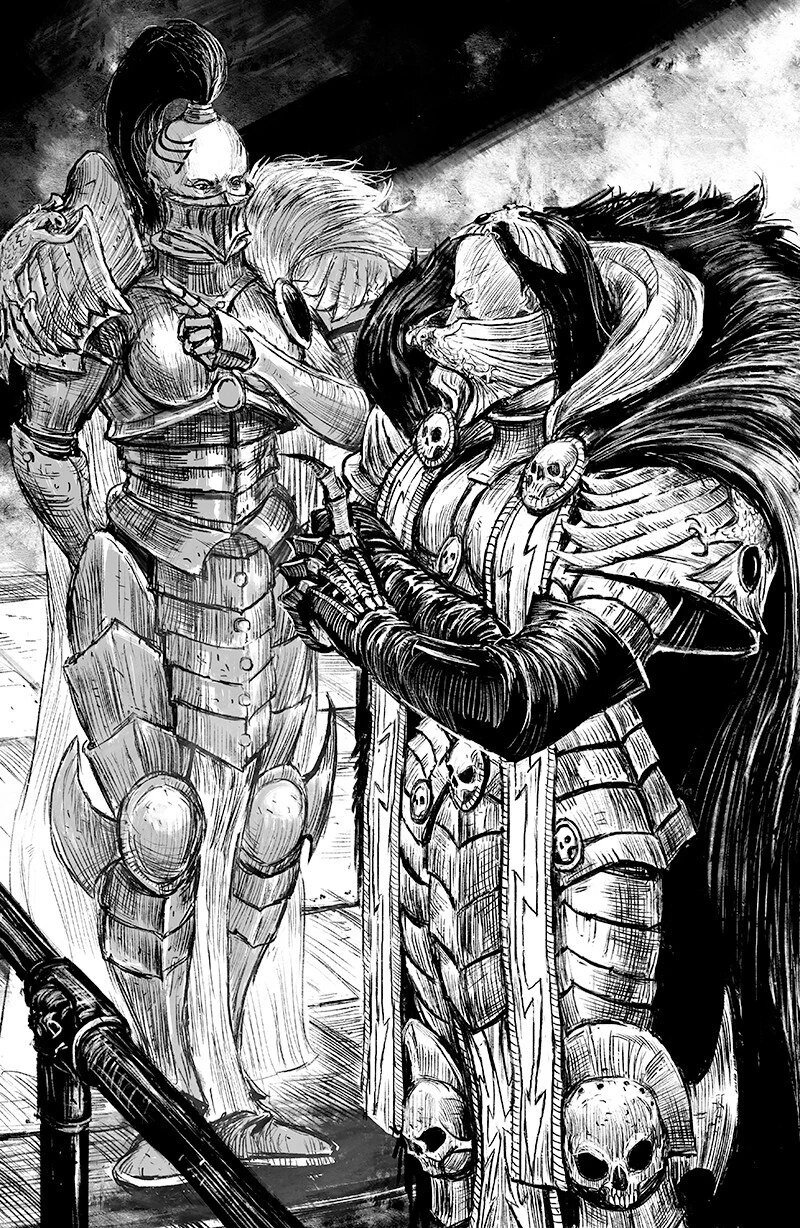
When a senior Sister needs to communicate with anyone outside the order, she can’t. So the Sisterhood brings a Proloquor. These are apprentice-acolytes, themselves Untouchables, warriors in training who haven’t taken the Vow yet. Their job is to stand there and translate their superior’s hands into speech. A child, more or less, speaking on behalf of a woman who has spent her entire life hunting psykers.
It’s the corporate version of a director who only communicates through their assistant, except the assistant is twelve and armed.
There’s a second method that I somehow like even more. The order maintains techno-linguis systems that render the sign-forms machine-readable at speed and, if things are urgent enough, push them out as a vox signal through servo-automata. So in an emergency a Sister of Silence can speak to you, after a fashion, through a machine that converts her hands into vox output.
They also keep fluency in Astartes battle-sign, plus voidsys and graph-binarc, so they can talk directly to Imperial military forces without an interpreter in the loop. That’s the functional, unglamorous version and it’s the one that would actually come up most often on campaign.
The Day Job Is a Prison Ship
Their routine work happens aboard the Black Ships, which is the bit I think gets skipped when people file the Sisterhood under anti-psyker shock troops and move on. The League of Black Ships is one of the two main organs of the Adeptus Astra Telepathica, and it’s the machinery that collects the Great Tithe. Every inhabited world gets a visit eventually. Every psyker the local authorities have rounded up goes into the hold.
Squads of Silent Sisters garrison those ships. They keep to the lower decks where the most unpredictable of the harvest are held, partly because that’s where the danger sits and partly because the astropaths and other psychically sensitive crew physically cannot stand to be near them. So the vessel ends up with a permanent internal exclusion zone, staffed by women nobody else aboard can bear to share a corridor with.
Enforcement is theirs too. A world that under-reports its psykers, or quietly declines to hand them over, gets investigated by the Sisterhood and dealt with without much in the way of appeal. That authority extends to organisations which consider themselves above planetary law, Ecclesiarchy holdings and Mechanicus forge worlds included.
Some worlds see a Black Ship less than once a generation. The gaps run long enough that the arrival stops being an administrative event and turns into folklore, and the folklore turns into panic, and panicking hive populations start turning on each other to make sure somebody gets handed over when the ramp comes down.
The Sisters of Silence Keep Vanishing From the Records
Here’s where I go a bit sideways, because the silence is an institutional habit as much as a personal discipline, and it has consequences that ripple out across ten thousand years of Imperial history.
An order sworn to secrecy writes very little down about itself. The Untouchables who make up its ranks are already the sort of people planetary records prefer not to mention. Add a vow that forbids testimony, and you get an organisation that is almost impossible to audit. So the Imperium loses track of it, more than once, and for long stretches at a time.
After the Heresy the surviving Sisters were scattered and directionless, and a fearful Imperium pushed them out. They then drop out of Imperial history for roughly fifteen hundred years. That number doesn’t fit in my head properly. My Imperial Fists have been in progress for eleven years and I already can’t remember what the first tactical squad looked like before I stripped it, so fifteen hundred years of an entire institution being quietly misfiled is beyond me.
They resurface during the War of the Beast in M32, when the last remnants of the Sisterhood turn out to matter rather a lot in stopping the biggest Ork WAAAGH! the Imperium had ever seen. Then they get officially disbanded after the Age of Apostasy in M36, except they don’t really, because enclaves keep operating anyway, just quieter and more selective about who they answer to.
And then there’s the world designated 9-13. The Fandom write-up of the order’s founding mentions it as the source of the Untouchables that the rebuilt Divisio Investigates was formed around. No such world appears in the databases of the Cartographica Imperialis. The number is simply missing from the sequence. I don’t know whether that’s meant to read as a redaction, a clerical failure, or GW leaving a door open, and I’d rather it stayed unanswered.
The Squad I Never Painted
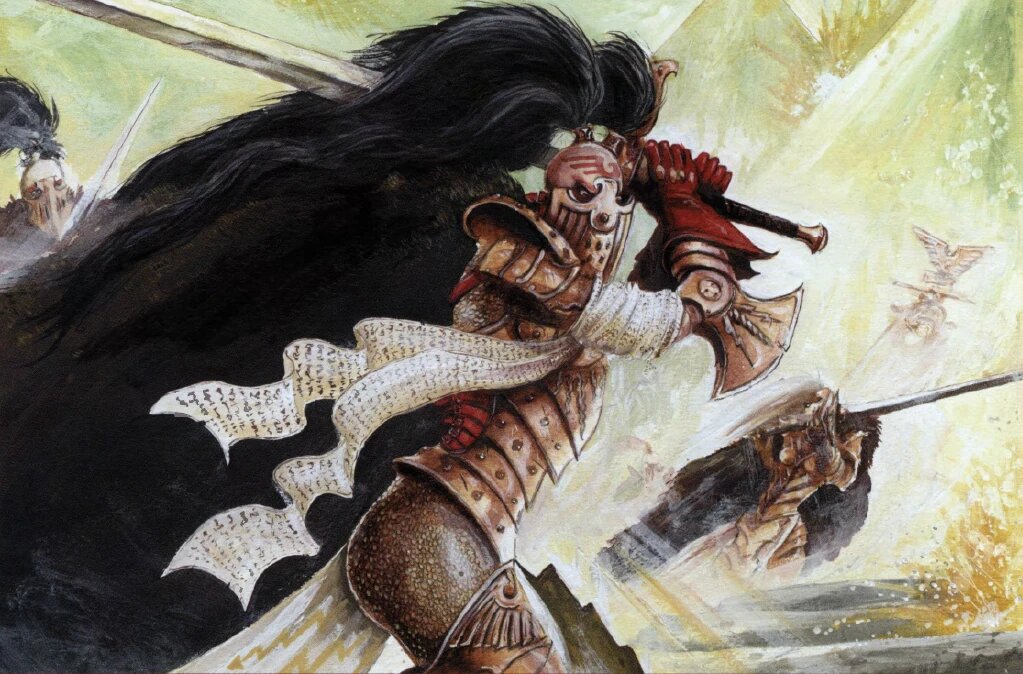
So, right. Burning of Prospero. 2016. I bought that box for the Custodes, obviously, because everybody bought that box for the Custodes. The Sisters sprue went into a drawer and stayed there for something like six years. Pete had his built and based inside a fortnight, which is Pete all over.
When I finally got them out I did the thing where you spend an entire evening on one detail nobody will ever see. Four hours on ten gorgets. Edge highlight, wash, re-highlight, a little bit of silver chipping on the grille bars. On the table they’re a dark smudge under a chin at eighteen inches. Pete looked at them, said “nice”, and went back to his Salamanders.
I built them all as Prosecutors, by the way, because I liked the boltguns. I’m aware the flamers do more work. I’ve never changed them and I’m not going to…
Anyway. My ten quiet ones sit in a foam tray and come out maybe twice a year, which is exactly the right usage rate for a unit whose entire lore identity is being forgotten about for centuries at a time.
Guilliman Had to Write Them a Letter
The restoration is the part that makes the whole thing land for me. When Guilliman comes back and the Great Rift opens, he remembers what his father thought these women were worth. So he issues the Dispensatus Anathema and sends out emissaries, specifically Sisters who’d fought alongside him at the Battle of Luna.
Note what that implies. The Imperial Regent could not simply summon them. There was no central register to pull, no chain of command to activate. He had to send people who personally knew where some of them were, and hope word travelled.
They came in from every direction, and by the time the Indomitus fleets mustered there were somewhere near three thousand of them on Terra. Each isolated group had spent generations solving different problems in different ways, so their tactics and traditions had drifted badly apart. Guilliman named the assembled hosts the Vigil Indomitus and split them into cadres across the crusade battlegroups.
Three thousand, spread across a galaxy’s worth of crusade fleets. Set against the Custodes, who they’ve partnered with since the Palace days, that works out thin.
I keep going back and forth on whether the vow is a strength or a self-inflicted wound. Most of the article above reads like I think it’s the second thing, and honestly for a paragraph or two while writing this I’d talked myself fully into that. An order that can’t testify, can’t be counted, and can’t advocate for itself is an order that gets disbanded by clerks. But then, they’re still here. The Ecclesiarchy has been reformed, the Inquisition has fractured into a dozen squabbling Ordos, and the Sisterhood just kept doing the same job through all of it without ever needing to argue its case. So I genuinely don’t know. I’ve argued myself into both positions writing this and I haven’t settled it.
The models are still around, split between the Talons of the Emperor kits and the odd character. If you do end up painting a squad, the gorget is worth the four hours even though nobody across the table will ever pick it out at eighteen inches.