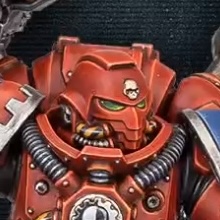
The Apothecary coming to Space Marine 2 belongs to a profession whose equipment list includes a chainsword for emergency amputations. I went looking for a description of the narthecium and ended up reading the armour annotations for a Minotaurs medic called Intendant Haukar. Imperial Armour Volume Twelve: The Fall of Orpheus, in its Minotaurs Chapter Apothecary section, identifies his Acitus-pattern chainsword as a weapon that also gets used to remove limbs when circumstances require it. He’s carrying a bolt pistol as well, with specialised cranial-penetration ammunition for administering the final mercy to a brother beyond recovery.
That’s the part of this job I’d like Saber to keep somewhere in the presentation. An Apothecary looks after a wounded man and the biological material needed to make the men who’ll replace him, sometimes during the same encounter. I’ve been reading the old implant descriptions alongside the announcement, particularly the instructions for recovering and storing progenoid glands.
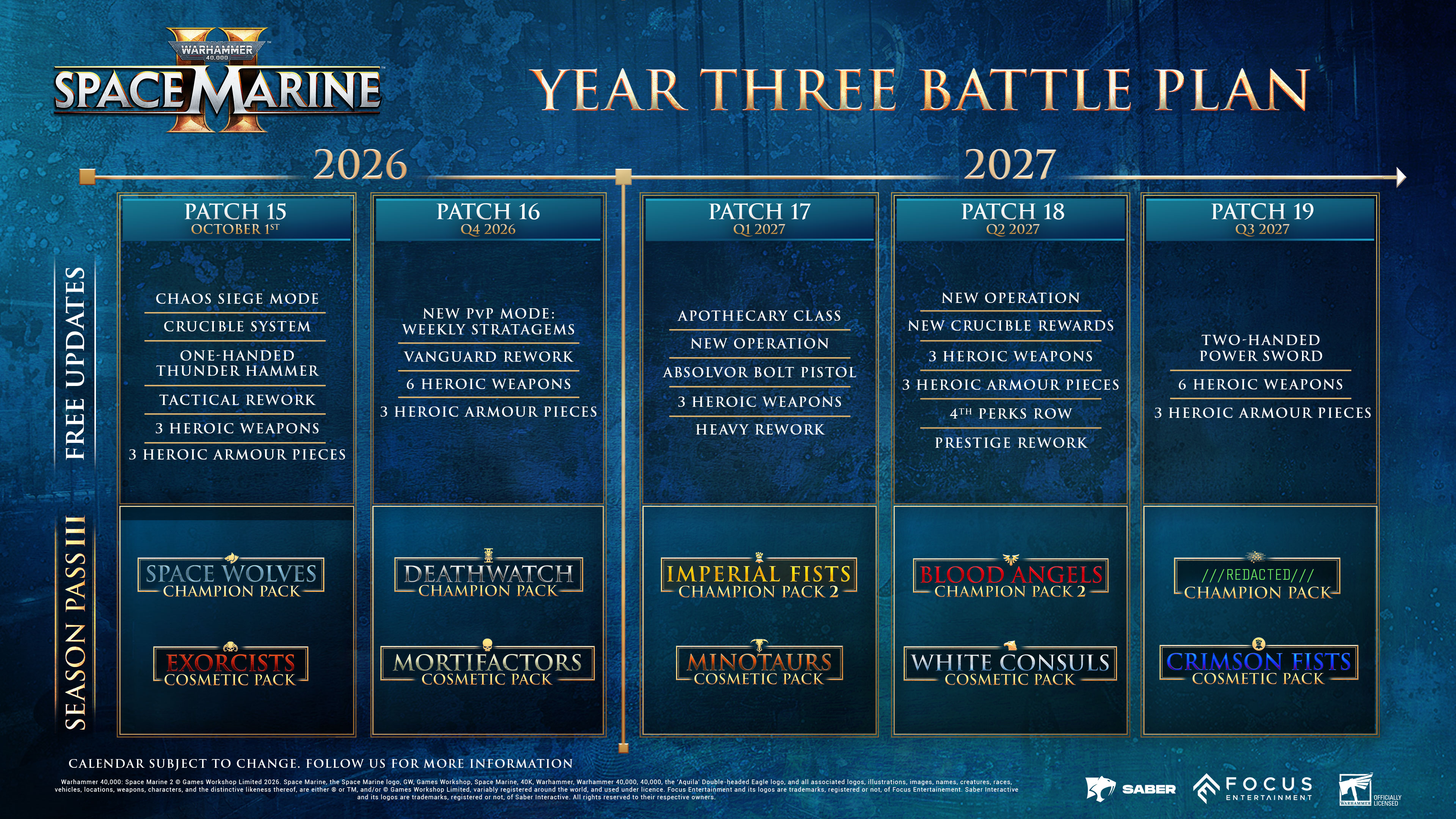
Focus’s September Community Update confirms the Apothecary class for Patch 17, planned for the first quarter of 2027. Its Champion skin is due in the following update. The October anniversary release put the Year 3 plan back in front of everyone, but the class is still ahead of us, and Focus says further information will come later. The published announcement doesn’t give us a skill tree or a healing ability to evaluate yet.
Space Marine 2’s Apothecary has somebody else’s organs to look after
White Dwarf #301’s Apothecaries entry describes the qualification quite specifically: aptitude for physiology, accompanied by the proper reverence for the Chapter’s gene-seed. I like that combination. A recruit has to understand the machinery of a body and treat its inherited material with something approaching religious devotion. The same entry says Apothecaries deal with injuries too severe for a Marine’s enhanced physiology and power armour to manage.
Power armour already participates in keeping its wearer alive. In White Dwarf #421’s implant descriptions, the black carapace interfaces with the armour’s monitoring, medicinal, and maintenance systems. The Marine has biological safeguards as well. That issue describes the oolitic kidney working with the secondary heart to circulate blood rapidly during emergency detoxification, leaving him unconscious while the process runs. An Apothecary arrives with a patient whose body has already attempted a fair amount of its own treatment, potentially while the patient was still firing a boltgun.
Haukar’s equipment plate makes the practical work easier to picture. The Fall of Orpheus gives his armour integral biological scanners and illuminator lamps, alongside narthecium and reductor apparatus. There’s a haemogenic transfuser containing concentrated blood-based regenerative and antitoxic preparations derived from the Chapter’s gene-seed. The annotation says high doses are dangerous and that the solutions are fatal to unaugmented humans. I wouldn’t expect an Imperial civilian to get much reassurance from watching him approach with one of those.
The same section places Haukar with the Minotaurs’ Amarah Prime task force during the Orphean War. Necron gauss weapons were inflicting molecular flaying injuries that even Astartes physiology struggled to survive or heal. It’s a useful limit to keep in mind when someone asks why a superhuman needs a medic. His organs can be doing everything they’re designed to do while the weapon hitting him removes tissue faster than any of them can respond. The book locates that problem in the fighting against the Necrons, with the Apothecarion working through the resulting casualties.
The Minotaurs also expect their Apothecaries to fight as the equals of the brothers around them, according to Haukar’s entry. Medicine doesn’t excuse him from combat training or make the chainsword ceremonial. That gives Saber quite a bit to work with before anyone starts inventing a special attack: armoured surgery under fire, a scanner, a pistol, and a man trying to make a judgement with something horrible coming through the door behind him.
Five years for one gland, ten for the other
The progenoids are where the job gets difficult to reduce to a videogame ability. White Dwarf #421, in its Phase 18 implant description, places one gland in the neck and another deep inside the chest. They grow within the Marine, absorbing genetic material and hormonal stimuli from his other implants. The neck gland matures after five years; the chest gland after ten. Once mature, a gland can be removed. The article then describes preparation, checks for mutation, and storage of the usable gene-seeds under suitable conditions.
There’s an important detail in that sequence: maturation permits removal. The description doesn’t make death a universal prerequisite. The issue’s Reproducing Zygotes section explicitly allows recovery from a living Marine or a very recently dead one. So whenever the question comes up about why Chapters don’t take out every available gland before deployment, I get wary of answers which turn one battlefield scene into a rule for the entire setting. The source establishes that living extraction is possible. I don’t know a single scheduling policy that covers every Chapter, and this passage doesn’t offer one.
Each mature gland carries gene-seeds corresponding to the implanted organs, in #421’s account. Recovering it gives the Chapter material from which replacement implants can be cultivated. That still leaves a considerable process ahead. The same issue’s Stages in Space Marine Initiation table spreads surgery across the recruit’s adolescence, with ideal implantation ages attached to individual organs. I’ve already spent time on the Scout waiting for his black carapace; the progenoids sit inside that larger progression, alongside training and the rest of the implantation programme.
You can’t turn a bag of recovered glands into a replacement squad for tomorrow’s assault. Reproducing Zygotes says each Marine has only two progenoids, which restricts the rate at which a Chapter can make new warriors. It also says rebuilding after heavy losses can take years, and that the efficiency of different Chapters’ gene-seed varies. The Apothecary is handling something whose eventual use stretches well beyond the battle in which he retrieves it, through storage, cultivation, and implantation into a recruit.
And a recovered gland can be unusable. #421 specifically mentions radiation and other genetic disturbances as causes of spoiled gene-seed. Its preparation instructions require individual gene-seeds to be checked for mutation before sound material is stored. I keep thinking about the handover after a supposedly successful retrieval: the squad got the body out, the extraction happened, the transport reached the Apothecarion, and the subsequent tests can still produce a loss. I’d be interested in a campaign following that material back to the fortress, especially if the Chapter has already committed its available recruits to another expedition.
The Torchbearer fleets brought fresh gene material and Primaris technology to Chapters across the Imperium, with all the administrative confusion that involved. Even with those deliveries in the setting, the day-to-day work described here has somewhere to go. The Apothecarion has to maintain its stock, process recoveries, and oversee the biological side of turning suitable recruits into battle-brothers.
I painted the wrong bit for an entire evening
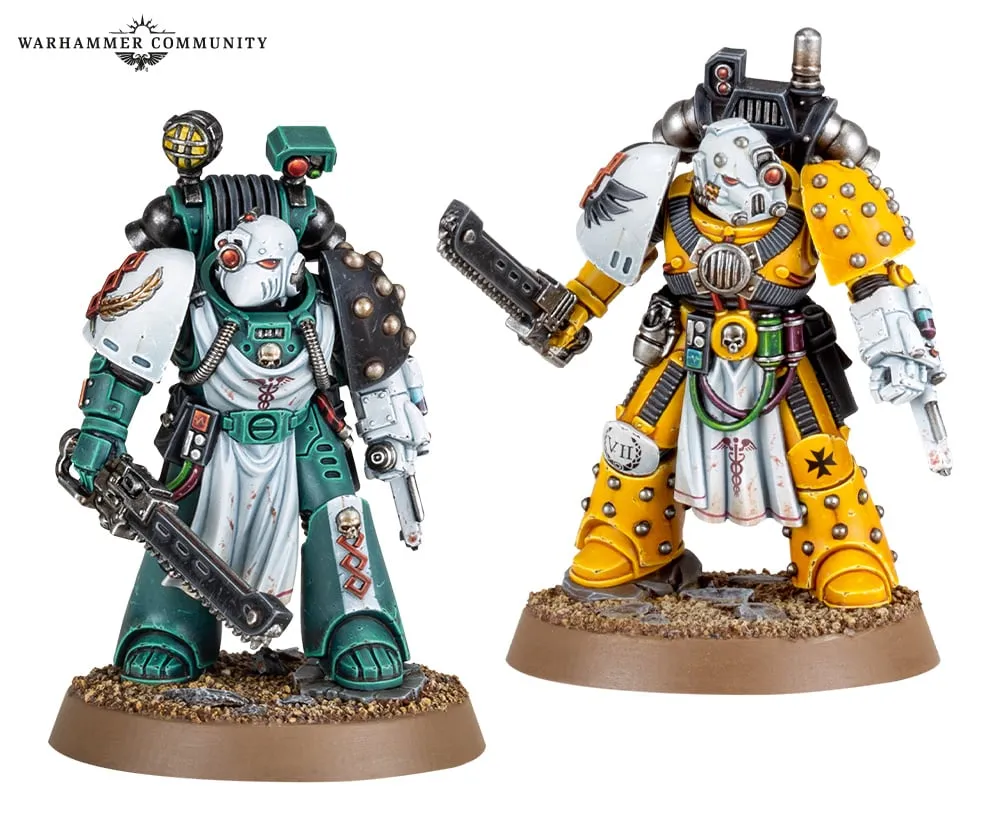
Around the end of 6th edition I tried to make an Apothecary for my Imperial Fists out of a spare command-squad body and the white-armoured bits I’d been avoiding. I spent most of a Thursday evening getting the little vials on his belt to look like glass. Caliban Green underneath, a narrow lighter stripe, a white dot. Then I glued his arm on and covered two of them with the pistol. Pete saw him at the next garage game and asked whether I’d meant to put the shoulder pad on upside down. I hadn’t, and by then I’d varnished it.
My poor little doctor stayed that way. Fixing him would’ve meant taking a blade to a paint job I’d already spent too long on, so I decided the pad was some obscure Apothecarion custom and hoped nobody else asked. This was before I got into the habit of reading the equipment descriptions. I mostly wanted a white model to break up the yellow, which also explains why I was so annoyed when the pistol hid the only bits I’d painted properly.
So, yeah. The medic. You want him nearby. Close enough to get you up. Then you’re running towards the next fight and he’s still back there doing the job, and you realise you’ve left him with the enemies you ran past. I’ve done the tabletop version of that, with the white model very helpfully visible to everybody across the garage.
The Biologis brings a different set of tools
The Gravis-armoured Apothecary Biologis is worth separating out while we’re waiting to see Saber’s class in detail. In WarCom’s Leviathan contents article, his described function is to collect enemy biomatter with a vivispectrum and use that biological knowledge against the enemy. The heavy armour allows him to advance through hostile fire to acquire those samples. That’s the model with the large specimen container that turned up in the launch box.
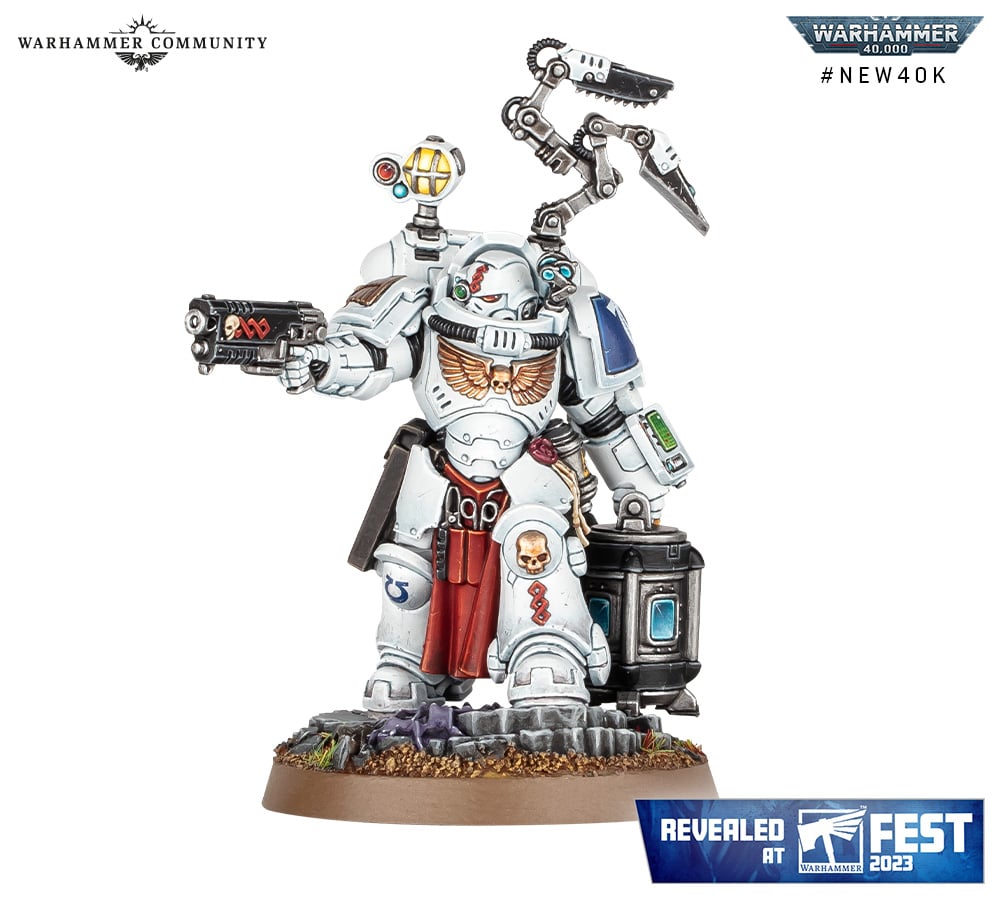
The Biologis gives the profession an additional battlefield purpose, and I can see why people gravitate towards him when picturing a new class. He’s broad, heavily protected, and carries a prop you can recognise across a room. Still, armour shape alone won’t tell us how Saber intends its Apothecary to operate. The class announcement leaves that discussion open. The tabletop miniature shown here illustrates the Biologis role; it’s no evidence of a particular mechanic coming to Space Marine 2.
I started writing this thinking gene-seed recovery ought to be the centre of the class. I’m less certain after trying to imagine doing it repeatedly in Operations. A squadmate goes down, you stabilise him, the group pushes on; that’s immediately useful and easy to read in combat. Having the healer repeatedly stop to perform extractions could become tedious, particularly if the other two players are waiting at a lift. I’d probably be the one complaining by the third run of the evening, which is awkward given how much I want the setting’s medical work to survive the adaptation.
A mission objective could make room for it. Recover a fallen squad’s gene-seed, get the container aboard the transport, perhaps decide whether to take a dangerous route to reach another casualty. Those are my suggestions, completely separate from the announced roadmap. They’d give an Apothecary something to do with the reductor while letting ordinary fights concentrate on helping living brothers. The equipment could appear in the animations and mission dialogue even when the moment-to-moment ability is straightforward healing.
White Dwarf #301 ends its Apothecaries entry by pointing to the Celestial Lions’ terrible losses on Armageddon. It presents them as a Chapter discovering what the loss of these specialists means for its continued existence. That small reference has stayed with me through the research because it puts a Chapter-scale consequence beside the everyday work we’ve been discussing, without needing a famous Chief Apothecary or a duel with a daemon.
For the game, I’d be happy with one retrieval mission that lets the squad finish the shooting and then asks somebody to go back for a brother whose remains are still out there. Give the Apothecary a scanner reading, make the other two cover him, and let the extraction take long enough that I have to stop sprinting towards the exit. I’d like to hear what the squad says over the vox while he works.