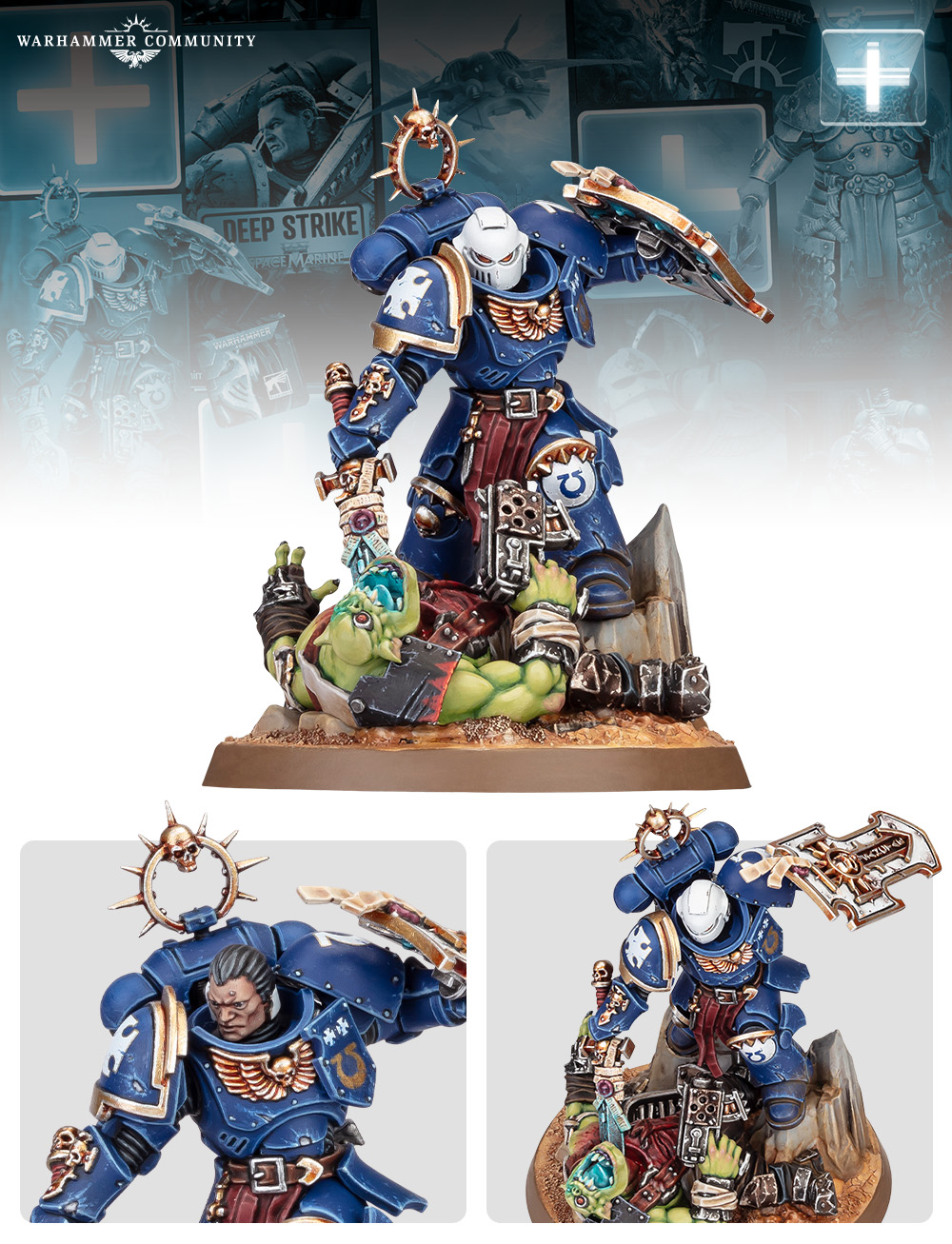
“Wrath of Macragge continues a sterling tradition of Space Marines stabbing Orks on bases.”
That’s Games Workshop’s own copy, from Thursday’s Warhammer+ reveal, and it’s clearly written as a throwaway gag. It’s also the most honest sentence about GW’s art direction I’ve read in a while, and I don’t think whoever typed it knew how literal they were being.
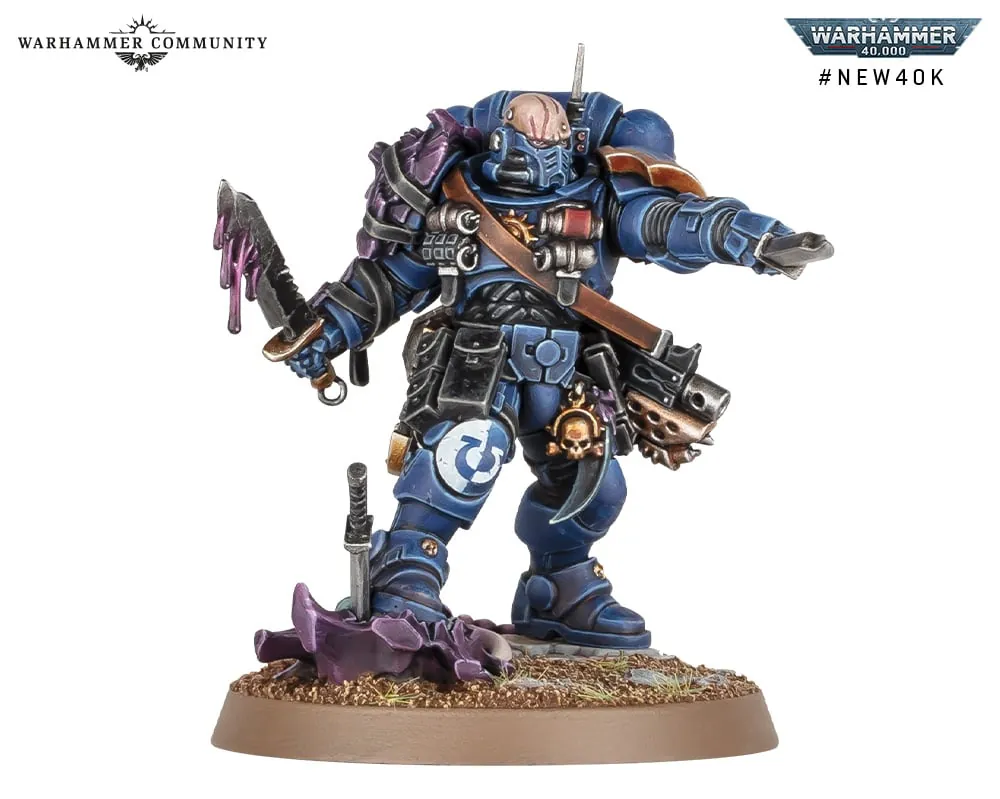
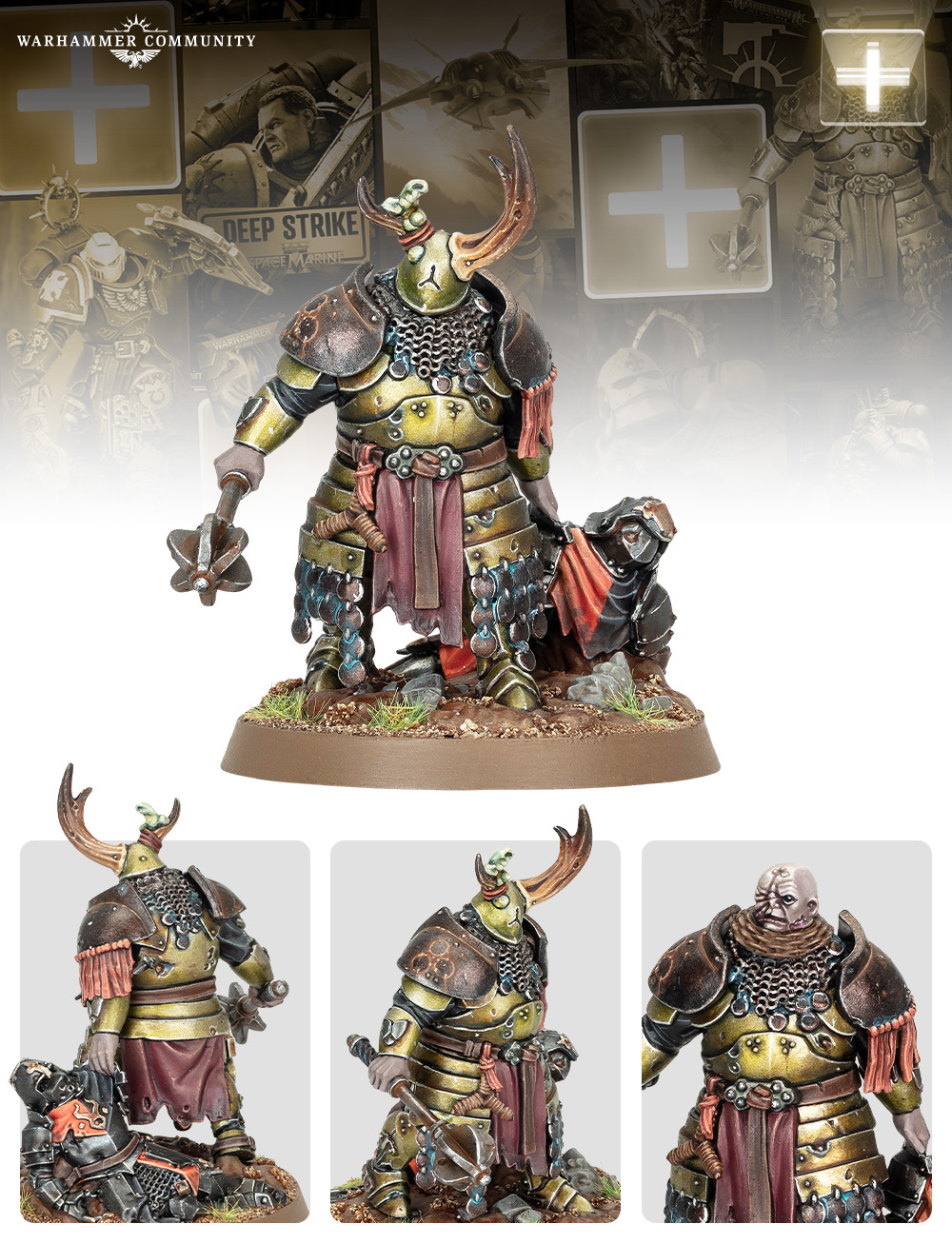
The model is a Bladeguard Veteran mid-lunge, relic blade already on its way down into an Ork that’s flat on its back with one arm raised in the least effective block in the galaxy. Iron halo, tabard, the usual seals hanging off him. There’s a bare-head option too, older-looking bloke, slicked-back hair, scar across one cheek. GW painted it Ultramarine blue for the photos and named it after Guilliman’s homeworld, then went out of their way to say there are no sculpted Chapter markings anywhere on it, so you can paint it for whoever you collect. The other model this year is The Plague Knight’s Burden, a Maggotkin Rotsword hauling a battered Freeguild soldier off somewhere by the scruff of his armour.
The naming is the odd bit. Wrath of Macragge, after a planet, on a sculpt carrying nothing that says Macragge. GW’s position is that the blue in the photos is a suggestion and the model is Chapter-neutral, which is completely true, and then they named it after a specific world anyway. The Age of Sigmar one is called The Plague Knight’s Burden, which at least describes what’s happening in it.
The picture came first, then somebody built it
In 1993 the Warhammer 40,000 2nd edition starter box went out with cover art by John Blanche. Space Marines and Orks, red everywhere, spikes on things that don’t need spikes. Standard for that period.
The year after, Mike McVey, then working on the ‘Eavy Metal team and later the bloke behind the Horus versus the Emperor diorama that half the hobby has tried to copy, converted that cover art into an actual miniature. Built the painting out of plastic and metal. It ran in White Dwarf 174.
That sort of thing was normal in the mid-nineties in a way it really isn’t now. ‘Eavy Metal weren’t only painting studio armies; a decent chunk of White Dwarf in that era was the painting team showing off pieces they’d built because they felt like it, and cover art was fair game as a brief. Somebody looks at a box, decides they can do it in three dimensions, and the magazine runs eight photos of the result. No product attached to it. It was just what they did that month.
Then in 2012, Games Workshop turned McVey’s conversion into a commemorative miniature and sold it at Games Day. That one’s in White Dwarf 385.
So you get a painting, then a hobbyist’s model of the painting, then a factory model of the model of the painting. And now, fourteen years on from that, another factory model of more or less the same tableau, posted to every Warhammer+ subscriber who’s signed up by the end of August. That’s thirty-three years of GW coming back to the same composition. I was four when the first one shipped.
Wrath of Macragge is at least the third go at the same tableau
I want to be careful here, because I can’t tell you the 2012 Games Day model and the 2026 subscriber model are the same sculpt. They’re obviously not. Different Marine, different armour mark, different Ork, thirty years of casting technology in between. What’s identical is the arrangement: one Astartes upright and mid-kill, one greenskin on the floor beneath him, both on a single base, sold as a display piece.
And I’ve owned a version of it without realising. Around 2013 I bought a job lot of old metal off eBay, twenty-two quid, entirely because there was a Rhino in the listing photo that I wanted for my Imperial Fists and I couldn’t face paying retail for one. It arrived in a shoebox full of loose arms and a smell I still associate with stripping paint. Somewhere in the middle was a metal Marine on a slotta base with a dead Ork sculpted under his boot. No idea what release, no tab markings I could read, and it wasn’t yellow, so into the drawer it went while I got on with the Rhino. It’s still in there, still unpainted. It only clicked what it probably was when I read Thursday’s reveal. Thirteen years and I never turned the thing over to look at the tab.
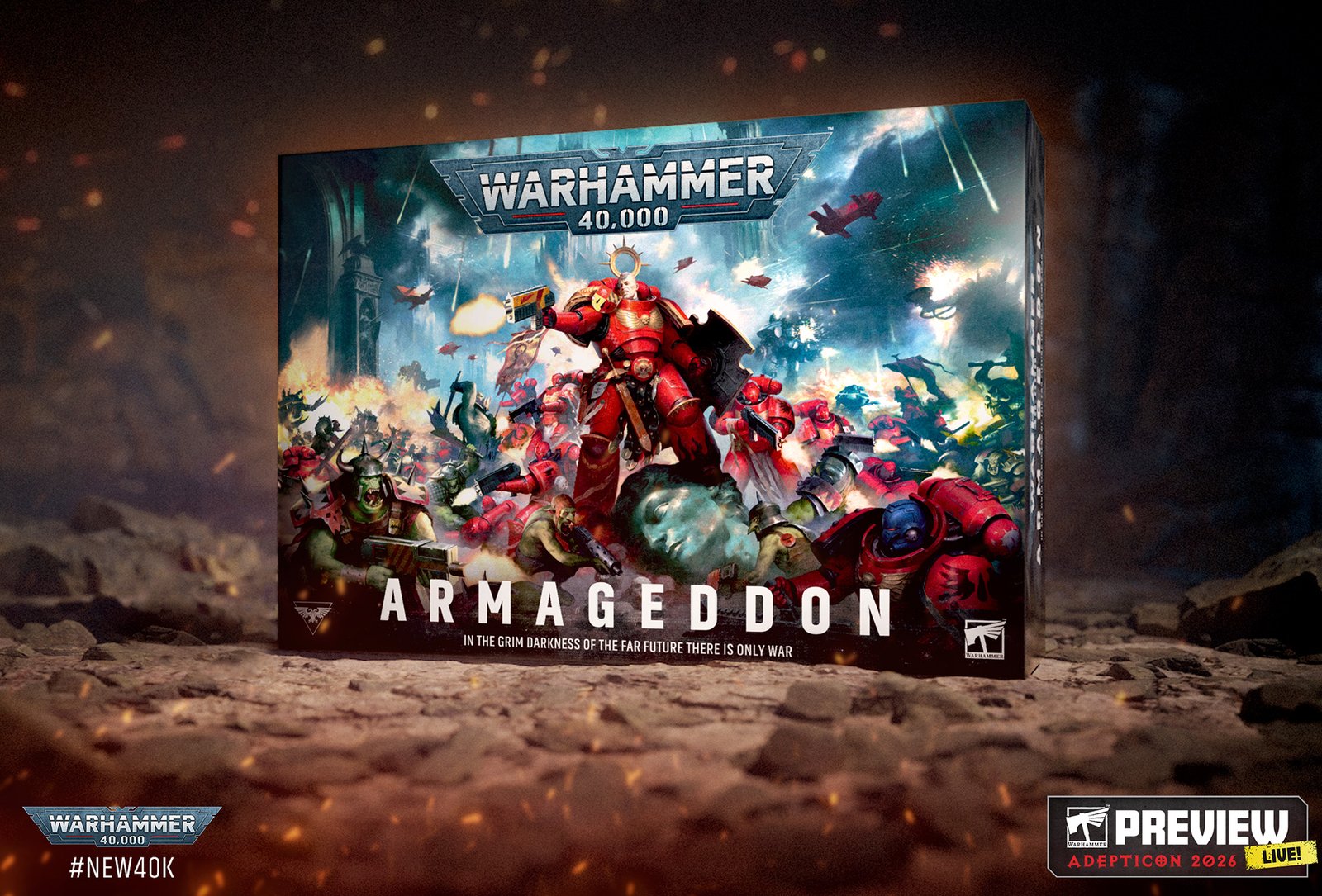
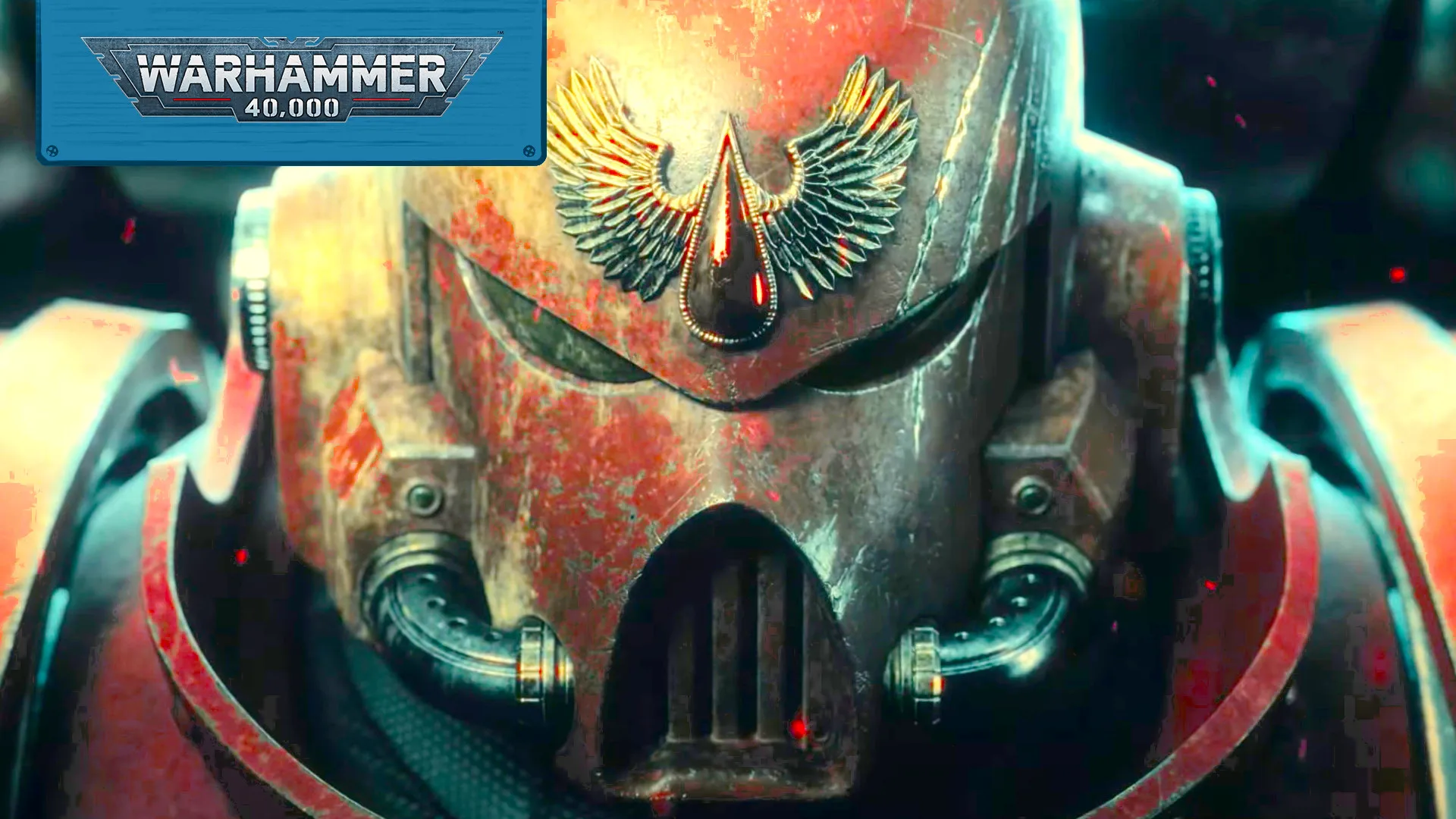
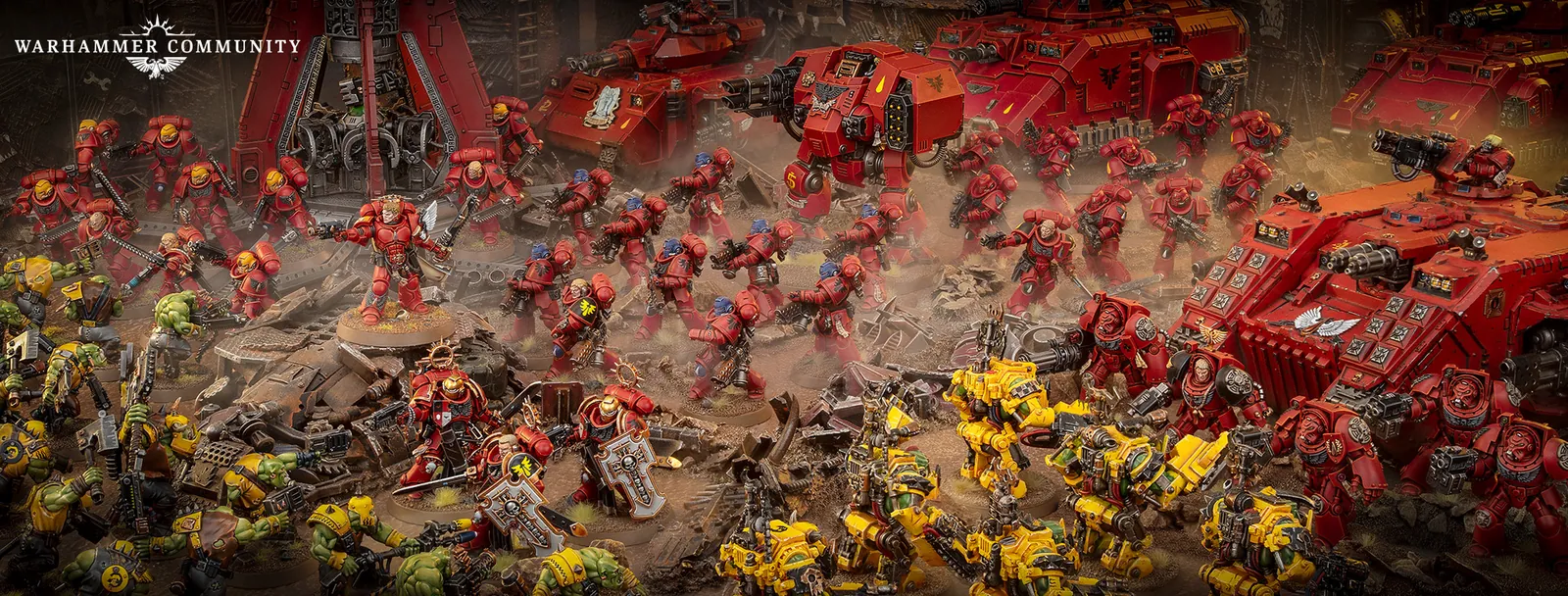
Walk past a Warhammer store this month and the same picture is in the window at a much bigger size. I did exactly that a couple of weekends back with my daughter, who is six, doesn’t play, and has no idea what any of it is. She looked at the Armageddon box, pointed, and told me the red robot man was winning. She’s completely right. The 11th edition launch box is a Blood Angels Captain up on the rubble with a relic shield and a bolt pistol, a severed Ork head roughly the size of his chest sitting under his boots, and a six-year-old with zero context read it correctly in about a second. I’ve gone on at length about the 1993 loop that box closes and won’t do it twice here, but that’s the same arrangement of bodies blown up to shop-window size and lit from below.
What a commemorative model is actually for
Nobody needs another Bladeguard Veteran. They’re not scarce, they’re not expensive, and a single one on a scenic base isn’t going into anyone’s list. GW isn’t filling a hole in the range with this.
The job of a commemorative is to be a year. You put it on the shelf and in eight years’ time it says 2026 at you, the same way the blind-box Space Marine Heroes stuff says whichever year you cracked those open. So GW gets to pick anything in the entire setting, has to narrow it to one sculpt, and then that sculpt goes out to every name on the subscriber list.
Run down the commemorative and subscriber line since it started and the Imperium is doing most of the heavy lifting. A Primaris Captain in 2018. Lieutenant Amulius and Sergeant Jovan in 2019. A Chaplain in Terminator armour, Uriel Ventris, Primaris Sergeant Castus, a Company Champion, Captain Centos for the 500th store opening, a jump-pack Captain last year. There are Necron lords and Skaven and a Kroot in there too, but the centre of gravity is a bloke in power armour, and it has been for the better part of a decade.
Last year’s Warhammer+ pair genuinely swerved it. The 40K model was Infinity’s Lament, a Spiritseer standing in the wreckage of a shattered Wraithlord, head broken into angular shards. That’s a mournful thing to sculpt. Nobody’s winning in it. Then 2026 rolls around. GW calls it their biggest subscriber year ever, sticks the first Warhammer Yearbook in alongside both models, and the 40K one is a Bladeguard Veteran with his sword through an Ork’s chest.
The bit where I argue myself out of it
A single-figure diorama needs a height difference or there’s no scene, though. You want drama on a 40mm base, you put one model up and one model down. That’s geometry doing the work. Every wargame company that has ever sold a display piece has sold a bloke standing over another bloke, and if the two figures are the same height and both upright it reads as two people queuing.
I sat with that for a bit, because it’s a decent objection and I nearly binned this whole article over it.
Then I looked at The Plague Knight’s Burden again. Same year, same line, same two-figure format, same base size. A Rotsword dragging a Freeguild soldier away, the soldier’s plate dented all over from the maul the Rotsword is carrying. It’s got the height difference. It’s got the drama. And it reads as a horror story, because the Chaos model is carrying someone off to whatever happens next. So the format wasn’t forcing GW’s hand. They had the other option available in the same reveal, on the same day, and they used it for the Age of Sigmar half.
There’s a version of this where I’m just annoyed on behalf of the Orks, who have now spent three decades as the thing that goes under the boot in GW’s official photography while being, by some distance, the most likeable faction in the setting. Ghazghkull would be fine with it, mind. Getting stomped on and coming back bigger is more or less his entire deal…
The reason the image works isn’t complicated, and it’s the same reason it worked in 1993. Blanche’s grammar for grimdark needs a victim in frame for the armour to mean anything. A Space Marine standing alone is a man in a suit. A Space Marine standing on something is the Imperium. My daughter got there without knowing a single faction name.
Anyway. I’ll probably end up with the thing. I’ve been a Warhammer+ subscriber since the Vault got the old White Dwarf back issues, mostly for the 2003-onwards scans rather than anything else, and this year I don’t have to choose which model I want, so I’ll get a Bladeguard Veteran I have no use for and it’ll go in a drawer next to a metal one I bought by accident in 2013.
The rest of the subscription keeps its usual shape. Four new animated series over the next twelve months and north of a hundred episodes of the hobby, gaming and lore shows. The Vault now carries White Dwarf back to 2003 alongside background sections from Imperial Armour, Psychic Awakening and a stack of other supplements. Unlimited lists in Battle Forge, a monthly fifteen percent merch voucher, subscriber-only competitions. Paying annually gets you twelve months for the price of nine and the models arrive earlier.
The new subscription year starts on 25 August. Both models and the Yearbook are included from that date, and last year’s pair, The Summons and Infinity’s Lament, cycle out the same day. GW’s footnote on the reveal says the Ork can be painted for whichever clan you fancy, “though as it doesn’t look like it’s his lucky day, maybe not a Deathskull.”