
There’s a hollow planet on the galactic fringe with a machine inside it that can murder any star you point at. It’s been sitting there for over sixty million years. The people who built it are mostly still on duty, mostly still immortal, mostly still not using it. And every so often a Reddit thread goes up saying “why didn’t the Imperium just steal the Celestial Orrery already,” and the answer is always more interesting than the question.
I want to talk about that answer, because the Orrery is one of those pieces of 40K lore that reveals more about its owners the less it gets used. You can tell a lot about a civilisation by the weapons they don’t reach for.
What the thing actually does
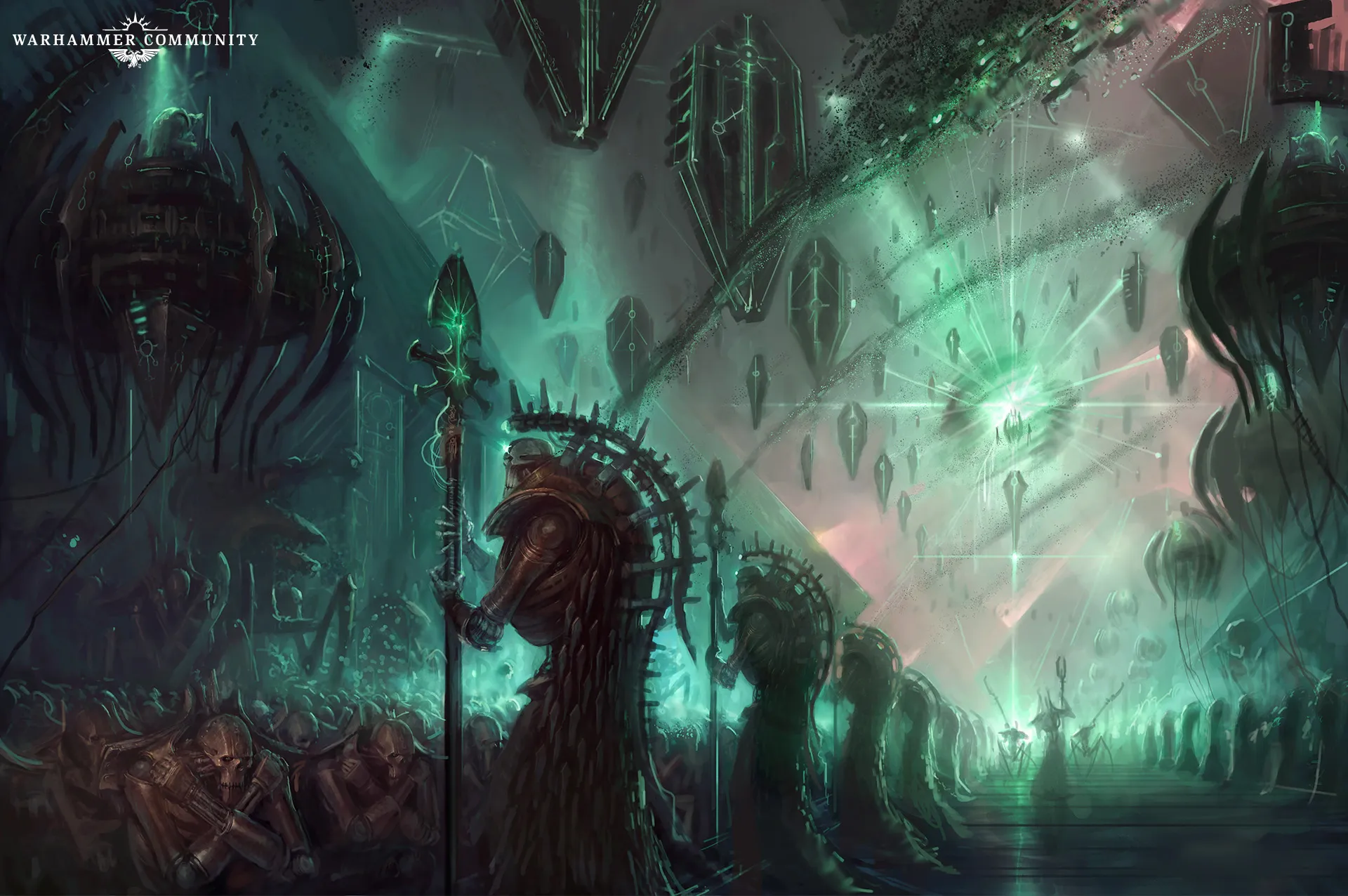
The Celestial Orrery lives at the heart of Thanatos, the hollow Crownworld of the Oruscar Dynasty. It’s a sphere of holograms and necrodermis suspended in a chamber at the planet’s core. Each floating point of light corresponds to one star in the Milky Way, and the relationship between them isn’t symbolic. It’s physical. Snuff out one of those tiny lights and the real star, wherever it is in the galaxy, goes supernova millennia ahead of schedule. Every world in its system dies. Every civilisation around it ends.
There is no weapon in 40K that does this at this range, with this precision, from this kind of safety. The Death Star is a fireworks display next to this thing. The World Engine was a planet-sized ship that had to physically arrive somewhere to wreck it, and it got stopped by seven hundred and seventy-two Space Marines who were willing to die. The Celestial Orrery is an armchair.
The catch, and this is the part people gloss over when they get excited about the weapon, is that every star you kill breaks the cosmic load-bearing structure a little. Pull too many and the whole web collapses. So the Oruscar don’t just press a button and leave. They spend thousands of years afterwards using the same Orrery to rebalance what they broke. Each single use is a millennium of careful post-surgery.
Sixty million years of not pressing the button
This is where it gets interesting to me. The Oruscar call themselves gardeners. That’s the word they use. Not executioners, not kings, not even astronomers. Gardeners. They think of the galaxy as an overgrown orchard and their job as occasional, sparing pruning. Keep the weeds down. Don’t uproot the roses. The idea of conquering the galaxy with it never seems to come up in any surviving account, and that absence is the weirdest thing in the lore.
Think about how long sixty million years is. The dinosaurs died something like sixty-six million years ago. The Oruscar have been quietly tending this device for longer than mammals have been the dominant life form on Earth. The people who originally sat down to build it were in their thirties, forties, fifties. Their dynasty’s first Phaeron was mortal, had a lifespan Necrontyr lifespans could be measured in single decades before biotransference, and commissioned the thing expecting to be dead before it was finished. Their descendants have had it as long as you could run an Imperium. Twice. Six times.
By Necron standards it’s obsolete. Imotekh the Stormlord’s Sautekh Dynasty is the one doing the conquering these days, with armies and strategic patience and the occasional strategic nuke from a Pylon. The Oruscar sit on a weapon that could make the Sautekh project redundant in an afternoon, and they never call them up to offer it. Nobody offers it. Nobody even seems to really want it, aside from Trazyn, and we’ll get to him.
I got into all of this honestly because I was trying to paint an Imotekh model for a friend’s narrative game in 2021 and fell asleep with the 9th edition Codex: Necrons open on my chest. Woke up at three in the morning with the book face down on the carpet, the corner bent, and a line about the Orrery highlighted with my own tiny pencil marks. I don’t remember doing it. I still don’t know what I was trying to note. But that was the rabbit hole, and the rabbit hole went deep. The best bit of Necron lore is always the bit you weren’t meant to be reading yet.
What the Oruscar actually believe
The gardener framing isn’t a joke. Necrons, or at least the ones who kept their minds through biotransference, run on obligations rather than ambitions. They are ancient, ancient beings who have watched species rise and die. The Oruscar have seen the Old Ones fall, the War in Heaven end, the Eldar empire rise, the Eldar empire implode, the Imperium build itself out of the wreckage, and they have catalogued every single one of those events without touching the Orrery for any of them. That’s not restraint, that’s identity. They are the dynasty who holds the weapon, and the point of them is that they don’t use it. If they used it, they wouldn’t be them anymore.
There’s also the practical bit. If the Oruscar ever announced they were about to start firing, they’d have every other Necron dynasty at their gates inside an afternoon. The Szarekhan wouldn’t permit it. Imotekh wouldn’t permit it. The entire political stability of the post-awakening Necron galaxy would collapse the second somebody actually started snuffing stars at scale. They’d spend more effort fighting their own kind than they’d ever spend on whatever target they were trying to kill.
And then there’s the thing about the custodianship being generational. The people who currently guard the Orrery didn’t invent the weapon. They inherited the job. Imagine if your family had been doing one task for sixty million years. You wouldn’t know how to stop. The Oruscar don’t run the Orrery because they want to, they run it because they always have. That kind of institutional momentum is one of the truly horrifying Necron concepts and it’s one the books never quite spell out, though you can feel it underneath every description.
I’m going to walk that back a little. Sometimes when I write about Necron restraint I worry I’m making them sound noble. They aren’t. The Oruscar wage wars constantly to stop other Necrons from getting near the Orrery, and those wars presumably end with worlds burned and fleets smashed and civilian populations reduced to corpse-piles. So “wise stewards” is probably giving them too much credit. They’re paranoid arsonists who won’t share their lighter. Which is arguably more Necron anyway.
The one time someone actually used it
The thirteenth Black Crusade, 999.M41. Trazyn the Infinite of the Nihilakh Dynasty shows up on Thanatos, offers some mixture of bribes and charm and almost certainly a stolen artefact to return, and gets permission to look inside the Orrery. He isn’t there to murder a star. His home tomb world of Solemnace has been damaged by an ancient Imperial relic called the Bell of Saint Gerstahl ringing itself off, which was what it was built to do when Chaos threatened the whole galaxy, and Trazyn wants to know what’s causing it.
What he sees is the Orrery lit from below by a crimson stain. It pulses under the web of stars like an infection. And the Oruscar know. They’ve known for centuries. Maybe millennia. They haven’t moved.
That’s the line that made me reread the passage three times the first time I found it. The Oruscar saw the rise of Chaos through the Orrery and did nothing because inaction was the price of their custodianship. Trazyn, who acknowledges no master save his own amusement, does not have that restriction. He traces the corruption to its source, a drab grey world on the edge of the Eye of Terror called Cadia, and he goes. He teaches Belisarius Cawl how to activate the Cadian Pylons. He releases parts of his collection as reinforcements. He loses. But he tries, and he only tried because the Orrery showed him the problem, and the Orrery could only show him because someone had kept it running for sixty million years without firing it.
So why doesn’t the Imperium steal it
They don’t know where it is. Thanatos is a hollow tomb world on the galactic edge with a standing Necron garrison that has had deep time to prepare. Even if the Adeptus Mechanicus somehow learned it existed, in the sense that a confused Magos got a secondhand rumour in a data-slate, the fleet they’d need to punch through the Oruscar and successfully extract a device they don’t know how to operate and can’t take with them would be the kind of thing the Imperium only assembles for a Black Crusade. And you can’t use the Orrery without breaking the cosmic web, which means you’d be holding a doomsday weapon whose first pull of the trigger kills your own worlds via chain reaction unless you know the micromanagement trick, which took the Oruscar a sixty million year internship to learn.
So yeah. Oruscar. Crownworld. Tomb. Big weapon. Been there forever. Nobody’s taking it. Nobody’s using it. Just, sort of, humming away under the surface of the setting, doing nothing, influencing everything. Point is, it keeps being the scariest thing in 40K precisely because it stays quiet.
There’s a version of the setting where GW pulls the trigger on the Orrery for real, where some Necron civil war or Chaos breach forces the Oruscar to fire a round, and the galactic map permanently loses a sector. I don’t think they’ll ever write it. The weapon works better as the thing that didn’t happen, which is true of half the greatest mysteries of 40K anyway. A gun on the wall in Act One, sixty million years in, still hasn’t gone off.