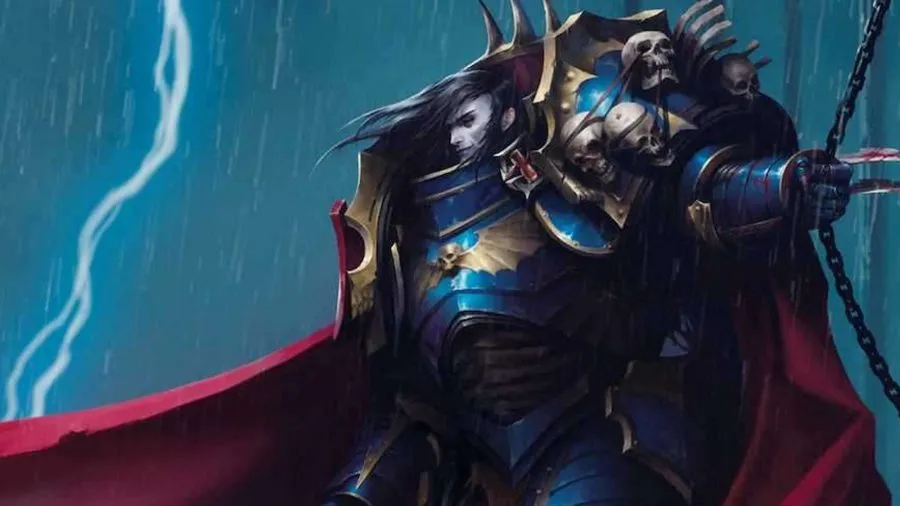
M’Shen walked into the throne room on Tsagualsa without being stopped. No guards on the approach. No alarms sounded. The corridors of the fortress where the VIIIth Legion had dug in after Nostramo burned were empty all the way up to the Primarch’s seat. M’Shen was the only mortal in recorded lore to put a Primarch down, and the reason she managed it is the single most disturbing thing about Konrad Curze: he knew she was coming, and he cleared her route.
He wanted her to succeed. Curze told her, as she stood in front of him with the phase blade raised, that his death would vindicate everything he had done. Then he let her finish the job.
That is the door into the character. Every other Primarch dies fighting, or dies of something that outlives them. Ferrus Manus at Isstvan. Sanguinius over Terra. Horus in the Vengeful Spirit. Curze dies by invitation. It isn’t a martyrdom in the clean Blood-Angels sense; it’s closer to a man signing off on a conclusion he had been rehearsing since he was a feral child on Nostramo.
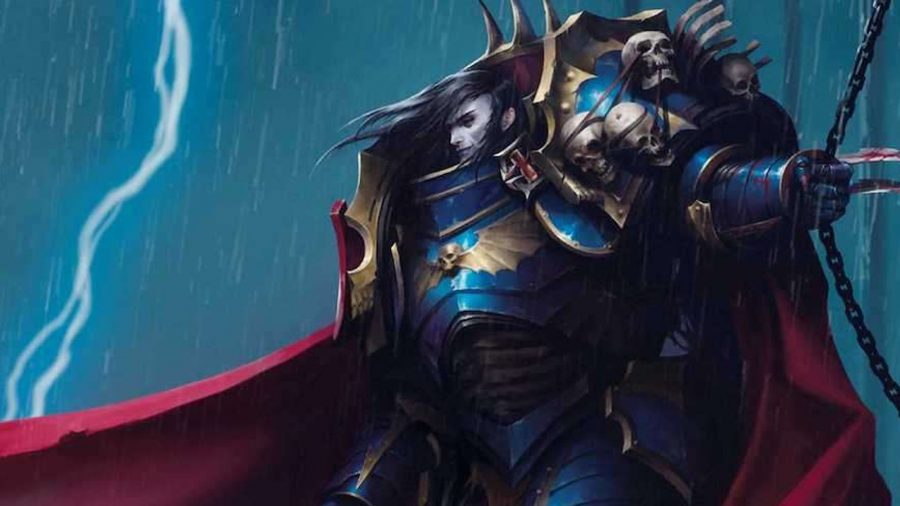
Nostramo built him before the Emperor turned up
The precognition bit, the one everyone quotes, the thousand-yard-stare visions of his own end, doesn’t fully work without Nostramo first. The visions alone would have broken any of Curze’s brothers. What made him Curze was landing on a world where those visions were a perfectly rational response to the local weather.
Nostramo Quintus was a hive of unbroken night, the sun barely getting through the atmospheric ash, its cities run by a criminal aristocracy that treated murder as a minor transaction cost. The adamantium went up the shaft. Everything human rotted in place. Curze’s gestation capsule crashed into that. He survived alone, with no bonded cult like Lorgar got, no tribal fathers like Vulkan. He grew up a feral child in the sewers, eating the same rats he was competing with.
So when he started killing people, it wasn’t out of some lofty Manichaean design. He killed the first criminal because he was hungry and angry and the man was handy. The philosophy calcified around the act afterwards, once he noticed nobody was stopping him and the streets got quieter.
The “Night Haunter” name was local folklore before he ever claimed it. People whispered that some creature was hunting killers in the lower levels. Curze only found out he was the Night Haunter much later, when someone told him that’s what they called the thing stalking them.
The one-strand curse
Prince of Crows does the heavy lifting on this, and you can tell the current Black Library writers still love that novella because every time Curze shows up in newer fiction they’re still echoing its beats. The gene-fragment Curze inherited from the Emperor was psychic precognition. Same as Sanguinius’s. Same, in a weaker and weirder form, as Magnus’s. Curze saw one rail.
One future. One specific ending. Every choice he made looped back to the same frame.
That’s worse than it sounds at first pass. Curze couldn’t unsee the end. Every branch of every decision he could have made collapsed back to the same corpse on the same floor. Every act of mercy he attempted rolled down the same rail and finished the same way.
Under that kind of precognition the only stable psychological response is nihilism. If every branch dead-ends in the same corpse, the branches stop mattering. Morality becomes an aesthetic preference. Curze was hyper-moral in a specific local way (he enforced a kind of murderous justice on anyone who committed crimes under his eye), but the morality had no reach beyond his own disgust. He couldn’t be argued out of it. The arguments didn’t change the shape of the vision, so what would the point of arguing have been.
The Emperor meets the Night Haunter
When the Emperor arrived at Nostramo to make compliance with the VIIIth, Curze had a seizure so severe he tried to claw his own eyes out. The Emperor physically stopped him. That isn’t fan speculation; it’s one of the only moments in the whole setting where the Emperor is shown restraining a Primarch from self-harm.
In the seizure, Curze saw everything. He saw the Heresy. He saw Sanguinius die aboard Horus’s flagship. He saw his own assassination. He went into the Great Crusade knowing it was already over. Every compliance he made after the seizure was performed by a man who already knew the outcome.
Kiran and I actually fell out over this once, at a Kill Team event, in an embarrassingly long pub argument. He plays Death Guard. He was trying to tell me Mortarion’s suffering on pre-Fall Barbarus was worse than Curze’s, because at least Mortarion believed in his cause right up until Barbarus went sideways. I said Curze had it worse, because being right about every dark thing from adolescence onward is a much harder thing to carry than eventually finding out you were wrong. We didn’t resolve it. We never do. Some nights I think Kiran had the better reading and I just argued louder.
The Thramas Crusade and the fight with the Lion
Curze’s precognition wasn’t a permanent off-switch for his fighting capacity. He waged a three-year full-fleet campaign against the Dark Angels in the Eastern Fringe, 007.M31 to 009.M31 by the Lexicanum’s dating. He pulled the entire First Legion out of position for the Siege of Terra. The Thramas Crusade is probably the single biggest strategic gift the Night Lords ever gave Horus, because the Dark Angels arrived at Terra too late to affect the outcome of the Siege.
The bit of Thramas everyone fixates on is the duel with Lion El’Jonson on Tsagualsa, from Aaron Dembski-Bowden’s “Savage Weapons” short story. The two Primarchs meet under a parlay flag with two warriors each. Curze goads the Lion. The Lion, unprompted, runs him through. The fight breaks out. Curze gets the upper hand and is strangling the Lion to death when Corswain, the Lion’s seneschal, stabs Curze through the spine from behind to save his Primarch. That spinal wound puts Curze into the catatonic deathless state the whole of Prince of Crows is then set against.
“Savage Weapons” is honestly more interesting as Lion characterisation than Curze characterisation. The Lion strikes the dishonourable first blow under parlay. Dark Angels fandom has had to metabolise that their Primarch doesn’t play cleanly either. That’s a tangent.
Nostramo burns
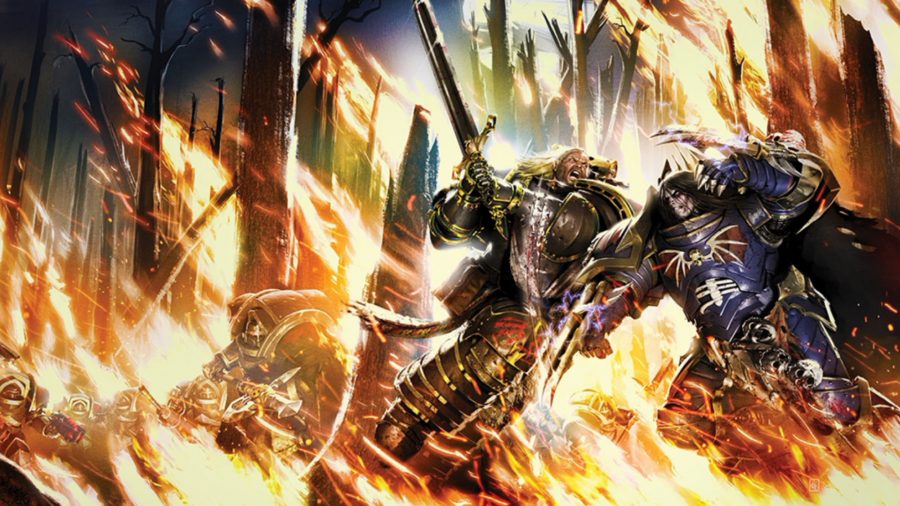
Between the Great Crusade and the Heresy proper, Curze learned Nostramo had relapsed into criminal anarchy in his absence. This matters: his whole rule over the planet had been maintained by personal terror. Once he physically left, the criminal families crept back in, and the world went rotten again inside a generation.
Curze took the fleet back and destroyed the planet. Orbital bombardment to core breach, the whole thing overheating and tearing itself apart from the inside. He fought Rogal Dorn over it and wounded him badly. The Night Lords fleet left Nostramo behind as a debris field.
The usual reading is that this was Curze’s moment of breaking. I think the more interesting reading is that destroying Nostramo settled a question he had been holding open. Terror as a governance tool only worked while he was physically on the planet. The moment he left, the criminal families came back. The bombardment was him confirming that.
The line in the throne room
Back to Tsagualsa. Curze’s claim to the Callidus in his final moments, depending on which source you read, was some variant of this: the Emperor sent you because I did exactly what he did, and he cannot face that. He told her the Imperium’s own methods (terror as statecraft, public atrocity as pacification, the use of fear to enforce compliance) were indistinguishable from his own, and that the Emperor was assassinating him to bury the resemblance.
Modern 40K lore writers keep quietly ratifying that claim without explicitly agreeing with it. Look at the actual machinery the Imperium runs on. The Commissariat shoots its own men in front of their squads to guarantee obedience. That is terror pedagogy, delivered by the Guard’s own officers. The Officio Assassinorum is a secret terror arm pointed at any sufficiently influential threat, internal or external. The Adeptus Arbites handles civilian order through exemplary brutality. Planetary Governors run pacification campaigns that look functionally identical to Night Lords campaigns, just with Imperial Aquilas stencilled on the Rhinos.
Commissar Yarrick is literally venerated for being a terror-weapon the Orks are afraid of. The Imperium’s official policy on its best Commissar is to lean into the fear.
That was Curze’s argument in the throne room. He was telling M’Shen the Imperium had been doing what he did, all along. He thought that’s why the Emperor had sent her.
Comparing him to his brothers
Stand Curze next to the other fallen Primarchs for a second. Angron is a Primarch whose agency was mechanically removed by the Butcher’s Nails; he’s a victim of his own cranial hardware. Perturabo picked Chaos as a calculated engineering response to a perceived slight. Mortarion rebelled after losing his own internal war on Barbarus and thinking the Emperor had robbed him of it. Magnus broke because he overcorrected for his own pride on Prospero.
Curze is the only one whose fall is purely epistemic. He rebelled because the precognition kept giving him the same ending, and he read that as license to stop pretending his loyalty meant anything. Curze is the Primarch whose corruption came from information. That’s rare even inside the traitor ranks. He stayed Curze all the way through, without the kind of direct patronage arrangement Magnus eventually worked out with Tzeentch or Mortarion worked out with Nurgle.
The Legion after him
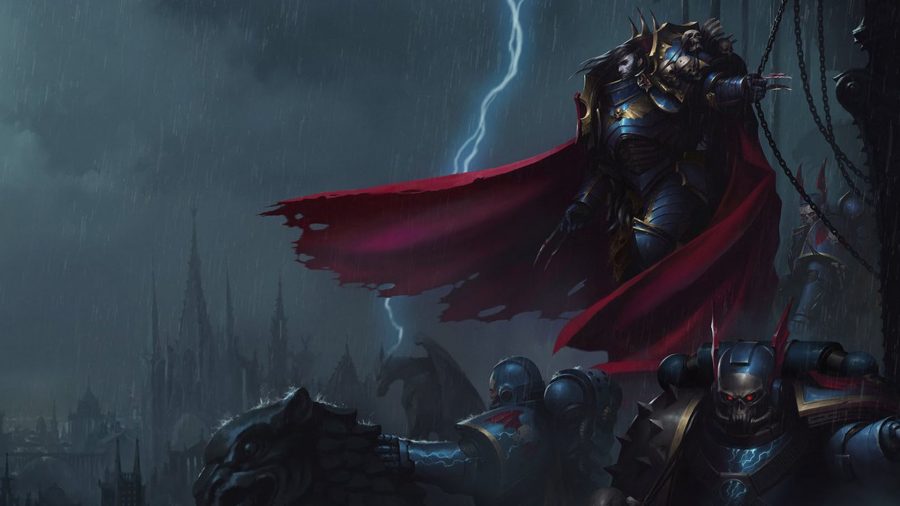
The Night Lords after Curze’s death are interesting precisely because they don’t have him. The Legion splintered immediately. No central command. No grand strategy. Just warbands. Most of the surviving officers openly admit they miss the clarity he gave them even when they hated being under him. Sevatar, in the Dembski-Bowden Night Lords trilogy and in Prince of Crows, is the closest thing the Legion has to a surviving soul, and he spends most of his screen time trying to work out what the Legion is actually for without the Haunter to aim it.
Probably nothing. That’s the answer most of the Black Library fiction has quietly settled on. The VIIIth in 40K proper is a piracy operation dressed up as a Legion. They still paint the lightning bolts. They still use the trophies. They still run the terror theatre. The thesis behind the theatre died on the floor of a throne room on Tsagualsa, and none of the surviving officers have managed to articulate a replacement.
That is a very bleak ending for the Legion that the most self-aware Primarch produced. He saw it coming. The surviving warbands don’t actually agree with each other on what the Night Lords stand for now.
Why Curze matters in 11th
With 11th edition leaning hard on Horus Heresy throughlines (the Armageddon cycle, the Rogal Dorn rumours, the return of Yarrick), there has been a steady drip of reader interest in the less-covered traitor Primarchs. Curze still gets less screen time than Mortarion or Magnus or Fulgrim. He’s a harder character to put in a book. He sits outside the Chaos-god structure, and his argument is that the Imperium is morally indistinguishable from him, which isn’t an argument Black Library has ever been eager to sit with for 400 pages.
Which is probably the reason he’s 40K’s most relevant Primarch for the current setting. The Imperium in 11th is openly running on exemplary terror. The Armageddon campaign is a decade-long example of pacification-by-atrocity on both sides, and the Ork Waaagh is horrifyingly symmetrical with the Imperial response. Curze’s argument, restated in 2026 terms, is that the Night Lords and the Imperial Guard are running functionally similar campaigns on Armageddon, and the Imperium has just always had better propaganda around it.
Black Library hasn’t given him a proper modern novel in years. The Primarchs series entry by Guy Haley is solid but it’s a pre-Heresy setup book. What he needs is an after-Nostramo, mid-Heresy character study that reckons with the actual thesis. The closest we have is still Prince of Crows, and that came out in 2012.