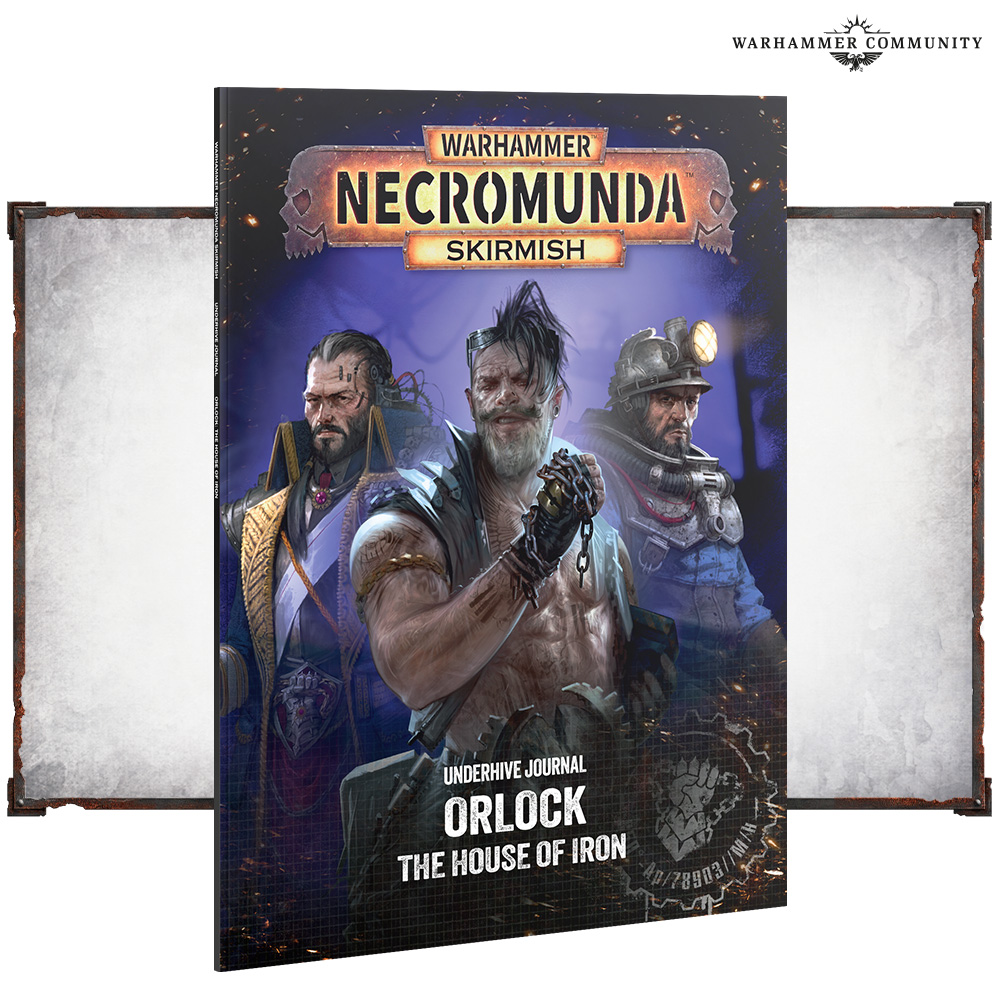
Page four of Underhive Journal: Orlock – The House of Iron is a section called “Arisen From Dust.” I haven’t read it. As far as I can tell nobody outside GW has, because all we’ve got is the contents page Warhammer Community posted on Monday alongside the new House Orlock models for Necromunda. I’ve spent more time staring at that one line than at any of the actual miniatures, which probably says something about me.
The contents page goes like this. House Orlock on page 2, Arisen From Dust on 4, The Aranthian Succession on 9, House Structure on 10, then Outland Gear, a timeline, House Holdings and Gangs of Legend running up to page 18. The rules half starts at 26 with the two new variant gang lists, Wrecking Crews and Outrider Gangs, and ends with Orlock Legendary Names, gang tactics, something called Bravado Skills, territories, side jobs, and a one-page equipment reference on 47.
Where House Orlock actually came from
If GW is keeping the founding story from the 2020 House of Iron supplement, and “Arisen From Dust” is a pretty loud hint that it is, it goes roughly like this. In 003.M38 an Ash Wastes nomad called Olandus Orlock, prosperous “by the standards of the duster clans” according to Lexicanum’s write-up of that book, got caught in a bad dust storm with his family and sheltered inside a wreck. The wreck turned out to be an ancient vessel. He spent years quietly stripping it for archeotech, got rich, and used the hulk as a fortress to lean on smaller clans (Kamund, Cinderjack and Merdena) until they joined him in a road war against a bigger outfit called House Orlund. Decades of raids and hijacked cargo. It finally ended in 111.M38, when Orlund’s youngest daughter Kaylana secretly married Olandus’s eldest son Kavar, and her father Vetrix was so heartbroken he wandered off into the wastes. Kavar and Kaylana are the first family of the House of Iron.
So the house started as a family of dusters with a lucky find, and a good chunk of what came next was robbing other people’s convoys, right up until the wedding.
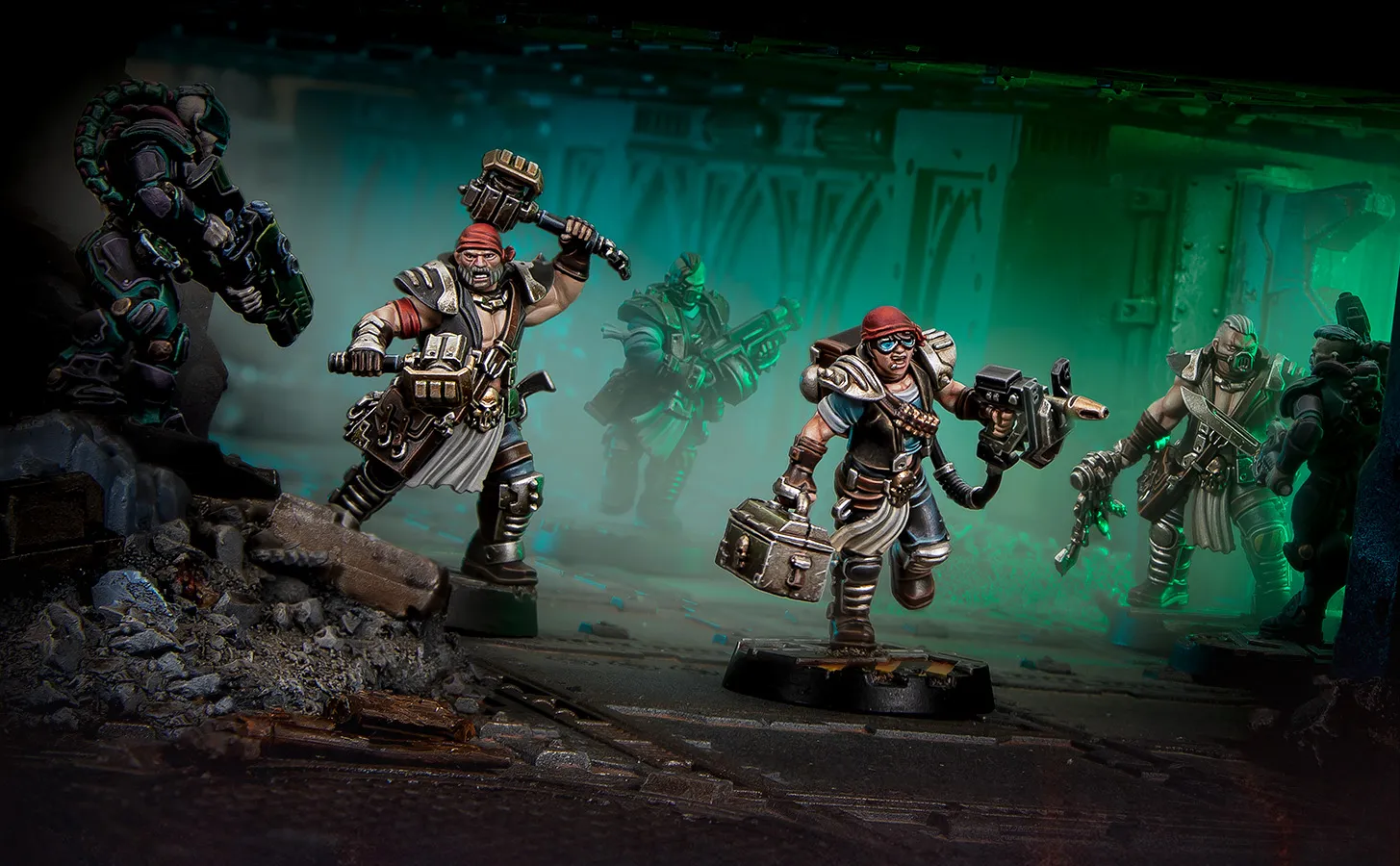
Now look at what the house does for a living in basically every bit of fiction since. White Dwarf #424, the 2017 relaunch issue, says Orlock controls the mines and “the most vital transmotive lines and land routes between them,” and that it’s “famed for its tough and fearless outriders who defend the convoys from ash waste nomads and rival House agents alike.” Three thousand years after Olandus found his wreck, the house’s headline gang is a convoy escort whose job description includes shooting the next Olandus. The new Road Warriors box is eight gangers built for exactly that job, split into Road Shooters, Road Engineers, Road Enforcers and Road Blasters, with dual shotguns, boltguns, pneumatic hammers and scrap welders across the sprues. The Outrider variant gang in the new book customise their vehicles and earn legendary names on high-risk runs.
I went back and forth on whether that’s even hypocrisy. Every protection racket starts with the people doing the robbing. A duster clan that gets big enough to own the road turns into the toll booth, and of course the toll booth hates the next raider. It’s the guy who busked outside the station for ten years and now sits on the residents’ committee trying to get buskers banned. I’d honestly talked myself into the boring reading for about a day. Then I went back through the White Dwarfs looking for something else entirely, and WD #427 had a paragraph about harpoons in it.
The harpoons, and the Drudges
It’s the February 2018 issue, the one with the plastic Orlock gang kit in it, and it says Orlocks like harpoon launchers because they can “impale their targets before dragging them kicking and screaming (if they’re still alive) to work in their many factories and mines.” So the house that started out scavenging the wastes also scavenges people. That same issue describes the house’s serfs, the Drudges, kept in line by overseers with “electro-goad and psi-whip, until nought but unthinking obedience remains.”
I watched a harpoon launcher do exactly that once, sort of. This was at my local store in 2019, and I was meant to be playing a Kill Team game with Kiran. Instead I drifted over to a Necromunda table where some guy’s Orlock gang, the 2018 plastics with the drum-mag autoguns, was fighting a Delaque gang, and the Orlock player had a heavy with a harpoon who spent three turns reeling the same Delaque ganger across a gantry. Every time it hit, the Delaque player sighed a bit louder. I stood there for about forty minutes. At one point I said “get him” out loud, the Delaque player turned round and gave me a look, and I went back to Kiran, who’d set up both our teams and was sitting there doing nothing with my Drukhari lined up in the wrong deployment zone. I didn’t correct it, and Kiran’s Plague Marines won by something like twelve points.
The gangs are the way out of the mine, anyway. WD #427 again: “To be an Orlock ganger is to have risen above the brutal drudgery of serfdom.” Under the House of Iron version, Drudges still count as Orlocks and can join a gang if they prove themselves, which is more than most houses offer the people doing the actual work. Lexicanum’s summary of that book is blunt about why. It works as a means of control, with Gang Lords holding up promoted gangers to the rest of the pit as proof that hard work pays.
That arrangement dates to the Crucible Schism. Early in M39 a work crew in the Bighole mines revolted, the rebels got rich enough off the mine to outbid the mercenaries the house hired to crush them, and the uprising spread across the spoil. A young settlement founder called Avor Orlock turned rebels to his side with a creed, gang before House, House before the rest, and with help from Rei Merdena, a rebel daughter of the Merdena family, he put the rising down from the inside. Avor became Lord Orlock. From then on the gangs were drawn from the Drudges and topped up with family members.
WD #424 also says House Orlock is “one of the most unified and disciplined Houses in the hive, with their apparently riven system of leadership experiencing remarkably few schisms.” Three years later GW published a book whose founding civil war is literally called the Crucible Schism. Maybe that’s deliberate, a house that tells outsiders it never fights itself. Maybe two writers just didn’t compare notes. I don’t know which version the new Journal goes with, and page 10, House Structure, is where I’ll be looking first.
So yeah, the Code. Gang, House, then everyone else. Looks great on a banner. WD #427 finishes the thought though, and it’s forget the code and you end up “gutted, facedown in a sump-flow.” Which, fine, it’s Necromunda, everybody ends up in a sump-flow eventually. But it does kind of mean the thing that gets you out of the pit is also the thing that stops you walking back down and telling the Drudges what gang life is actually like. Or I’m reading way too much into a White Dwarf blurb. Probably that.
The Ogryn Minders, and the House of Iron’s other hires
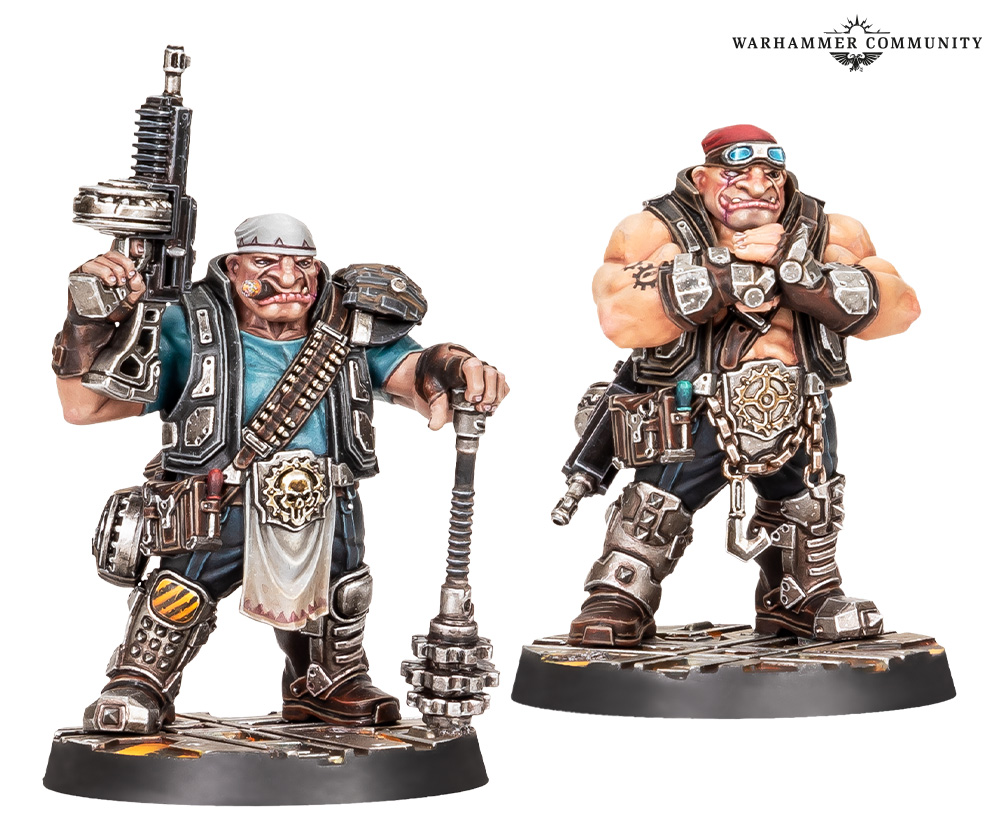
The Ogryn Minders come two to a box. Each one gets a ripper gun and knuckledusters, a ripper gun and a maul, or the spud-jacker, which is an oversized wrench and my favourite weapon name of the year so far. Warhammer Community’s line on why Orlocks hire them is that convoy work suits “listless Ogryns, who Orlock gangs are only too happy to hire for their natural head-breaking talents and tendency to follow orders without question.” Bell of Lost Souls points out Ogryns were already in Necromunda as Hired Guns, and Lexicanum’s list of Orlock forces includes Ogryn Servitors, the lobotomised kind. The Minders get paid, sit on the gang roster, and are built as bodyguard Brutes.
Put that next to the psi-whips. House Orlock has spent a few thousand years trying to beat unthinking obedience into its workforce, and now it’s happily hiring Ogryns, who come with it already installed. I don’t think GW meant it as a comment on anything. The models have separate toe caps for their boots.
Wargamer spotted the other nice bit, which is that the Minders’ ripper guns are drum-fed, a callback to the Rogue Trader Ogryns. That fits the house, oddly. Orlocks were first described by John Blanche in White Dwarf #192 as “a cross between outlaw bikers and Jean-Claude van Damme style street fighters,” and that was in 1995, so the House of Iron has had the same look for a couple of years longer than I’ve been alive. The new Road Warriors still look like that. Bandanas, sleeveless leather, goggles pushed up on foreheads.
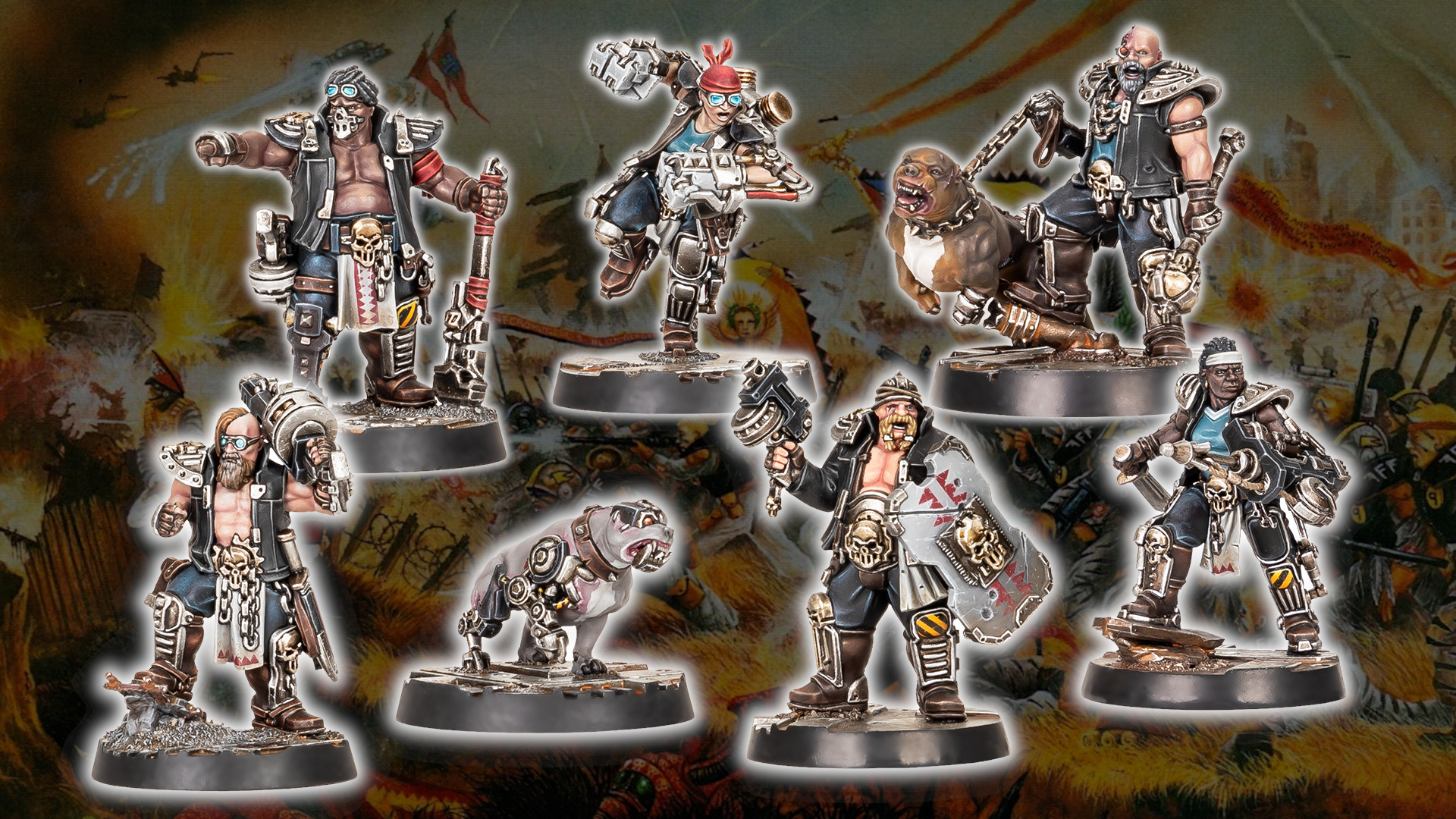
The Road Sergeants box is a Road Captain, five Road Sergeants and two cyber-mastiffs, and one of the dogs is on a chain thick enough to tow a Cargo-8. It’s the same format as the Goliath Forge Bosses with their sumpkrocs and the Escher Matriarchs with their phyrr cats, both of which I wrote about over the summer (Goliath here, Escher here). Leader box, pet, specialists, Journal. GW has a pattern going for this edition and it’s sticking to it.
One thing from the House of Iron lore I’d like to see survive into the Journal is that Orlocks get on surprisingly well with House Escher, apparently because Orlock culture has always treated women better than most of the other houses do. Every other house relationship on Necromunda is a feud, a debt or a monopoly. The Delaque one is all three. According to WD #424, Orlock stole the lucrative Ulanti Contract off House Delaque by bribing underhive raiders to blow up the fuel lines into a Delaque guild factory, and the Delaques eventually answered by assassinating Lord Hagen Orlock. Raiders again, though WD #424 never says whose.
And in the most recent story material, the Aranthian Succession, Orlock was holding the ash gates, the way in and out of Hive Primus from the wastes, when House Goliath came across the Riftways for Ash Gate 17 in the White Dwarf #495 campaign. Page 9 of the new book is where that gets folded into Orlock’s own history. The gate’s a toll booth too, if you think about it…
I don’t play Orlock and I’ve never owned a single Orlock model. I’ve still asked my local store to put a box of the Ogryn Minders aside, because a spud-jacker is a spud-jacker, and I’ll work out which gang they’re minding once they’re painted.