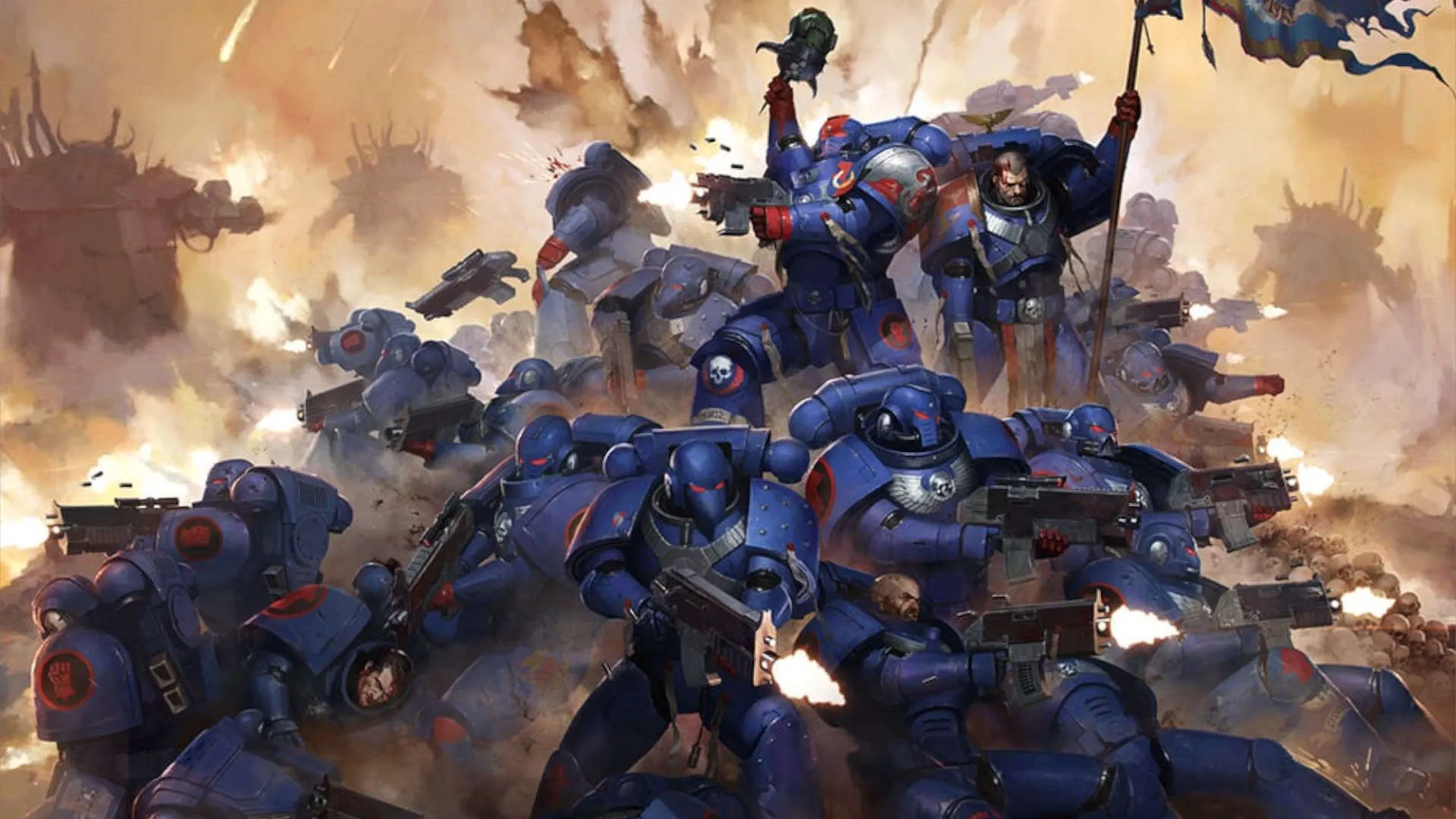
There’s a painting from 1987 of a Space Marine crouched behind a low wall. Bolt pistol up, a scatter of spent casings round his boots, the little ammo counter on the gun reading close to nothing. You can’t see what he’s shooting at. You don’t need to. The whole composition tells you he’s about to be overrun and he’s going to keep firing anyway.
That Marine wears dark blue armour with a red gauntlet. He’s a Crimson Fist. And for a huge number of people, that John Sibbick cover for the original Rogue Trader rulebook was the first Space Marine they ever laid eyes on. The first image the entire setting put forward wasn’t a triumphant hero standing over a corpse. It was a man losing, slowly, with no expectation of rescue. The painting is older than I am by a couple of years, and it still does the job better than most of what GW commissions now.
I keep coming back to that, because the Crimson Fists have spent their entire existence as a Chapter living up to a piece of cover art. They are the successor Chapter that’s most famous for nearly dying. And right now, in June 2026, they’re back in the spotlight in a way they haven’t been for years.
The diorama that brought them back
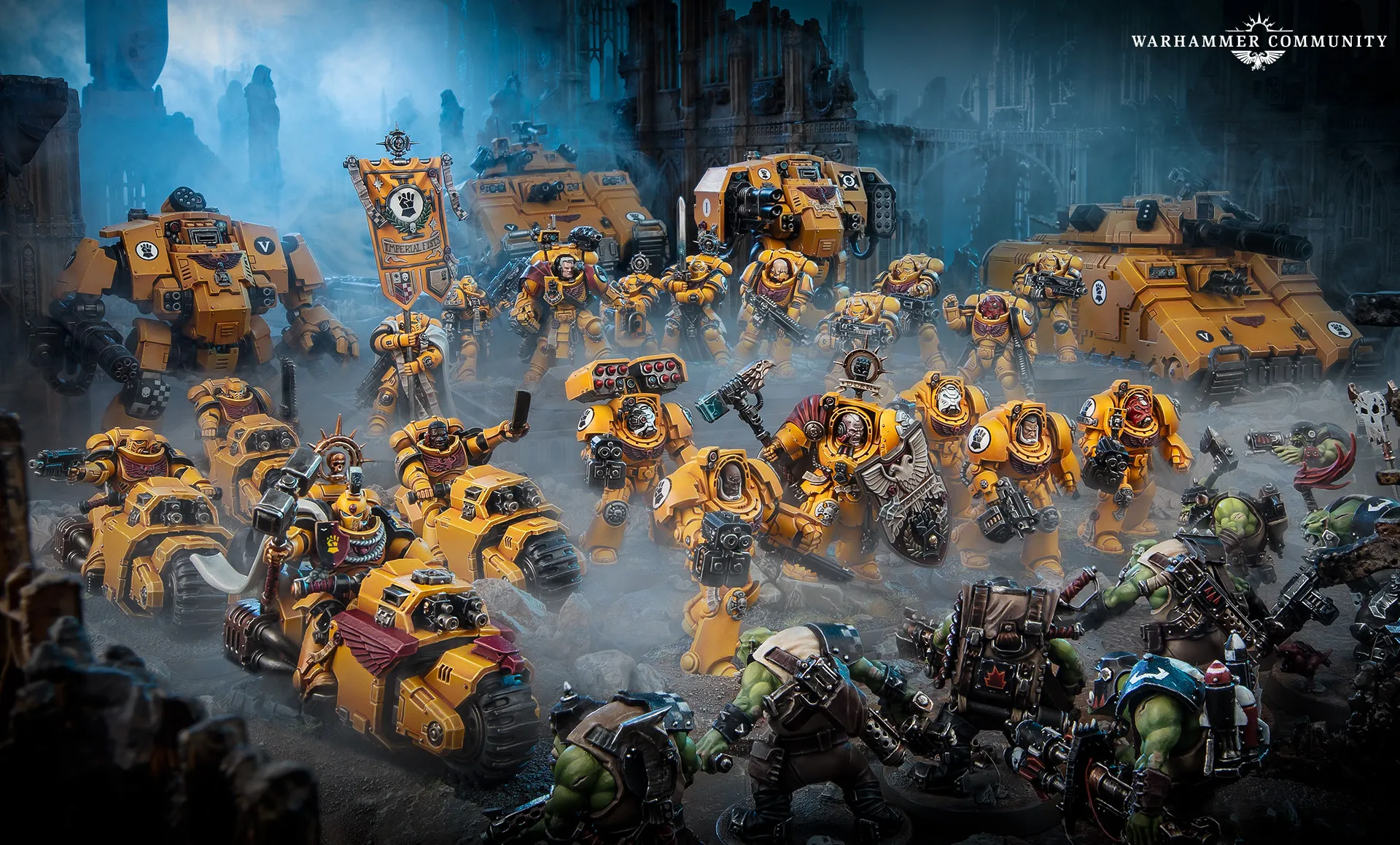
Warhammer World just unveiled a new display piece called The Battle for Grendel’s Lock. It’s a 11th-Edition centrepiece, over 400 Ork Boyz, grav-tanks, a Thunderhawk tangling with Ork jets, a half-built Stompa in the middle of what used to be the busiest port on Armageddon. And spearheading the Imperial counterattack, the bit GW chose to put front and centre, are the Crimson Fists.
They commit four companies to Operation Imperator, the big liberation push for Armageddon, alongside a strike cruiser and a battle barge. For a Chapter that famously couldn’t field four companies total for a long stretch of its history, that’s a quiet little statement in itself. There are also persistent rumours that Pedro Kantor’s getting a new model in 11th, which would make sense of all this attention. I’m not going to pretend I have a source on that. It’s the kind of thing that’s either obviously true or completely made up and I genuinely can’t tell which.
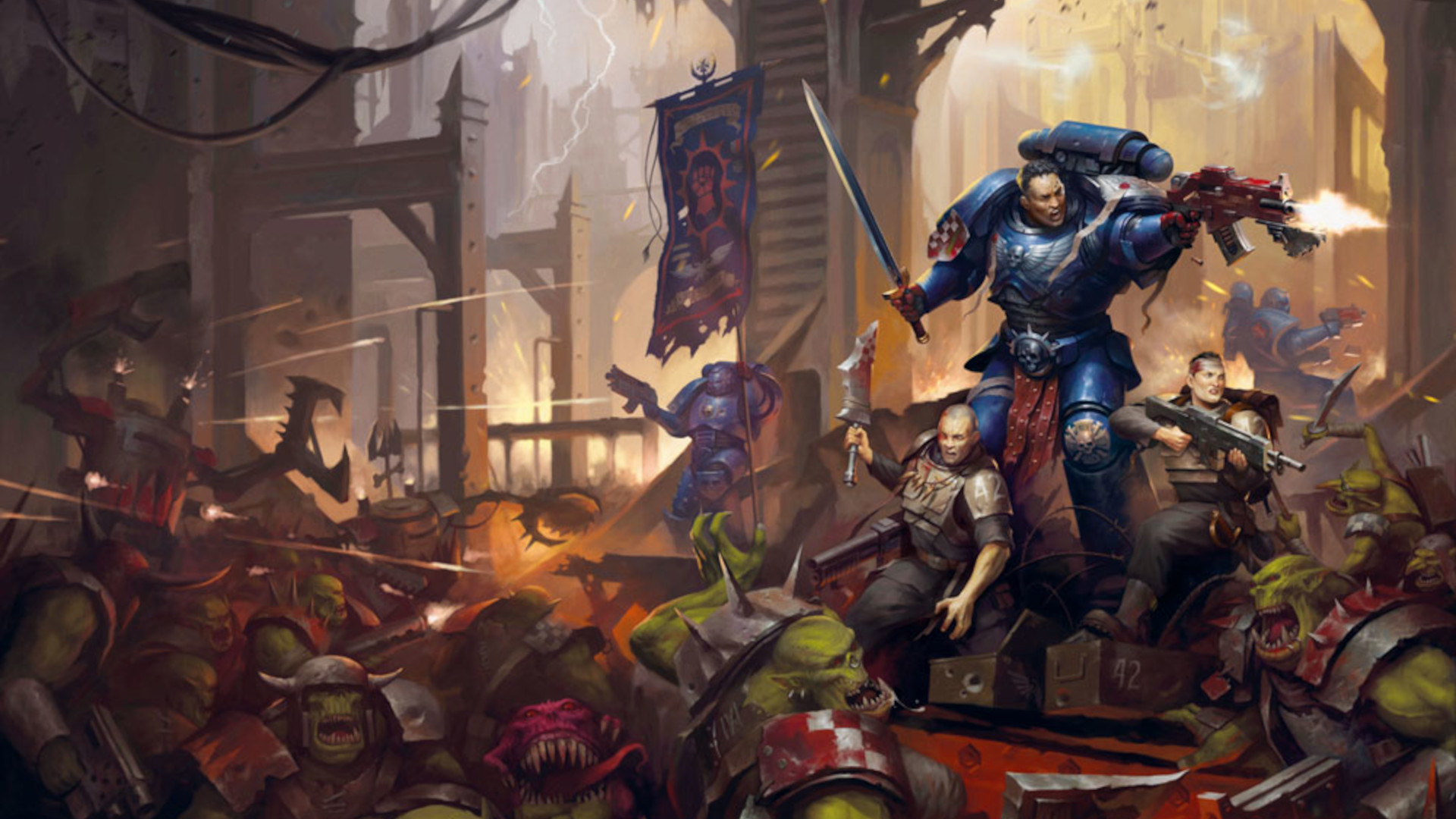
But whether or not Kantor gets a fresh sculpt, the reason a display team at Warhammer World reached for the blue-and-red is the same reason that 1987 cover still works. These guys are the Imperium’s designated survivors. They’ve been the Chapter you point at when you want the Astartes to look like they’re in real trouble, and they’ve been doing that job since 1987.
What actually happened on Rynn’s World
You can’t talk about this Chapter without the disaster, so here it is.
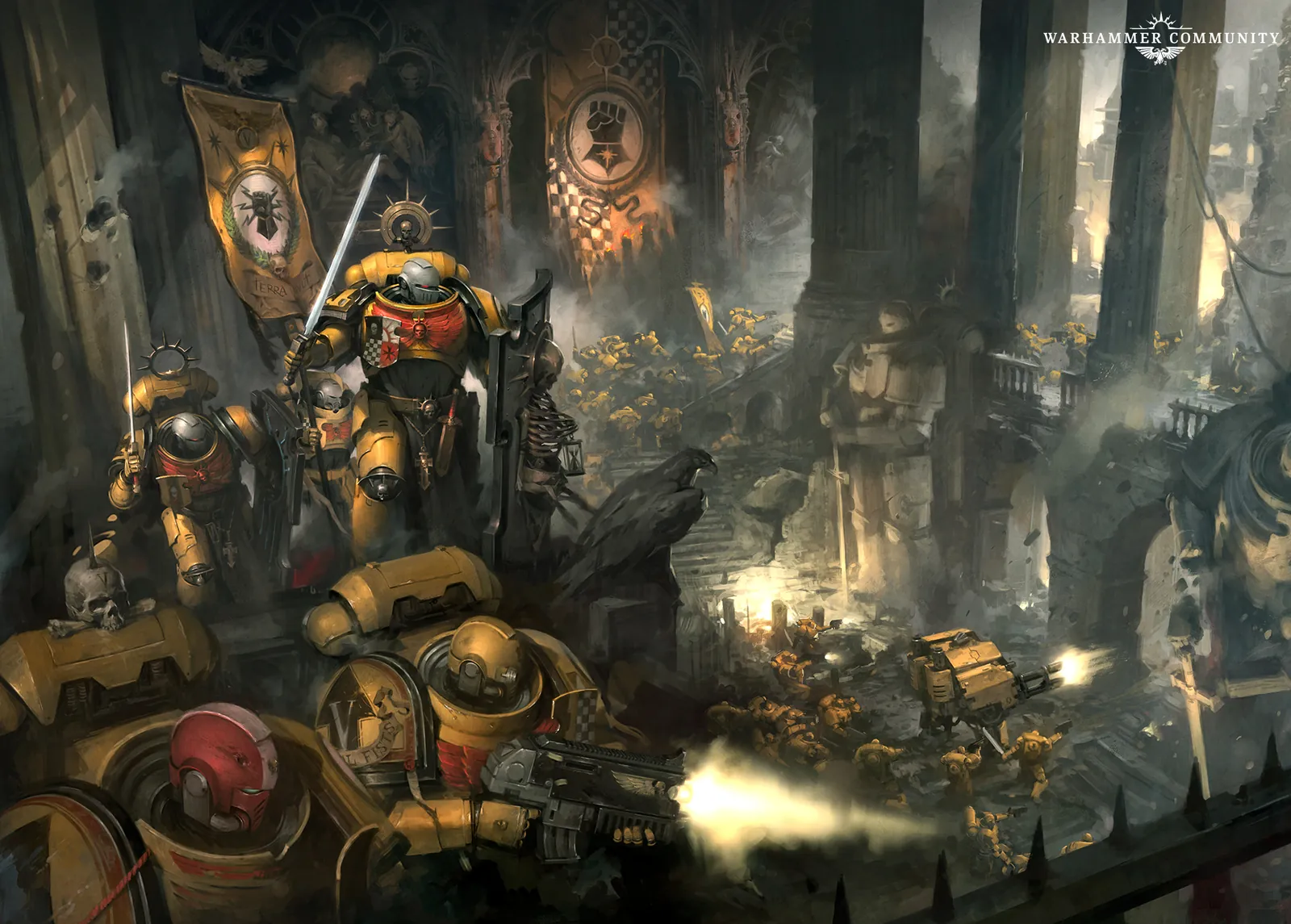
They’re a Second Founding offshoot of the Imperial Fists, split off from Rogal Dorn’s Legion after the Heresy when Dorn finally, grudgingly, agreed to break the VII up. Their first Chapter Master was Alexis Polux, who led them for the better part of 800 years and shaped how they read the Codex. Solid, stubborn, defensive specialists. Good at sieges, good at holding ground. Very Dorn.
Then 989.M41. An Ork warlord called Snagrod, the Arch-Arsonist of Charadon, kicks off a WAAAGH! and rolls toward Rynn’s World, the Chapter homeworld. The Crimson Fists send their 3rd Company under Captain Ashor Drakken to gauge the threat. They badly underestimate it. Only a handful of Astartes get back to warn anyone.
So the Chapter does the sensible thing. It pulls its strength back to the fortress-monastery, Arx Tyrannus, to organise a proper counter-offensive. Companies gathering, officers planning, the whole apparatus of a Space Marine Chapter preparing to do what it does best.
And then one of Rynn’s World’s own planetary defence missiles malfunctions, or is sabotaged depending on which account you read, and comes down directly on the fortress-monastery. The strike sets off the armoury. Secondary explosions tear through the place. Six entire companies of Crimson Fists die in minutes, in their own home, without firing a shot in the battle they’d assembled to fight.
Sixteen Marines survive. Sixteen. Pedro Kantor lives only because he was out manning the outermost perimeter when it went up.
Now, I’ll be honest, part of me has always found the friendly-fire missile a slightly cheap way to gut a Chapter. A faulty defence battery? It reads like the writers wanted the Crimson Fists devastated but couldn’t bring themselves to let Orks do it cleanly, so they reached for an accident. The more I sit with it, though, the more it works, because it’s so much grimmer than a straight defeat. There’s no glory in it. Nobody died holding the line. They died standing in a courtyard because a machine the Imperium built failed. That’s about as 40K as it gets, honestly.
Eighteen months in New Rynn City
Kantor doesn’t fold. He gathers the survivors, links up with what’s left of the planetary defence forces, and conducts a fighting retreat through Ork-held ground to New Rynn City, where the Imperials dig in for a siege that lasts eighteen months. They hold. Eventually the Orks are broken and Rynn’s World is, technically, saved.
But the gene-seed reserves went up with Arx Tyrannus. And that’s the part that actually defines the modern Chapter, more than the missile, more than the siege. A Space Marine Chapter that loses its gene-seed stock can’t just recruit its way back to strength. It has to grow slowly, the long way, raising new Marines a careful few at a time. So for centuries afterward the Crimson Fists run permanently understrength. Decades of grinding small-scale war against the Ork empires of the Loki Sector, fought by a Chapter that can never quite replace its losses fast enough.
It plays out like a small business that took one catastrophic hit and never really recovered. Still trading. Always short-staffed, always making do, always one bad campaign from real trouble. There’s a line of Kantor’s that sticks with me, about being wounded sorely yet still standing with fire in the heart. With the gene-seed gone, it reads like a man quietly doing the books.
Then 999.M41 happens and the Great Rift tears open, and the warp storms that follow dump daemonic incursions right on a Chapter that’s already clinging on by its fingernails. They survive that too, barely, and at horrendous cost.
So yeah, the Crimson Fists
Let me just talk about them for a second without the timeline. So they’re Dorn’s grandkids, basically. Blue armour, red fists. Stubborn as anything. Got blown up by their own planet, lost almost everyone, spent a thousand years quietly not dying. Kantor’s the boss, been the boss since before the disaster, carried them through all of it. They fight Orks mostly because Orks are what’s nearest. They’re not flashy. There’s no big primarch, no special gimmick, no signature super-unit. They’re just very good at the worst job in the galaxy, which is being outnumbered and not running. Point is, the appeal isn’t complicated.
The relief, when it finally came, came from Cawl’s Primaris project. When the Indomitus Crusade reached Rynn’s World it brought a new generation of Crimson Fists down from the freighter-hulk Zar-Quaesitor, the first reinforcements in living memory that actually moved the needle. After all those centuries of careful, painful rebuilding, the Chapter got handed a future in one delivery. I have complicated feelings about the Primaris retcon in general, but for the Crimson Fists specifically it’s the one place where “here are a load of new Marines, no strings” lands as genuinely good news rather than a marketing exercise.
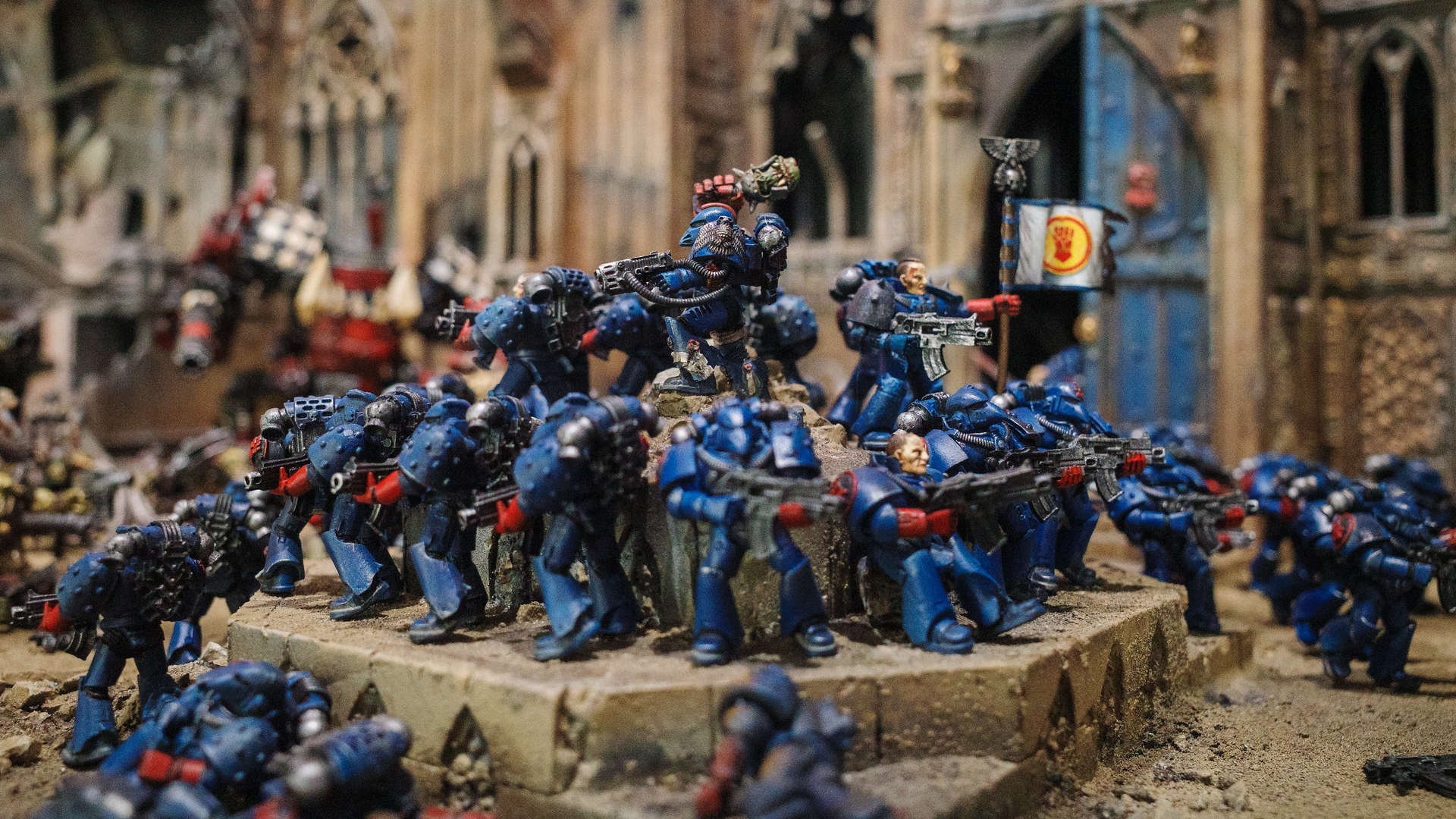
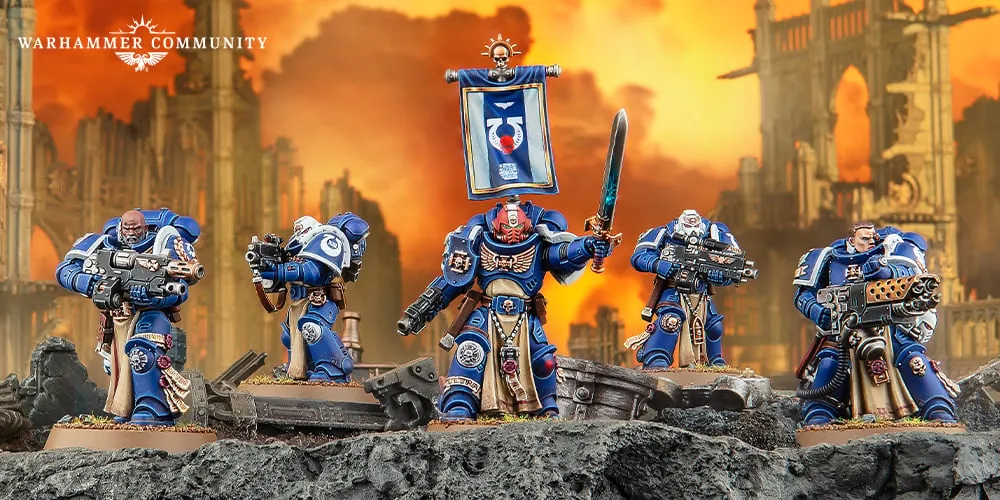
I tried to paint a squad of them once. This was years ago, late 5th edition, when I’d burned out completely on doing Imperial Fists yellow for the hundredth time and wanted a break that was still vaguely on-brand for a Dorn player. Crimson Fists, easy, just blue with red gauntlets, how hard can it be. The answer is that red over a dark blue basecoat is a nightmare. Mephiston Red just vanishes into the blue, goes muddy and brown, and you end up doing three thin coats over a careful undercoat just to get the fists to read as actually red and not as dried blood. I did one Marine, decided the colour scheme had defeated me, and the other four sat in a half-painted box for about two years before I stripped them back to Imperial Fists. Which, given the chapter’s whole deal, felt almost respectful. They’re used to losing companies.
The first impression that stuck
What gets me about all of this is the order it happened in. The Crimson Fists were the face of Warhammer 40,000 before the Ultramarines were, before the Black Library catalogue, before any of the modern poster boys. Sibbick’s cover went out in 1987 and set the tone for everything that followed, and the tone it set was a Marine with his back against a wall and the count running down. The fiction spent the next four decades catching up to one painting.
And then the lore went and built a whole Chapter to match it. Rynn’s World, the missile, the sixteen survivors, the thousand-year recovery. It’s almost too neat, a Chapter whose entire history is one long performance of the cover art. I don’t think GW planned it that way in 1987. I think they had a great piece of art and a name and worked backward, the way a lot of the best 40K lore got made, accidentally, by people who thought they were just writing a wargame.
Which is maybe why sticking them at the front of the Armageddon diorama feels like the obvious call. You want to show the Imperium bleeding and not quitting on the most fought-over rock in the galaxy, and there’s exactly one Chapter with that on its record going back nearly forty years. So they’re back in the middle of it. If Kantor does get that new model, I’ll probably buy him, and I’ll definitely lose another fight with the red gauntlets.