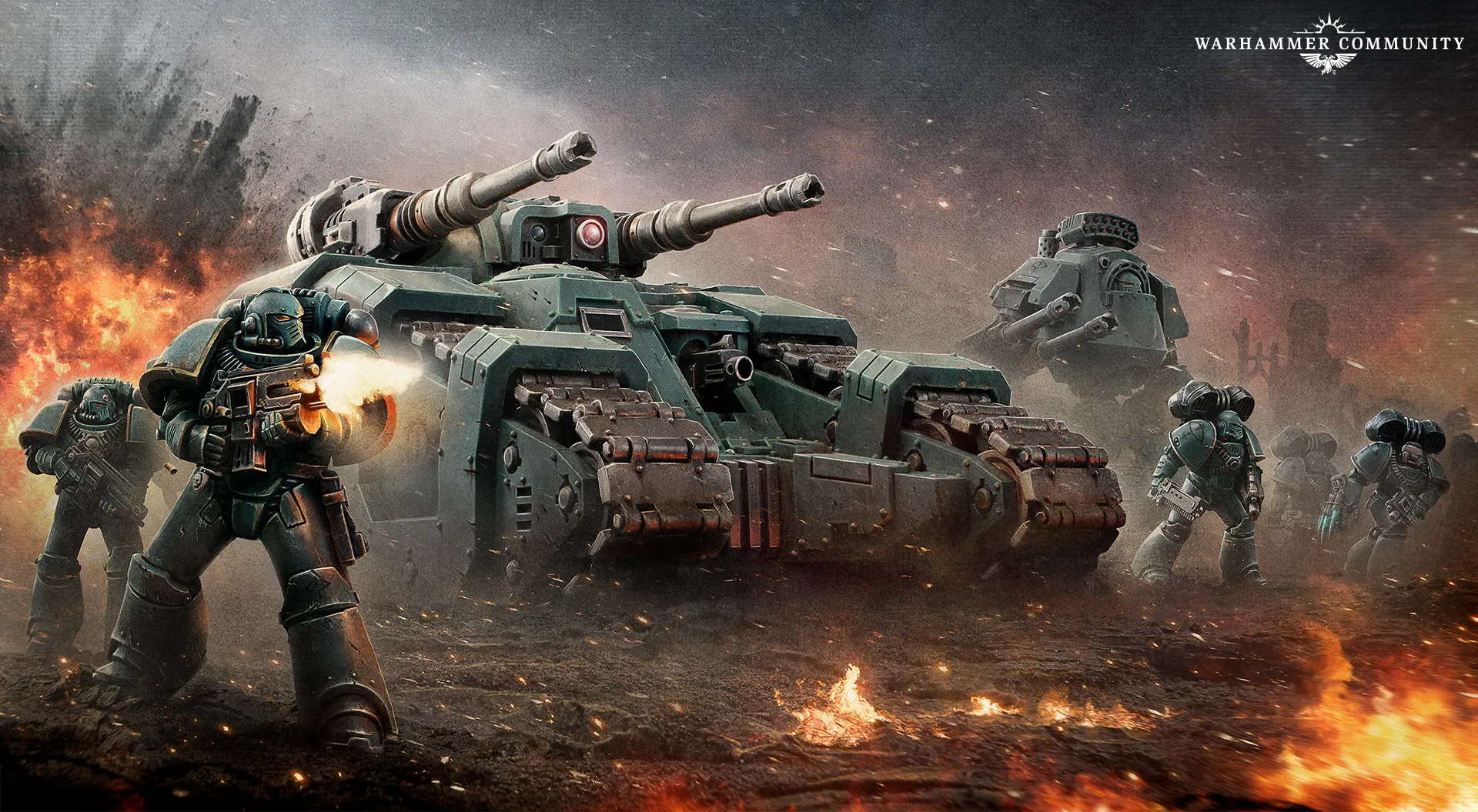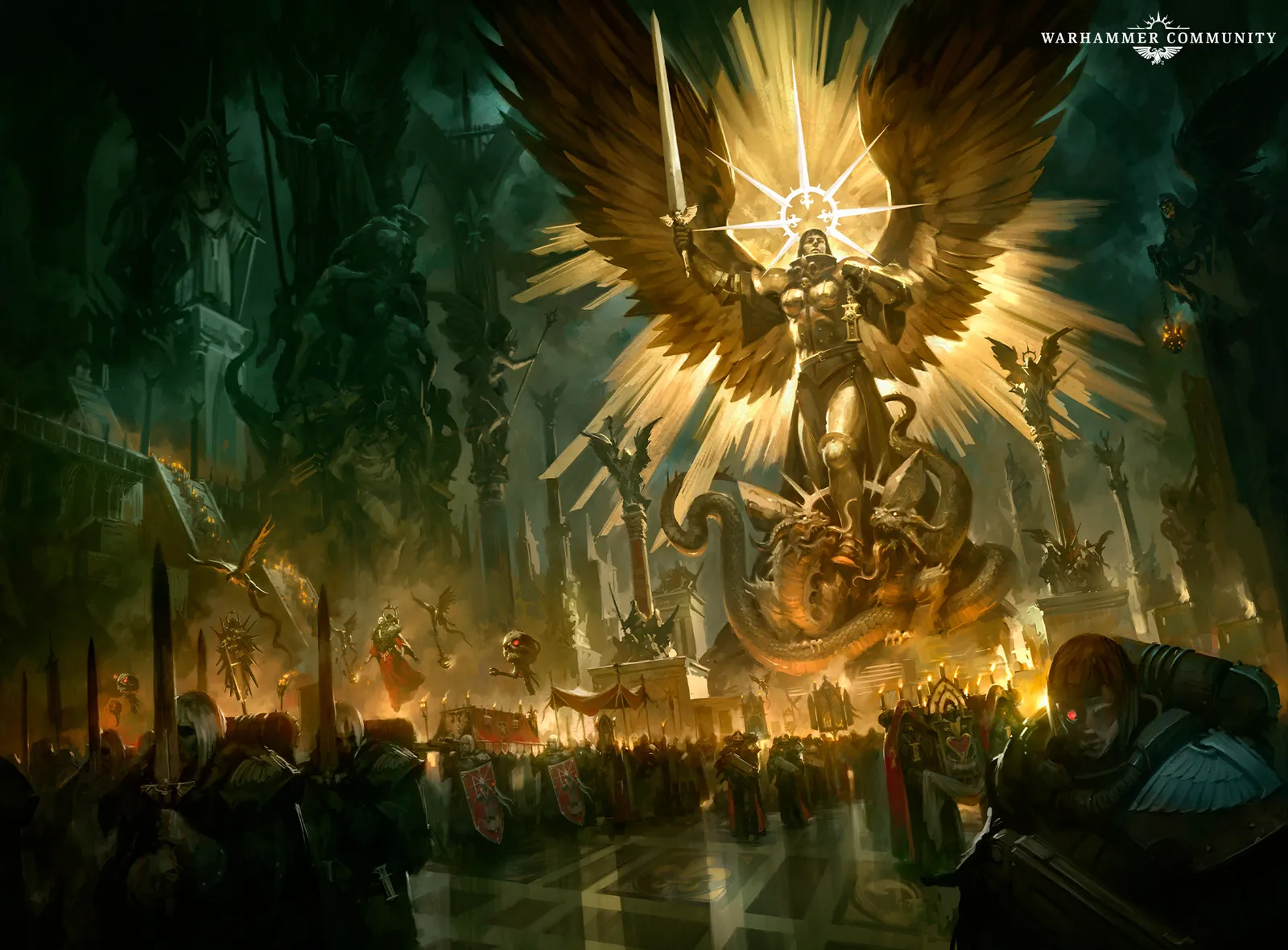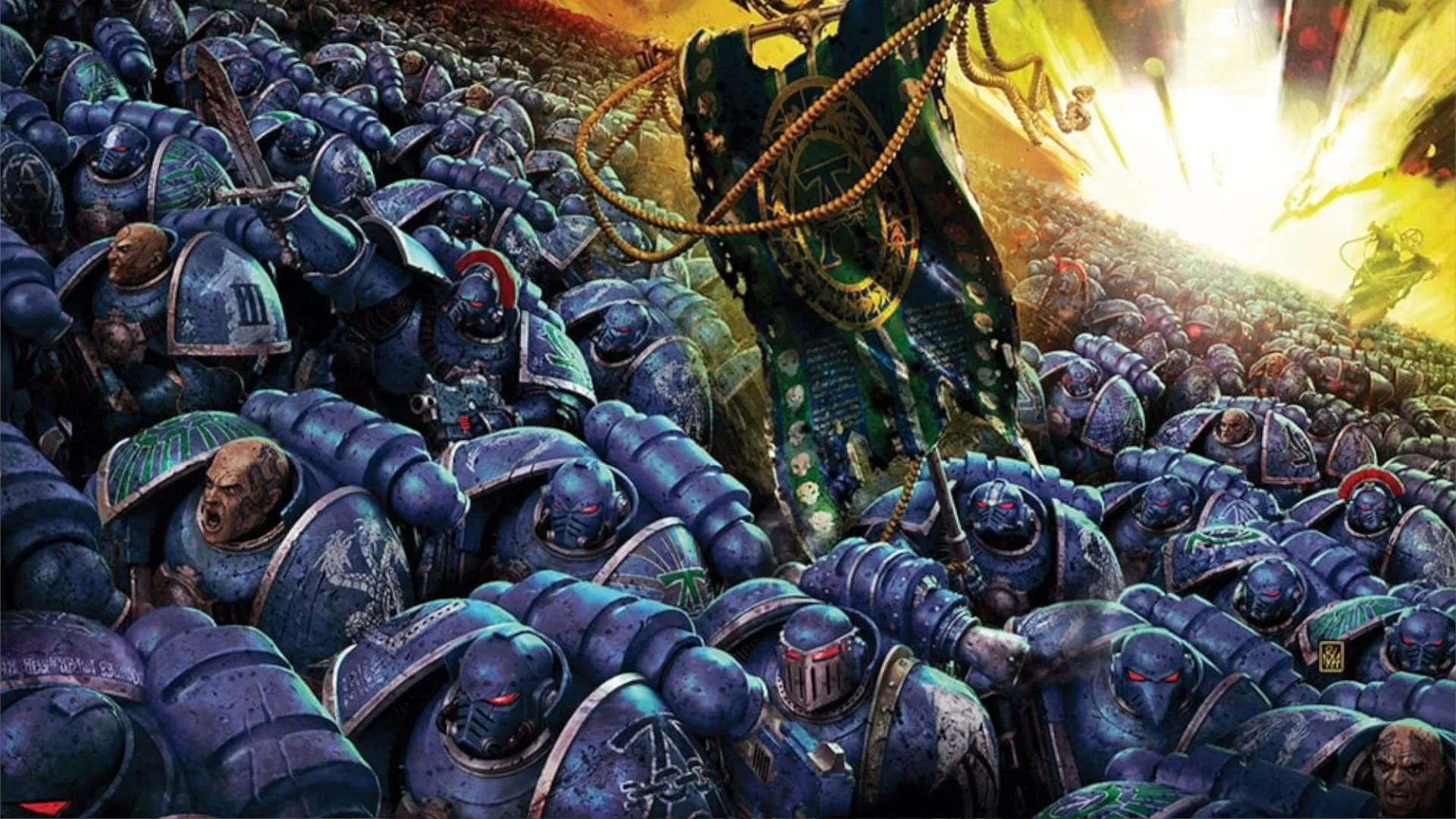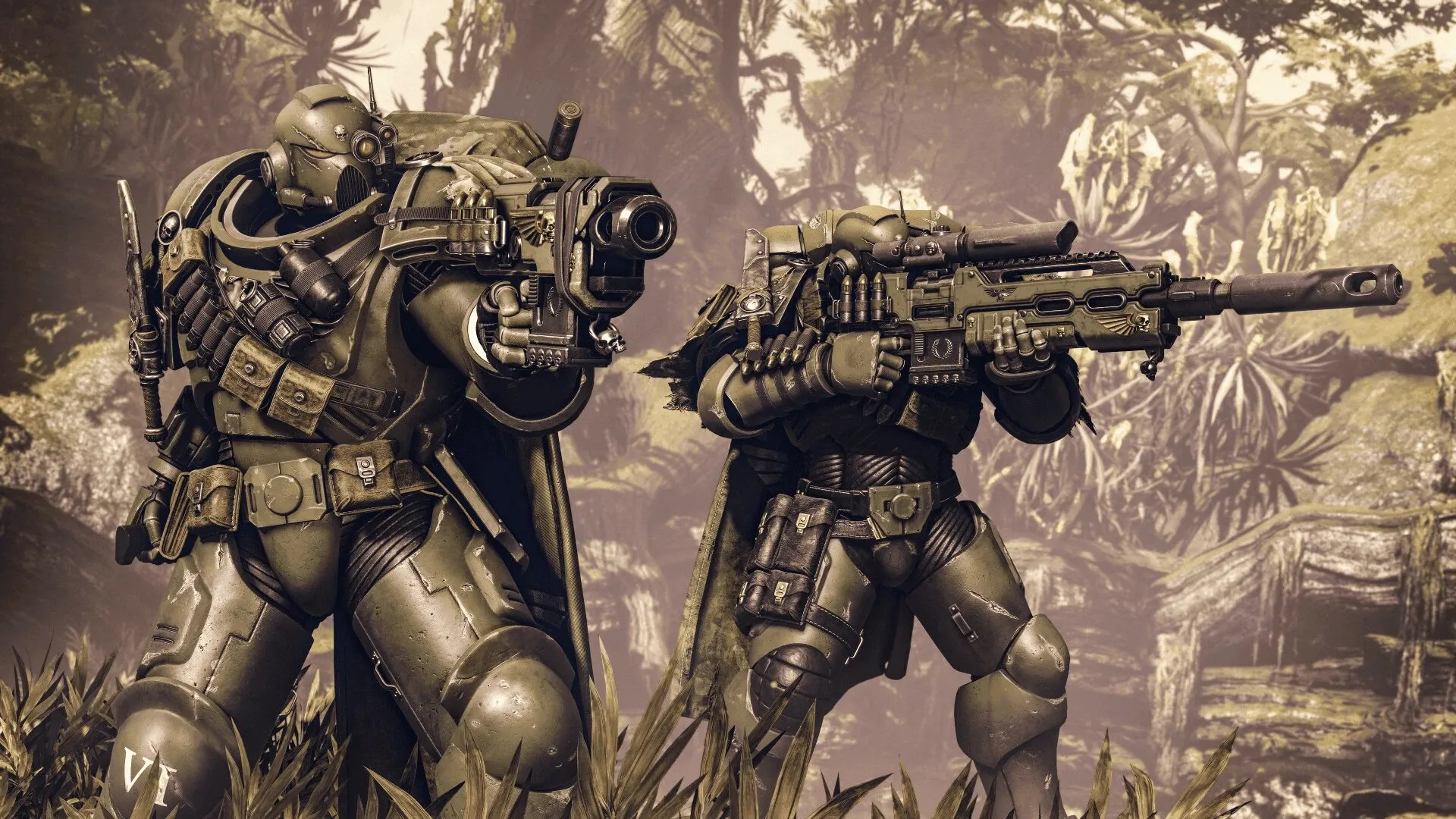
Band of Brothers episode nine is called “Why We Fight”. It’s the one where Easy Company walks into a camp in the woods outside Landsberg and the series stops being about soldiering for the better part of an hour. John Orloff wrote that episode. He wrote episode two as well, picked up an Emmy nomination for the work, and then spent the next two decades doing more of the same, ending up as the creator of Masters of the Air, nine hours about B-17 crews dying over Germany at a rate the show never quite puts a number on.
He’s now writing a Deathwatch animated series. That came out on the 28th of July in Games Workshop’s 2025-2026 annual report, filed for shareholders, under a heading about licensing revenue. Kevin Rountree’s exact words were that GW has “begun work on a full animated Warhammer 40,000 series featuring our Space Marines, Deathwatch”, that it “will be written by John Orloff, with Blur again animating”, and that it’ll be released through Amazon. Blur made the Space Marine 2 episode for Secret Level, so the look of the thing is broadly a known quantity. Orloff’s only previous work in a wholly invented setting is an animated film about owls that Zack Snyder directed in 2010.
The same report is where the Mike Flanagan news came from, and that ate every headline going. Flanagan has finished initial outlines on the live-action series, United Artists have come aboard, Cavill and Vertigo are still attached. I wrote a whole piece a couple of weeks back about where I think that show should actually start and nothing in the report shifts my view. But animation moves faster than live action, GW says the outlines are only outlines, and the Deathwatch series is the one likely to reach a screen first.
A kill team is the only Space Marine unit that can argue with itself
Every attempt at putting Space Marines on screen hits the same wall, which is that they all agree with each other. A tactical squad from one Chapter shares a gene-line, a primarch, a training regime, a set of rites and about ten thousand years of settled institutional opinion on how things get done. You can write a sergeant and a novice, or a veteran and a hothead, and you’ll get some sparks out of it, but you’re manufacturing the friction yourself. What are they supposed to fall out about?
A Deathwatch kill team is five or six marines from five or six different Chapters who have mostly never met. Their doctrines contradict. Their Chapters may have shot at each other inside living memory. An Iron Hand who regards his own flesh as a design flaw gets assigned alongside a Salamander who’ll walk into a collapsing hab block for a family he’s never met. A Space Wolf and a Dark Angel end up sharing a corridor and an objective, with several centuries of very specific bad blood sitting between their Chapters.
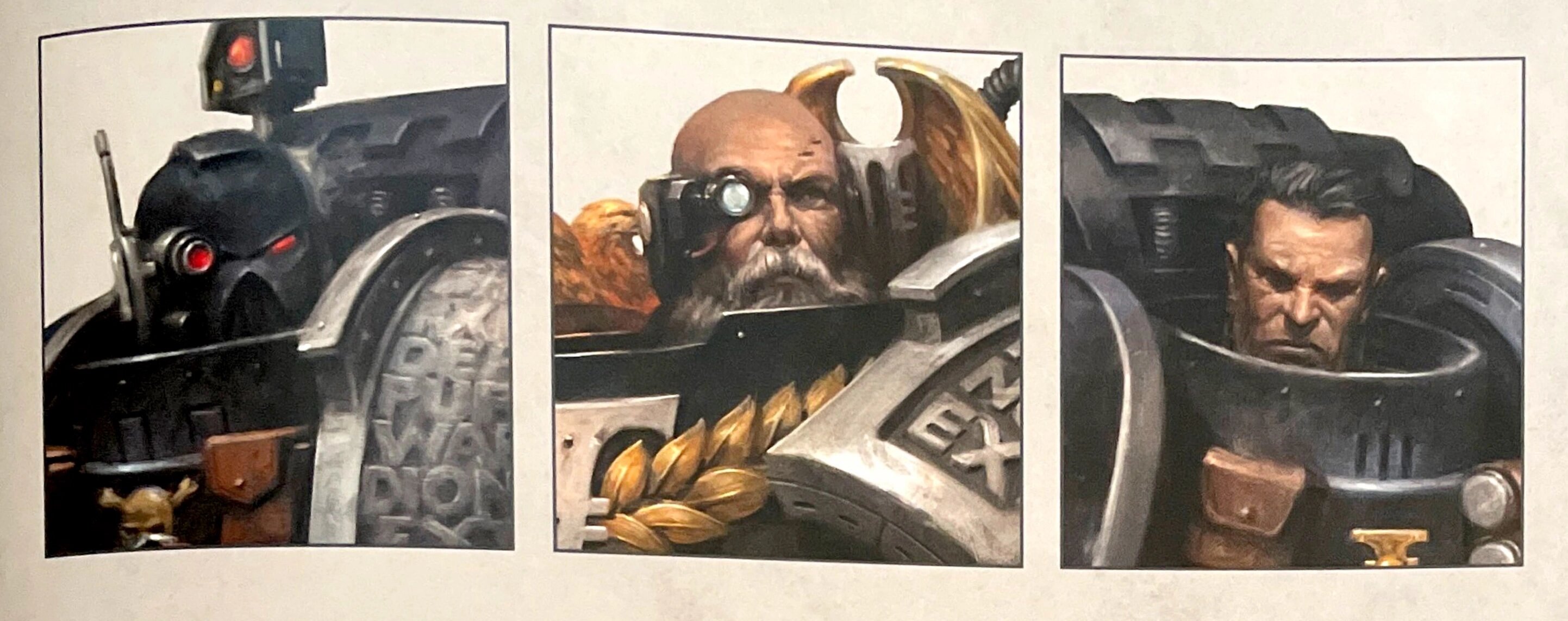
Orloff has written that exact shape twice. Band of Brothers and Masters of the Air are both stories about men from incompatible backgrounds who get hammered into a functioning unit by attrition, and both of them are structurally ensembles with no single protagonist. The Deathwatch handles the cast problem for free, too. The Long Vigil has no fixed term. A brother serves as long as the Watch Commander finds him useful, then goes home under an oath of silence, and another Chapter sends a replacement. A season can turn over half its cast without anyone in the writers’ room having to invent a reason for it.
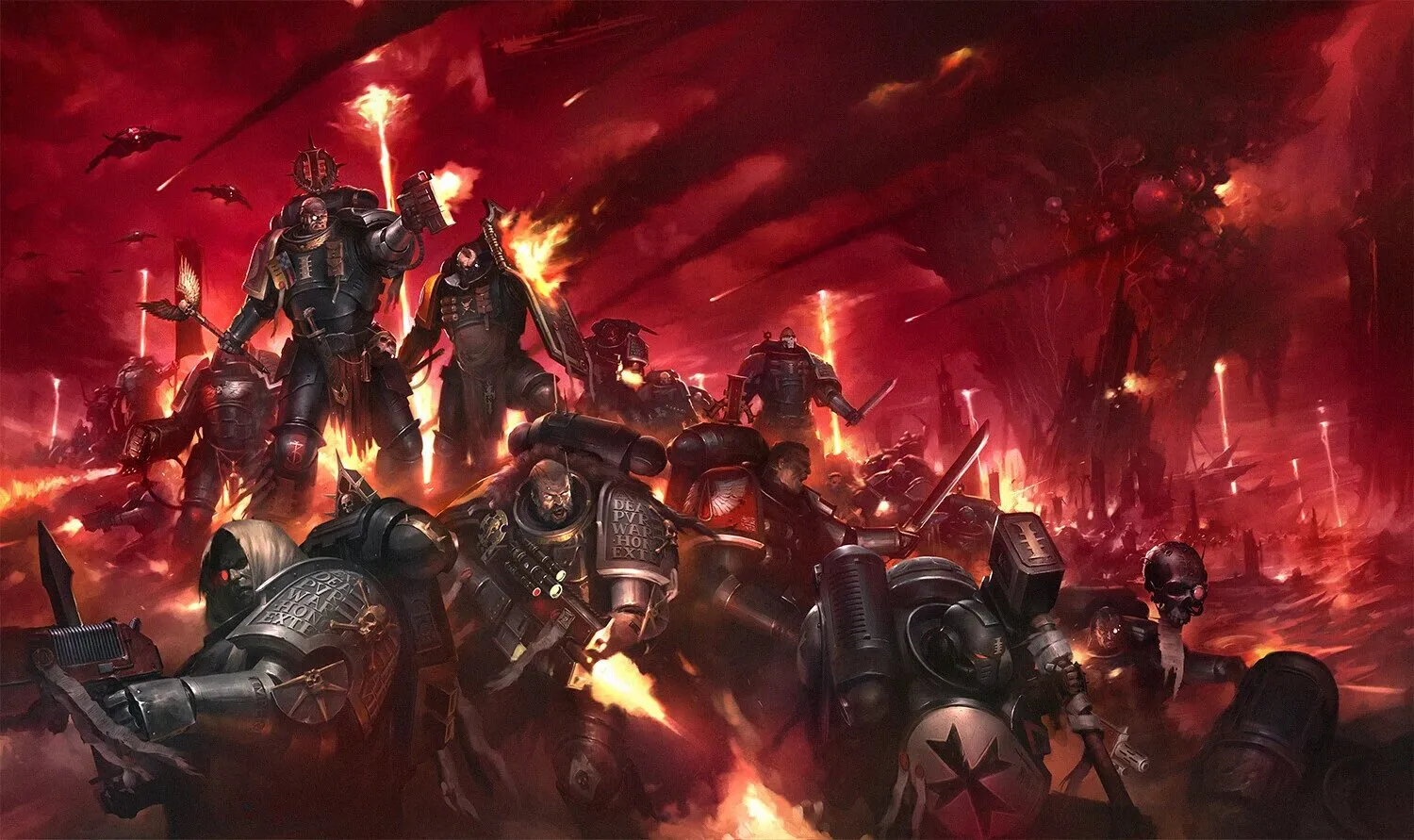
The Deathwatch is the Chamber Militant of the Ordo Xenos, the branch of the Inquisition that deals with aliens. Imperial Armour Volume 2’s Alien Hunters extract describes its Watch Fortresses standing “the length and breadth of the galaxy, each a nigh impregnable bastion standing watch over some threat known to hold sway there”, with stasis-sealed arsenals holding everything from relics predating the Imperium to “forbidden tools of destruction wrought by the hands of long dead alien beings”. Marines are seconded to it from their parent Chapters, painted black, and keep one shoulder pad in their own heraldry. I’ve gone through the range’s history at length in the 2003 White Dwarf piece if you want the model side of it.
Sometime around 2019 I went looking for the Jericho Reach at about eleven at night because Pete had mentioned Watch Fortress Erioch in the group chat and I didn’t know what it was. Three hours later I was reading about Imperial Guard field rations and how the Munitorum ships corpse starch, having passed through the Achilus Crusade, two Forge World books I don’t own, and a forum argument from 2013 about whether Watch Stations have their own Chaplains. I could not tell you now how I got from one to the other. I know I never did find out what I’d originally wanted to know about Erioch, and I’ve never gone back to check.
Orloff writes soldiers you’re allowed to like
The engine of Band of Brothers is moral clarity, and that’s the bit I keep turning over. The whole design of that series, and of Masters of the Air after it, is that these are decent men doing an appalling job in a cause the audience never has to interrogate. Episode nine exists precisely to hand the audience its justification. You watch Easy Company find the camp and every hard thing they’ve done for eight episodes gets retrospectively underwritten.
The Ordo Xenos has nothing you could build an episode nine around. For a single piece of lore that shows how far in the other direction it runs, White Dwarf #459’s profile of Inquisitor Allexei Macara is hard to beat. Macara is Ordo Xenos, she operates with Deathwatch detachments, and by the estimate of the Inquisitorial scribe writing her up she has had a hand in “rendering some nineteen species of xenos extinct in the earliest stages of their development, creatures only just employing stone tools and utilising fire”. Nineteen civilisations that had recently worked out fire, cleared off the board pre-emptively, on the grounds that one of them might eventually become a problem. She’s on our side. She’s a valued asset. The write-up treats the nineteen as a line on a CV.
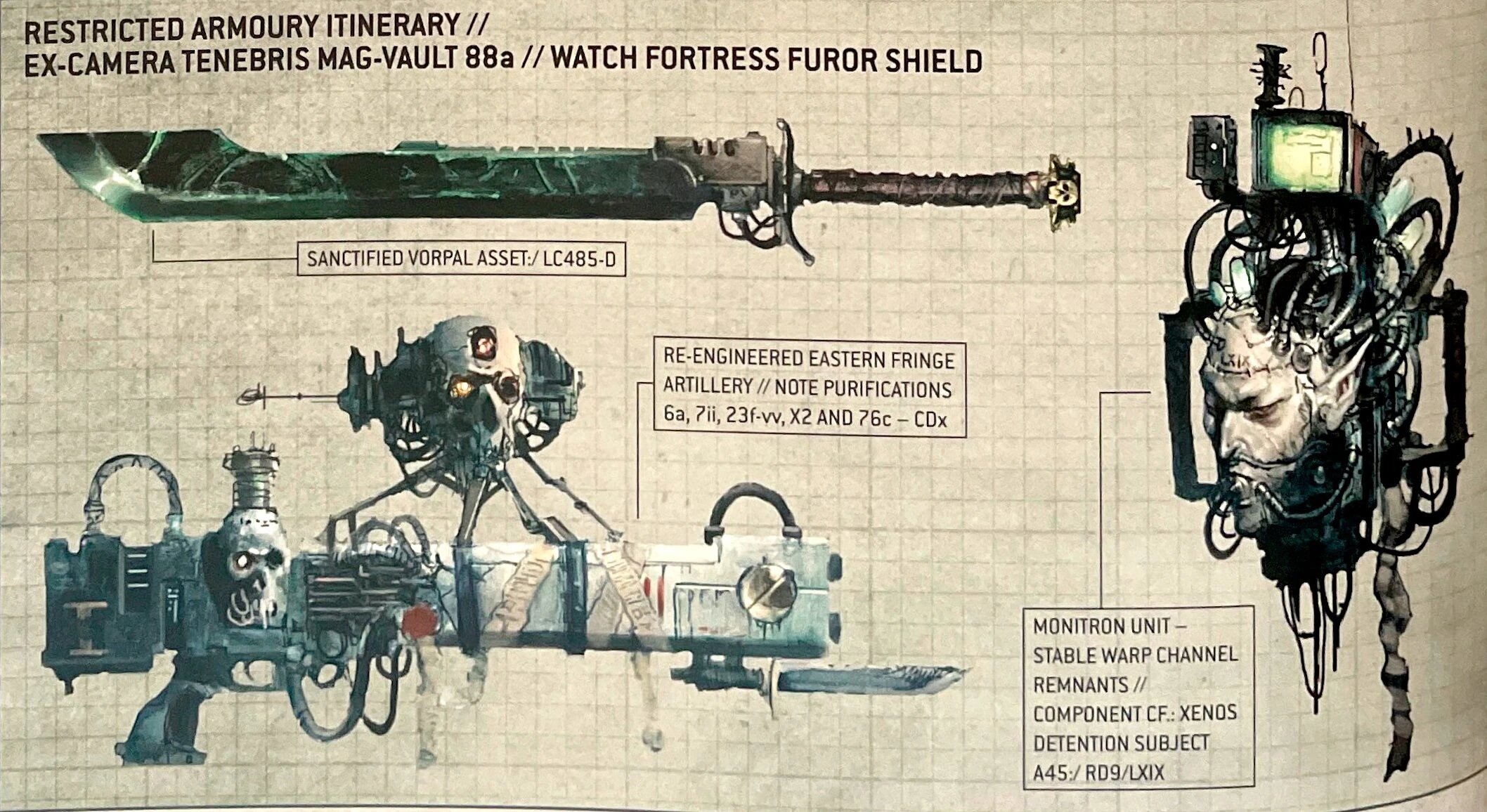
That’s the flavour throughout. Imperial Armour Volume 2 logs a campaign on Tyrama Secundus in 964.M41 where a previously unknown species rises from the oceans and starts enslaving the human population, and an Ordo Xenos inquisitor arrives with Deathwatch marines to conduct what the book calls, in as many words, a xenocidal campaign, casting down the aliens’ cyclopean fane-cities. The aliens started that one, so it’s the version of the job where the Imperium looks defensible, and it’s logged in the same ledger, at the same intensity, by the same people who logged Macara’s nineteen. The book files it under 964.M41 and moves straight on to the next entry.
So yeah. Nineteen species. Stone tools. And that’s the organisation the kill team works for, and the kill team are the good guys, and they’re the ones you’re supposed to be watching through the visor with. There isn’t a version of episode nine you can write for that. You can’t walk the audience through a door and show them the thing that makes it all worth it, because the thing behind the door is Macara’s filing.
Although. I’ve been assuming that’s a problem, and I’m not sure it is. Orloff isn’t a naive writer. “Why We Fight” earns its title by making you sit with the price rather than waving it away, and Masters of the Air is fairly unsparing about what strategic bombing actually involved for the people underneath it. A writer who can hold both of those at once might be exactly the right person to put a Deathwatch kill team on screen and quietly let the audience notice, three or four episodes in, that the men they’ve grown fond of work for something monstrous. That’s more or less what Abnett does in the Eisenhorn books and it’s the best thing in them. I’ve talked myself halfway back round while writing this.
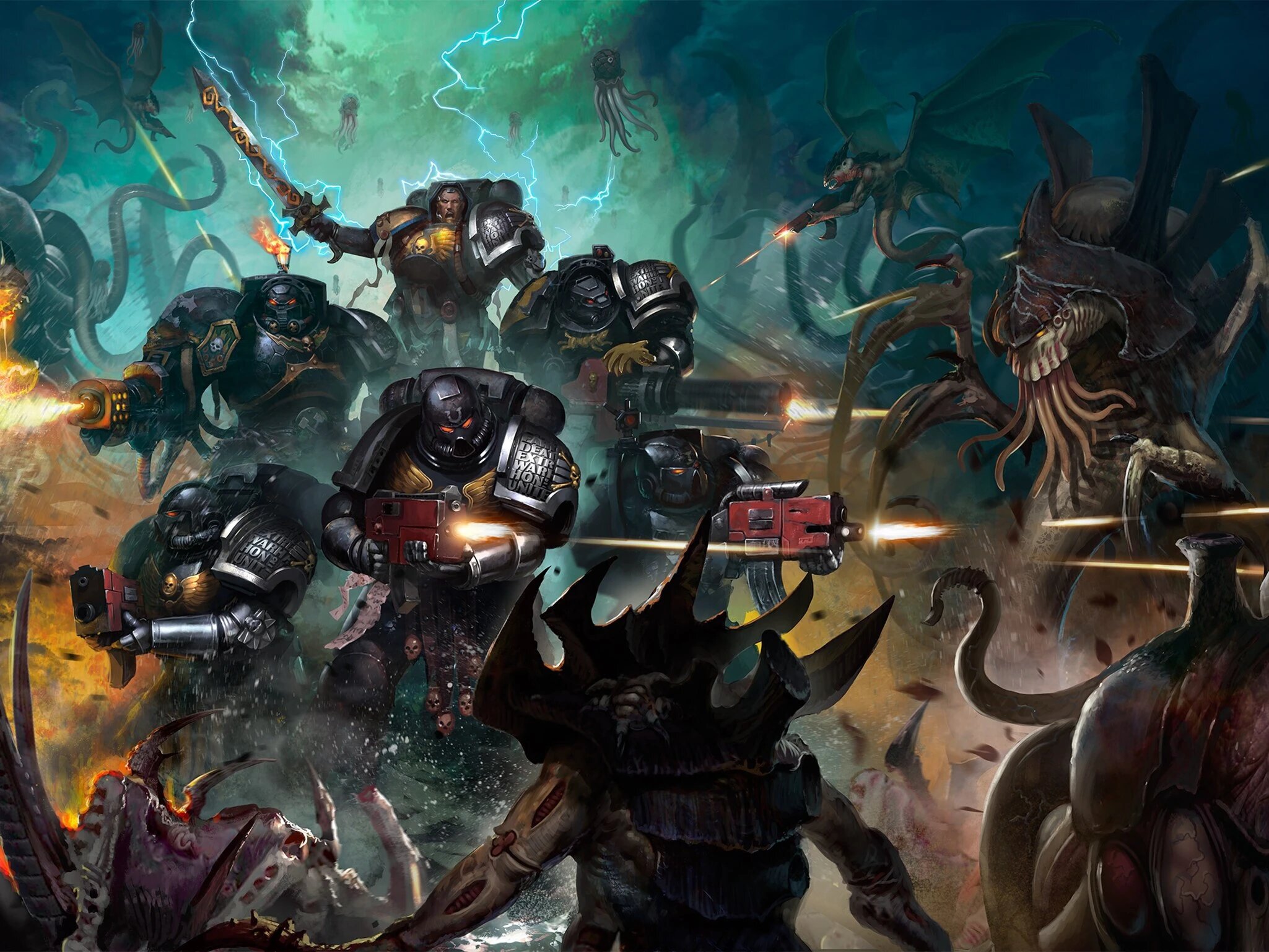
The other risk is duller and more likely: xenos-of-the-week. The Deathwatch premise commits you to a new alien species every arc, and GW’s screen output so far has been overwhelmingly Tyranids and Orks, because Tyranids and Orks are legible to people who’ve never touched the game. If the series runs twelve episodes and ten of them are Tyranids, the format has been wasted. The Deathwatch’s back catalogue is full of genuinely strange things that would never survive a pitch meeting, and I’d love to be wrong about that. I don’t know how many episodes it is. GW hasn’t said. They haven’t said a release window either, and the working estimate floating around is 2027 or 2028.
Worth flagging that this is a separate thing from Astartes II, which lands on Warhammer+ in December and is a completely different production. GW went out of its way to note that the Amazon animated series, the Secret Level Age of Sigmar episode and the live-action project are all running independently of each other and of Astartes. That’s four or five distinct 40K screen efforts in flight at once, which is a genuinely odd sentence to be able to write about a company that had none a decade ago.
Pete’s had a Deathwatch army since the 2016 codex and has been asking for something like this for years. His pitch was always Cassius, the Salamanders Chaplain, running a kill team that hates him. Mine was never anything, because I don’t own a single Deathwatch model and I’ve spent two editions saying I’ll get round to it. What I do keep coming back to is that pauldron rule. One shoulder in black, one in the colours of the Chapter that sent you, so every man in the room is wearing a reminder of where his real loyalties sit. Put six of those in a drop pod and you’ve got a series before anyone opens their mouth.