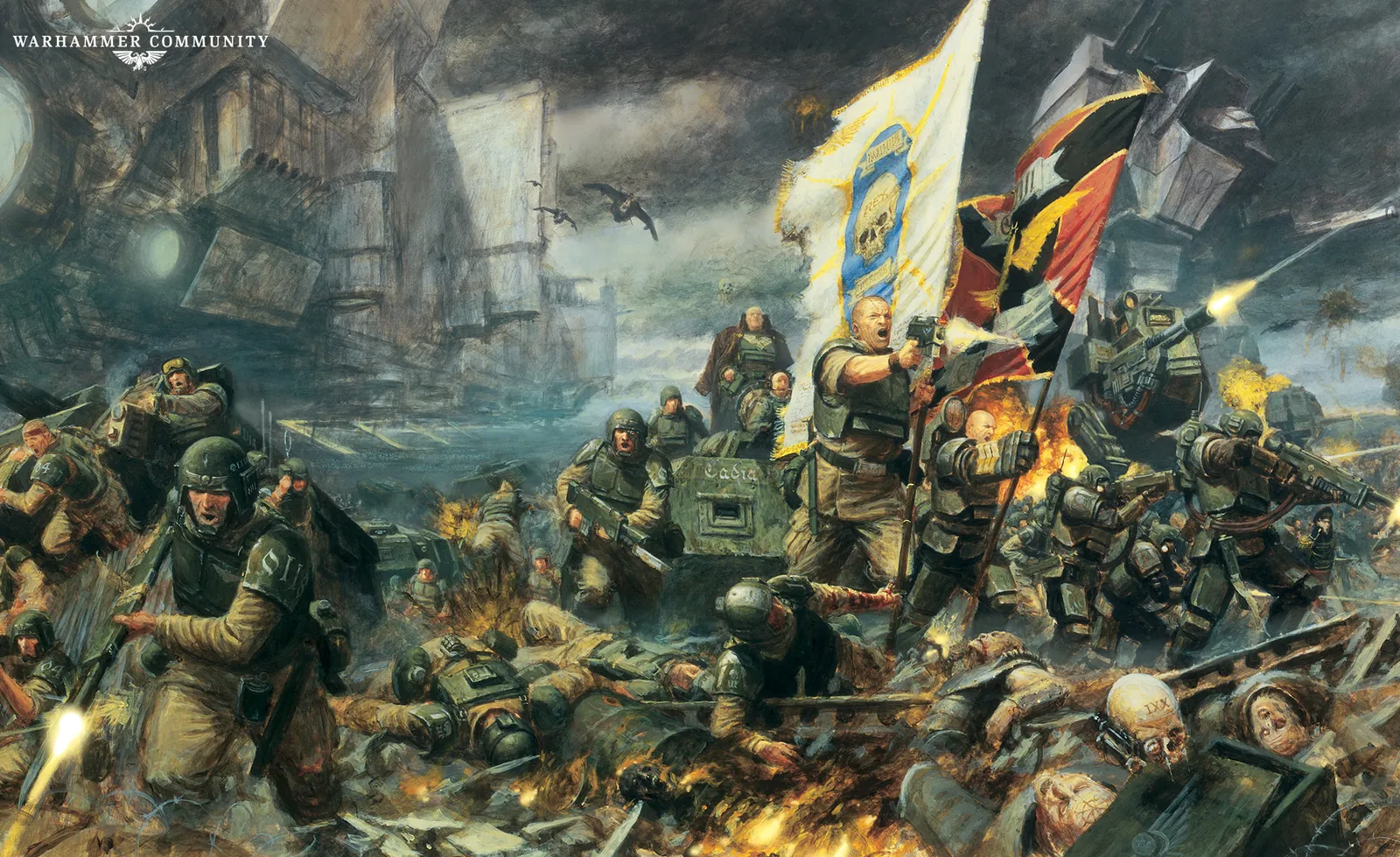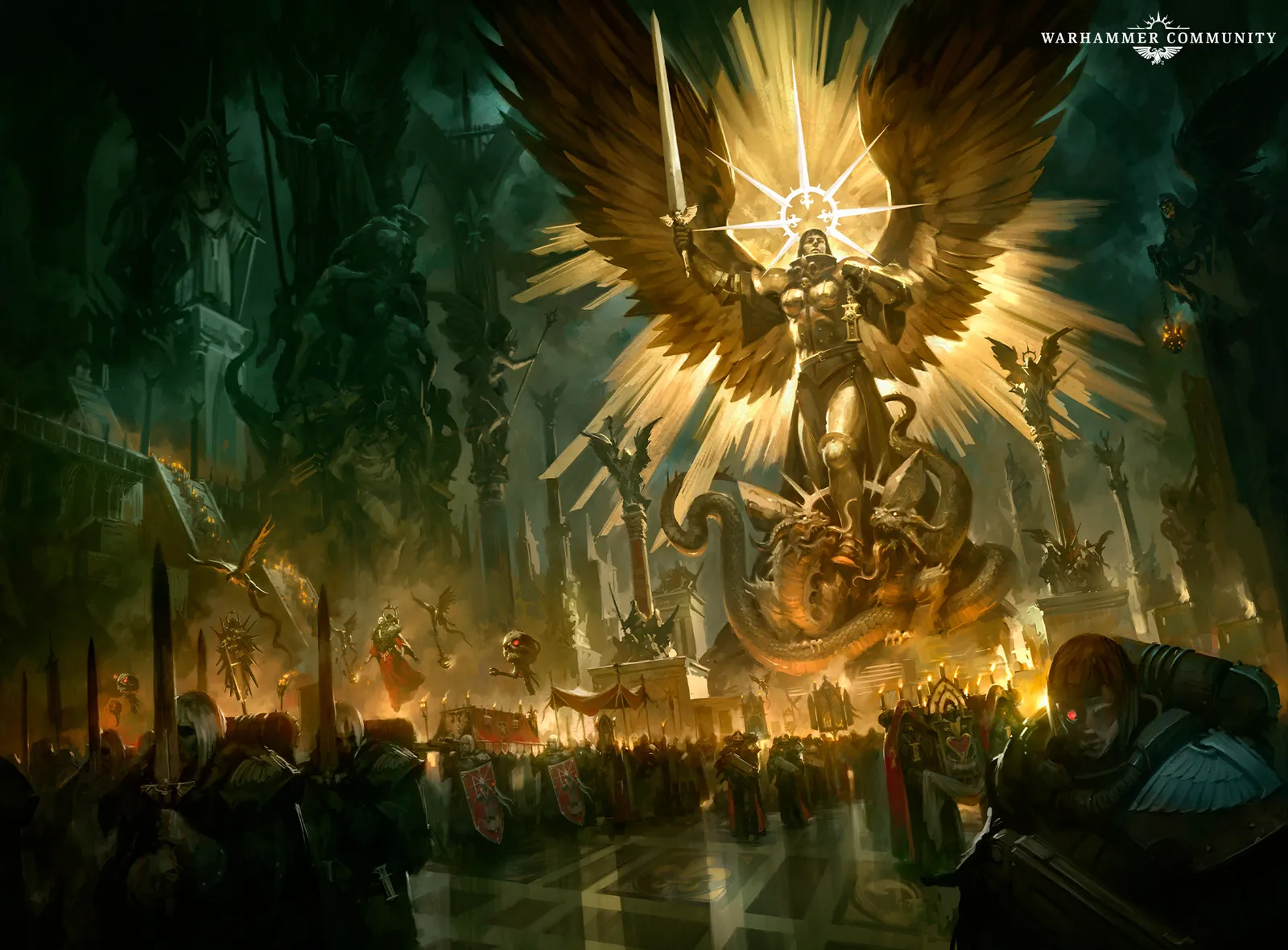

“God-Emperor, grant us but a portion of Your strength.” “With it may we drown Your foes.” That’s a Haephosian Tritons company at prayer before a landing, printed in White Dwarf #458, and I think it’s the most 40K piece of dialogue in the archive. Nobody in the room says a word they came up with themselves. An officer intones a line, the whole company gives the fixed reply, and then four hundred men slam their lasgun butts into the deck. It’s liturgy, and liturgy is the exact opposite of the thing Mike Flanagan does better than anybody else working in television. Three exchanges in that scene, all of them written centuries before anyone in the room was born.
Deadline reported on the 29th that Flanagan is in talks to run the Amazon Warhammer 40K series as showrunner, writer and director, with an EP credit on top. Games Workshop’s annual report the day before had him listed as “writer”, which is a job you can be hired for and quietly replaced on. Showrunner means the thing is his, and it’s a substantially bigger claim than the one GW filed with shareholders forty-eight hours earlier.
The Amazon deal behind it was signed in March, a multiyear overall arrangement with Amazon MGM. Carrie arrives on Prime on the 7th of October as its first project and 40K is the second. Vertigo’s Roy Lee and Natalie Viscuso are still producing, Cavill is still attached to star and EP, and United Artists have come aboard with Scott Stuber. Andy Smillie and Max Bottrill are the GW names on the paperwork. Flanagan is also writing and directing The Exorcist: Martyrs for Blumhouse at the same time, so the man’s diary is not what you’d call empty.
What Flanagan actually does with a scene
Everyone files him under horror. The unit of craft in a Flanagan show is one person talking, uninterrupted, for a very long time, about what they believe and what they’re afraid of. Midnight Mass has two characters sit on a porch and take turns describing what they think happens when you die, and it runs for something like ten minutes with no cuts to spare you. The Fall of the House of Usher is structurally a confession: Roderick Usher sitting in a ruined house telling a prosecutor everything he did, across eight hours, because he’s finally decided to say it out loud. Hill House keeps stopping the ghost story so somebody can admit to something.
I should own up here. I watched Midnight Mass across two nights and got genuinely teary at a monologue about a dog, in front of my wife, at half eleven on a Tuesday. So weigh what follows accordingly.
The speeches are always the same shape underneath. A character who has been performing certainty stops performing it. And the reason that lands is the setting always allows the confession to happen: there’s a bar, or a porch, or an AA meeting in a church basement, or a lawyer with a recorder, and the person listening is going to hear the whole thing out.
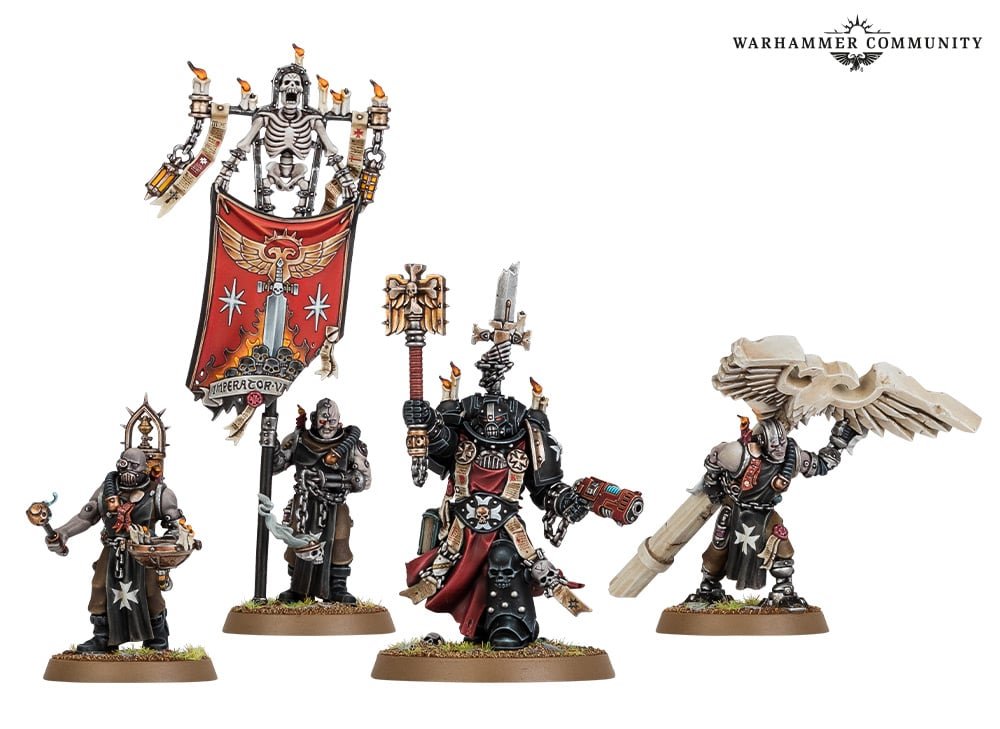
Now put that man in the 41st millennium. The Imperium produces an enormous volume of speech, more than almost any setting I can think of, and virtually none of it is a person saying what they actually think. Chaplains are the clearest case. Index Astartes Apocrypha describes them fighting alongside their brothers “reciting extracts from the Chapter’s Creed and Liturgies”, their “inspirational sayings and constant exhortations” hardening everyone’s resolve. Extracts. Recited. The Chaplain is a delivery mechanism for text that predates him by millennia. The same passage has him presiding over recruits’ indoctrination, teaching loyalty to the Chapter and reinforcing its precepts through ritual and ceremony, which is a description of a man employed to keep the wording stable.
White Dwarf #431 ran a little redacted panel that I’ve never forgotten, in the Regimental Standard house style. “+ FILE ACCESS DENIED + A questioning mind betrays a treacherous soul. ++ ADMINISTRATUM NOTIFIED ++”. Six words of doctrine and an automated report to the authorities.
Asmodai counts confessions like jewellery
There is exactly one institution in the setting built to produce a Flanagan monologue, and the Dark Angels run it.
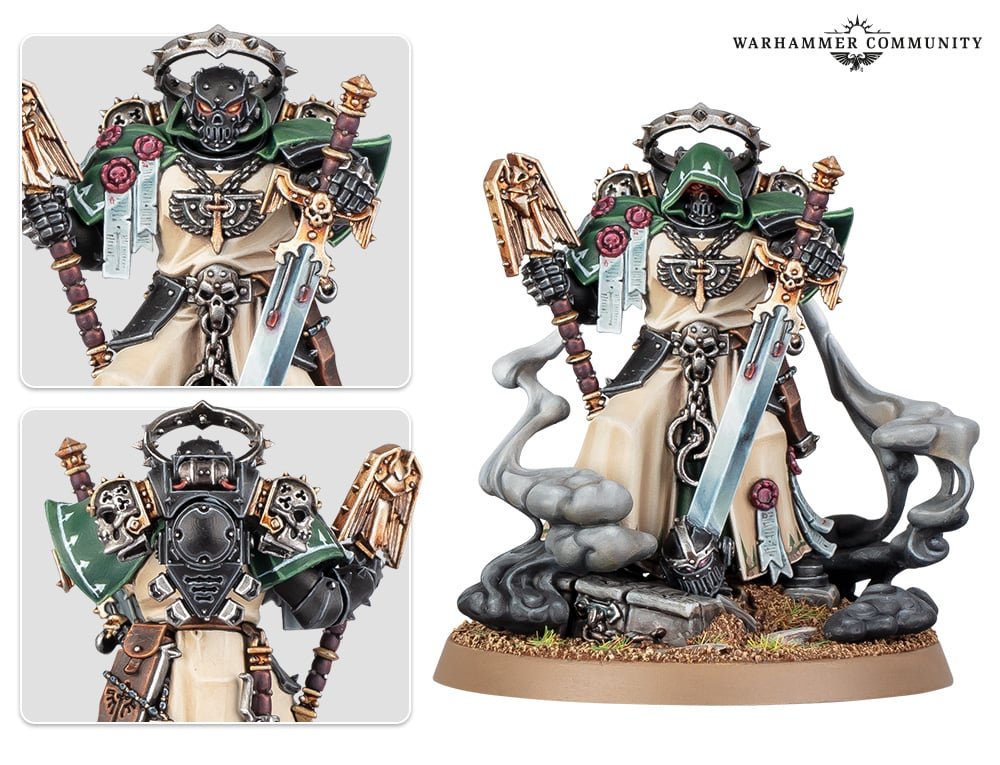
White Dwarf #464’s Index Hereticus material on the Unforgiven is the most useful thing I’ve read on this. The Chapter takes Fallen Angels alive wherever it can, and the reason is stated flatly: “The traitors must instead confront their crimes and be compelled to repent them.” Prisoners go to interrogation cells in the depths of the Rock, which is the last physical fragment of Caliban, held together by force fields and pushed through the void by warp engines that took centuries to build. Other Unforgiven Chapters keep their own versions. The Disciples of Caliban use a shielded vessel called the Ward of Kazael. The Cowled Wardens carved icy catacombs into an unnamed asteroid in the Sirikoid Belt.
The Interrogator-Chaplains who work those cells have studied the Fallen “to the point of obsession”, and they have a Librarian in attendance to weaken the prisoner’s mind and pick truth out of what the write-up calls an inevitable torrent of lies. And here’s the detail that made me put the issue down. For every prisoner an Interrogator-Chaplain successfully brings to repentance, he adds one black pearl to his rosarius. The most gifted in the Chapter’s history accumulate a handful across a lifetime.
So yeah. Black pearls. One each time you talk a man into saying it out loud. The best of them manage, what, five? Six across an entire career? And the moment a Fallen Angel does repent he’s put to death immediately, because that was the whole transaction. Most of them never do. Most of them die broken and still defiant, and then someone files the attempt.
I bought a second-hand Land Raider off eBay in 2013 for a Crusade list I never finished. The seller posted it in a Tesco carrier bag with a single sheet of newspaper for padding, so it arrived as a kit again, plus about nine pieces I never located. I still have the sponsons in a takeaway container somewhere. This has nothing to do with anything, but the phrase “in the depths of the Rock” always sends me back to that period of my hobby life for reasons I can’t reconstruct.
The speech you’re not allowed to make
Falling to Chaos, in almost every version of the story Black Library has ever told, begins with a sentence. Someone articulates a doubt where another person can hear it, and the rest follows from there. So the Imperium’s rules about speech are the best gift the setting could hand a writer like Flanagan, because they put a price on the thing he builds every season around. In his other shows the worst outcome of a confession is that somebody stops loving you. Here the Administratum gets notified.
White Dwarf #458 carried a Black Library extract that does this in about thirty words, and it’s stayed with me longer than most of the novels I’ve actually finished. Sister Miriya has a plasma pistol against a corrupt confessor’s forehead. He recants, he pleads, he calls her kindred of the cloth, and when she asks what he could possibly be begging for he says, in a small voice, “Forgiveness?” She kills him with a knife instead of the pistol, on the practical grounds that the door lock needs his eyes intact. A few pages later her own Canoness opens a vox channel with “If you wish to confess, the time for that has passed.”
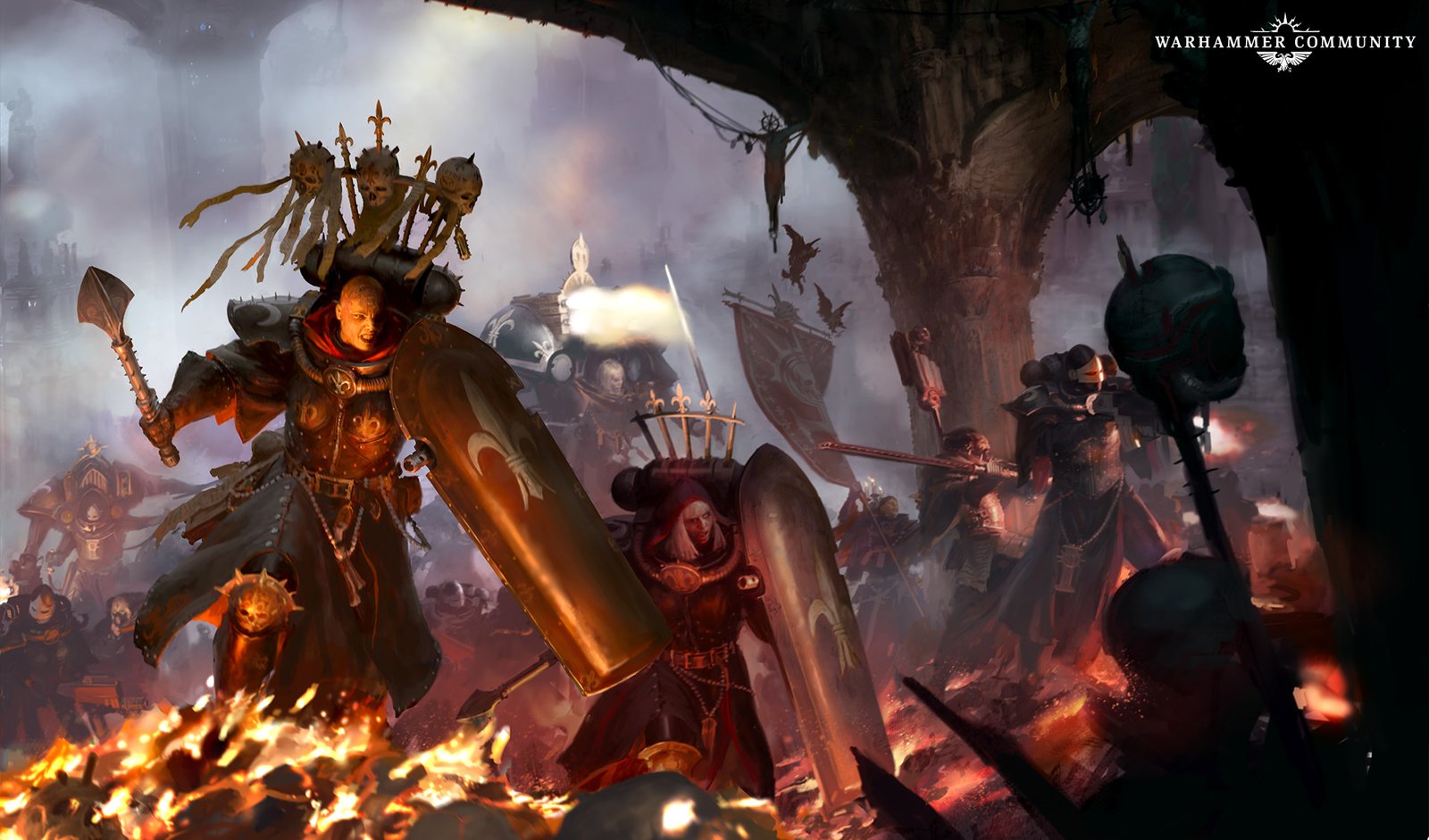
Two people in that scene try to say something true about themselves, and the Ecclesiarchy has a procedure ready for each of them. One procedure involves a combat knife and a retinal scanner.
Although I’ve argued myself into a corner. If every honest speech in the setting is a capital offence, your lead can only make one, and it has to be near the end. Flanagan’s shows work because characters keep confessing, in episode two and episode five and episode seven, each time going a bit deeper. Do that in the Imperium and your protagonist is dead before the halfway point, or the Inquisition looks incompetent for not noticing. I don’t have a good answer to that. Maybe you set it somewhere the machinery is thin on the ground, a backwater regiment or a rogue trader’s ship, but that’s a smaller show than the one Amazon paid for.
The Warhammer 40K oil tanker problem
The thing that gives me pause has nothing to do with 40K. Flanagan has been developing a Dark Tower series since 2022, longer than my eldest has been in school, and when he was asked about it last year he compared it to building an oil tanker: constantly in the works, enormous, not moving quickly. That’s his one attempt at a sprawling multi-season franchise adaptation, and it’s the one thing on his slate that hasn’t shipped. The contained originals get made. Carrie got made in about eighteen months. 40K is an oil tanker with a bigger displacement than Roland Deschain’s.
He’s also in talks. Deadline said in talks, twice. GW’s own report used the word “writer” and said the outlines are only outlines. Nothing about this is signed.
Pete reckons the whole live-action project is a decade away and he’s been saying that since 2023, which makes him the most consistently correct person in our garage group. I still think it’s the best news the project has had, because where the show should start has always mattered less than whether anyone in charge has a specific obsession they want to work out through it. Flanagan has one, and it’s institutions that keep hurting people because nobody left alive remembers what the rule was originally for. The Imperium has a ten-thousand-year-old worked example of that on Terra, wired into a chair.
Realistically the Deathwatch animated series reaches a screen first. Animation moves faster, Blur are already attached, and GW has confirmed that one has begun work. No release window has been given for either. The working guess floating around for live action is 2028, and I’d want to see a cast announcement before I believed any date at all.