Page 15 of Kill Team: Exodite has two sentences on it that add a god to the Aeldari pantheon. Ieronsath, daughter of Morai-Heg the Crone. She hunted sentient insanities from the back of a mount called Chadhu, a beast wrought from a wisp of her mother’s hair. That’s the entry, and there isn’t a second one anywhere else in the book.
The Exodite release got covered to death, quite rightly, and I wrote about the models myself when they were revealed. The box came out last weekend and the conversation since has been almost entirely about pivot rules and whether mounted operatives are broken. As far as I can tell, the only place that name has been written down outside the book itself is a wiki edit dated this week.
What Morai-Heg already had
The Crone is old. Second-edition-codex old, which in Aeldari terms means she’s been sitting in the background of this faction since 1994. Goddess of fate and souls, and depending on which book you’re holding, goddess of the underworld. She’s the third of a trinity with Isha the Mother and Lileath the Maiden, which is about as unsubtle a Maiden/Mother/Crone as you can build without printing a diagram. Lexicanum notes she’s probably a lift of the Morrígan, and possibly the Moirai, and honestly it’s both.
The famous story about her is the hand. She wanted the wisdom that ran in her own blood, and Khaine was the only being who could actually wound a god, so she engineered it. Sent her daughters, the Banshees, to haunt their father with their screaming until somebody would agree to anything to make it stop. Khaine took the hand off. She drank, got the knowledge, and Khaine got the Aspect of the Banshee as his fee. White Dwarf #415’s The Croneswords of Morai-Heg is where I first read the follow-up: Vaul took the five fingers of that severed hand and forged them into five blades with dominion over life and death, which is why Yvraine spends the Gathering Storm books chasing them around the galaxy.
There’s a smaller detail I like more than any of that. Aeldari belief holds that a soul is joined to its body by a silvered strand, and only Morai-Heg has the right to cut it. Doing it yourself is called Cutting of the Crone’s Cord, and it’s outright banned on some craftworlds. Which means the Hemlock Wraithfighter, a real unit you can buy in a real box, is a war crime in the eyes of a chunk of its own faction. Iybraesil has built its entire identity on her. Their rune is the Hand of Heg, their warhost leads with Howling Banshees, and their founding legend is a bargain in which seven times seven of their women became the Crone’s handmaidens so that their sisters could live full lives with her touch off them. That one’s from the ninth-edition codex, page 28.
Some other things attached to her, for completeness. The Aeldari homeworlds inside the Eye are called the Crone Worlds after her. There’s a relic called the Torc of Morai-Heg that clouds enemy thoughts and sensors, and gemstones called the Tears of Morai-Heg that prophecy links to finishing Ynnead’s rebirth. Some sources put the slow crystallisation of very old Farseers down to her as well. None of that is new. All of it has been sitting in codices for years.
Ieronsath is the second one
Here’s the part that made me sit up. In January 2025, when GW previewed Lhykhis, the Warp Spider Phoenix Lord, they mentioned in passing that her sword Vhattarkan was blessed by “Ahnakh-Yth, the primal weaver goddess and first daughter of Morai-Heg.” Codex: Aeldari expanded her a bit on pages 13 and 45: the Weaver, mother of spiders, watching from a cosmic web, measuring the thread of a life. She’s said to have made the Warp Spiders that crawl through the infinity circuits.
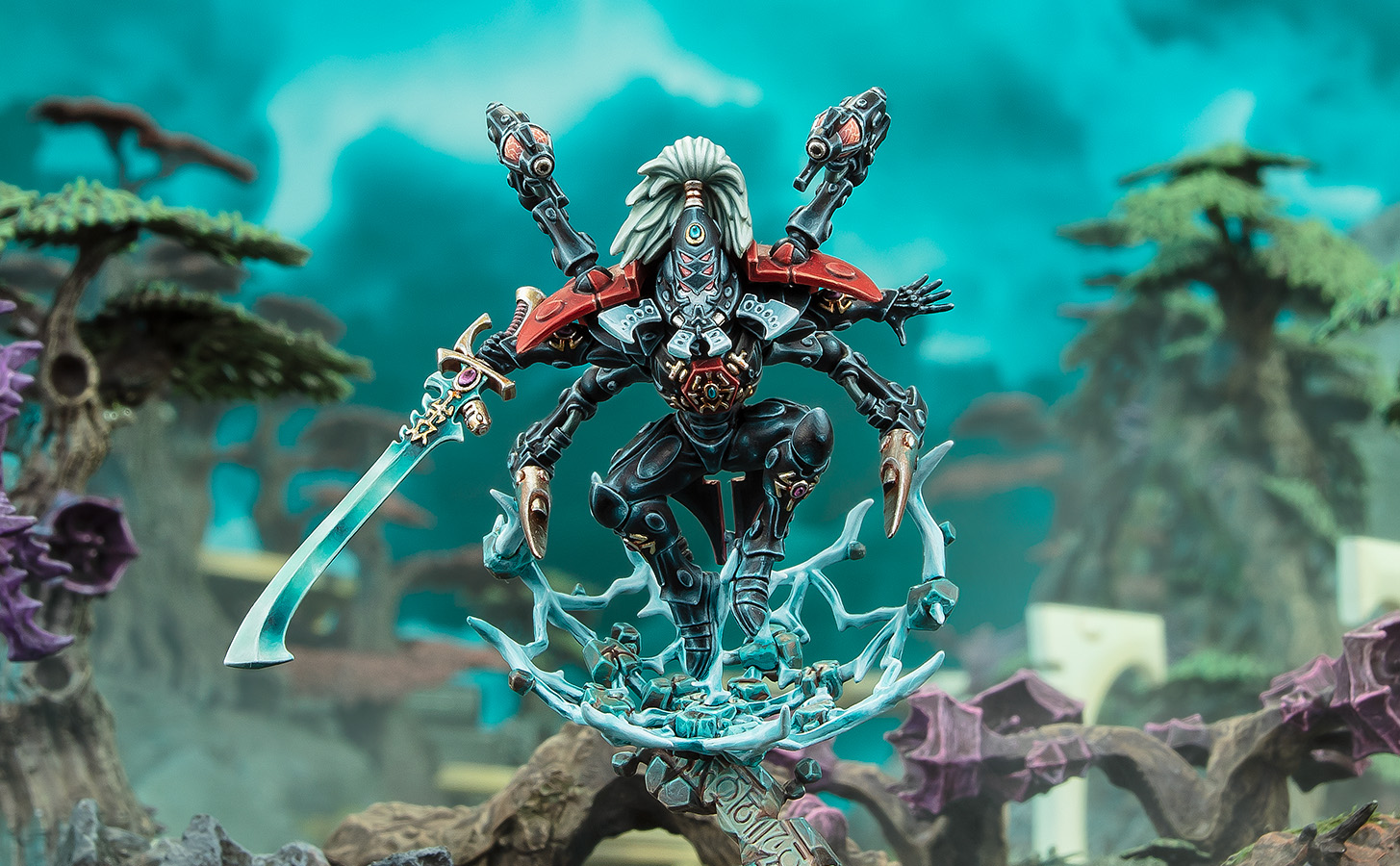
First daughter. Which implies a second, and eighteen months later we got one.
The Banshees are the precedent worth looking at. They’ve been called Morai-Heg’s daughters since the second-edition book, but always as a collective, a screaming plural with no individuals in it. Their father, per a White Dwarf note from 2017, was Kaelis Vara’lanthian, “the death god yet to be,” which is about as heavy a hint at Ynnead as anyone has ever dropped into a footnote. What’s happening now is that single names are being cut out of that plural and given jobs.
So in the space of about a year and a half the Crone has gone from a woman with a bag of runes and a pack of screaming daughters to a named lineage. Ahnakh-Yth measures the thread. Ieronsath hunts things. Both of them turned up attached to a kit: Ahnakh-Yth to a Phoenix Lord with a spider motif, Ieronsath to a team of elves riding lizards. GW is growing this pantheon through the Crone’s family, at the level of daughters and minor deities. The last addition at the top of the tree was Ynnead, and Ynnead took a whole narrative event and three character models to establish.
Sentient insanities
I don’t know what that phrase means and I’ve been chewing on it for two days.
It could be Enslavers. It could be a poetic way of saying warp entities, which is the boring answer and probably the right one. It could be a nice-sounding pair of words a writer put in a myth because myths talk like that. But “sentient insanity” as a thing you can hunt down and kill, from the back of an animal, is a very specific image, and specific images in this setting usually come from somewhere. The Aeldari myth cycle is stuffed with monsters that are really concepts wearing teeth, so a hunt for sentient insanities sits comfortably in that tradition even if it never turns out to mean anything more than it says on the page.
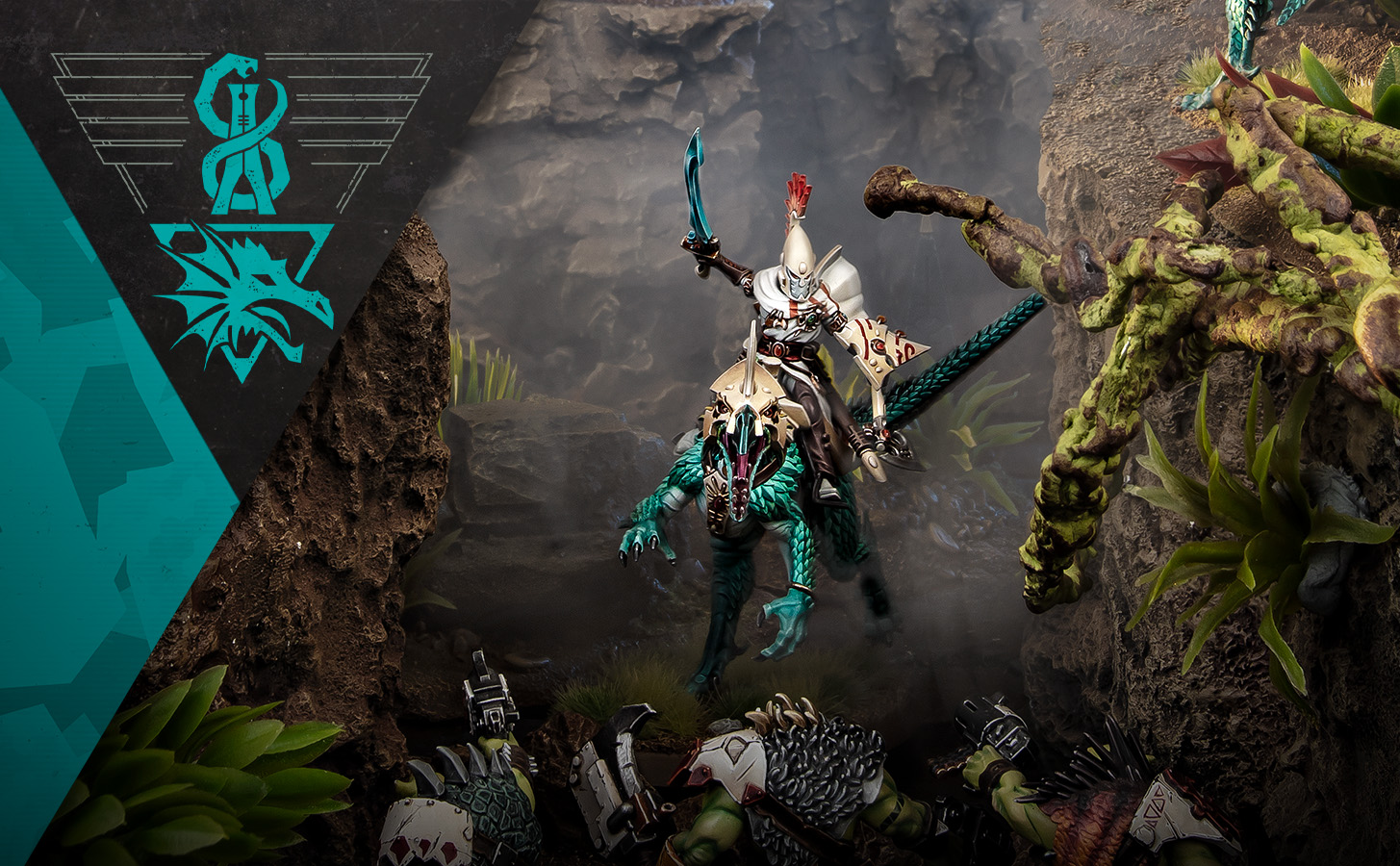
And Chadhu. A beast made from a strand of the Crone’s hair, given to her daughter to ride. Which is a very convenient origin myth to hand to a faction whose entire visual identity is riding beasts. I’d bet a reasonable amount that Exodite drakesteeds are meant to be Chadhu’s descendants, or at least that Exodites tell each other they are. GW hasn’t said that. I’m inferring it from the placement of the entry in a book about dragon riders, which is exactly the sort of inference that gets you into trouble.
Right, so, let me argue against myself. This is two sentences. Two. In a background section of a skirmish game supplement, next to some artwork and a paragraph about ritual triads. Every faction book in this hobby is full of names that got written once and never used again, and Aeldari myth in particular has a long tail of gods who exist entirely as a footnote. Hoec, the Wanderer, for one. There’s a whole rank of them nobody has thought about since the nineties. It is entirely possible that Ieronsath joins that list next week and this is two days of me over-reading a caption.
Except Ahnakh-Yth didn’t. Ahnakh-Yth got a codex page and a named weapon and a Phoenix Lord’s whole origin hung off her. So the precedent for a Crone-daughter turning into load-bearing lore is one for one so far, which is a small sample and I’m aware of that.
The thing I bought and never painted
Back in 2017 I read that Croneswords sidebar in White Dwarf and immediately bought the Triumvirate of Ynnead. Yvraine, the Visarch, the Yncarne, all three, on the strength of a lore box-out about severed fingers. I had no Aeldari. I have never had Aeldari. I play Thousand Sons and I had, at that point, about forty unpainted Tyranids in a drawer already.
They are still on the sprue. Nine years, which is most of the time I’ve been doing this hobby at all. The Yncarne is one of the best models GW has ever made and mine is a flat grey plastic frame in a box under my desk with a Kill Team ruler and a dead spray can. Kiran found it during a clearout last year, held it up, and just looked at me. Didn’t even say anything. I’d bought the thing off the back of a lore box-out about severed fingers, owning no Aeldari and having no plan to start any, and I still think that was a reasonable way to spend forty quid.
So my track record on getting excited about Morai-Heg lore is not spotless is what I’m saying.
What we actually have
The concrete situation: two named daughters, both introduced in the last two years, both arriving alongside a product. One has a codex entry and a Phoenix Lord’s sword. One has forty words in a Kill Team book. Neither has appeared in any fiction. Neither has a model, and I’d be genuinely surprised if either ever gets one, because 40K doesn’t usually put gods on the table unless they’re avatars of something.
What I keep coming back to is that the Exodites are the ones carrying this. Not the craftworlds, who have the Paths and the infinity circuits and the entire apparatus of remembering things properly. The lot who left, went agrarian, and spent thirty thousand years on dirt worlds herding lizards are the ones with the myth GW chose to expand. That reads as deliberate to me. The people who kept the old religion kept the old gods, including the ones the survivors stopped naming after the Fall took most of the pantheon.
Whether Ieronsath survived it, nobody has said. Morai-Heg didn’t. Asuryan didn’t. Eldrad has spent ten thousand years working around the fact that the Aeldari gods are mostly digested, and the standing assumption is that anything in the pantheon that wasn’t Cegorach or Isha went the same way when Slaanesh woke up. Ieronsath gets no verdict either way. She’s just there on page 15, riding a beast made out of her mother’s hair, and then the book moves on to the terrain rules.