When Mephet’ran the Deceiver walked into the court of the Triarch and offered the Necrontyr a way out of dying, one voice in the room said no. Orikan the Diviner was the Silent King’s astromancer, the one whose entire job was reading what was coming off the movement of the stars, and he read this one right. Biotransference would eat the thing it was supposed to preserve. The Triarch heard him out and went ahead regardless.
Then Orikan got in the queue with everyone else and let them pour him into a metal body. It took his soul the same as it took everybody else’s.
He’s never explained why. The 5th edition codex says he submitted out of loyalty to his species and then moves straight on to the next paragraph, which is about as much interiority as GW has ever handed him.
Black Library put the sequel up for pre-order on Saturday. The Wicked and the Warped, by Robert Rath, hardback on the 15th of August, five years after The Infinite and the Divine turned two ancient robots bickering over a tomb into one of the best things the imprint has ever published. This one drops Trazyn into the awkward position of trying to patch things up with an embittered Orikan while the pair of them chase a lost expedition to a Chaos-corrupted world called Amenthis.
Warhammer Community ran a free extract on the 30th. It’s Trazyn’s half of the double act and only his: he gets swallowed side-on by a flying Tzeentchian thing mid-sprint, ditches a relic disc sideways as a decoy, and rides his own consciousness through four separate lychguard bodies to hit an extraction window with 0.4 seconds left on his own countdown. He’s laughing through most of it. Orikan doesn’t appear once.
How Orikan the Diviner cheats at prophecy
He called the Fall of the Aeldari. He called the rise of Mankind, the Horus Heresy, and the arrival of the Tyranids, all of it thousands of years before any of it happened. That’s the reputation, and the courts of a dozen dynasties will grudgingly pay for his time because of it, even though nobody likes him.
Orikan’s calculations aren’t perfect, and warp travel in particular plays merry hell with them, because the immaterium doesn’t care what the stars said. So when a prediction is about to come apart, he goes back down his own timeline and stands in the past at whatever point lets him bully the future into agreeing with him. He’d forecast that the Imperial Navy dockyards at Helios VI would not survive Waaagh! Skullkrak. The dockyards survived, because the Silver Skulls 4th Company turned up and made a nuisance of themselves. So Orikan went back several weeks, arranged for a Necron force to ambush that company and very nearly wipe it out, and let the timeline roll forward again into the outcome he’d promised. Helios VI burned on schedule, and the court that had paid for the forecast filed it as another clean hit.
You know that mate who announces you’re definitely going to miss the train, then spends four minutes at the ticket machine choosing a fare? That, but with orbital dockyards.
It didn’t go clean, either. Five Chapters came looking for payback afterwards, including the Death Spectres, the Howling Griffons and whatever was left of the Silver Skulls, and they descended on the Lazar System and levelled the tomb world that had commissioned Orikan’s prediction in the first place. His own client, erased, because he wanted to be seen to be right. Nobody ever traced it back to him.
The Carnac campaign has the same fingerprints. Anrakyr the Traveller went after a tomb world and found it covered in Aeldari Exodites, with Alaitoc arriving to help and Farseer Eldorath Starbane doing the prophecy work on their side. Orikan’s divinations aren’t as sharp as a Farseer’s, but he doesn’t need them to be. He just needs to muddy the water enough that Starbane’s readings go wrong, and they did. Pathfinders kept arriving where Anrakyr was supposed to be and finding Deathmarks waiting instead. Then, at the decisive moment, Carnac’s stasis tomb woke up on its own, which was very convenient, and Necron reinforcements started arriving in a trickle that never stopped, and Alaitoc had to abandon the World Spirit shrine and go home.
Orikan asked for no trophy afterwards. Trazyn took the entire shrine as spoils. Orikan simply hoped nobody would think too hard about the timing of that awakening.
What a chronomancer actually is
Chronomancy is one of the more common Cryptek disciplines, which surprised me the first time I read it properly. White Dwarf #499’s Mysteries of the Crypteks lists it alongside technomancy and plasmancy as one of the useful, employable specialities that royal courts actually want on staff. Tomb ships get chronotronic nodes built into their hulls so they self-repair faster. The Nekthyst Dynasty parks entropic accelerator satellites out in the deep void and quietly ages entire planets into dust over a few decades without firing a shot. Whole worlds have been taken that way with nobody deploying at all.
The same issue’s Diviner’s Dilemma piece says flatly that no greater chronomancer exists than Orikan, that he moves in secret up and down his own timeline, and that lately his readings have been getting scrambled by waves of temporal disharmony rolling out of the Nephilim Anomaly. He’s gone in there personally to find out what’s causing it. WD #499 is the only place I’ve seen that thread picked up, so take it as one source rather than settled canon.
His staff is the detail I like most. The Staff of Tomorrow exists a fraction of a second ahead of the present, so when he swings it, the blow has technically already happened by the time you decide to move.
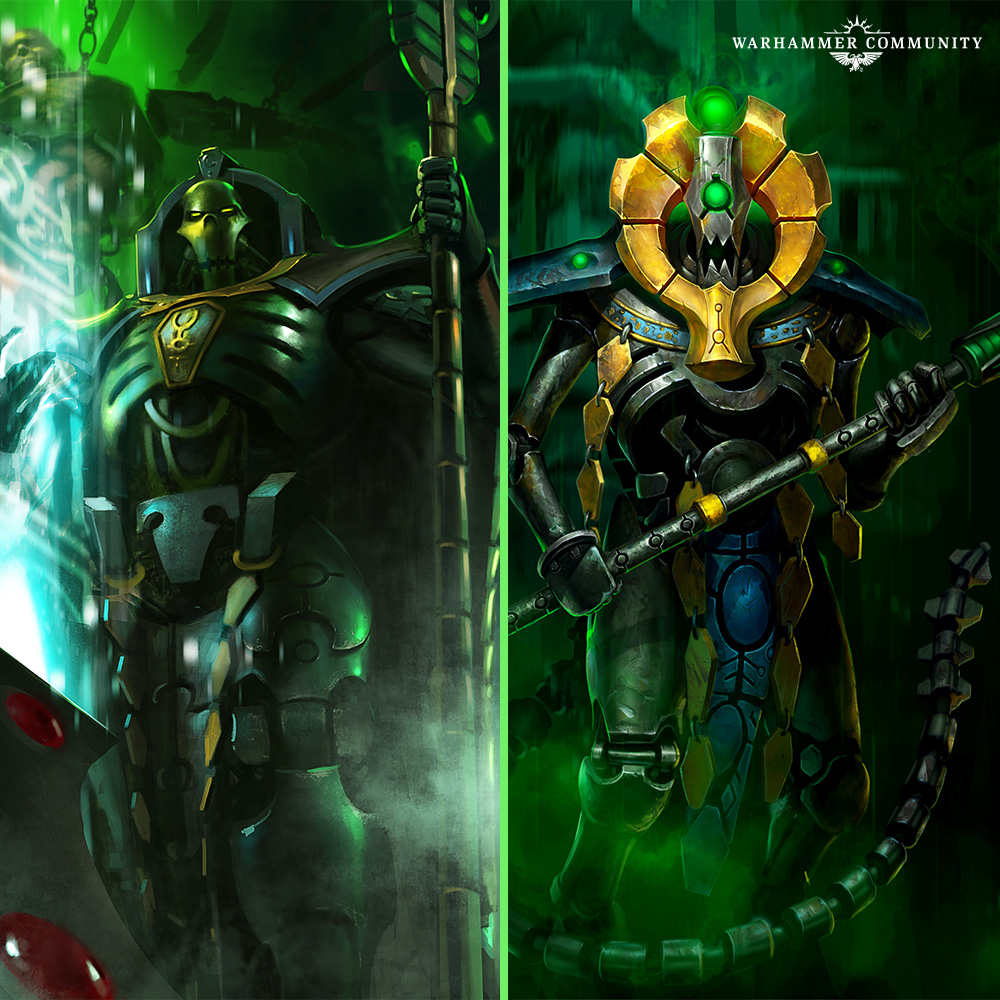
So yeah. Orikan. Skinny gold robot, enormous collar, stick. Been in the codex since fifth, got his model somewhere around 2011, plays as a support piece. Everyone else on that shelf fights over planets. He fights over which version of last Tuesday gets to be the real one. On the table this mostly comes out as slowing people down and a staff that always swings first.
I overheard a game at my local store years back, 7th edition, so 2015-ish. Necron player kept rolling for Orikan’s ascension every single turn and kept missing it, and by turn four his opponent had started doing a countdown out loud, and by turn five the two of them were having a proper argument about whether a model that can rewrite the past should be allowed to reroll anything. It went on much longer than it needed to. I stood there with a half-built Tyranid in my hand pretending to look at paint. Never did find out who won.
The one time the ascension actually landed
Orikan has been building towards godhood for roughly a thousand millennia. He’d been at it about a hundred thousand times longer than I’ve been in this hobby, and I’ve rebased my Thousand Sons twice in mine. The plan needed the stars in a specific configuration, and the on-table version of that is the old “The Stars Are Right” rule, where he occasionally lights up with borrowed power for a few minutes and then goes dim again.
The full version happened on Serenade, and it happened because Trazyn wouldn’t leave him alone.
Both of them wanted into the stasis tomb of Nephreth, a phaeron of the Ammunos Dynasty, which supposedly held wonders and which only opened when certain astrological formations lined up. Serenade itself hummed. There was a numeric sequence broadcasting endlessly out of the tomb, 3211-1545-4131-5322, seeping into every part of life on the planet for millennia, and prolonged study of it sent Necrons mad. I went looking for what the sequence actually decodes to and came up with nothing, so if there’s an answer buried in the novel I’ve missed it.
To get rid of his rival, Trazyn released a genestealer into the depths of Serenade to kill Orikan. Orikan survived. The genestealer didn’t die, it escaped, and over the following centuries it became a Patriarch and built a cult and rose up, and the Imperium eventually solved the problem the way it solves most problems, which left Serenade a dead world with a Necron tomb still intact underneath. Orikan was buried in the Exterminatus.
Digging out took him a hundred years. Except it didn’t, because every time the timeline resolved back into Trazyn trapping him, he reset it and started again, and by his own subjective reckoning he spent over two thousand years down there.
Then the punchline. Nephreth’s tomb was a myth. There were no wonders. The whole legend had been seeded into Necron culture by a shard of the Deceiver, who had spent ten thousand years playing the pair of them off against each other for the sole purpose of getting himself freed. The same C’tan Orikan had stood up in front of the Triarch and warned everybody about, running the same trick again. Trazyn had been worked for exactly as long and hadn’t noticed either.
He won, in the end. Trazyn handed him an Aeldari gemstone, and Orikan used it to transform into a being of light and put the shard down. The ascension he’d spent a million years calculating towards finally arrived, and he spent it cleaning up the mess he’d predicted at the very beginning while a museum curator handed him the tools. Whether the gemstone was a one-off or whether he could do the whole thing again with the right kit, I genuinely don’t know. Nobody’s said.
I’ve written most of this article as a tragedy. Cassandra with a laser stick, right about the C’tan, overruled, condemned to keep being correct about things nobody wants to hear. Sitting with it a while longer, I think I’ve been generous. He treats the entire nobility with open contempt. He wears that permanent expression of someone in on a joke you haven’t been told. He had his own client’s tomb world destroyed to protect a forecast. That’s a character enjoying himself. Then again, he walked into biotransference knowing exactly what it would take off him, and I keep coming back to that, and I don’t have anywhere tidy to put it.
The Silent King overruled him, which fits everything else we know about how Necron memory got written and by whom, and Orikan has spent the sixty million years since as the only one in the room who could say he told them so. I can’t find a single source where he says it.
The Infinite and the Divine is being reprinted in hardback alongside the new one, which matters if you’re one of the people who’s been paying silly money for a secondhand copy. I’d tell you to read it first except I bounced off it myself the first time, put it down around page sixty because I’d decided a comedy novel about two robots arguing wasn’t what I wanted from 40K’s most alien faction, and only picked it back up two years later because Kiran wouldn’t stop going on about it. He was right and I was wrong, and I’ve had to hear about that more than once since. Orikan’s model is still the 2011 sculpt, incidentally, so if a refresh is coming this would be the obvious window for it.