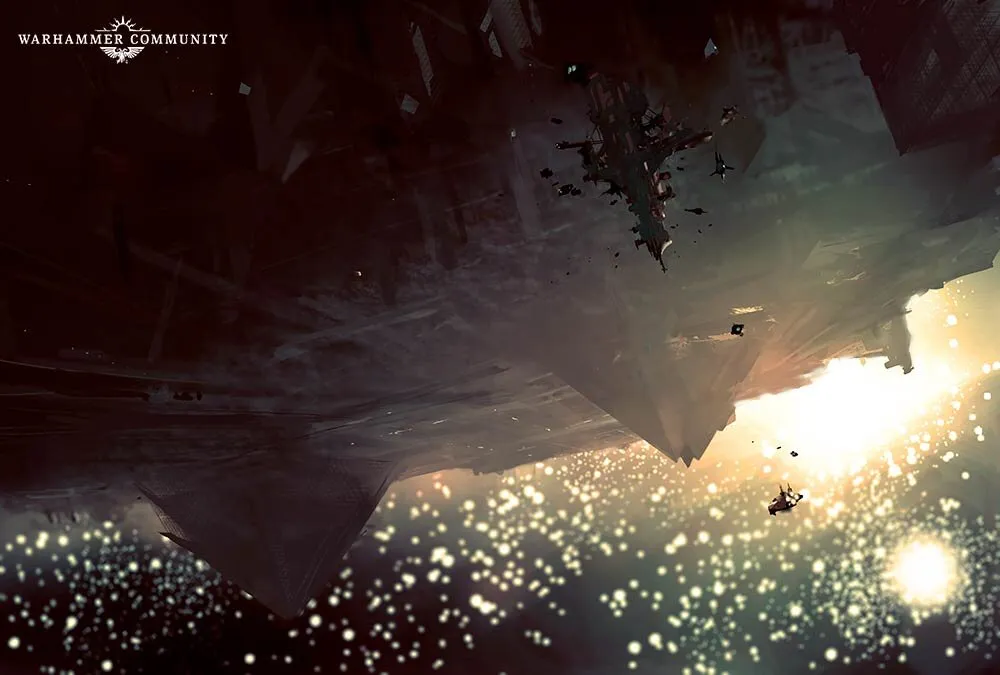
When the Will of Eternity came down on Cadia, the kinetic impact killed millions of surface defenders almost instantly. The planet itself broke apart over the following hours, for reasons people still argue about. Here’s the simplest reason: Cadia’s bedrock and the Blackstone Fortress that crashed into it were made of the same mineral.
Nobody writes about that. BoLS just published a Xenos Mysteries piece on the Blackstone Fortresses that walks through Abaddon’s Gothic War, the 13th Black Crusade, the 7th Blackstone at Precipice, and a tantalising new Mephrit Dynasty connection from the 9th-edition Necron codex. It’s a fine summary. It just doesn’t quite make the noctilith connection.
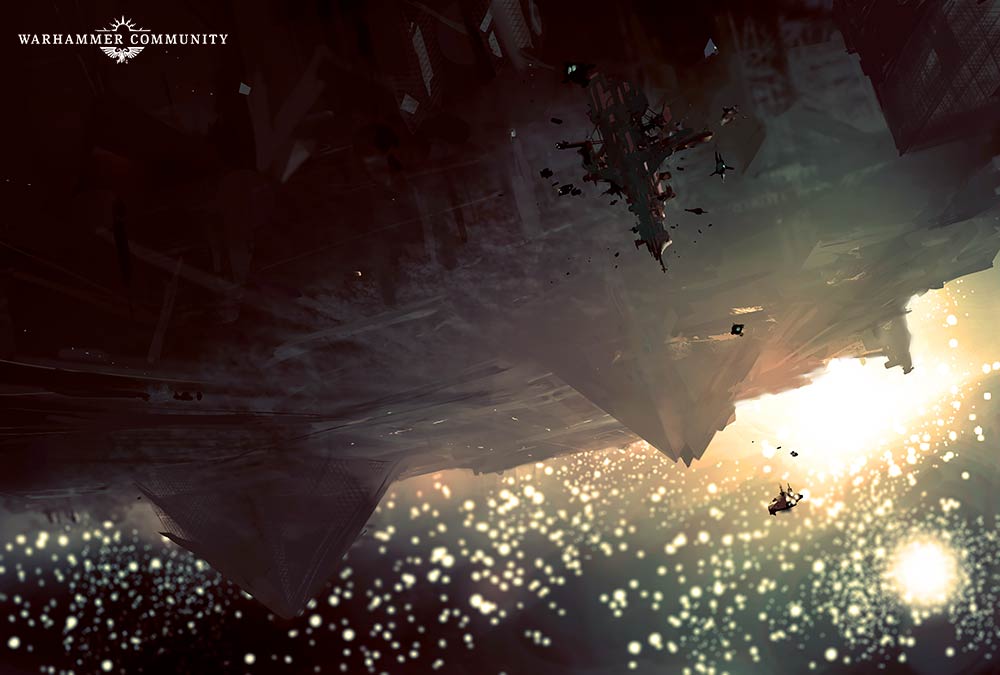
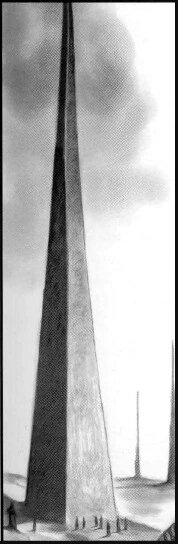
The mineral is called noctilith. Or blackstone, depending on which Mechanicus archive you’re reading. (Or Pariah Stone, if you’re a Tech-Priest with too many opinions about the Null gene.) The Blackstone Fortresses are made of it. The Cadian Pylons were made of it. The Eldritch Needles of Nemesis Tessera, the obsidian slabs in the wreckage of the Gates of Kromarch, all noctilith. And Belisarius Cawl, in a passage from the Forgebane background book that almost nobody quotes, worked out that the difference between a planet-killer and a Warp-shield is which way you charge the rock.
Six fortresses, six pylons, one mineral
Cawl calls it the Theory of Empyric Polarity. The pitch is that blackstone behaves a bit like ferrite metal. It can be magnetised, except instead of holding a magnetic field, it holds an empyric one. Charge it negatively and it pushes the Warp away. Charge it positively and it draws Warp energy in and lets you weaponise the result. The Cadian Pylons were charged negatively. The Blackstone Fortresses are charged positively.
This is the bit BoLS won’t quite commit to in print, even though Codex: Heretic Astartes spelled it out in 8th edition and Forgebane built a whole boxed set around it. Abaddon’s six Blackstones in the Gothic Sector were the positive half of a system whose negative half was sitting on Cadia, holding the Eye of Terror in shape for ten thousand years.
When the Will of Eternity came down, the kinetic impact killed the surface, and the same impact drove tonnes of positively-charged blackstone into a planetary crust laced with negatively-charged blackstone. I’ve never seen GW write that in plain words. They didn’t need to. The pylons cracked, the geothermal stress ripped the crust apart, the Eye expanded outward in a way no previous Black Crusade had ever managed, and the only mechanism that fits (given that none of the other twelve Black Crusades did anything remotely similar) is that the polarity went haywire when the two materials touched. Twelve Black Crusades is what it took Abaddon to engineer that meeting.
The board game I never finished
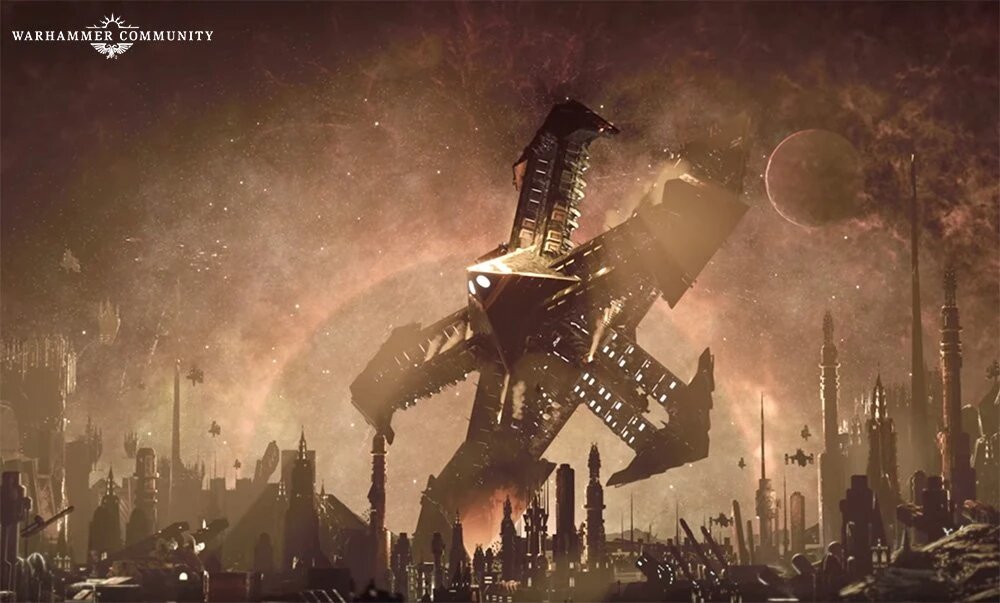
I should admit something here. I bought the Blackstone Fortress boxed game in late 2018, played it twice with Kiran, and then it sat on top of my Tyranid storage in the spare room for the better part of two years. Eventually I put it on a shelf. I think I cracked it open one more time when the Escalation expansion came out. Janus Draik has never been above level four in my hands. The whole No Respite expansion is in shrink. Twelve hostiles I haven’t even punched out of cardboard.
The reason I’m dragging this up is that the boxed game is the only piece of GW’s Blackstone material that takes the lore seriously as architecture. The interior tiles reshape themselves between explorations. That’s a mechanic. The Spindle Drones are maintenance constructs the fortress dispatches when interlopers wander too far in. Janus Draik’s whole pitch is that he’s there for archeotech treasure, and the fortress gives him things sometimes. Different runs cough up different things, and the rules don’t always tell you why.
That’s a fortress with intent. And then in the 9th-edition Necron codex, GW casually drops that the Mephrit Dynasty woke up to find their armoury of “spaceborne weaponry of incredible power, capable of destroying stars” missing. (Imagine going out to your shed after a few thousand years’ nap and discovering somebody nicked your Black & Decker. Now make the Black & Decker capable of going supernova.) I was reading the Necron codex on a Sunday afternoon thinking about something completely unrelated, Doomstalkers, I think, I was working out whether to add a third one to my Tyranids’ Necron rival list, and I just stopped. Because that description lines up too cleanly with the Blackstone Fortresses for it to be coincidence. Three hours later I was in the Lexicanum Mephrit page tracing the boundaries of the dynasty against the boundaries of the Gothic Sector and getting a slightly worrying buzz from the overlap.
(I should probably get back into the board game…)
What the Necrons want back
The Mephrit overlap is real, and BoLS hinted at it without finishing the thought. Mephrit territory on the Necron codex map sits right under the Gothic Sector. The Mephrit are called the Solar Executioners specifically because they used to murder stars. Their armoury is missing. The Blackstone Fortresses can murder stars (the Tarantis system, in concert) and were found scattered across that exact patch of space. Read Necron Dynasties for the broader dynasty geography; the timing lines up.
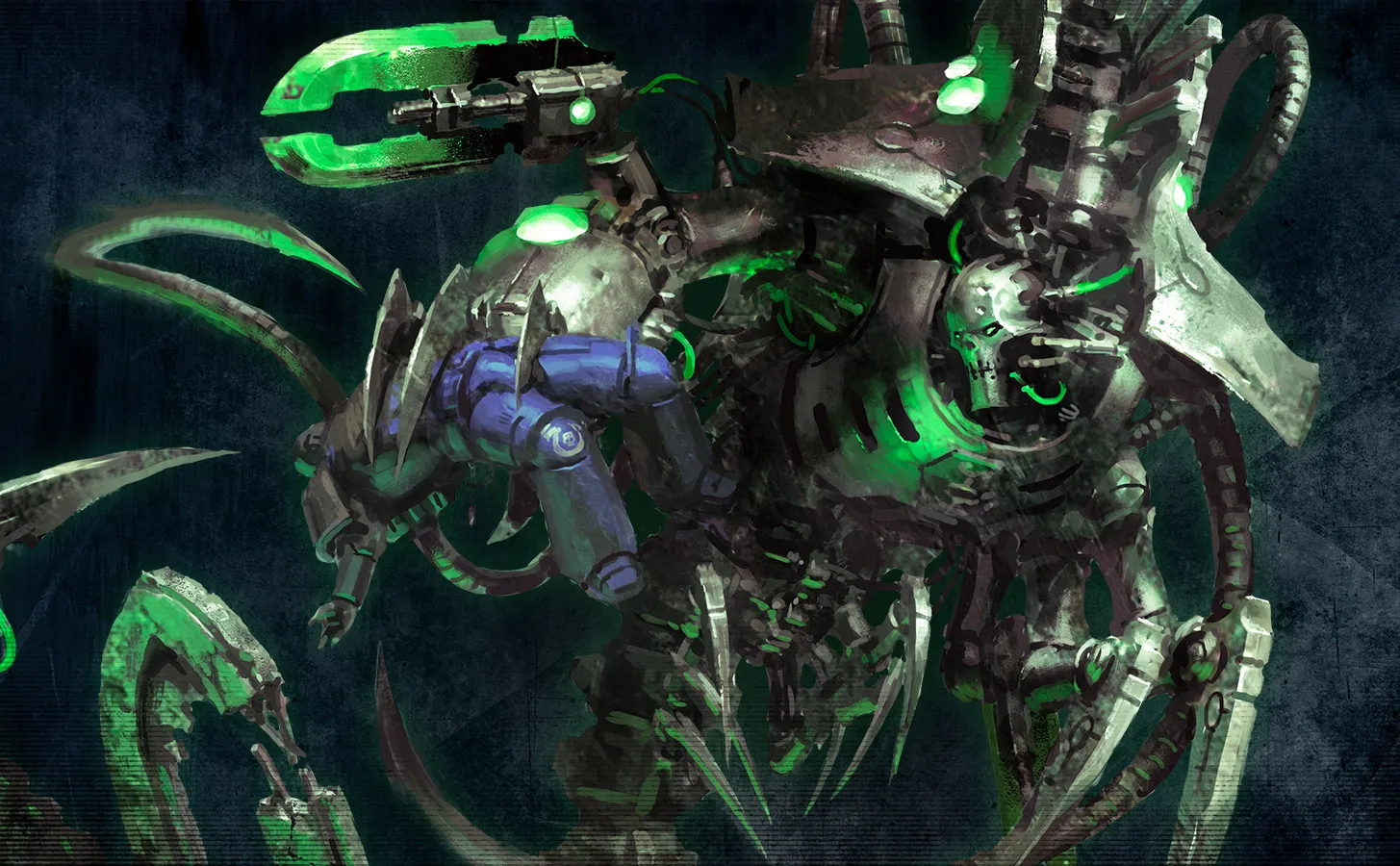
One reading is that the Necrons built them, which contradicts the bit where Necron tech is C’tan-derived and the C’tan loathe Warp-based weaponry. The cleaner reading is that the Necrons captured a cache from somebody older, parked the Blackstones in what would later be Mephrit territory, then went into stasis after the War in Heaven. The Blackstones did exactly what an Old One weapon should do, which is hurt the C’tan. The Old Ones did Warp manipulation as a matter of course; their Necron enemies, even with C’tan engineering on their side, couldn’t get near the empyrean.
So the cleanest reading is that the Old Ones built the Blackstones during the War in Heaven, the Necrons captured a cache and bolted them into their planetary defences, and after the war everyone forgot they were there. The Mephrit went into stasis, the Old Ones lost, the Aeldari survived as a degraded race-memory and called the Fortresses “Talismans of Vaul” in their mythology. Six of those Talismans ended up in the Gothic Sector by accident or design, where they sat for tens of thousands of years until the Imperium found them in M33.
I’m not actually sure I buy the Old Ones explanation. The Blackstones use void shielding and apparent inertia-less propulsion, neither of which match anything else attributed to the Old Ones. And there are the Sabbat Worlds Sector “Fortress Worlds,” architecturally similar, described as having been used by successive intelligent species over eight million years. Maybe the Blackstones are remnants of a species the lore hasn’t named yet. Maybe Inquisitor Lord Horst was right when he said somebody else destroyed the four Blackstones at the end of the Gothic War, somebody who didn’t want them in play, and who was old enough to have built them in the first place.
The Deceiver might have been the one. The wiki cites this explicitly: there’s evidence the C’tan known as the Deceiver manipulated the Gothic War to ensure the destruction or scattering of the Blackstones. If the Blackstones can hurt C’tan, the Deceiver has every reason to want them gone, and Abaddon makes a useful instrument. That would mean the Despoiler’s whole Gothic War wasn’t his idea. Which is, I admit, not a take you’ll see Black Library publish any time soon.
The codices have at least three viable origin stories on file (Old Ones, Necrons, an unnamed older species) and refuse to settle on one. They’ve kept that posture for thirty years, across editions. The Lost Primarchs got the same treatment. So did the Celestial Orrery. I read the unresolved posture as GW keeping the Blackstones in reserve for a future campaign rather than as actual indecision.
Three more turning up in M42
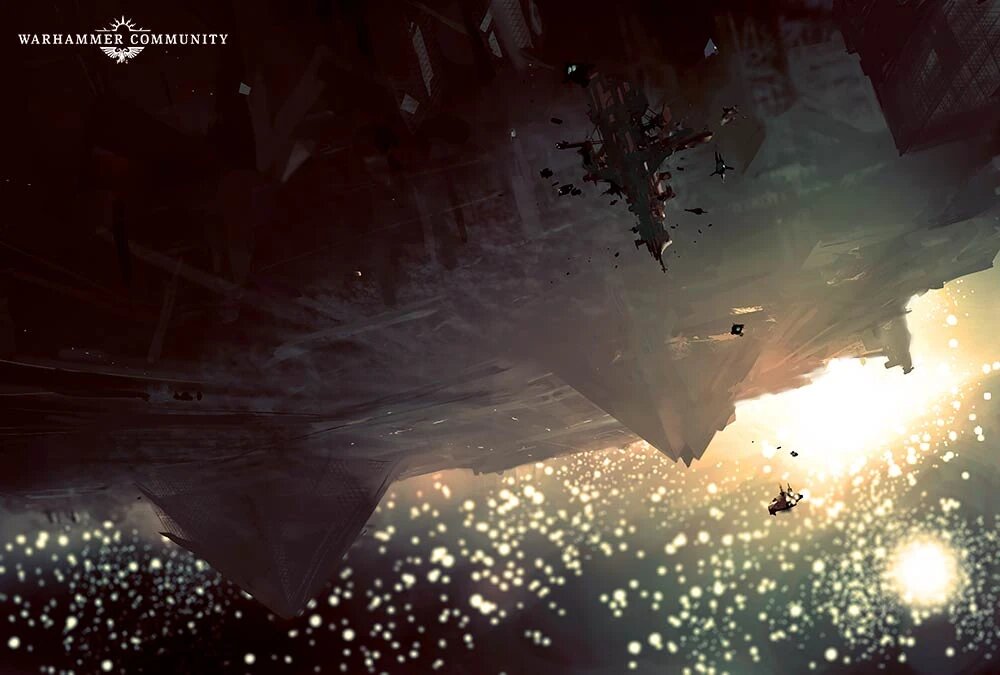
After Cadia, after the Great Rift, after Guilliman’s Crusade, three more Blackstone Fortresses have surfaced. The 7th sits in the Western Reaches of Segmentum Pacificus, surrounded by a debris field a million miles across, with a ramshackle waystation called Precipice clinging to one edge. The 8th sits in the Ultima Segmentum near Nekthyst Necron territory. The 9th is in the outer regions of the same Segmentum, near nothing in particular except the eastern Necron range.
The 7th is awake. It rearranges its own interior between expeditions, collects entities from across time and steers them toward intruders, and pulls ships out of the Warp into its orbit. Whatever was containing the original six Blackstones stopped containing this one as soon as the Great Rift opened.
The 8th and 9th are where the picture gets pointed. Both sit next to Necron territory. Codex: Necrons (9th edition) is the only codex that puts them on its galactic map at all. The Necrons know where the Blackstones are. Imperial cartography mostly hasn’t caught up. That’s the campaign hook for whatever 11th edition does with this. The Mephrit and the Nekthyst could both wake up properly and start hunting Blackstones the way Abaddon did, only with full knowledge of what the stones are for.
Why this matters in 11th edition
Honestly, I don’t fully know yet. The 11th-edition roadmap doesn’t call out a Necron-Blackstone tie-in. There’s no rumoured codex supplement. But Cawl is still active in the lore (see Ashes of the Imperium for what Wraight has him doing post-Siege), the Mephrit description in 9th edition has not been retconned, and the 11th-edition reset is the obvious lever to pull on a long-buried thread.
What I’d tell anyone asking is: read up on the greatest mysteries of 40K before the next big Necron release. Notice that the Blackstones, the Celestial Orrery, the missing Halo Devices, and the Sabbat Worlds Fortress Worlds all converge on one question. Who built the weapons that can end the galaxy, and why don’t they want them used? The Blackstones are the load-bearing answer. The 7th, 8th, and 9th sit on the M42 map and somebody at GW gets to choose when they come back into play.
The Mephrit waking up to reclaim their stolen armoury would make a clean spine for the 11th-edition Necron narrative. Without that move, the Blackstones quietly drift into the same lore-orphan status as the Celestial Orrery and the rest of the late-edition Chekhov’s guns. The noctilith angle is the one nobody on the news sites is committing to in print, and it’s where I’d be aiming my next 11th-edition speculation.
Anyway. I should go pull the Blackstone Fortress boxed game off the shelf. Janus Draik isn’t getting to level five on his own.