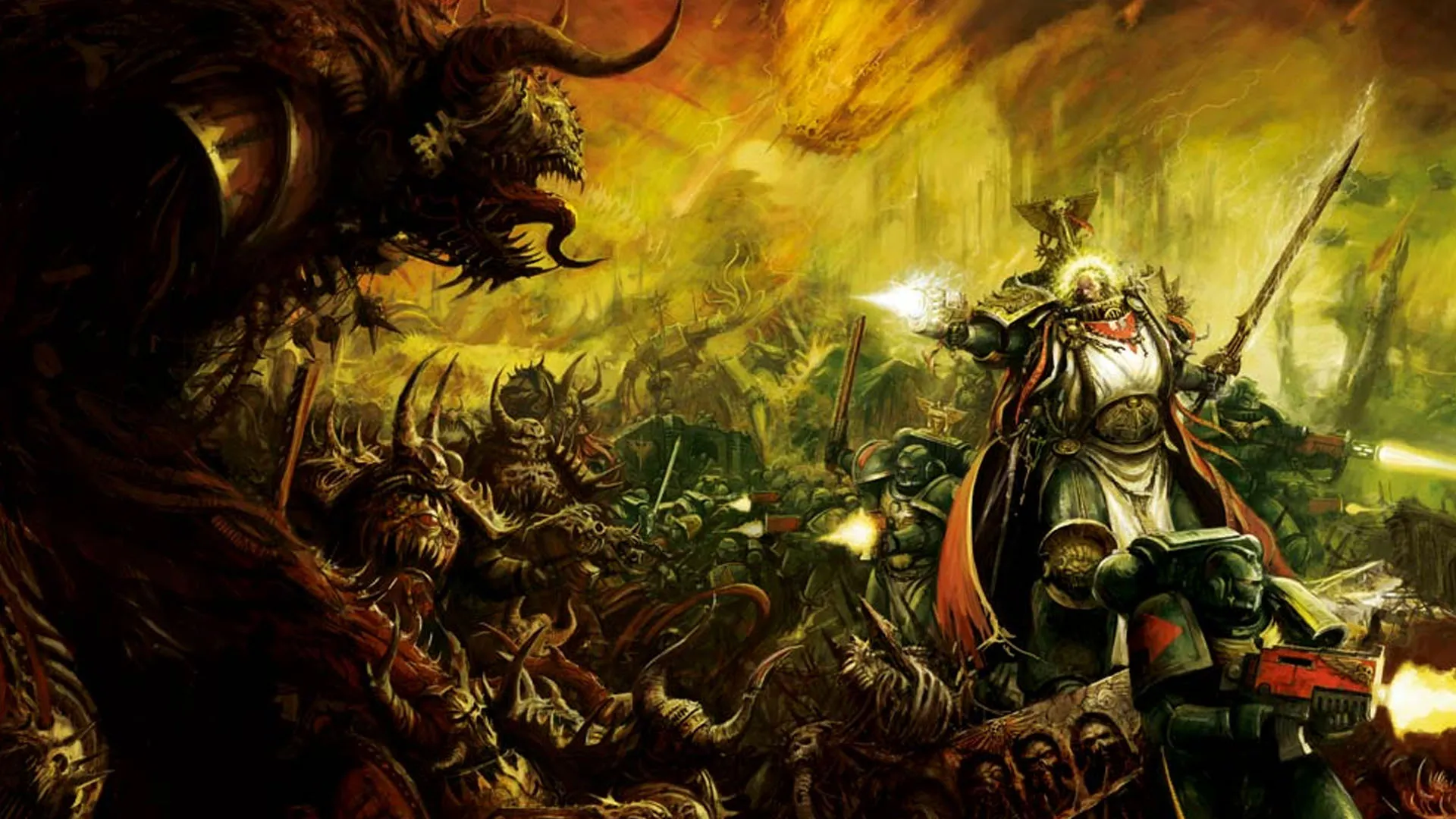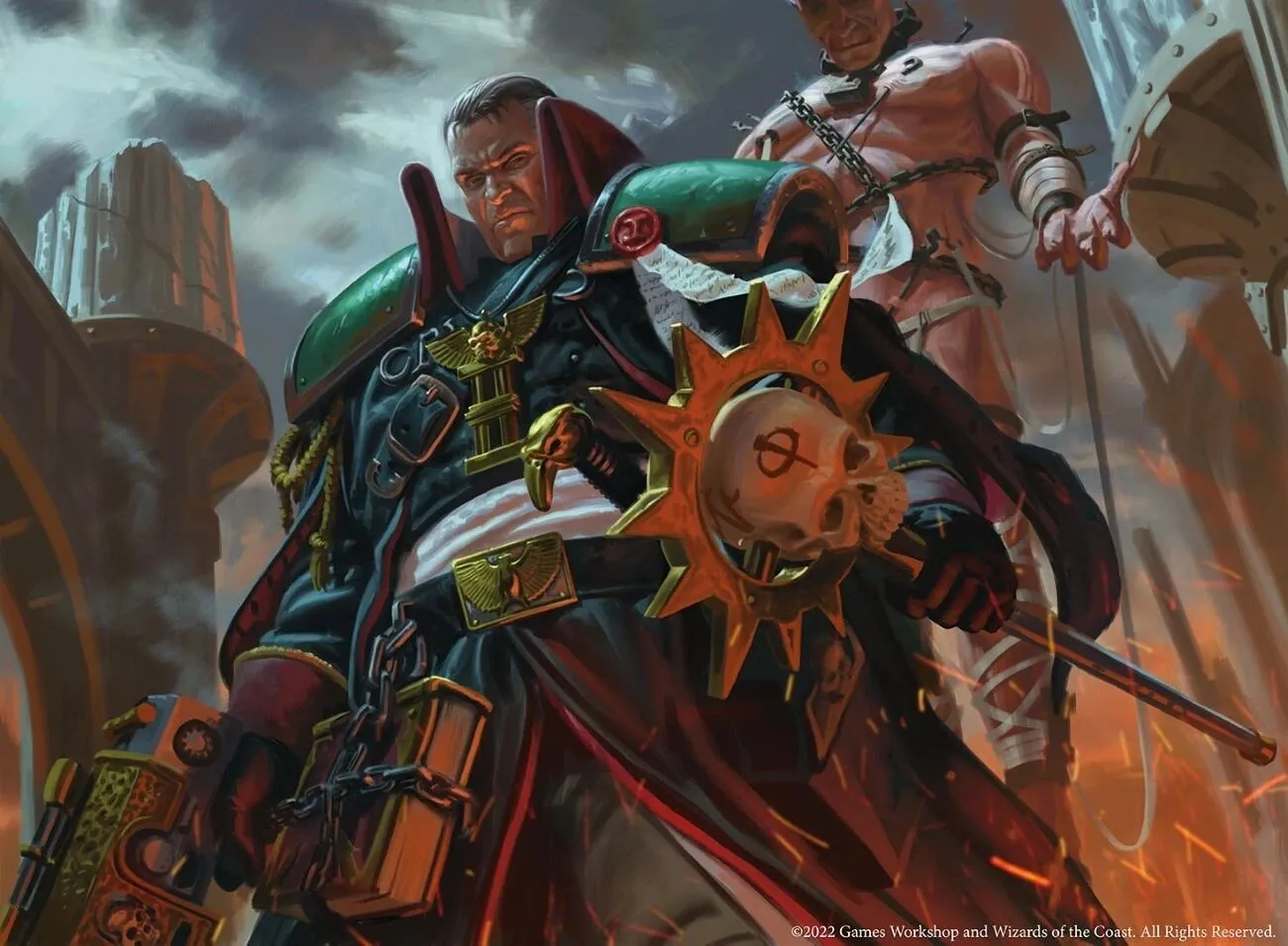
I reread the Eisenhorn omnibus over about three weeks in June, twenty minutes at a time after my kid went down, which is also the window I’m meant to be using for painting. The paint stayed in the pot. I got through all three books and a third of The Magos before accepting that the Imperial Fists were not going to undercoat themselves.
The reason I went back to it is a bit embarrassing. For years I’d been telling people at my local store that the trilogy ends with Eisenhorn answering for himself. I was confident about it. I’d have argued the point across a table mid-game. Somewhere in my memory there was a conclave, a sentence, some grim ceremony where the man finally gets asked about the daemon he keeps on a leash.
None of that is in the books. I’d either invented it or imported it from something else, and I’d been repeating it for most of a decade.
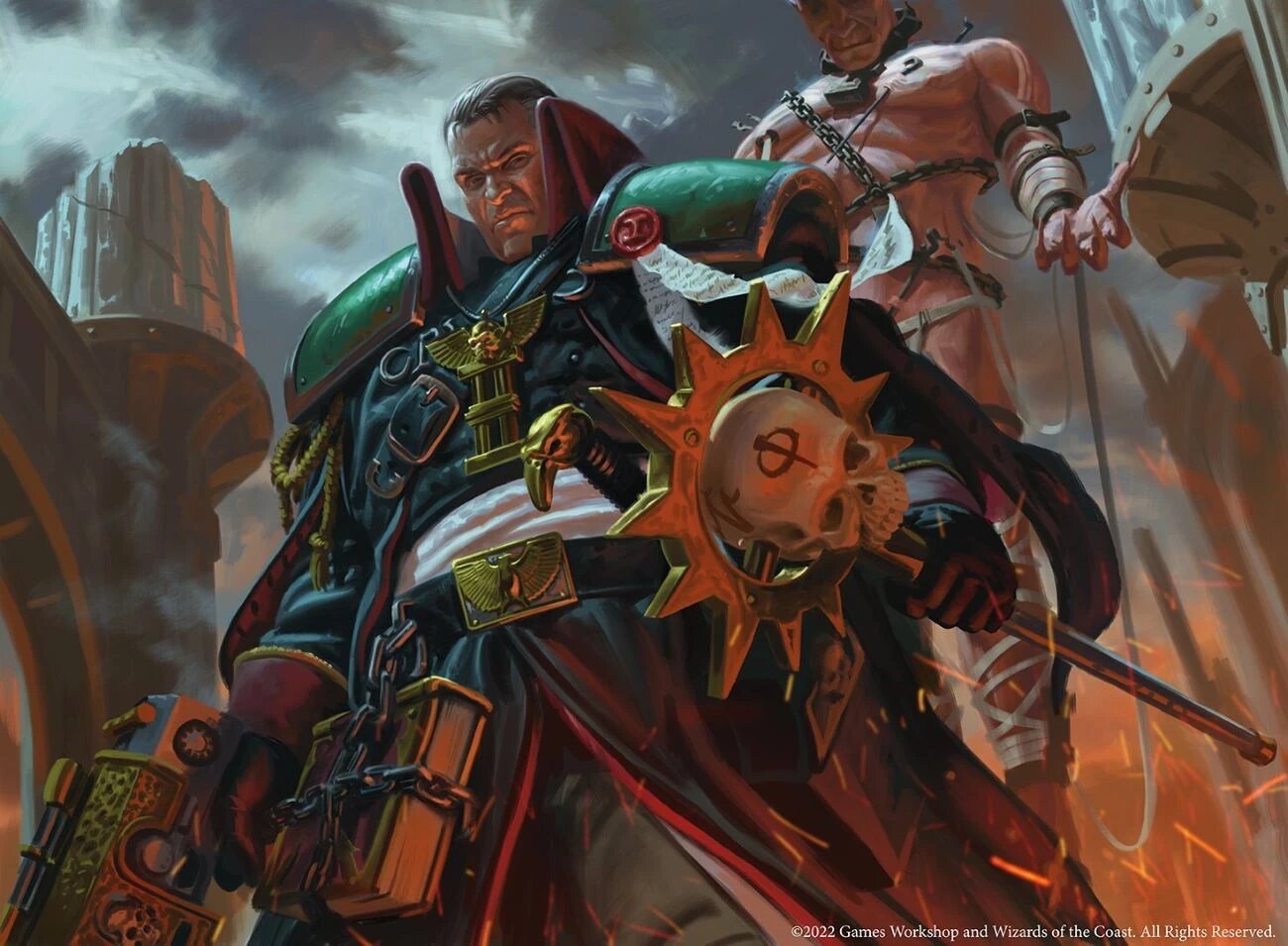
What Quixos was executed for
Quixos is older than the novels. He’s in the background section of Inquisitor, the 54mm skirmish game GW put out in 2001, and his writeup is one of the better things in that book.
By his one hundred and seventy-sixth year he’d accounted for eighteen hundred heretics, mutants and aliens. On Lackan XV a daemon got part of its claw lodged in his heart, and since removing it would have killed him, he left it there. The claw turned out to function as an antenna. His psychic potential climbed and his body began to rot, and he kept notes on both.
From there he goes the way you’d expect. He meets a cartel on Maginor called the Mystic Path who’ve been quietly using warp artefacts to improve their trade position for generations, and he spends years observing their practices and handing them artefacts to test. He convinces himself that Chaos energy is a neutral force which wrongdoers simply got to first. He builds two daemonhosts, one carrying Cherubael and one carrying an entity he never fully identifies called Prophaniti. He acquires the Malus Codicium. He binds a daemon called Kharnagar the Deathly into a sword.
Then a young Inquisitor named Helgrund, who has spent nearly thirty years hunting the Malus Codicium and wants it destroyed, tracks the thing to Maginor and finds a fellow Inquisitor at the centre of the cult. They fight. Inquisitor says some Inquisitors have since compared that duel to Horus and the Emperor, which is a bit much for a book about 54mm miniatures, but the outcome is straightforward enough. Quixos puts the daemonblade through Helgrund’s stomach and Helgrund burns.
Quixos then works on undisturbed for another century.
What finally ends him is a coalition. The book’s phrasing is that his opponents within the Inquisition united against him, and that Inquisitor Eisenhorn declared Quixos and all his works “Heretic and Extremis Diabolus.” Three years after that, a cell of five Inquisitors led by Eisenhorn hunted him down and executed him.
So the charge sheet Eisenhorn signs off on runs roughly: two bound daemonhosts, one forbidden grimoire, one dead Inquisitor.
The vote on the Necroteuch
Worth saying what the young version of this man was like, because the first book has him behaving completely differently.
Eisenhorn tracks the surviving Gudrun cabal to a colony world held by a xenos species called the Saruthi, who have got hold of a copy of the Necroteuch and translated it into their own language. He gets hold of the human copy, written in High Gothic, and burns it on the spot, before anyone can propose vaulting it for study.
A radical called Konrad Molitor then accused him of heresy on the spot, in front of a conclave, for destroying a weapon that could have been turned on Chaos. Schongard backed him. Voke and Titus Endor shouted them both down, the attending Deathwatch captain said he’d have burned it himself without a second thought, and Lord Inquisitor Rorken closed the matter by commending Eisenhorn.
Eisenhorn asks, in the middle of this, whether he is on trial. Rorken tells him no. So the first time his orthodoxy came up, the question was settled by who happened to be in the room and how loudly they were prepared to shout.
He loses his left hand a year later on Sameter, to a former Guard sharpshooter among a group of ex-soldiers who’d gone mad and started ritually killing civilians. He’s offered a bionic and turns it down, lives with a fused stump for two years, and eventually has a vat-grown hand grafted on instead. Somewhere in the same era Gorgone Locke tortures him badly enough to destroy most of the nerves in his face, and he never regains the ability to smile.
Eisenhorn ends up holding the same list
By the close of Hereticus Eisenhorn has Cherubael. The same daemon out of the same books, in the flesh, on the payroll. He’d banished it after killing Quixos, then in 345.M41 he summoned it back and bound it into a new body, for interrogation and study, in secret.
He has the Malus Codicium, because he took it off Quixos’s corpse and didn’t burn it.
And he has a dead Inquisitor.
Bastian Verveuk
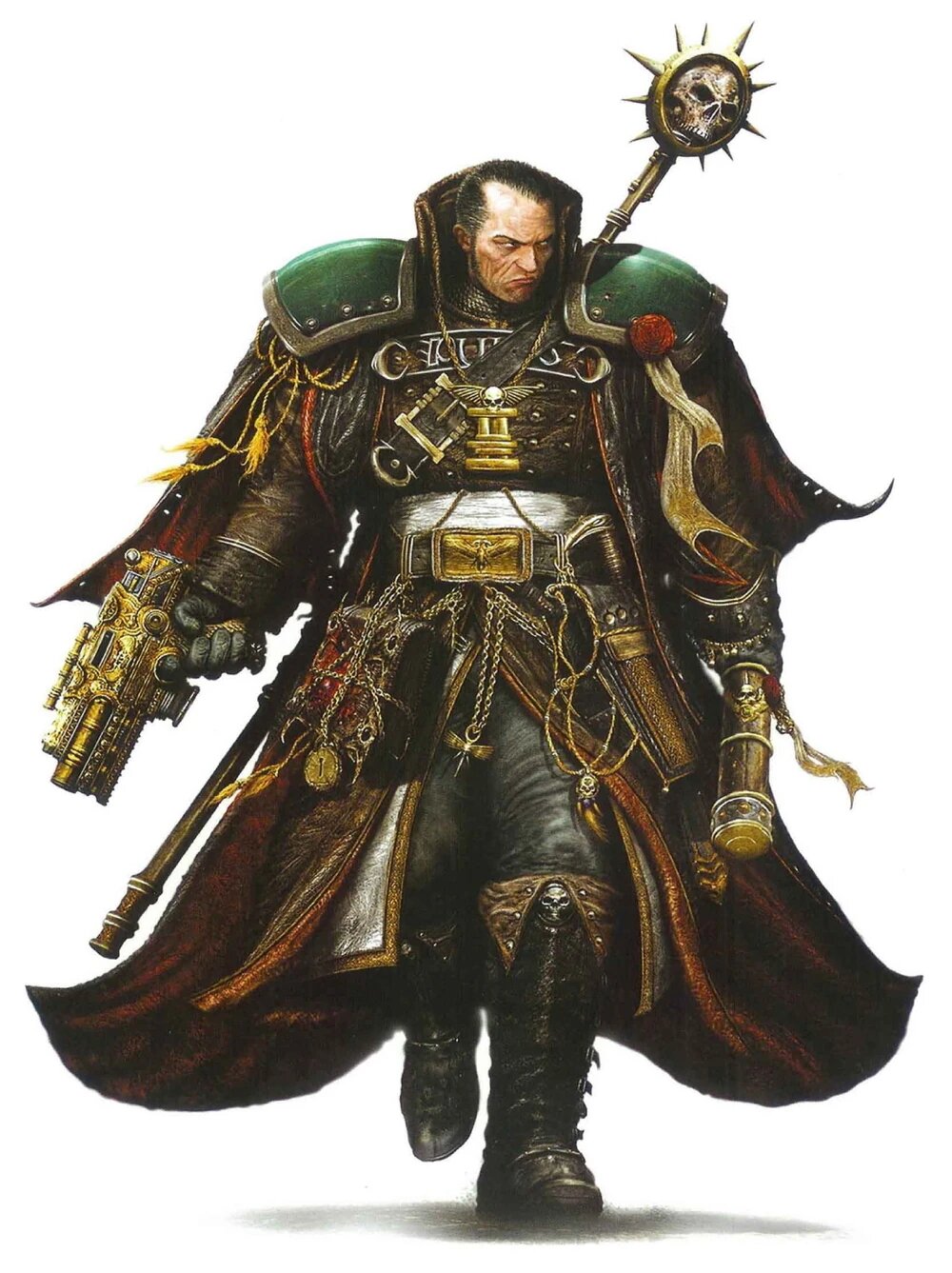
Verveuk is the part of these books nobody puts on the cover. Thirty-two years old, an Inquisitor of seven months, formerly Osma’s interrogator, attached to Eisenhorn as an observer by Lord Rorken. Eisenhorn cannot stand him. He’s an obsequious careerist who gets the gun-cutter destroyed by commandeering it, and one of the chapter headings in Hereticus is essentially a curse aimed at his name.
Then, on a beach on Miquol, Eisenhorn needs a body.
He had unleashed Cherubael from its host to kill a Chaos Titan, and with the Titan dead the daemon is loose and has to go back into flesh straight away. Verveuk is lying nearby, mortally wounded. He is also still alive, and he puts out a hand, because he thinks Eisenhorn is coming to help him.
Eisenhorn kneels down and asks him three questions. Whether he’s a true servant of the Emperor. Whether he’ll serve in any way required. Whether he is pure, which matters only because purity is a desirable property in a host. Then he daubs runes on the man’s forehead and neck and heart using his blood, apologises to him by name, and binds the daemon into him.
He knows the binding destroys whoever the host used to be. He admits, in his own narration, that he tries not to think about whether Verveuk was still alive when it started. Fischig later asks him straight out whether the man was dead first, and Eisenhorn doesn’t answer him, then lies to him. Pontius Glaw brings it up again later in plainer language.
That act never becomes a charge. Nobody investigates it. It doesn’t appear in any of the proceedings against him, because the proceedings against him are about other things entirely, and by the time anyone might have looked, the man who could have told them is dead and the daemon isn’t going to volunteer it.
White Dwarf 448’s Index Imperialis section is blunt about what making a daemonhost involves. You tattoo warding runes into a living person’s flesh, chain them with blessed and ensorcelled bindings, then trick a daemon into taking the body so you can trap it there. That same issue calls the practice an act of near-madness that all but the most radical would count as heresy. Eisenhorn does this, keeps doing it, and stays an Inquisitor in good standing.
What happened to the two charges
The first charge is formal and it isn’t gentle. Osma serves a carta extremis, Lord Rorken eventually countersigns it, and Eisenhorn is declared Heretic and Extremis Diabolus. He spends something like three months being interrogated, comes close to dying in the process, and gets out with help from his own retinue. Then he goes to Farness Beta and kills Quixos.
The carta is abolished once he’s back on Gudrun, and his own account of why is the bit worth having. None of Osma’s allegations could stand up against the evidence gathered at Farness. The evidence gathered at Farness was a dead renegade Inquisitor. He notes, without much warmth, that nobody ever offered him an apology.
The second time there’s no clearing at all, and it took me an embarrassingly long time to notice that. Osma, by then Grand Master of the Ordos Helican, boards Maxilla’s ship with Heldane and reads out a list of charges that is very specific: consorting with daemons, conjuring daemonhosts, concealing proscribed texts, shielding Pontius Glaw. Osma tells him he’s going to burn.
Then the record stops. The closing dossier in Hereticus says his fate is not recorded and that anything after that date is conjectural at best. Osma is noted as having disappeared. The wikis will tell you his outcast status was rescinded, and the word they use is “apparently,” which I read straight past for years. By The Magos and Pariah he’s working outside the Ordos as a declared heretic with Ravenor hunting him.
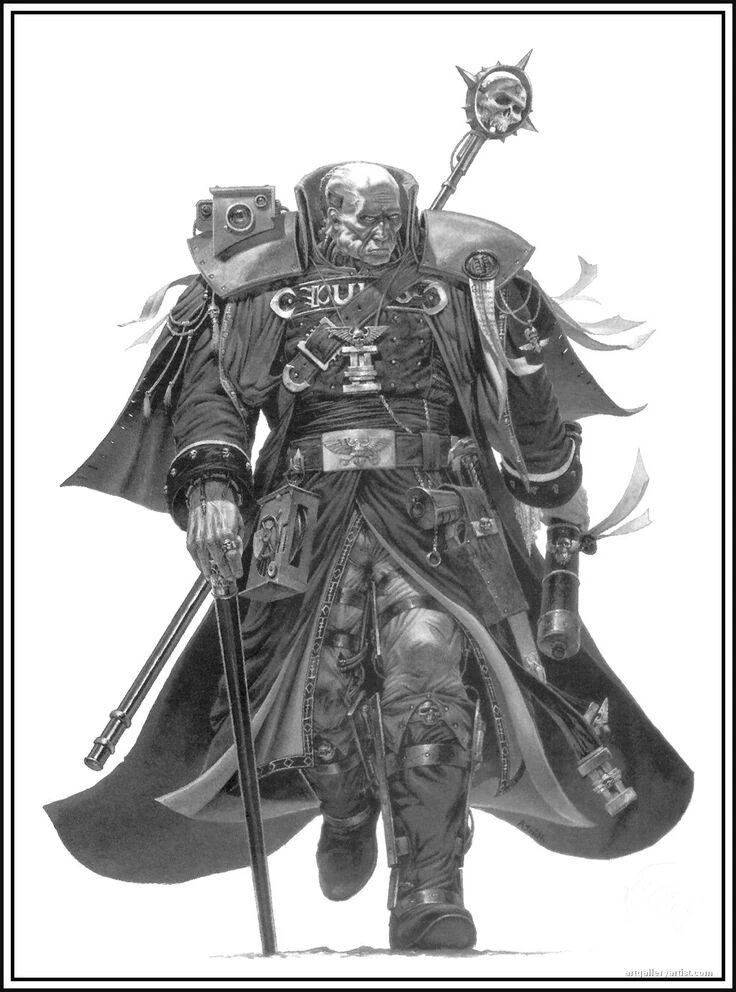
The body he’s left with records all of this fairly precisely. The augmetic assist rig that holds him upright was fitted in a hurry near the end of the Pontius Affair, it’s permanently attached, and the lore is fairly direct about it being sub-par work. It projects from the back of his skull and cages his legs. He shaved his head to accept it. He carries a swordstick because the rig alone doesn’t keep him balanced, and he keeps his rosette in an inside jacket pocket most of the time rather than on display.
One charge dropped because he could point at a corpse, and one charge that nobody ever got round to closing. The Inquisition wasn’t evaluating his methods. It was reading his results and working backwards.
Coteaz has a line quoted in that same White Dwarf that fits here better than anything in the novels: “Let none judge my deeds but the Emperor himself, for no other possesses the right nor the vision.” Coming from Coteaz it plays as a boast. It also happens to describe the filing system Eisenhorn’s career ran through.
The 54mm one in my drawer
I bought the old 54mm Eisenhorn off eBay in about 2019 for an amount of money I didn’t tell anyone, because I had a plan to paint him as a display piece and put him on the shelf above the desk. My favourite grumpy old man in 40K, done properly, one model, no army pressure, no rush.
He is still primed grey. He has been primed grey through two house moves. Pete came round, spotted him in the drawer among the Fists transfers and a bag of bases, and asked whether I was ever going to do anything about it, and I said yes, and that was three years ago. Pete has finished two Salamanders armies since then.
The metal one’s a lovely sculpt, is the annoying thing. Big coat, the mace, the face of a man who has had a long week.
What the Inquisition actually does to its own
Eisenhorn’s outcome reads differently once you line it up against a few of his colleagues.
Inquisitor Thrax, written up in White Dwarf 498, spent four hundred years as an Ordo Malleus Inquisitor and declared six Space Marine Chapters Excommunicate Traitoris over the course of a century. He got possessed while investigating the Grey Slayers’ corruption, and the Grey Knights killed him for it. Then, and only then, a conclave was assembled to go through his dealings and work out how one of their own had turned out to be vulnerable. The review got scheduled after the funeral.
Kryptman redirected a hive fleet into Ork space and burned Imperial worlds to build a firebreak, and got stripped of his rank for it, though his gambit worked. Drakan Vangorich murdered the entire Senatorum Imperialis and ran the Imperium for about a century before Imperial Fists Successors finally put him down. Two men who overreached and were eventually met with consequences, in one case a century late.
Eisenhorn did more than either of them and finished his career with his rosette in his pocket.
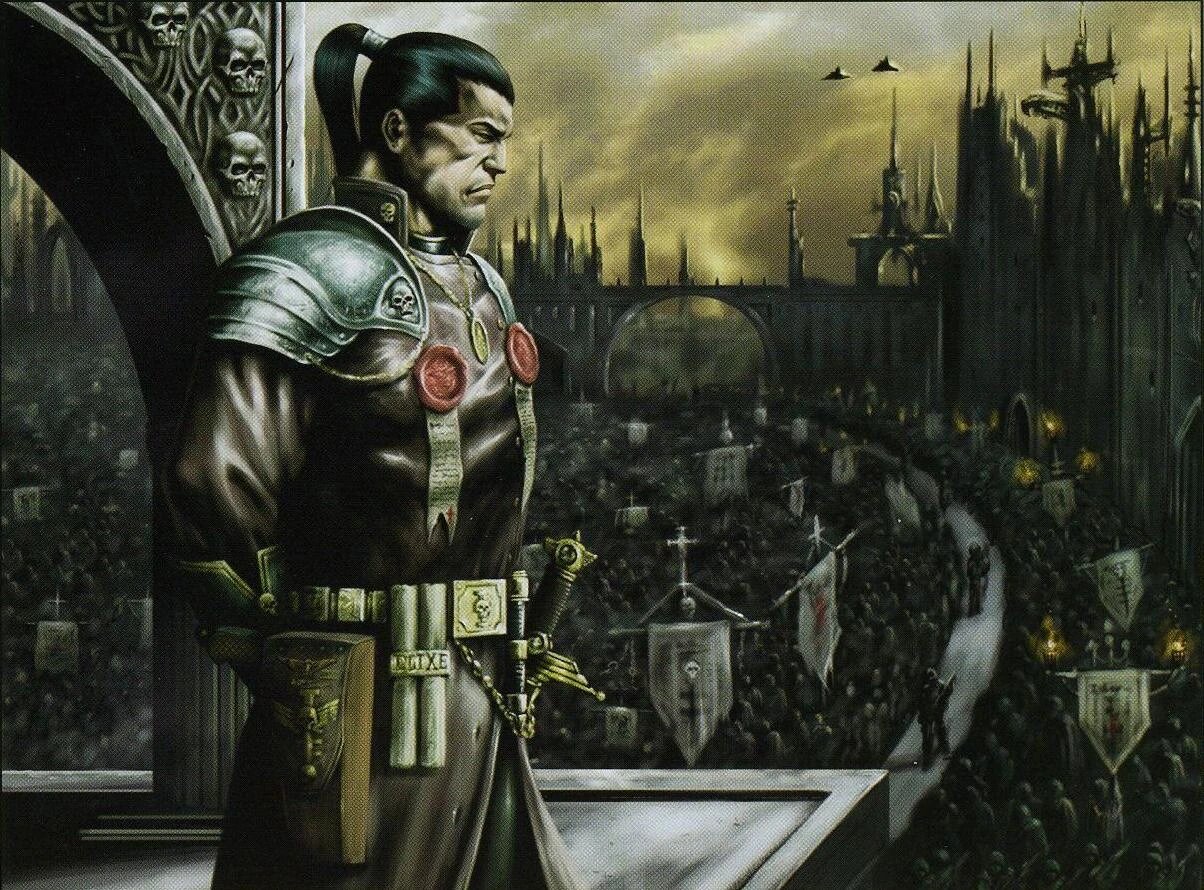
The Inquisition has no shortage of doctrine about this. White Dwarf 448’s piece on Puritans and Radicals says most Inquisitors start somewhere on the puritan end, that the temptation grows as they grasp the scale of what they’re facing, and that some lines cannot be uncrossed. It’s a good paragraph. It’s also written entirely in the language of temptation and damnation, and it stops there. Eisenhorn’s career is what that language looks like once it has to survive contact with an actual conclave. Kroyle rides a xenos beast in plain view and files reports about it.
The retinue
The people around him do pay, which is the bit that stayed with me on the reread.
Gideon Ravenor was an able-bodied man before the atrocity at the Thracian Primaris Triumph, an attack engineered to break several Alpha Plus psykers out of Imperial detention, and he spends the rest of his life in a force chair. Alizebeth Bequin, an untouchable and the most quietly decent person in the books, ends Hereticus comatose. Aemos is compromised. The gun-cutter is destroyed. And Godwyn Fischig, the Arbites man who signs on in the first book, is the only person in the retinue who genuinely tries to hold Eisenhorn to account. He’s the one who goes to Osma. He’s where the specifics on that charge list came from. He also shoots out both of Eisenhorn’s knees, which is where the augmetic rig comes from, and stands over him asking him to renounce the warp, and Medea Betancore shoots him dead for it.
Cherubael gets bound into Fischig’s body afterwards. The face doesn’t entirely stop being his.
Midas Betancore was killed by Fayde Thuring in 312.M41, and Eisenhorn promised to keep an eye on Midas’s infant daughter Medea. Which he did. When she came of age she joined the retinue as his pilot, doing her father’s job, for the man her father had been working for when he died.
None of that generates a hearing. Losing your staff isn’t heresy. Abnett is careful about this, I think, because the cost sits there on the page while the records stay quiet about it, and the records are the thing his narrator keeps producing.
Two last things about the paperwork, both about the same event. Inquisitor says the cell that executed Quixos numbered five; the novel has Eisenhorn assemble three other Inquisitors and go. And Inquisitor dates the execution to 342.M35, roughly six thousand years before the novels put Eisenhorn anywhere near the man. As far as I can tell nobody at GW has ever gone back and squared the two. The most decisive act of judgement in Eisenhorn’s career is recorded in the wrong millennium, by a book that can’t agree with the novels on how many people were in the room.